

A satellite dish doesn’t automatically need planning permission in England. Under Class H, a house can generally have up to two antennas, but size, position and other restrictions matter. The Town and Country Planning Act’s satellite dish rules sit within the Town and Country Planning (General Permitted Development) (England) Order 2015, as amended, according to The National Archives.
It’s easy to assume a dish is allowed wherever it can be mounted. In practice, a dish that exceeds the permitted size or sits in a restricted position may need planning permission. Conservation areas and listed buildings can also bring extra controls.
This guide explains how Class H works, including limits on dish numbers and size, siting rules, and the additional controls for conservation areas and listed buildings. You’ll also learn how removing a dish you no longer need can help keep your property’s exterior tidy.
Key Takeaways
- Class H permitted development can cover satellite and microwave antennas on houses, but restrictions on the property and proposed work can change the answer.
- Check the number and size of dishes, along with where they would sit, before assuming an application isn’t needed.
- Conservation-area controls can restrict visible dish locations, while listed buildings may need separate consent.
- Antennas should be positioned to minimise their effect on a building’s appearance, and unused ones should be removed as soon as reasonably practicable.
- If an old dish is no longer needed, learn what removal involves and how to leave the fixing points tidy.
Class H permitted development for satellite and microwave antennas in England
Class H sets the permitted development rules for certain antennas on houses in England. Whether you need an application depends on the property, the dish’s size and position, and any local restrictions.
Permitted development rights for antennas
Permitted development rights allow specified work without a planning application, provided every relevant condition is met. For householders, that distinction matters: a dish may be allowed in principle but still fall outside the rules because of its size, siting or property type.
Class H covers the installation, alteration or replacement of a microwave antenna on a dwellinghouse or within its curtilage. The Town and Country Planning (General Permitted Development) (England) Order 2015, as amended, governs antenna permitted development in England, according to The National Archives.
Rules under the GPDO
The GPDO sets conditions that limit which antenna work qualifies as permitted development. Under Class H, a dwellinghouse can have no more than two antennas, and only one of two may exceed 0.6 metres in length under the size criteria, according to The National Archives.
Other limits also matter. A single microwave antenna longer than 1 metre is not permitted under Class H, and an antenna cannot exceed 35 litres in cubic capacity. The rules also restrict roof and chimney positions. For example, a dish on a roof without a chimney cannot project above the roof’s highest part.
Planning permission and lawful development certificates
Planning permission is the formal route when proposed work does not meet permitted development conditions. An application allows the local planning authority to assess the dish and its location against the relevant controls. A lawful development certificate is written confirmation of whether development is lawful; it can help document a dish’s status when that needs to be established.
So, do the 2015 Order’s rules allow every satellite dish without an application? No. Class H only covers development that satisfies its conditions, and restrictions such as size, position or property type can mean permission is needed. A local planning authority can take enforcement action over unauthorised development, which may require correcting or removing it.
Regional differences in permitted development
Do permitted development rights for satellite dishes differ in Wales, Scotland and Northern Ireland? The Class H rules described here apply to England and should not be taken as the rules for the other UK nations. Each has its own planning framework, which determines whether a dish needs permission.
For an English property, first identify whether it is a house, then assess the dish against Class H. Flats and maisonettes do not receive the same Part 1 permitted development rights as houses. Listed buildings and properties affected by local restrictions may also need separate consideration, so a permitted development assumption should not replace an assessment of the specific site.
Requirements to minimise visual impact and remove unused antennas
Class H requires an antenna to be sited, so far as practicable, to minimise its effect on a building’s external appearance. Location therefore matters as well as size: a less prominent position may better meet the rule than a visible roof slope or chimney.
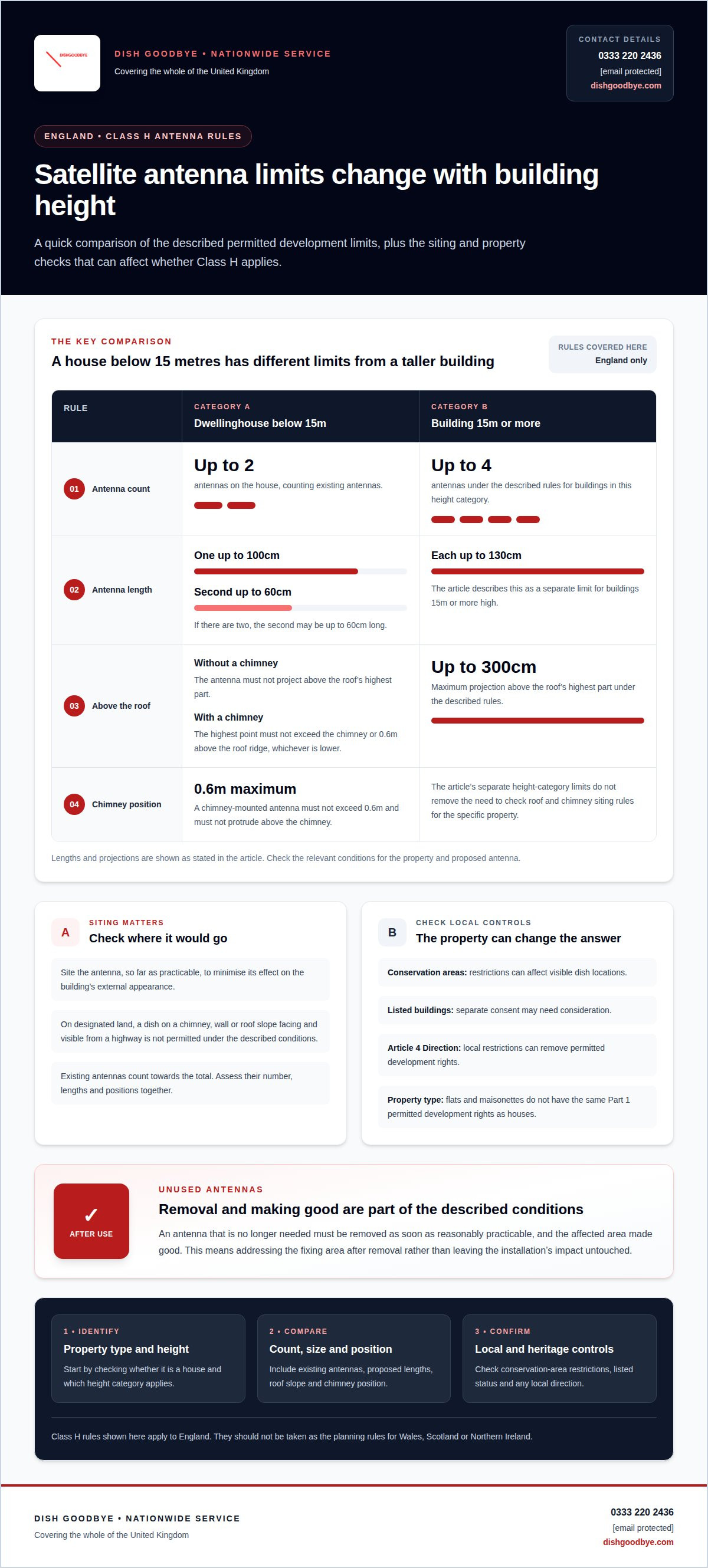
For a dwellinghouse below 15 metres, the described permitted development limits allow up to two antennas. One may be up to 100 centimetres long; if there’s a second, it may be up to 60 centimetres. A chimney-mounted antenna must not exceed 0.6 metres, and the roof and chimney position limits still apply.
Check the total number of antennas on the house and its curtilage, not just the dish you are considering. Existing antennas count towards the limit. For example, if one dish is already installed, assess both dishes together, including their lengths and positions, before adding another.
Buildings 15 metres or more high fall under different antenna limits in the described GPDO rules. They may have up to four antennas, each up to 130 centimetres long, and an antenna may project no more than 300 centimetres above the roof’s highest part. These limits are separate from the Class H limits for a dwellinghouse.
Height affects siting, too. On a roof without a chimney, an antenna must not rise above the roof’s highest part. On a roof with a chimney, its highest point must not exceed the chimney or 0.6 metres above the roof ridge, whichever is lower. A chimney-mounted antenna must not protrude above the chimney.
Position also matters on designated land. An antenna on a chimney, wall or roof slope facing and visible from a highway is not permitted under the described conditions. A planning department can explain local restrictions affecting a property, including whether an Article 4 Direction removes permitted development rights.
Unused antennas cannot remain on a building indefinitely. Under the described GPDO conditions, an antenna that is no longer needed must be removed as soon as reasonably practicable, and the affected area made good. This means addressing the fixing area after removal rather than leaving the installation’s impact untouched.
Before adding a dish, note the building’s height, existing antenna count, proposed lengths, roof slope and chimney position. These details help establish which limits apply and whether the installation meets the relevant permitted development conditions.
Conservation areas and listed buildings
Conservation areas and listed buildings face extra controls because changes can affect the character of a place or historic property. Conservation-area status can affect whether a satellite dish needs planning permission, so check the applicable restrictions before installation. The usual Class H conditions may not be the only consideration, so identify local restrictions before installing a dish or aerial.
Designated areas include conservation areas, National Parks, Areas of Outstanding Natural Beauty and the Norfolk and Suffolk Broads. In these locations, the described antenna conditions restrict dishes on a chimney, wall or roof slope that faces and is visible from a road. This may rule out an otherwise practical mounting position, even if the dish meets the usual size criteria.
An Article 4 Direction can remove permitted development rights for a particular area or type of development. Its effect depends on the direction’s terms, so the property’s location and the work it covers matter. Some directions require planning consent for all satellite dishes within their specified area, including properties where a dish might otherwise qualify as permitted development.
Where an Article 4 Direction applies, consent will not normally be granted for dishes visible from the street in the affected areas described by that direction. Such directions can cover single-family houses, flats and commercial property. Before planning exterior work, establish whether a direction covers the address and proposed alteration.
Listed buildings bring a separate concern. Work to a listed building can raise heritage considerations, particularly if it changes the building’s character or appearance or affects its setting. This consent is separate from planning permission, so one does not automatically replace the other. Consider the dish’s visibility, fixing points and position, as well as its height and relationship to the roofline.
These controls can affect alterations to a building’s exterior. For a listed property, the relevant question is whether the work affects its character, appearance or setting. In a conservation area, the applicable planning restriction and any Article 4 Direction determine the consent position. The dish’s modest size alone does not settle whether permission is needed.
Keep the decision focused on the exact property and proposed work. Establish whether it is listed, inside a conservation area or within another designated area. Then determine whether an Article 4 Direction applies and whether the alteration needs planning permission, listed building consent or both. This separates planning control from heritage protection before work begins.
Listed building consent
In England, listed building consent is separate from planning permission. A satellite dish may need both, depending on the property and proposed work. The key issue is whether fixing or positioning the dish affects the listed building’s character or appearance, or its setting. Even a modest dish can matter if it changes a prominent roofline or historic feature.
To apply for planning permission, identify the local planning authority responsible for the property and submit an application describing the proposed dish and its position. The cost depends on the application category and the authority’s current fee schedule. Planning permission and listed building consent are separate decisions, so an application for one does not amount to approval for the other.
For listed building consent, explain how the installation relates to the building’s historic features. Consider the fixing points, visibility from public places, cables and effect on the roof or wall. For example, placing a dish beside an existing modern fitting may affect the building differently from attaching it to a prominent historic elevation. The authority assesses the effect on the building’s character, appearance or setting.
Planning permission may also be required where a dish falls outside permitted development conditions. For example, a satellite dish with cubic capacity exceeding 35 litres is not covered by the described Class H allowance. A dish’s position can matter too: a prominent location visible from public areas may face additional restrictions, especially in a conservation area or under an Article 4 Direction.
Check ownership arrangements before arranging an installation. A landlord or property owner may need to give permission, even if planning rules allow the work. A lease, tenancy agreement or covenant may also restrict external alterations. These private conditions are separate from planning permission and listed building consent, so meeting one set of requirements does not automatically meet the others.
Before proceeding, establish these points for the specific property:
- Whether the building is listed and whether the proposed work affects its character, appearance or setting.
- Whether planning permission is needed because the dish falls outside permitted development rules.
- Whether the landlord or owner’s consent is required under the ownership arrangement.
- Whether a lease or covenant restricts dishes, cables or other exterior changes.
For example, a listed house with a dish exceeding 35 litres could require planning permission and listed building consent, while its lease may separately require the owner’s approval. Treat each decision independently. That keeps planning control, heritage protection and property ownership clear before any fixings are made.
Class H limits on dish numbers and sizes
For a house in England, Class H counts antennas on the dwellinghouse and within its curtilage together. The limit is two, so an existing dish counts when you consider adding another. Assess the combined number and dimensions, rather than each proposed dish in isolation.
For two antennas, only one may exceed 0.6 metres in length under the Class H size criteria, according to The National Archives. The other must meet that lower limit. A single satellite antenna may measure up to 100 centimetres, while a satellite broadband dish in a not-spot may be up to 130 centimetres under the described rules.
Length is measured in any linear direction. Projecting feed elements, reinforcing rims, mountings and brackets are excluded. The measurement therefore focuses on the antenna itself, not the full width of every attached part. Check the dish’s dimensions before comparing them with the permitted limit.
Other size tests apply too. Class H does not permit a microwave antenna with cubic capacity greater than 35 litres. A single microwave antenna longer than 1 metre also falls outside the allowance. These are separate tests: meeting the length limit does not make a dish permitted if its cubic capacity exceeds the threshold.
Position can affect the answer even when a single antenna meets the size limit. On a roof without a chimney, its highest part cannot rise above the roof’s highest part. On a chimney, it must not exceed the chimney or 0.6 metres above the roof ridge, whichever is lower. A dish facing and visible from a highway on designated land is also restricted under the described conditions.
Buildings 15 metres or more high use different antenna limits under the described GPDO rules. Those rules allow up to four antennas, each up to 130 centimetres long, with no more than 300 centimetres above the roof’s highest part. These provisions should not be substituted for Class H’s house limits. Flats also require attention to the building-wide count, rather than treating each flat as a separate house.
Use this comparison before deciding whether general permitted development rights cover the installation:
- House under Class H: count up to two antennas across the house and curtilage, then compare their lengths and positions.
- Taller building: assess the separate rules for buildings 15 metres or more high.
- Restricted site: check whether a designated-area or local restriction changes the permitted position.
A dish that exceeds a relevant limit may need planning permission. The decision depends on the number of antennas, their dimensions, the building type and the proposed siting.
Dish Goodbye: Sky Dish Removal
If an unused dish is cluttering your property’s exterior, Dish Goodbye provides Sky Dish Removal. The quote covers removal of the dish, its bracket and associated cable, plus filling the associated fixing holes.
Any additional cables, holes or devices must be mentioned in your initial enquiry and quoted separately. Access, height and property conditions are considered for each quote to define the work for your building.
If a redundant Sky dish is ready to go, contact Dish Goodbye on 0333 220 2436 or email [email protected] to discuss the removal.
Make your next step a considered one
Planning rules for a satellite dish under the Town and Country Planning Act are only part of the picture. Ownership arrangements, the building’s character and the finish you want also shape the next steps. Keep the Town and Country Planning Act rules for a satellite dish in mind when planning changes to your property’s exterior.
If an old dish no longer serves a purpose, removing it can help create a tidier exterior. Dish Goodbye provides Satellite Dish Removal and Sky Dish Removal, including removal of the dish, its bracket and associated cable, plus filling the associated fixing holes. Mention any additional cables, holes or devices in your initial enquiry, as they must be quoted separately.
Choose a straightforward next step. Contact Dish Goodbye about your dish to discuss removal. You can also call 0333 220 2436 or email [email protected].
Planning ahead can make the removal easier to organise and help leave your property’s exterior tidy.
Frequently Asked Questions
Do you need an application?
Not always. In England, a householder can install an antenna without a planning application if the work meets the relevant permitted development conditions. An extra dish could take a property beyond the allowed antenna count, while an oversized dish or prominent position may fall outside the rules. Assess the property type, existing dishes, dimensions and proposed location together before deciding whether to apply.
How many antennas, and how big?
For a house under Class H, the limit is two antennas on or within its curtilage. A single satellite antenna may be up to 100 centimetres, while a second antenna is limited to 60 centimetres under the described size criteria. Satellite broadband dishes in not-spots may be up to 130 centimetres. Count existing antennas too, rather than assessing a new dish alone.
Which properties can use Class H?
Class H applies to qualifying dwellinghouses in England, not flats or maisonettes under the Part 1 rights. It also excludes certain properties whose dwellinghouse use was allowed only under change-of-use classes G, M, MA, N, P, PA or Q. A house built under Part 20 is excluded too. These property checks come before relying on the usual antenna limits.
Does the Town and Country Planning Act require planning permission for a satellite dish in England?
Not for every dish. The relevant framework is the Town and Country Planning (General Permitted Development) (England) Order 2015, as amended, according to The National Archives. Its conditions determine whether an installation qualifies as permitted development. If the dish does not meet those conditions, or local restrictions apply, planning permission may be required. The Town and Country Planning Act satellite dish rules therefore depend on the specific site and proposal.
What size and number limits apply to satellite dishes on a house?
Class H generally allows two antennas on or within a house’s curtilage. Only one of two antennas may exceed 0.6 metres in length under the size criteria, according to The National Archives. A single microwave antenna longer than 1 metre is outside the allowance, as is one exceeding 35 litres in cubic capacity. Length excludes projecting feed elements, reinforcing rims, mountings and brackets.
Where can a satellite dish be installed without planning permission?
A dish may qualify as permitted development when the property, size and position meet the relevant conditions. On a roof without a chimney, its highest point must not rise above the roof’s highest point. On designated land, the described rules restrict installation on a chimney, wall or roof slope facing and visible from a highway. In England, a dish in a conservation area requires planning permission regardless of position.
Do satellite dish rules differ for flats, listed buildings, and conservation areas?
Yes. Part 1 permitted development rights for houses do not apply to flats or maisonettes, and antenna limits in flats may concern the whole building. Listed buildings can require separate listed building consent if work affects character, appearance or setting. In England, satellite dishes in conservation areas require planning permission. An Article 4 Direction can also remove permitted development rights for specified work or locations.
What are the rules for installing a satellite dish on a rented or leasehold property?
Planning permission and private property approval are separate matters. Before installation, tenants and leaseholders should establish whether they need permission from the landlord or owner. Review the tenancy agreement or lease for conditions on external alterations, fixings, cables or visible equipment. Even when planning rules allow a dish, those property terms may affect whether it can be installed. Obtain the relevant approval before arranging work.