

Loose exterior cables aren’t automatically safe to cut. Removing redundant exterior cables starts with identifying what each one connects to and confirming it’s disconnected from every power source before handling it.
It’s understandable to want old, tangled wiring gone: it can look untidy and create trip risks. But a cable may still be in use, and removing the wrong one can cause problems. This guide explains how to plan the work safely, what can affect its scope and timing, and how to handle removed cable responsibly.
You’ll also learn when a cable is better left in place and how Dish Goodbye’s satellite dish removal service fits into tidying an exterior. The work involved depends on the cable and the property, so the right plan starts with knowing what’s attached and where it runs. Contact Dish Goodbye on 0333 220 2436 or [email protected].
Key Takeaways
- Identify what each exterior cable connects to before any removal, and treat uncertain or live wiring as a safety risk.
- Access, cable routes and the condition of the property all affect the work plan, timescale and individual quote.
- Disconnect cables from every source of supply and make them safe before arranging responsible disposal.
- Whether a cable can be removed depends on its purpose and electrical status, so don’t assume every old-looking wire is redundant.
- For Sky dish removal, make clear which associated cable and fixing holes are part of the quote, and mention any additional items in your enquiry.
Safety risks of moving equipment yourself
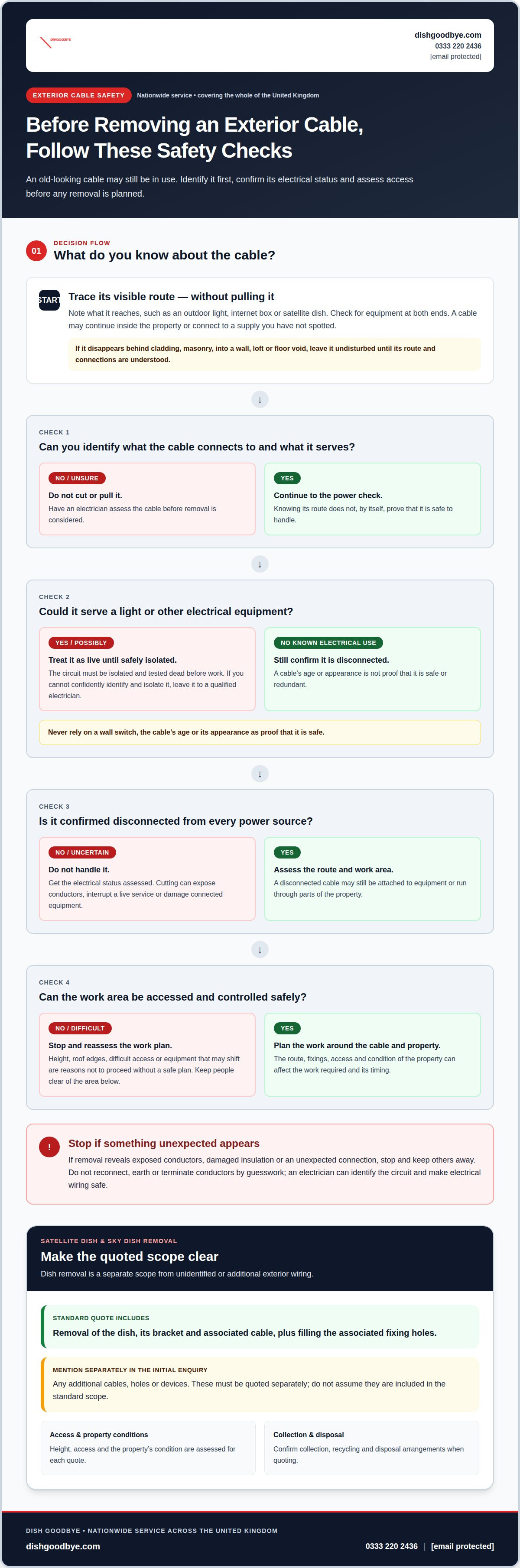
Cutting an unidentified cable can expose you to electric shock, interrupt a live service or damage connected equipment. If you can’t identify its route and purpose, don’t cut or pull it. Have an electrician assess it first.
- Identify the cable before touching it. Trace its visible route and note what it reaches, such as an outdoor light, internet box or satellite dish. Look for equipment at both ends, but don’t pull a cable from behind cladding or masonry to discover where it goes. A cable can continue inside the property or connect to a supply you haven’t spotted.
- Treat electrical wiring as live until safely isolated. If the cable may serve a light or other electrical equipment, stop before cutting. A forum electrician advised isolating the lighting circuit and testing that it is dead before starting work. Don’t rely on a wall switch, a cable’s age or its appearance as proof that it’s safe. If you can’t confidently identify and isolate the circuit, leave it to a qualified electrician.
- Avoid pulling, crushing or cutting an unknown run. Pulling can damage a cable where it enters a wall, while cutting can expose conductors or leave a live end behind. Don’t use a nail or other improvised method to pierce a cable. If a cable disappears into a loft, floor void or wall, leave it undisturbed until its route and connections are understood.
- Plan for falls and falling equipment. An exterior cable may be fixed high on a wall or close to a roof edge. Don’t lean from an open window or stretch from a ladder while holding tools. A dish, bracket or cable can shift as fixings loosen, so keep people clear of the area below. Stop if safe access or control of the equipment is difficult.
- Check nearby equipment and airflow. A coil of spare cable around a router, power unit or other device can restrict airflow and contribute to overheating. Overheating gadgets can become a fire hazard. Remove clutter without blocking vents or disturbing connected wiring. Older equipment can also use more energy because it may be less energy-efficient; the cable itself isn’t necessarily the source of that extra use.
- Leave uncertain electrical work to a professional. If removing redundant exterior cables reveals exposed conductors, damaged insulation or an unexpected connection, stop and keep others away. Don’t reconnect, earth or terminate conductors based on guesswork. An electrician can identify the circuit and make electrical wiring safe before any exterior tidying continues.
One contributor recounts an old practice of driving a nail through a disconnected cable to short it and prevent accidental energisation. Don’t copy this: the cable’s status may be uncertain, and piercing it can expose conductors or conceal damage. Older equipment may use more power because it is often less energy efficient, so assess the equipment separately rather than treating cable removal as an energy fix. Organisations should dispose of redundant cables safely in line with applicable environmental safety regulations.
Potential costs and timescales
- Define the work before arranging it. List each cable you want removed and where it runs. One surface cable is a different job from several lines entering separate rooms. Include attached boxes, brackets or other equipment in your description. The scope affects the work required, so distinguish cable removal from electrical investigation or other property work.
- Note access and height. A cable beside a ground-floor doorway presents different access needs from one near a roofline. Record the building type, cable height and any obstacles below. Restricted access, steep ground or fragile surfaces can affect the work plan and timing. Removing redundant exterior cables won’t take the same time at every property.
- Describe the route and condition. Say whether each cable runs along brickwork, passes through a wall or disappears beneath cladding. A loose, exposed line may need a different approach from one secured with clips or concealed beneath a surface. Damaged insulation or an unidentified connection can also change the work required and affect scheduling.
- Separate removal from electrical work. A cable that may still carry power needs to be assessed before removal. An electrician may need to identify and isolate a circuit first. That investigation is different from removing a known, disconnected exterior cable. Describe any uncertainty rather than assuming electrical checks are part of straightforward exterior work.
- Clarify what happens to the wall. Removing clips or fixings can leave marks, while a cable passing through masonry may leave an opening. Say whether you want cable removal only or also want associated holes addressed. Don’t assume filling, rendering, painting or repairing every old opening is included in the same job.
- Ask for the scope to be clear. Each job is assessed against its requirements, not a universal cable-removal rate. A quote should distinguish the identified cable work from extra devices, additional holes or electrical investigation. One cable and its fixings are different from several routes that need separate attention.
- Plan around the details provided. A short, accessible run may require less work than cables at height or routes concealed behind building materials. Multiple cables, difficult access, uncertain connections and separate repair tasks can all affect scheduling. Give a clear description and, where possible, photographs so the proposed work plan reflects the property and cable layout.
Safe disposal of redundant cables
Before disposal, confirm the cable is disconnected and check whether removal will leave an opening in the wall. Handle the cable and fixings carefully so they don’t create new trip hazards.
Check Removal Rules and Permissions
Start by identifying the cable and checking the installation’s status. An energised cable remains part of the installation and is subject to normal wiring regulations. A permanently isolated cable is generally outside their scope, although a metallic-sheathed cable may count as an extraneous-conductive-part in some situations.
For a listed building or a home in a conservation area, seek advice from the local planning authority before removing fixings or altering historic fabric. Whether consent is needed depends on the property’s status and the proposed work, so don’t assume every cable removal is treated alike.
- Record what you plan to remove. Note the cable’s route, visible connections and fixing points. For example, distinguish a cable clipped along brickwork from one entering a wall or running beneath cladding. Keep any identifying labels or connection details with your notes.
- Keep uncertain wiring in place. If you can’t establish that a cable is permanently isolated, don’t cut it or put it in household waste. Electrical status affects how it should be handled. Arrange for its purpose and supply to be assessed before removal.
Remove Disconnected Exterior Cables Safely
Start only after the cable has been disconnected from every supply and made safe. Follow the visible route, releasing clips carefully rather than yanking the cable from the wall. Keep loose lengths, sharp fixings and tools off paths to reduce the risk of trips or injuries.
- Take down the cable in manageable lengths. Keep each section under control as clips come away. Don’t let long loops drop across a doorway, garden path or shared access. Stop if the cable is difficult to reach or appears attached to equipment that remains in use.
- Separate cable from other materials. Gather removed lengths and fixings together, then keep them apart from general rubbish until disposal arrangements are clear. Cable types and attached components can differ. Follow applicable environmental safety requirements, and don’t leave discarded wiring where people might handle or trip over it.
- Protect the wall opening. Removing clips may leave small marks, while pulling a cable through masonry can disturb the entry point. Yes, careless removal can damage exterior walls or affect weatherproofing if it leaves an opening exposed. Inspect the route and entry point, and arrange suitable repair where needed.
- Finish with a clear access route. Collect offcuts, clips and tools from the work area. Check the ground below the cable run and remove anything that could catch a foot or wheel. Keep the collected cable contained until its disposal is arranged.
Which exterior cables can legally be removed in the UK?
- Identify whether the cable is energised. An energised cable remains part of the electrical installation and is subject to normal wiring regulations. Don’t remove it just because it looks old or unused. First establish whether it still carries power and what equipment it serves. If its status is unclear, leave it untouched until its purpose is identified.
- Distinguish permanent isolation from appearance. A permanently isolated cable is generally outside the scope of wiring regulations. That doesn’t mean every cable that looks disconnected is safe to remove. It may still be connected at an unseen end or supply equipment elsewhere. Treat its appearance as a clue, not proof of its electrical status.
- Take extra care with metallic-sheathed cables. Even a permanently isolated cable may matter if its metal sheath counts as an extraneous-conductive-part in that situation. Don’t cut or remove a metallic sheath based only on the cable being disconnected. Understand its role in the installation before anyone alters it.
- Consider Part P separately for lighting cables. Part P is relevant when considering the removal of redundant lighting wiring in a UK home, but the cable’s age alone doesn’t establish whether the proposed work is notifiable. Don’t assume every removal is automatically exempt or automatically requires notification. Establish what the work involves before proceeding.
- Record the cable’s route and connections. Note whether it ends at a light, switch, outdoor box or another device. For example, a cable that disappears through an exterior wall may continue to a circuit inside. Write down visible labels and connection points. This gives an electrician a clearer starting point if the cable’s purpose remains uncertain.
- Separate cable removal from building alterations. Removing an exposed, isolated cable differs from opening a wall, disturbing a concealed run or changing an electrical installation. Record the proposed work, and don’t pull out a cable buried in plaster or concrete just to make it disappear. The method can affect both the wiring and the building fabric.
- Pause when the legal or electrical status is unclear. Leave the cable in place if it may still be energised, forms part of a live installation or has a metallic sheath with an uncertain role. Have the installation assessed before removal. “Redundant” describes an assumption about a cable’s use, not its legal or safety status.
Can I remove an old TV aerial or satellite cable myself?
- Identify the cable and its purpose first. A coaxial lead serving a television may look abandoned but could still connect to equipment inside your home. Trace the visible route and check both accessible ends. If its destination is hidden, its status is uncertain or it connects to electrical equipment, don’t cut it based on appearance alone.
- Choose DIY only for a simple, accessible job. A short cable clipped along a reachable wall differs from one running beneath roof tiles or through a loft. Consider whether you can control the cable as you release the clips and keep the area below clear. If the work involves awkward height, unstable access or heavy equipment, leave it to someone equipped to manage those conditions.
- Keep the dish or aerial separate from the cable task. Removing a cable doesn’t automatically make it safe to take down the attached dish or aerial. Brackets and fixings may be difficult to reach, and equipment can move as fastenings loosen. Don’t climb onto a roof or lean from a window to reach a mounting point. Keep clear of the area below while anything is being released.
- Remove only cable you know is disconnected. Before handling it, establish that it has no connection to a power source or equipment still in use. If you can’t establish that, stop. Don’t rely on cutting the end, taping exposed conductors or connecting cores to earth instead of identifying the cable and making it safe.
- Release clips without pulling the cable through walls. Follow the accessible route and remove fixings carefully. Pulling a cable through a tight opening can damage its insulation, disturb masonry or leave a gap. If it disappears beneath plaster, concrete or cladding, don’t excavate just to remove every concealed section. A short remaining piece may be less disruptive than damage to the wall.
- Stop at buried or armoured cable. A cable beneath paving or soil needs a different approach from surface wiring. Pulling or digging without knowing its route can damage the cable or surrounding surfaces. Don’t use improvised cable pullers or excavate based on guesswork. Leave buried runs in place until their route and purpose are properly understood.
- Collect loose lengths and fixings as you go. Keep cable off paths and doorways, then gather clips and offcuts for safe disposal. If the job includes a satellite dish, bracket or associated cable, arrange removal suited to the access and property conditions rather than attempting an unsafe climb yourself.
A contributor suggests cutting back and insulating a redundant cable or connecting it to earth. Another suggests terminating its cores in a suitable junction box using screwed connections. A further suggestion is to remove old cables where possible, including buried armoured cables using cable pullers or excavation. These suggestions don’t establish that a cable is safe to handle or that excavation is suitable for a particular property. If its route or status is uncertain, leave it untouched and seek competent advice.
Dish Goodbye
Dish Goodbye can remove an old satellite dish and its associated cable when they clutter your home’s exterior. The standard quote includes removal of the dish, bracket and associated cable, plus filling the fixing holes left by that installation. Mention any additional cables, holes or devices in your initial enquiry, as these are quoted separately. Access, height and property conditions inform the work plan. Ask about collection, recycling and disposal arrangements when requesting a quote.
If you’re ready to clear an unwanted dish, contact Dish Goodbye by calling 0333 220 2436 or emailing [email protected].
Make your next step a clear one
Before removing redundant exterior cables, decide which items you want addressed and note their visible routes. A clear description helps distinguish a satellite dish and its associated cable from separate wiring or other devices. Leave unidentified or potentially live cables untouched until their purpose is established.
For a redundant dish, Dish Goodbye provides satellite dish and Sky dish removal. Include relevant details in your enquiry, including any additional cables or devices you want considered. This defines the scope of the work and helps keep expectations clear.
Contact Dish Goodbye to discuss your removal. Call 0333 220 2436 or email [email protected], and take the first step towards a tidier exterior.
Frequently Asked Questions
How much does professional removal of exterior cables cost in the UK?
Each job is assessed individually, and the quote reflects the work required. Factors include the number of cables, their location, access and height, and whether equipment or additional fixing holes need attention. For a satellite dish, the standard quote includes removal of the dish, bracket and associated cable, plus filling its fixing holes. Mention any extra cables, devices or holes in your initial enquiry so they can be quoted separately.
How do I dispose of removed cables and recycle them in the UK?
Keep removed cable contained and away from paths until you’ve arranged disposal. Don’t put unidentified or potentially live wiring out with general rubbish; establish that it’s disconnected and safe first. Cable materials and attached components can vary, so ask about collection, recycling and disposal arrangements when requesting a removal quote. For example, say whether loose cable has already been taken down or remains attached to exterior equipment. For enquiries, call 0333 220 2436 or email [email protected].