
Just moved in and found an old Sky dish on the house? Before arranging removal, check whether it’s still needed. Removing old sky dish after moving in starts with a simple check: look for signs it’s connected, and ask the previous owner if you’re unsure. Dish Goodbye provides Sky dish removal nationwide across the UK. Visit dishgoodbye.com, call 0333 220 2436 or email [email protected].
A dish can look like a small job, but working at height or loosening fixings can put you and the property at risk. This checklist helps you assess the dish safely from the ground, decide what needs attention and understand what a removal quote covers. That way, you can plan a tidier exterior without taking unnecessary risks.
A standard Dish Goodbye quote includes removal of the dish, its bracket and associated cable, plus filling the fixing holes associated with that removal. Mention any additional cables, holes or devices in your initial enquiry so they can be quoted separately. Ask about collection, recycling and disposal arrangements when requesting a quote.
Key Takeaways
- Check whether the dish is still needed, then note its location and visible condition from a safe position.
- Removing old sky dish after moving in is easier to plan when you record the dish, bracket, cable and any visible extras before deciding what to do.
- Don’t assume a reachable-looking dish is safe to remove yourself. Roof, chimney and other high-access work needs appropriate assessment and safety equipment.
- Prepare a clear enquiry with your postcode, dish location and any additional items you want included, so the job can be scoped accurately.
- Use the checklist to choose a sensible next step and work towards a tidier exterior without taking unnecessary risks.
Just moved in? Start your old Sky dish checklist with a clear exterior view
An old dish doesn’t need to become an urgent project. Start by working out whether it’s still needed, noting what you can see and choosing a safe next step. Check use and access before arranging removal. You don’t need to touch the dish or climb up to gather useful information.
Begin from ground level and look at the whole exterior. Check the front and accessible sides of the property, including the roofline and chimney, from a safe position. This wider view can help you identify where the dish is fitted and whether a cable appears to run towards a window, wall or another part of the building. Don’t approach roof edges or climb a ladder to get a closer look.
Record where the old Sky dish is fitted
Note whether the dish appears to be fixed to a wall, roof or chimney. Take ground-level photographs showing the dish, its bracket if visible, and the route of any visible cable. A wider photo gives context, while a closer view from a safe place may show its apparent condition. These observations make it easier to explain the job without inspecting it at height.
Keep your notes factual. For example, record that a cable runs down the outside wall or that the dish is mounted high on the chimney. If a fitting looks loose, damaged or weathered, describe what you can see rather than testing it. A photo can’t establish whether fixings are secure, so leave hands-on checks to someone equipped to assess access safely.
Decide whether the dish may still be needed
Think about the television equipment and viewing arrangements used in the home. Check where relevant boxes connect and whether anyone in the household relies on satellite reception. If you’ve just moved in, the previous owner’s setup may not reflect how you plan to watch television. The dish’s appearance alone won’t tell you whether it’s active.
If you’re uncertain, ask the household member who uses the equipment or contact the relevant service provider to clarify what the current setup needs. Don’t assume a particular service always needs a dish, or that it never does. The Understanding Satellite Dishes overview can help you recognise the general parts and purpose of the equipment, but it won’t establish whether your dish is in use.
Once you’ve checked its likely use, recorded its position and considered access, you’ll have a clearer basis for deciding whether to leave it in place or plan removal. A little preparation turns an untidy exterior question into a practical next step.
Inspect the Sky dish, bracket and visible cable before planning exterior tidying
A useful inspection doesn’t mean getting close to the installation. From a safe place, record what you can see, then leave anything that requires reaching or handling at height to someone with suitable access and safety equipment. Visible observations help describe the job; checking or altering high fittings requires safe access.
Separate facts from guesses as you look. “Cable runs down the side wall” is useful. “The bracket is unsafe” is a conclusion you can’t reliably make from the ground or a photograph. Accurate notes help avoid disturbing something that may still be connected or in use.
Note visible condition without disturbing the installation
From ground level, note whether the dish appears intact, visibly damaged, tilted or loose. If it looks unchanged but unused, record that as an observation too. Don’t tug the dish or cable to test it, and don’t pull, cut or disconnect anything. A cable may continue around a corner or enter the building somewhere you can’t see.
Describe the visible route clearly. For example: “The cable descends from the dish along the wall and disappears near a window.” You can photograph the dish, bracket, cable path and surrounding wall from a safe viewpoint. Photos show appearance and location, but can’t confirm whether a fixing is secure or establish corrosion, structural damage or damp. Where needed, those require an in-person assessment.
Make an accurate list of items for an enquiry
Before planning the exterior tidy-up, make a short inventory. Include the visible dish and bracket, cable routes, apparent fixing points and other items you may want dealt with. Don’t assume every cable or old fixing on the property belongs to this installation.
- Note how many dishes you can see and where each one is fitted.
- Record any additional cables or devices that may need attention.
- Note visible holes or fixings that appear separate from the dish and bracket.
- Describe access in plain terms, such as a low wall position or a high chimney location.
For removing old sky dish after moving in, these details can make your enquiry clearer from the start. Mention additional cables, holes, dishes or devices in your initial enquiry because they must be quoted separately. If you’re unsure whether an item is part of the dish installation, describe its location and include a ground-level photograph rather than trying to trace it by hand.
The US Federal Communications Commission explains its own rules in the FCC OTARD Rule on Satellite Dishes. That reference concerns the United States, so it isn’t UK guidance. For this checklist, focus on documenting your installation and its condition without disturbing it. If your notes point towards removal, the Dish Goodbye service website is a place to start planning the next step.
Is removing an old Sky dish yourself worth the risk? Understand access and scope
A dish that looks easy to reach from the garden may still be unsafe to remove yourself. What you can see doesn’t show how stable the fixing is, how the cable is routed or what conditions you’ll face when working close to the installation. A wall-mounted dish at low level and one fixed to a chimney are not the same job.
Removing an old Sky dish after moving in is a good time to pause before acting. A clear view or apparently simple bracket doesn’t prove that the work is safe. This section isn’t a dismantling guide: don’t touch fittings at height or attempt to loosen them. Focus instead on whether professional removal is the sensible next step and on clearly defining the work.
Why height and property conditions matter
Roof, chimney and other high-access locations need appropriate assessment and safety equipment. The property’s layout and the dish’s position affect what can be done safely, so access and property conditions are assessed for each quote. A photograph or ground-level view can help describe the setup, but it can’t replace that assessment.
Dish Goodbye’s experienced team carries out insured removal using proper safety equipment and techniques. Every property is different, so don’t assume one access arrangement suits every installation. Share clear details about the dish’s position and any access constraints when requesting a quote.
Know what the standard removal quote covers
A standard Dish Goodbye quote covers removal of the dish, its bracket and associated cable, plus filling the fixing holes associated with that removal. This gives you a clear baseline for planning the exterior tidy-up. It doesn’t automatically cover separate cables, unrelated holes or other devices.
Mention any additional cables, holes or devices in your initial enquiry so they can be quoted separately. A quote helps define the work and distinguish it from extras. If you want several items dealt with, list them together at the outset rather than assuming they’re part of the dish removal.
Before deciding, compare what you know about the installation with the work you want completed. For example, if there’s a second cable or another device nearby, note it and describe its location. Don’t try to trace or disconnect it yourself. Clear information helps set expectations and reduces the chance of overlooking something when the exterior is being refreshed.
If access involves a roof, chimney or another high position, leave hands-on removal to a properly equipped team. Use your observations to explain the setup, then rely on an individual assessment to establish the work involved. This helps you plan for a tidier exterior without turning a move-in task into a risky DIY project.
Use this move-in checklist to plan a tidy exterior without missed details
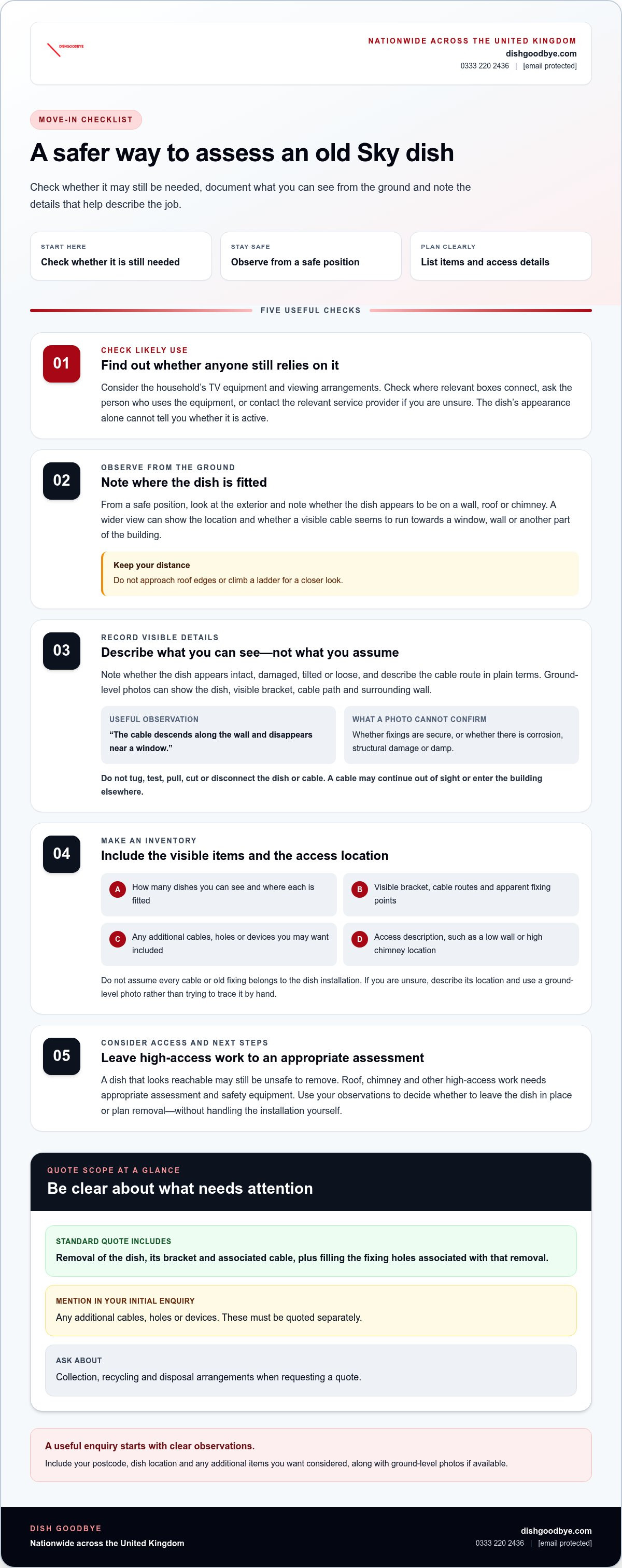
A few clear notes can turn an overlooked dish into a manageable move-in task. Follow this checklist in order: establish whether it’s still needed, record what you can see, list any extras, then choose your next step. Keep your inspection to safe, ground-level observation. Don’t climb or handle fittings to fill in gaps.
- Confirm use. Consider your household’s television equipment and viewing arrangements. If you can’t tell whether the dish is still required, check with the relevant household member or service provider before deciding.
- Document its location. Note whether the dish is fitted to a wall, roof or chimney. Take clear photographs from ground level showing the dish and visible cable route.
- List visible items. Record the dish, bracket and associated cable, plus any additional cables, dishes, devices or apparent fixing holes you may want included.
- Choose the next step. If the dish is redundant, use your notes to plan a removal enquiry. If it may still be in use, resolve that first.
This sequence makes removing old sky dish after moving in a deliberate decision rather than a rushed part of decorating. It also gives you a useful record of what you’ve seen, without suggesting that a photograph can establish the condition of fixings or the safety of access.
Prepare useful details before requesting a quote
Gather your postcode and describe where the installation is, such as on a wall, roof or chimney. Note the visible dish and bracket, the associated cable and anything extra that may need to be included. Additional cables, holes, dishes or devices must be mentioned in the initial enquiry and quoted separately. Send clear photographs taken safely from ground level. Don’t approach roof edges or climb for a closer view.
Sequence the dish work with other exterior plans
Decide whether the dish is redundant before arranging work to refresh the outside of the property. If removal is planned, factor it in before painting or other finishing work. The standard removal quote includes filling the fixing holes associated with removing the dish and bracket. Painting, rendering and wider masonry repairs are separate exterior work, not part of that scope.
Consider the wider appearance of the frontage too. A dish may be one of several priorities, so a broader kerb appeal plan can help you decide what to tackle and in what order. Keep the removal enquiry focused on the dish installation and identify any separate exterior work you’re planning.
For an outline of professional dish removal, visit the Dish Goodbye service website. Use your notes to prepare the enquiry and set out the items you want considered.
Arrange professional old Sky dish removal and finish your move-in checklist
Once you’ve established that the dish is no longer needed and noted what’s visible, turn your checklist into a clear enquiry. Share the property postcode, where the dish is fitted and any relevant access details. Mention extra items at the outset so the requested work can be scoped properly.
What to expect when requesting a removal quote
Dish Goodbye provides a free, no-obligation quote for Sky dish removal nationwide across the UK. The standard scope covers removal of the dish, its bracket and associated cable, along with filling the fixing holes associated with that removal. Additional cables, holes, dishes or devices must be raised in your initial enquiry and quoted separately.
Describe the job concisely, for example: “Dish on the rear wall, cable visible down the side, with another cable nearby.” Add clear photographs taken safely from ground level if you have them. Access and property conditions are assessed for each quote, so share useful details about the position, such as a roof or chimney mounting.
Dish Goodbye offers fixed pricing with no hidden fees. Same-day removal is available where feasible. When requesting a quote, ask about collection, recycling and disposal arrangements so you know what has been agreed for the removed items.
Finish the move-in checklist with a clear next step
Dish Goodbye’s experienced team uses proper safety equipment and techniques for insured removal. Once your enquiry details are ready, request a quote through the Sky dish removal contact page or call 0333 220 2436.
Before sending the enquiry, check that it includes:
- Your postcode and the dish’s location on the property.
- Any additional cables, holes, dishes or devices requiring separate quotation.
- A request to clarify collection, recycling and disposal arrangements.
That completes the move-in checklist: you’ve considered whether the dish is needed, recorded the visible setup and identified a safe way to plan removal. A clear enquiry helps define the job before work is arranged and keeps dish removal separate from wider exterior plans such as painting or rendering.
For a quote, contact Dish Goodbye on 0333 220 2436 or email [email protected]. Visit the Dish Goodbye service website.
Make your next move towards a tidier exterior
A new home comes with plenty to organise, so make the old dish a clear, manageable decision rather than an unfinished question. Once you know it’s no longer needed, turn your notes into a practical plan. If you’re arranging other exterior work, consider how removal fits into the schedule and keep separate repairs or finishing tasks clearly defined.
For removing old sky dish after moving in, you don’t need to resolve every detail yourself. Share what you’ve observed and use the removal quote to understand the next step for your property. A little preparation can help you move on with a tidier exterior and one less job on your list.
Request a free, no-obligation quote to get started. Call Dish Goodbye on 0333 220 2436 or email [email protected]. Visit the Dish Goodbye service website for more information.
Frequently Asked Questions
Is an old Sky dish automatically included when I move into a house?
No. Finding a dish doesn’t establish whether it’s still needed or who arranged its installation. Check your current television equipment and viewing setup, and review any relevant handover notes or property information. If other household members use the television, ask how they watch before deciding. First work out whether the dish is redundant, then plan safe removal as a separate step.
Can I tell whether an old Sky dish is still being used?
Not reliably from the dish and visible cable alone. Check which television equipment is connected and how household members watch their programmes. If the setup is unclear, ask the person who uses it or contact the relevant service provider. Don’t climb to inspect the installation or disconnect a cable as a test. A ground-level view can help describe the dish, but it can’t prove whether it’s redundant.
What should I photograph before asking about old Sky dish removal?
Take ground-level photographs showing the whole dish, its apparent mounting position and any visible associated cable. Include a wider view of the property so the location is easy to understand. Note the postcode and whether the dish is on a wall, roof or chimney. Mention extra cables, holes or devices in your initial enquiry, as these need to be quoted separately. Don’t climb for a closer picture.
Should I remove an old Sky dish before repainting or rendering the house?
Decide whether the dish is still needed, then consider removal alongside your exterior finishing plans. The standard removal quote includes filling the fixing holes associated with removing the dish and bracket. Painting, rendering and wider masonry repairs aren’t included, so treat them as separate work. The right sequence depends on the wider project; not every property needs the same order.
Will removing an old Sky dish affect my television reception?
It may affect viewing that relies on that particular dish. The impact depends on the equipment and service used in your household, so establish whether the installation is still needed before arranging removal. Check which box or television setup household members rely on, and ask the relevant service provider if you’re unsure. Don’t assume another viewing method will work without checking your own setup.
Can I ask about collection and recycling when I request dish removal?
Yes. Ask about collection, recycling and disposal arrangements when requesting your quote, so these can be discussed as part of the quotation process. Asking doesn’t guarantee a particular recycling destination or disposal outcome, so make sure the arrangement is clear before proceeding. If you have more than one dish or other items to include, mention them in the initial enquiry because they may need a separate quote.