

If you’re deciding what to do with an abandoned dish on your property, first identify and contact the person responsible for the property before arranging removal. Ask neighbours, leave a polite note or use HM Land Registry to look up ownership. An empty property or unused dish does not mean the owner has given up their rights to it.
An unwanted dish can make a tidy exterior look neglected, but approaching the issue carefully can help avoid misunderstandings. This guide covers practical ways to trace the responsible person, what to say and how to handle belongings left near the dish.
Follow the steps to work out who to approach and what to do next. You’ll also learn why it’s sensible to agree on removal before anything is moved, stored or disposed of.
Key Takeaways
- Start with neighbours and a polite note, then use HM Land Registry to help identify the property owner.
- An unused dish or an empty-looking property doesn’t prove that either has been abandoned.
- Establish who is responsible before moving or disposing of belongings left with the dish.
- For a damaged dish or an obstruction, focus first on the immediate hazard and contact the relevant property owner or authority.
- When removal is the next step, Dish Goodbye offers Sky Dish Removal across the UK.
Tracing and approaching the property owner
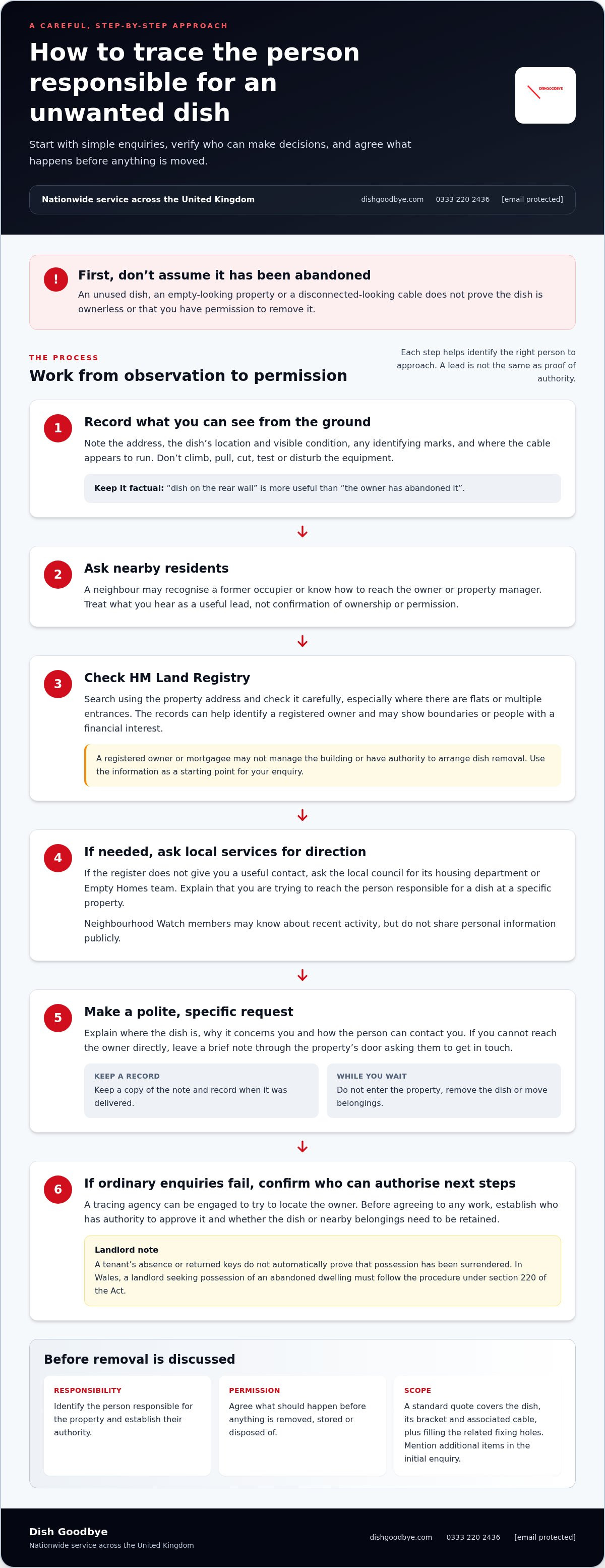
- Start with the address and note clear details about the dish. Record its location, visible condition and any identifying marks, without climbing or disturbing it. Ask neighbours whether they know who owns or manages the property. A nearby resident may recognise a former occupier or know how to contact the owner. Treat this as a lead, not proof: an apparently unoccupied building may still have an owner, tenant or managing agent. If you’re wondering what to do with an abandoned dish on my property, begin by finding the person responsible.
- Search HM Land Registry using the property address. Its records can help establish whether the property is registered and identify its owner. Check the address carefully, especially if the building has flats or multiple entrances. The register may also show boundaries and people with a financial interest, such as a mortgagee. That person may not manage the building or have authority to arrange removal, so treat the records as a starting point for your enquiry.
- If the register doesn’t provide a useful contact, ask your local council for its housing department or Empty Homes team. Explain that you’re trying to reach the owner about a dish fixed to or left at a specific property. The council may be able to help identify an owner or establish whether legal proceedings affect the property. Neighbourhood Watch members may also know about recent activity, but don’t share personal information publicly.
- Approach the owner politely and make a specific request. Explain where the dish is, why it concerns you and how they can contact you. If neighbours can’t provide details, leave a brief note through the property’s door asking the owner to get in touch. Don’t enter the building, remove the dish or move belongings while you wait. Keep a copy of your note and record when you delivered it, so you can document your reasonable attempts to make contact.
- If ordinary enquiries fail, a tracing agency can be engaged to try to locate the owner. Before agreeing to any work, establish who has authority to approve it and whether the dish or nearby belongings need to be retained. If you’re a landlord, don’t treat a tenant’s absence or returned keys as automatic proof that possession has been surrendered. In Wales, a landlord seeking possession of an abandoned dwelling must follow the procedure under section 220 of the Act, according to UK Government (legislation.gov.uk). A practical answer to what to do with an abandoned dish on my property starts with keeping the dish enquiry separate from any legal possession process.
What counts as an abandoned dish or satellite dish on private property in the UK?
- Distinguish “unused” from “abandoned”. A satellite dish may look neglected because it’s weathered, disconnected or no longer needed by the current occupier. None of these signs alone proves the dish has been given up or that you can remove it. An empty-looking house isn’t automatically legally abandoned either. Treat “abandoned dish” as a description of its apparent condition, not proof of ownership or authority to arrange work.
- Observe the dish’s position and visible connections from the ground. Note whether it’s fixed to a house wall, garage, boundary structure or shared part of a block. Record whether a cable runs towards the building or appears loose, but don’t pull, cut or test it. A cable that looks disconnected doesn’t confirm whether the equipment is still in use. Keep your notes factual: “dish on the rear wall” is more useful than “owner has abandoned it”.
- Consider the property arrangement when deciding who should act. A dish on a detached house may concern its owner or occupier; one on a block of flats may be fixed to a shared wall or roof. In a rented home, the landlord and tenant may have different roles, while a managing agent may handle shared areas. These examples don’t establish ownership, but can help identify who needs to discuss the dish.
- Look for signs that the dish is still connected to someone’s use of the property. A current occupier may still rely on it, even if it looks old or sits beside newer equipment. A dish left after someone moves may be redundant without being legally ownerless. Don’t treat the condition of the bracket, cable or surrounding brickwork as a substitute for permission. Ask the responsible person whether it’s still needed before arranging removal.
- Make a short record before taking the next step. Note the address, exact location of the dish, visible cable route and any damage or obstruction. A clear ground-level photograph can help explain which item you mean, but avoid capturing neighbours or private spaces unnecessarily. Once permission is settled and the dish is genuinely redundant, the Dish Goodbye service website outlines satellite dish removal. This keeps the decision focused on the dish, rather than assuming every cable or device nearby is part of the same job.
Who owns an abandoned satellite dish attached to a house or building?
- Start with the property owner, but don’t assume who owns the dish. A dish fixed to a wall may have been arranged by an owner, tenant or previous occupier. Its position alone doesn’t establish who bought it or who can authorise removal. Ask the current occupier, landlord or managing agent who arranged the installation. For example, a tenant may have ordered a dish for their own viewing equipment, while a previous owner may have left one behind after moving.
- Use property records to identify who to approach. HM Land Registry can help establish whether a property is registered and identify its registered owner. Its information may also show boundaries and people with a financial interest, such as a mortgagee. These records can point you towards the right contact, but don’t automatically establish who owns a particular dish. A mortgagee’s financial interest, for example, doesn’t by itself show that they manage the building or can approve removal.
- Check whether the building has shared ownership or management. In a block of flats, a dish may be attached to a shared wall or roof rather than an individual flat. Contact the managing agent, landlord or other responsible person to ask who controls that area. If the dish serves one flat, its occupier may know who installed it. If it’s on a communal structure, get permission from the relevant decision-maker before arranging work.
- Look for evidence of the original installation. Ask the owner or occupier whether they have an installation record, invoice, service paperwork or tenancy correspondence. A previous installer’s name on paperwork may help trace who commissioned the work, but doesn’t prove current ownership. Keep the question focused: identify the dish, where it’s attached and whether anyone still uses it. Don’t remove it simply because nobody in the current household recognises it.
- Get clear authorisation before removal or disposal. Ask the person with authority over the wall, roof or other fixing point to confirm permission in writing. If a tenant says the dish belongs to a former occupier, ask the landlord or building manager to resolve responsibility before anything is moved. Record what the agreement covers, such as the dish, bracket and associated cable. Treat belongings nearby separately: permission to remove a dish doesn’t automatically allow you to collect or dispose of other items.
Can a UK council collect or recycle an unwanted satellite dish?
- Start with your local council’s waste and recycling team. Collection arrangements vary between council areas, so there isn’t one UK-wide answer for satellite dishes. Give the team your postcode and describe the dish, including whether it’s detached or still fixed to a building. Ask whether the council accepts the item and what collection or drop-off arrangements apply. Don’t assume a council collection includes removing a dish from a wall or roof.
- Separate removal from disposal before making arrangements. A council waste service may deal with an item once it’s safely removed, but detaching equipment from a building is a different task. A dish left beside a bin store, for example, is not the same collection request as one fixed high on a house wall. Explain the location clearly and ask what condition the dish must be in for the council to handle it.
- Ask specifically whether the dish can be accepted through the council’s recycling route. Don’t assume it counts as ordinary household recycling because it’s made from recyclable materials, or that every recycling centre accepts it. Tell the council if it comes with a bracket, cable or other equipment, as these may need separate instructions. Follow the council’s guidance for the dish and each loose component instead of placing everything in a household recycling bin.
- If the council doesn’t collect the dish, ask whether a local household waste site accepts it and how to take it there. Explain whether you can transport the item and whether it’s intact, bulky or difficult to handle. The council can advise which local arrangements apply. Don’t leave a dish beside a public bin or at a waste site without permission; this doesn’t confirm acceptance and may cause an obstruction.
- Keep the council’s instructions with your removal plan. Note which team you contacted, what item you discussed and any preparation or delivery directions. If the dish remains attached, arrange authorised removal before treating it as household waste. If you use a separate removal service, ask about collection, recycling and disposal arrangements when requesting a quote. This helps prevent a detached dish from becoming an unwanted item with nowhere agreed to go.
Who should I contact if an abandoned dish is damaged, dangerous or obstructing access
- Keep people clear and describe any immediate hazard. If a dish is hanging loose above a doorway, keep residents and visitors away from the area below. Don’t climb, pull at the bracket or try to catch falling equipment. Note the building address, exact location and visible problem, such as a sharp edge or a dish blocking a shared path. If someone faces immediate danger, contact the emergency services and explain what’s happening.
- Contact whoever controls the building or affected area. For a house, approach the owner or occupier. For a rented property, contact the landlord or managing agent. In a block of flats, report a dish on a communal wall, roof or entrance to the building manager. Give them clear details and ask them to arrange a safe response. A dish obstructing a shared entrance needs prompt attention because residents may be unable to pass freely.
- Report public access obstructions to the relevant council. If a detached dish, bracket or cable blocks a pavement or public route, contact your local council and give the precise location. Explain whether pedestrians must step into the road or whether an entrance is affected. Don’t move the item onto the pavement or carriageway. For a blockage on private land, contact the person responsible for that site.
- Stay away from damaged fixings and exposed cables. A bent bracket, loose masonry or trailing cable can make a dish unstable. Don’t test or cut the cable, or use a ladder to inspect the fixing. From a safe position, record what you can see and tell the owner or property manager. If the dish is near overhead electricity lines, keep clear and contact the relevant electricity network operator about the hazard.
- Arrange removal only after the immediate risk is addressed. Tell the person authorising the work whether the dish is high up, loose, obstructing access or attached to damaged masonry. These details help them plan the next step. If it is stable but no longer wanted, use the Dish Goodbye service website to learn about planned satellite dish removal. Keep the route clear while you wait, and don’t move any nearby belongings without the owner’s agreement.
If you’re interested in buying a property with an abandoned dish, contact its owner politely to express your interest; you may need legal advice before making an agreement. If a landlord believes a tenant has left, they should try to contact the tenant and confirm the property is abandoned. The landlord should make sufficient enquiries to support a genuine and reasonable belief that the tenant has stopped living there before taking it back.
A landlord may leave a prominently displayed notice stating their belief that the property has been abandoned and asking anyone who knows the tenant’s whereabouts to make contact. The notice may say that the locks will be changed and ask tenants wishing to reclaim occupancy to contact the landlord or agent. Landlords should not change a tenant’s locks or take back a property without first following the applicable legal process.
Dish Goodbye: Sky Dish Removal
Dish Goodbye provides Sky Dish Removal when an unwanted dish has been identified and removal is authorised. The service covers homes and commercial properties nationwide, covering the UK. A standard quote includes the dish, its bracket and associated cable, plus filling the fixing holes left by that installation. Mention any additional cables, holes, dishes or other devices in your initial enquiry; these must be quoted separately.
When requesting a quote, share the dish’s location and details about access, height and the property’s condition. Please ask about collection, recycling and disposal arrangements as part of your enquiry. Once ownership and permission are clear, this is a practical next step, particularly if the dish is difficult to reach or you want the fixing holes filled after removal.
Contact Dish Goodbye on 0333 220 2436 or at [email protected] to discuss your Sky dish.
Make the next step a clear one
Once you know who can authorise the work, you can decide how to resolve the issue safely and tidy the exterior. If you’re deciding what to do with an abandoned dish on your property, focus on a practical outcome: a safely cleared space and a neater exterior. Dish Goodbye provides Satellite Dish Removal, including Sky Dish Removal, for unwanted equipment.
Share the dish’s location, access conditions and any additional cables or devices when you enquire. That helps define the work involved and keeps the next step straightforward. For help planning removal, contact Dish Goodbye through its service website, or call 0333 220 2436 or email [email protected].
Take it one step at a time, and you can turn an awkward leftover into a property task resolved with care.
Frequently Asked Questions
Can I remove an abandoned satellite dish from my property without permission in the UK?
Don’t remove a dish until the person responsible for the building or fixing point has authorised the work. A dish attached to a shared wall, rented home or neighbouring property may not be yours to alter, even if it appears unused. If ownership or authority is unclear, pause and ask the property owner or managing agent for written permission. This can also help prevent disputes if someone later says the equipment was still needed.
What steps should I take to identify and contact the owner of an abandoned dish?
Use the full property address to make your enquiry specific, and identify where the dish is attached. Ask the current occupier or building manager who handles the property, then check HM Land Registry if you need to identify its registered owner. Keep your message brief and ask for a reply about responsibility and permission. If the building has several flats, include the relevant entrance or shared area so your enquiry reaches the right person.
How do I safely remove a satellite dish and dispose of it in the UK?
For a dish fixed to a roof, chimney or high wall, don’t attempt removal from a ladder or by pulling at the equipment. Arrange a removal method suitable for the access and fixing conditions. Once detached, ask your local council whether its waste service or household waste site accepts the dish, and follow its handling instructions. Don’t leave it beside bins or on the pavement without permission.
What risks are there in removing a dish attached to a roof, wall or shared building?
Roof and chimney work carries a risk of falls, and a loosened dish or bracket could fall onto people or property. Removing fixings can also damage brickwork or leave holes that need attention. On a shared building, unauthorised work may affect communal areas or equipment used by another occupier. Check who controls the structure and keep people clear of the work area until removal is complete.