
What if the easiest way to deal with several old satellite dishes is to treat them as one property-wide job? If you’ve inherited a property with multiple old dishes, it can be hard to tell how many installations are there, which cables belong to each one and what other beneficiaries want to keep. Dish Goodbye provides satellite dish removal across the UK. You can reach the team on 0333 220 2436 or at [email protected].
Before anything comes down, make a simple inventory. Note each dish’s location, photograph the brackets and visible cables, and agree with the other beneficiaries which equipment should stay or go. A clear record helps everyone make decisions and gives you the details needed for an accurate removal enquiry.
This guide walks you through checking the property, documenting each installation and preparing your enquiry. Dish Goodbye’s standard quote covers removal of the dish, its bracket and associated cable, plus filling the related fixing holes. Mention any extra cables, holes or devices at the outset, as they’re quoted separately. To discuss removal, contact Dish Goodbye on 0333 220 2436 or [email protected].
Key Takeaways
- If you’ve inherited a property with multiple old dishes, assess each installation separately and decide whether to keep, remove or defer it.
- Record where each dish is fitted and note any brackets or cables that may need attention.
- For a clearer removal enquiry, provide the property postcode, describe each dish’s location and share photographs taken safely from the ground.
- A standard quote covers the dish, its bracket, associated cable and filling the related fixing holes. Mention any additional items or holes in your initial enquiry.
- Include collection, recycling and disposal arrangements in your quote enquiry so they can be discussed as part of the job.
Inherited a Property with Multiple Old Dishes? Start with a Property-Wide Inventory
Several old dishes can look like one tangled job, but you don’t have to decide what happens to every installation straight away. Start by building a simple property-wide inventory. It gives you a reliable picture of what’s there, helps beneficiaries discuss the same equipment and makes it easier to describe the work if you arrange removal later.
If you’ve inherited a property with multiple old dishes, resist the urge to treat every dish, cable and fixing as part of one identical installation. Some may be in different locations or have separate cables and fittings. Record what you can see without disturbing anything. A basic list and a few clear photographs can turn guesswork into a manageable plan.
How to record each satellite dish and its location
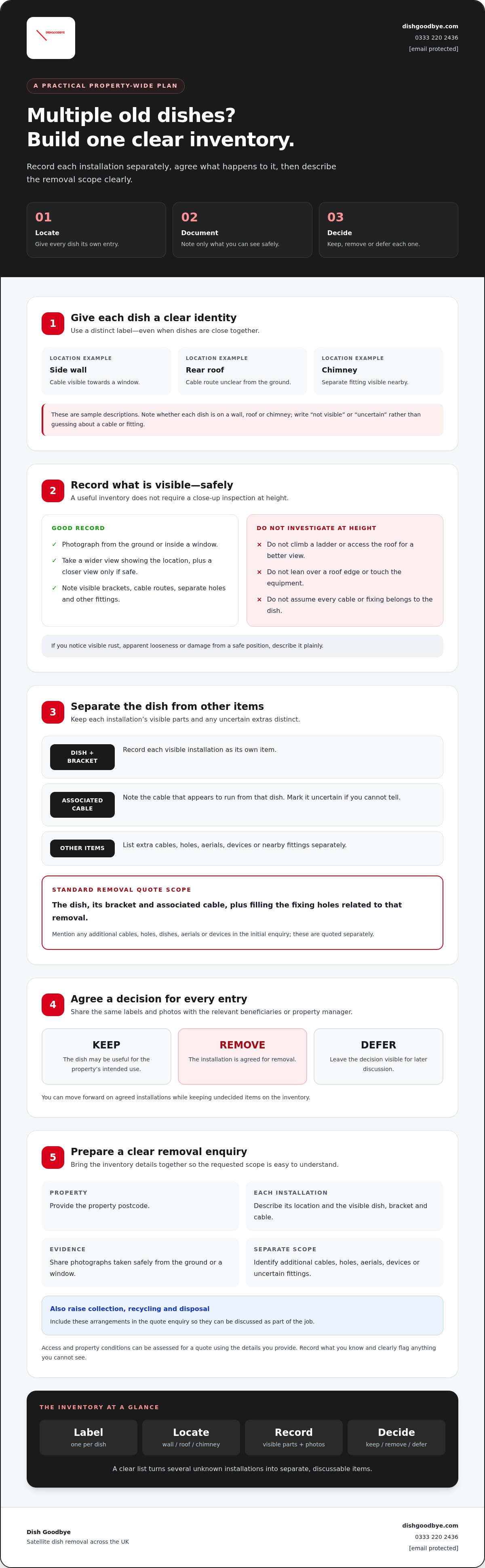
Give each visible dish its own entry, even if two are close together. Note whether it’s fixed to a wall, roof or chimney, and use a clear label such as “rear wall” or “chimney above the front roof”. If you’re unsure what you’re looking at, a guide to what a satellite dish is can help you recognise its general shape and purpose.
Take photographs from a safe position on the ground or from inside a window. Don’t climb a ladder, access the roof or try to remove a dish to get a better view. Include a wider photo showing where the installation sits, then a closer view if you can take one safely. Note visible cable routes, separate holes or fittings, and anything that appears to be additional equipment. Don’t assume every cable or fixing belongs to the dish.
- Dish A: side wall, cable visible running towards a window.
- Dish B: rear roof, cable route unclear from ground level.
- Dish C: chimney, separate fitting visible nearby.
These are just examples of useful descriptions. If you can’t see a cable clearly, write “not visible” rather than guessing. That distinction helps keep the inventory accurate.
How beneficiaries can agree on the next step
Share the inventory with the relevant beneficiaries or the person managing the property. Use the same labels and photos in messages or discussions, so everyone knows which installation is being considered. This keeps the conversation focused on the exterior equipment and avoids confusion between, for example, a dish on the rear roof and one on a side wall.
Then record a separate decision for each entry: keep, remove or defer. A dish may be useful for the property’s intended use, while another may be redundant or simply need more discussion. You don’t need a final decision about every item before creating the inventory. A clear list lets you move forward on agreed installations while keeping undecided ones visible for later.
Identify Which Old Satellite Dishes, Brackets and Cables Need Attention
Once you’ve made a property-wide record, look more closely at what appears to belong to each satellite dish. This helps turn a general list into a useful scope for an enquiry. A satellite dish is the round or oval receiver mounted outside, usually on an arm attached to a bracket. The bracket fixes it to the building, while a cable may run from the dish towards the property. From the ground, you may not be able to trace every cable or identify every fitting, and that’s fine. Record what’s visible without guessing.
What belongs on the satellite-dish inventory
Count every dish as a separate installation, even if several are mounted on the same wall. For each one, note its location and the bracket and cable that appear connected to it. A standard removal quote covers the dish, its bracket and associated cable, plus filling the fixing holes associated with that removal.
List other items separately rather than folding them into the dish entry. These could include an aerial, an extra cable running along the wall, a separate device or an old fitting nearby. Note additional holes or fixings too. They may relate to an earlier installation rather than the dish currently in place. Any extra cables, holes, dishes, aerials or devices should be described in the initial enquiry and quoted separately. This makes the requested scope clearer from the start.
- Dish and bracket: record each visible installation as its own item.
- Associated cable: note the cable that appears to run from that dish.
- Other equipment or fixings: list separately if you can’t tell what they belong to.
How to note condition without inspecting at height
Use a safe viewing position, such as the garden or a window. If you can see rust, a bracket that appears loose, or visible damage, describe it plainly in your notes. Don’t climb a ladder, lean over a roof edge or touch the equipment to investigate. A photo taken safely from a distance can help show the general condition, but don’t put yourself at risk to get a closer view.
Record whether each dish is on a wall, roof or chimney. These details help describe the installation and allow access and property conditions to be assessed for a quote. If you can’t tell whether a cable is associated with a dish, mark it as uncertain and mention that in your enquiry instead of assuming it’s included.
Keep this record focused on exterior equipment and removal scope, rather than inheritance or tax matters. For example, GOV.UK’s guidance on Inheritance Tax and Business Relief covers a separate subject. For help arranging satellite dish removal based on the installations you’ve documented, visit the Dish Goodbye service website.
Keep, Remove or Defer: Compare Your Options for Multiple Old Dishes
There’s no need to make one blanket decision about every dish. An inherited property may have several installations, but each can be considered on its own. Think about the property’s intended use and whether anyone expects to use a particular dish. Then record a clear outcome for each one: keep, remove or defer.
This simple approach is especially useful if beneficiaries have different views. Instead of discussing “the dishes” as one group, refer to the specific location and entry in your inventory. You can agree on the installations that are ready for action while leaving any unresolved choices aside.
When keeping a dish may suit the property plan
Keeping an installation may make sense if a beneficiary or future occupier expects to use it. Note exactly which dish is to remain, including its location, so it isn’t accidentally included in a removal request. Avoid assuming that a dish will or won’t suit someone’s future needs based on its appearance alone. The practical decision here is simply whether the people involved want that particular installation left in place.
When removal or a later decision may make sense
If a dish is no longer wanted, looks out of place or conflicts with the exterior appearance you’re aiming for, mark it for removal. If beneficiaries haven’t agreed, defer that entry rather than letting uncertainty hold up decisions about other dishes. A short note such as “rear wall, removal agreed” or “chimney, decision pending” keeps the status easy to understand.
For someone who has inherited a property with multiple old dishes, a mixed decision is often the most practical: one installation may stay, another may be removed, and a third may need more discussion. Don’t assume they all have the same purpose or status simply because they’re on the same property.
Agree the scope before making an enquiry
Before requesting a quote, share the inventory and decision notes with the relevant beneficiaries or property manager. Confirm which installations are agreed for removal and clearly mark those that should remain or are being deferred. This gives everyone a common record and helps prevent a dish being overlooked or included by mistake.
Use a short scope list to keep the enquiry straightforward:
- Remove: identify each agreed dish by its location.
- Keep: mark any installation that should remain.
- Defer: record dishes where a decision is still pending.
Only include agreed removals in the enquiry, and describe each one separately. If the plan changes, update the shared record before anyone sends or revises the request. That small step keeps the decision-making clear and helps turn a complicated set of inherited-property tasks into a manageable plan.
Prepare a Clear Enquiry for Removing Multiple Satellite Dishes
Use the decisions recorded in your inventory to make the requested work easy to follow. Start with the property postcode, then identify each dish you want removed. Refer to a specific position, such as “side wall” or “rear roof”, rather than describing several installations as one group. This helps distinguish the dishes if some are staying or still under discussion.
- Confirm the scope. Mark which listed dishes should be removed, kept or left for a later decision.
- Gather the postcode. Include the property postcode with your enquiry.
- Describe each installation. Note whether it’s on a wall, roof or chimney, and mention any visible access or property conditions that may be relevant.
Photographs can help clarify a location or access detail. Take them only from a safe position, such as the ground or a window. Don’t climb or approach a roof edge to get a closer view. If something isn’t clear, say so instead of guessing.
Details to include for an upfront quote
For each dish on the removal list, provide its location and any details that could help distinguish it from the others. Note visible cables, but identify any extra cables or holes separately rather than assuming they belong to the dish. Also mention aerials or other devices you want considered. Use the scope guidance above to describe these additional items in your initial enquiry.
Describe access plainly. For example, say whether an installation is on a chimney or roof and whether its position is difficult to view from the ground. Access and property conditions are assessed for each quote, so include what you can observe safely without inspecting equipment at height.
How to avoid confusion about the requested work
Use consistent labels from your inventory, such as “Dish A, side wall, remove” and “Dish B, rear roof, keep”. If beneficiaries are involved, make sure the enquiry reflects the agreed list. This reduces the chance of including an installation that should remain or overlooking one that’s ready to go.
If you want to discuss collection, recycling and disposal arrangements, raise that when requesting the quote. When your list and property details are ready, send an enquiry for your listed dishes.
Arrange Safe Removal and Leave the Inherited Property Tidier
With the agreed list ready, you can move from planning to arranging the work. Dish Goodbye carries out insured removal using proper safety equipment and techniques, so there’s no need to climb up or try to loosen a dish yourself. Leave the installations in place and use the locations and access details in your enquiry to describe what’s on the property.
What to expect when removal is arranged
Use the scope you’ve already set out in your enquiry, and keep a copy of the agreed list so everyone involved knows which installations are being addressed. Access and property conditions are assessed for each quote. Mention any relevant details about a dish’s position, particularly if it’s high up or difficult to view safely. Don’t assume every unusual or high-access installation can be handled in the same way.
Same-day removal is available where feasible. Include the number and locations of the dishes when requesting a quote, so the individual job can be assessed. If plans change, update the agreed list and enquiry details before removal is arranged.
Take the next step towards a tidier exterior
Once the removal details are clear, you can request a free, no-obligation quote. Fixed pricing with no hidden fees helps you understand the quoted work before proceeding. Any additional items you’ve identified should be included in the enquiry, as set out earlier in this guide.
Use the Dish Goodbye enquiry form, call 0333 220 2436 or email [email protected] to take the next step. A clear list makes it easier to coordinate the agreed work and leave the property looking tidier.
Make the Next Step a Simple One
An inherited property can bring plenty of decisions, so make this one manageable by focusing on the dishes everyone has agreed to address. If you’ve inherited a property with multiple old dishes, keep the shared inventory as your working record. It can help beneficiaries stay aligned as plans develop, while any undecided installations remain clearly marked for later.
Before you send your enquiry, check that the list reflects the current decision and that each dish is easy to identify by location. This small final check can prevent crossed wires and gives you a practical starting point for moving the property forward.
Request a free, no-obligation quote for your listed dishes, and take the next step towards a simpler plan for the inherited home.
Frequently Asked Questions
What should I do first if I inherited a property with multiple old satellite dishes?
Start with a separate record for each dish. Note its position and any cable that appears to connect to it, then take photographs from a safe place, such as the garden or a window. Share the record with the relevant beneficiaries or person managing the property. For example, label entries “front chimney” and “rear wall” so everyone can clearly identify which installations should stay and which can be removed.
Can I ask for several old satellite dishes to be removed in one enquiry?
Yes. Describe every dish separately and say whether it’s on a wall, roof or chimney. Include any visible access details, such as a steep roof or restricted space around the building. Mention extra cables, holes, aerials or devices in the initial enquiry, as these are quoted separately. A clear, item-by-item description helps the quote reflect the installations and conditions you’ve identified.
Does a standard satellite dish removal quote include the bracket, cable and holes?
Yes. The standard quote covers the specified dish, its bracket and associated cable, along with filling the fixing holes associated with that removal. If you’ve spotted a separate cable or old hole elsewhere, describe it as an additional item in your initial enquiry so it can be quoted separately. Unrelated fittings and wider masonry work shouldn’t be assumed to form part of the dish removal.
Should I remove old satellite dishes before selling or renting an inherited property?
That depends on the property’s intended use and what the beneficiaries agree. You could mark an installation for removal if it’s redundant, while leaving another in place if someone expects to use it. If the decision isn’t settled, record it as pending rather than including it in the removal request. This practical approach helps you organise the exterior work without assuming every dish needs the same outcome.
Can Dish Goodbye remove dishes from a roof or chimney?
Yes. Dish Goodbye handles Sky dish installations on walls, roofs and chimneys using proper safety equipment and techniques. Include the location and any relevant details in your initial enquiry. Access and property conditions are assessed for each quote, so a roof or chimney installation should be described accurately rather than assumed to have the same access requirements as a wall-mounted dish.
Does Dish Goodbye collect or recycle old satellite dishes?
Ask about collection, recycling and disposal arrangements when requesting your quote. These arrangements aren’t automatic, so include the question with your initial details and discuss them after the quote is confirmed. If there’s more than one dish, say how many are included in the removal request. That helps keep the discussion about arrangements specific to the items and work being quoted.
Is same-day removal available for multiple dishes at an inherited property?
Same-day removal is available where feasible, but it isn’t guaranteed for every job. Include the number of dishes, each location and any access details in your enquiry so the work can be assessed. For example, distinguish a wall-mounted dish from one on a chimney. This gives a clearer picture of the requested job without assuming all installations can be handled under identical conditions.