
Is that old aerial or satellite dish worth keeping, or is it just taking up space on your roof? If you’re asking, “is it worth paying to have an old aerial removed”, the answer depends on its condition, location and how safely it can be reached. Dish Goodbye serves households across the UK. Contact us on 0333 220 2436 or at [email protected].
It’s understandable to hesitate when the equipment no longer serves a purpose. Leaving it in place may be fine in some situations, but loose fittings, visible cables or a bulky bracket can affect your home’s appearance. Removing equipment at height can also be risky, and you may be left wondering whether fixing holes will be dealt with too.
This guide weighs up the practical reasons to leave or remove redundant equipment, explains what can affect access and the work involved, and shows what to share for a clear quote. You’ll also learn what a standard satellite dish removal quote covers, including its bracket, associated cable and related fixing holes, and why other items need to be mentioned separately. For Dish Goodbye enquiries, call 0333 220 2436 or email [email protected].
Key Takeaways
- Decide whether is it worth paying to have an old aerial removed by weighing its condition, location, access and the exterior finish you want.
- Separate TV aerials from Sky or satellite dishes when considering removal, as their quote scopes aren’t the same.
- Use safety, access and the equipment’s condition to weigh leaving it in place against arranging professional satellite dish removal.
- Know what a standard satellite dish quote covers, and identify any extra items that may need separate quoting.
- Prepare your postcode and installation details to make requesting a clear, no-obligation quote simpler.
Is paying to have an old aerial removed worthwhile?
There isn’t one right answer. Whether is it worth paying to have an old aerial removed depends on what the equipment is, its condition and position, how it can be accessed, and the finish you want for your home. A secure installation that causes no inconvenience may be fine to leave in place. If it’s unwanted or in the way of planned exterior work, removal could be the tidier option.
First, identify what’s on the property. A TV aerial and a Sky or other satellite dish are different installations, so don’t assume a quote for one covers the other. Dish Goodbye’s standard satellite dish quote covers the dish, its bracket, associated cable and filling the related fixing holes. Any aerial, additional cable, hole or other device needs to be mentioned in the initial enquiry and quoted separately.
A redundant satellite dish may become unnecessary after a change in viewing setup. You might now watch television another way, or be planning improvements that would look better without the dish and bracket on the wall or roof. Removal can help create a neater exterior, but age alone doesn’t mean equipment is unsafe. Consider its actual condition and location rather than assuming every unused installation needs urgent attention.
When keeping a redundant dish may be reasonable
Keeping the dish can make sense if it’s secure, you’re happy with how it looks and it doesn’t obstruct work you have planned. It may also still be useful to someone in the household. Think about whether its position affects the appearance you want, or whether exterior improvements would involve the same area. If nothing needs changing, leaving it alone may be a perfectly practical choice.
When paying for removal may make sense
Professional removal may be worth considering when a dish is fixed to a roof, chimney or hard-to-reach wall. Access and property conditions need to be assessed, so avoid an unassessed attempt to work at height. A professional removal can also address the dish, bracket, associated cable and related fixing holes together, leaving fewer loose ends. TV aerial removal is a separate topic from satellite dish removal, with its own considerations.
Use these questions to make the decision clearer:
- Is the equipment secure and still useful?
- Will it interfere with planned work or the exterior finish you want?
- Can it be reached safely, or does its position make a DIY attempt unsuitable?
If you’re considering an aerial rather than a satellite dish, keep that distinction clear when exploring your options. For a Sky or satellite dish, the right choice is the one that suits its condition, access and your plans for the property, not simply how old it is.
DIY or professional satellite dish removal: what should guide your decision?
Start by deciding whether the dish needs attention at all. Leaving it in place may suit you if it’s secure, still useful and not affecting your plans. If you want it gone, weigh the effort and access involved against the finished exterior you’re hoping for. There’s no need to choose professional removal simply because the dish is old, but don’t let convenience push you into an attempt that feels uncertain.
A dish at a low, accessible position presents a different decision from one above a roofline or near a chimney. From the ground, you may not be able to judge how it’s fixed or what reaching it would involve. Think about whether you can assess the position confidently without climbing or disturbing the installation. If you can’t, pause and consider a professional assessment instead.
What makes a DIY attempt unsuitable?
Height is only one part of the picture. The ground around the property, the shape of the roof and the route to the installation can all affect access. A ladder or roof route that looks convenient from indoors may not be suitable once the actual property is considered. Don’t climb to test your assumptions or begin dismantling equipment from an uncertain position.
If reaching the dish would mean working at height without a clear, suitable access plan, DIY is a poor fit. You can leave the equipment undisturbed while deciding what to do next. That’s a more measured choice than turning a tidy-up task into a job you can’t manage comfortably.
What professional removal adds to the decision
Dish Goodbye provides insured removal using proper safety equipment and techniques. The property and access conditions are assessed for each quote, including where a dish is positioned on a wall, roof or chimney. This helps establish whether the specific installation can be approached appropriately, rather than assuming that all properties present the same access conditions.
Professional help can also make sense when you want the work clearly scoped before it starts. Think through what you want changed and describe the installation accurately. If anything beyond the main dish is present, flag it early so the quote can reflect what you’re asking to have considered.
Use these points to guide your choice:
- Leave it: the dish is secure, still useful or not affecting your plans.
- Consider removal: you want the area clear or the exterior to look less cluttered.
- Seek an assessment: height or access makes a DIY attempt uncertain.
If professional help seems like the practical fit, learn about Dish Goodbye’s satellite dish removal service and consider the details of your installation before making your next move.
Which details affect whether old aerial removal is worth arranging?
A useful decision starts with the installation itself, not just how long it has been there. Look at its position, what you can see of its condition and how it affects the exterior you want. A dish that’s barely noticeable and doesn’t interfere with your plans may not need attention. One that dominates a wall or sits where you’re planning improvements may be more worth considering for removal.
If you’re wondering whether is it worth paying to have an old aerial removed, identify what’s actually installed first. A TV aerial and a Sky or other satellite dish are different types of equipment. Describe the item accurately in your enquiry so the requested work is clear. You can assess the visible details from the ground without trying to reach or handle the equipment.
How installation location and access affect the assessment
Note whether the satellite dish is mounted on a wall, roof or chimney. Its position gives useful context, but height and the layout of the property also matter. A dish on a low wall may be easy to describe, while one partly hidden by a roofline may be harder to assess from below. Access and property conditions are considered for each quote, rather than assumed to be the same from one home to another.
Record what you can see safely, such as the mounting location and any visible access constraints. Avoid climbing to get a closer look. If the property has unusual height or access conditions, mention them in your enquiry so they can be considered as part of the assessment.
How to describe the equipment and desired finish
From a safe vantage point, note the dish’s general condition, its bracket and the cable that appears to run to it. Then describe the result you’re hoping for. You might want the wall to look less cluttered, or need the area clear before planned exterior work. Being specific about the finish you want helps distinguish the main removal task from broader work on the property.
Also note whether there are other visible items nearby. Keep your description straightforward: identify the dish you mean, where it is, and anything else you’d like considered. Refer briefly to the quote scope already explained above, and flag any additional items in your initial enquiry rather than assuming they’re part of the main job.
Use this checklist to prepare:
- Location: Is the dish wall-mounted, roof-mounted or chimney-mounted?
- Access: What can you safely observe about its height and position?
- Condition: Does anything look loose, damaged or visibly untidy from the ground?
- Other equipment: Are there any other visible items you want considered?
- Desired finish: What would you like the exterior to look like after the work?
These notes help describe the property and your priorities without requiring a close inspection. They also make it easier to explain why removal may suit your plans, or why leaving the installation in place remains the better choice for now.
What does a standard satellite dish removal quote include?
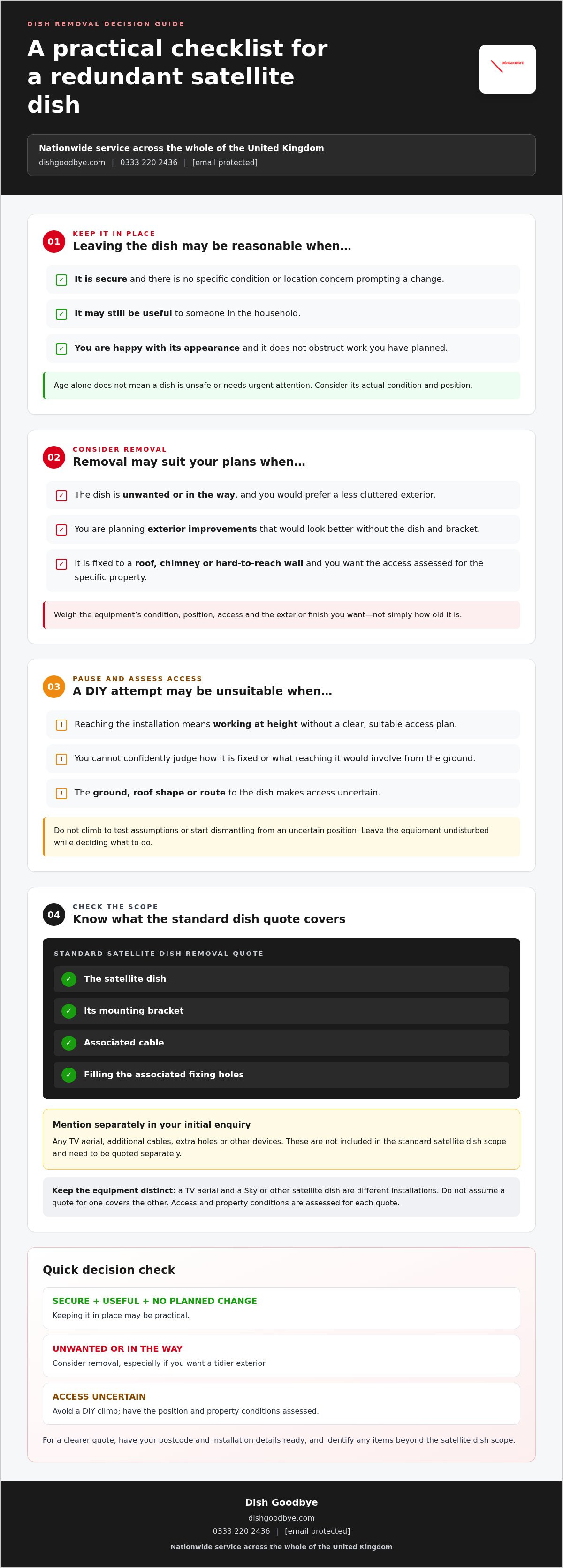
A standard quote covers the removal of the specified Sky or other satellite dish, its bracket and the cable associated with that dish. It also includes filling the fixing holes created by removing that dish and bracket. These items form the defined scope for the installation being quoted, helping you see what the core job covers before deciding whether it matches the result you want.
This scope is specific to a satellite dish. A TV aerial, another dish or other equipment elsewhere on the property isn’t automatically part of the same quote. If you’re considering whether is it worth paying to have an old aerial removed, identify the equipment clearly in your enquiry so the request is assessed for the right type of installation.
What is included for the dish installation being quoted?
For the specified dish, the standard quote includes:
- Removal of the satellite dish.
- Removal of its bracket and associated cable.
- Filling the fixing holes associated with removing that dish and bracket.
Hole filling applies to the fixing holes associated with the quoted removal. It doesn’t mean every hole on the property is included, and it doesn’t extend to painting, rendering or general masonry repairs. If you want a particular finish beyond the included hole filling, describe it clearly so the expected scope isn’t mistaken.
Which additional items need separate mention?
Mention every extra item in your initial enquiry. Additional cables, holes, dishes, aerials and other devices must be quoted separately. For example, if a second dish is fixed on another wall or an aerial is also visible, name it as an extra rather than assuming the main dish quote covers it. The same applies to holes that aren’t associated with removing the specified dish and bracket.
Quotes use fixed pricing with no hidden fees, and a free, no-obligation quote is available once you provide your postcode and installation details. Access, height and property conditions are assessed for each quote. When enquiring, also ask about collection, recycling and disposal arrangements so you know what is planned for the removed equipment.
Sharing a clear list of the installation and any extras makes it easier to understand the quote before proceeding. You can find information about the Dish Goodbye satellite dish removal service while preparing the details for your enquiry.
How to decide and request an upfront UK removal quote
A little preparation makes it easier to decide what you want and request a quote that reflects the installation. Start with the outcome: do you want the satellite dish removed for a tidier exterior, to clear an area for planned work, or because it’s no longer useful? Then note where it’s mounted and what else you want included. Clear details help avoid confusion between a dish removal and separate items such as a TV aerial.
Dish Goodbye provides a free, no-obligation quote after you provide your postcode and installation details. Quotes use fixed pricing with no hidden fees, and the service covers the UK. Access, height and property conditions are assessed for each quote, so share what you know about the installation rather than making assumptions about how it can be reached.
What to include in the initial enquiry
Give the postcode and say whether the satellite dish is mounted on a wall, roof or chimney. Describe the dish and its position from what you can safely see. If there are additional cables, holes, dishes, aerials or other devices, list each one in your initial enquiry because these items are quoted separately from the standard dish-removal scope.
Also ask about collection, recycling and disposal arrangements when requesting the quote. Including this question at the outset helps you understand what is planned for the removed equipment. You don’t need to climb or inspect the installation closely to provide useful information.
What to expect after requesting a quote
The quote will be based on your postcode and the installation details you provide, including the property and access conditions. Dish Goodbye’s insured satellite dish removals use proper safety equipment and techniques. Same-day removal is available where feasible, but no response or completion time is promised. Share any relevant access information so the assessment can take the specific property into account.
Before sending your enquiry, use this quick sequence:
- Choose your desired result. Be clear about which satellite dish you want removed and the finish you’re hoping for.
- Identify its position. Note whether it’s on a wall, roof or chimney, along with the postcode.
- List extra items. Mention any additional cables, holes, dishes, aerials or devices for separate quotation.
- Ask about disposal. Request details about collection, recycling and disposal arrangements.
If you’re ready to move from considering is it worth paying to have an old aerial removed to arranging satellite dish removal, send your postcode and installation details through the Dish Goodbye quote enquiry form. You can also call 0333 220 2436 or email [email protected].
Choose the finish you want for your home
The question of whether is it worth paying to have an old aerial removed is ultimately about what makes sense for your property, not age alone. If the equipment no longer serves a purpose and you’d prefer a cleaner exterior, decide what you want removed and get a clear picture of the work involved. If it’s secure and isn’t in the way, you may be happy to leave it where it is.
For a Sky or satellite dish, Dish Goodbye provides insured removal across the UK, using proper safety equipment and techniques. A standard quote covers the dish, bracket, associated cable and related fixing-hole filling. Same-day removal is available where feasible.
Ready to take the next step? Request a free, no-obligation quote for satellite dish removal. Share your postcode and installation details, and you can move forward with a clearer plan for your property. For enquiries, call 0333 220 2436 or email [email protected]. A tidier exterior can start with one simple decision.
Frequently Asked Questions
Is it worth paying to have an old aerial removed?
It can be, particularly if the equipment is unwanted, awkward to reach or in the way of planned exterior work. An old aerial isn’t automatically unsafe, so consider whether it’s secure, useful and in a position you’re happy with. If you mean a satellite dish, describe it as a dish when requesting a quote. That helps distinguish it from a TV aerial and makes the requested work clearer.
Can I leave an old satellite dish on my house?
Yes, you can leave it in place if it suits your circumstances. For example, if the dish is secure, you don’t mind its appearance and you’re not planning work on that part of the property, removal may not be a priority. Reconsider if you want a clearer exterior or need the area unobstructed. Age alone doesn’t mean a redundant dish is unsafe.
What does a satellite dish removal quote include?
A standard quote covers the specified satellite dish, its bracket, the cable associated with that dish and filling the fixing holes related to its removal. It doesn’t automatically cover a second dish, an aerial, unrelated cables or old holes from a previous installation. List any additional items in your first enquiry so they can be considered and quoted separately. You can also ask about collection, recycling and disposal arrangements.
Is an old aerial the same as a satellite dish?
No. A TV aerial and a satellite dish are distinct types of equipment, so identify which one is installed rather than using the terms interchangeably. Dish Goodbye’s standard quote is for a specified Sky or other satellite dish, its bracket, associated cable and related fixing-hole filling. If a TV aerial is also present, mention it separately in your initial enquiry so it can be quoted separately.
Can a satellite dish be removed from a roof or chimney?
Dish Goodbye handles satellite dish installations on walls, roofs and chimneys. The specific height, access and property conditions are assessed for each quote, so share the postcode and mounting location rather than assuming every installation has the same access requirements. You don’t need to inspect the dish at close range. A clear description from a safe position can help explain the setup.
Are the holes filled after a satellite dish is removed?
Yes. The standard quote includes filling fixing holes associated with removal of the quoted dish and bracket. This doesn’t extend to every hole on the property, including openings left by an earlier installation. If you’ve noticed other holes, identify them separately in your enquiry so they can be quoted apart from the fixing holes linked to the dish being removed.
How do I get a quote for old satellite dish removal?
Provide your postcode and say whether the dish is mounted on a wall, roof or chimney. Describe the installation and list any additional cables, holes, dishes, aerials or devices, as these need separate quotation. Request details about collection, recycling and disposal arrangements too. Dish Goodbye offers a free, no-obligation quote with fixed pricing and no hidden fees, based on the information supplied.