
A chimney-mounted aerial can be removed when the roof, fixings and access conditions make the work suitable. Removing old aerials from an inherited property starts with checking what is attached, where it is fixed and whether it appears damaged or unstable. The same checks can help identify old satellite dishes and cables that may need attention.
It’s easy to put these fittings off while dealing with the bigger jobs an inherited home brings. But a clear assessment helps you decide what needs removing and avoid taking unnecessary risks on a roof or chimney.
This guide explains how to assess aerials, dishes and cables, what affects removal quotes, and when professional help makes sense. You’ll also find what to consider before removing a chimney-mounted aerial, so you can plan the work and leave the property’s exterior tidier.
Key Takeaways
- Assess the aerial, dish, fixings and roof or chimney condition before deciding what needs to come down.
- A TV aerial may last ten to 20 years, but its visible condition and stability matter more than age alone.
- Trace unwanted cables to see where they run and whether they’re still connected before removing or concealing them.
- Access, height, equipment and the work required all affect a removal quote, so describe the property and fittings clearly.
- A chimney-mounted aerial can be removed when the access and property conditions suit the work; Dish Goodbye’s Sky dish removal quote covers the dish, bracket, associated cable and filling related fixing holes.
Assessing equipment before removal
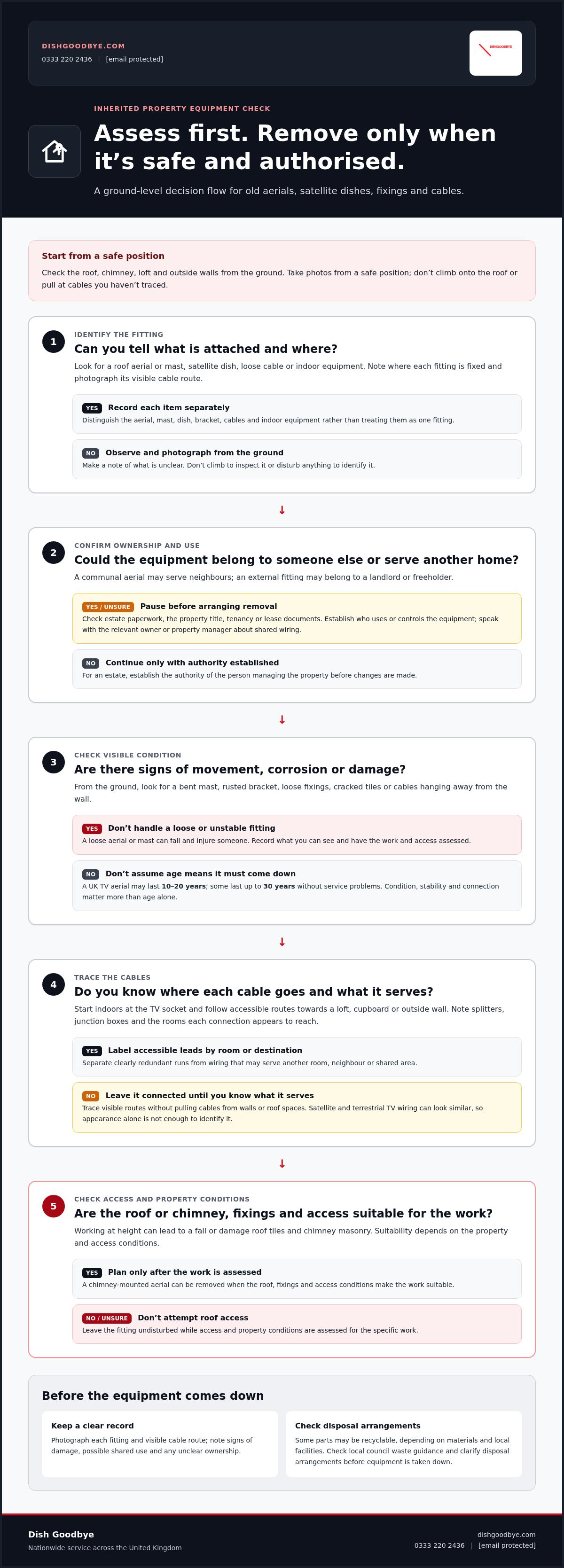
Before removing old aerials from an inherited property, identify each fitting and where it is attached. Check the roof, chimney, loft and outside walls from ground level. Note whether the property has a roof aerial, mast, satellite dish, loose cable or indoor equipment. Photos taken from a safe position can help you record what needs attention without climbing to inspect it.
What are the risks of removing a roof aerial, mast or cables? A loose aerial or mast can fall and injure someone. Working at height can also lead to a fall or damage roof tiles and chimney masonry. Pulling cables without tracing them can damage fittings or disturb wiring, so don’t climb onto the roof or yank at unseen cables.
Could an aerial be shared with neighbours or owned by a landlord or freeholder? Yes. A communal aerial may serve neighbouring homes, and an external fitting may belong to a landlord or freeholder. Check the property’s tenancy or lease documents and establish who uses or controls the equipment before arranging its removal.
Assess the fitting’s condition from several viewpoints. Look for a bent mast, rusted bracket, loose fixings, cracked tiles and cables hanging away from the wall. A satellite dish may have its own bracket and cable, separate from a TV aerial. Record each item individually to distinguish redundant equipment from fittings that still serve a room or another property.
- Photograph each fitting and its visible cable route.
- Check whether any cable enters the loft, a living room or a shared area.
- Look for signs of movement, corrosion or damage from the ground.
- List equipment that might belong to a neighbour, landlord or freeholder.
Age can guide the inspection, but it doesn’t prove that an aerial is unsafe or unusable. A UK TV aerial typically lasts between ten and 20 years; some can last up to 30 years without service problems. Compare its apparent age with its condition, fixing points and whether it appears connected. Don’t treat a weathered appearance alone as proof that removal is urgent.
Keep estate administration separate from the equipment assessment. If inheriting the home means you own two properties, HM Revenue & Customs says you must tell it which is your main home within 2 years. That tax-related task doesn’t establish who owns a shared aerial or authorise its removal.
For a separate legal topic, UK Government refers readers to guidance on applications under the Family Law Act 1996. Don’t confuse that guidance with the practical equipment checks: record the fittings, establish who uses them, and resolve ownership before planning removal.
Identifying and removing unwanted aerial and satellite cables
Trace each cable from its visible endpoint before deciding whether it can be removed. This helps distinguish unused wiring from connections serving another room or property.
Responsibility for Removal
Who is responsible for removing an old TV aerial from an inherited property in the UK? The person authorised to manage the property should arrange removal, but ownership and authority matter. Check the estate paperwork, property title and any tenancy or lease documents before work begins.
If an executor or personal representative is handling the estate, establish their authority before making changes. In a flat or shared building, check whether the aerial or cable serves another home or forms part of communal equipment. Speak with the relevant owner or property manager before disconnecting shared wiring.
Planning and Building Requirements
Do UK planning permission or building regulations apply to removing a roof aerial? It depends on the property and the work involved. Check for listed status, conservation controls, lease conditions or structural changes that could affect removal.
Keep the job to removing the aerial and its associated wiring where possible. If removal involves altering a chimney, roof structure or external fabric, ask the local planning authority or building control team what applies. Record any conditions before work starts, especially for a listed home or a building with shared ownership.
Recycling and Disposal
Can an old aerial be recycled, and how should its parts be disposed of? Some parts may be suitable for recycling, but acceptance depends on local facilities and the materials involved. Separate metal sections from cable and plastic components only when they can be handled safely.
Check your local council’s waste guidance for aerials, dishes and electrical equipment. Keep small connectors, amplifiers or power units separate from long lengths of cable, and don’t leave loose parts where they could fall or cause injury. Clarify disposal arrangements before the equipment is taken down.
Start indoors. Follow the cable from the television socket towards the loft, cupboard or external wall. A cable entering a room may serve a socket even if the aerial outside looks old. Look for splitters, junction boxes and extra leads, then note which rooms each connection appears to reach.
Coaxial cable often has a round outer sheath and a small central connector. Don’t rely on appearance alone: satellite and terrestrial television wiring can look similar. Label each accessible lead by room or destination, and leave cables connected to equipment until you know what they serve.
- Trace visible routes without pulling cables from walls or roof spaces.
- Mark cable ends and note any splitter or junction box.
- Separate clearly redundant runs from wiring that may serve neighbours or shared areas.
If the redundant fitting is a satellite dish, the Dish Goodbye service website has information about arranging its removal.
Removal costs and accessibility
The work required, not simply the number of fittings, determines an aerial removal quote. Height, roof access, fixing condition and the equipment involved all shape the job.
How do I find a qualified aerial installer or roofer to remove an aerial? Look for relevant aerial-removal or roofing experience, and ask for a written scope covering access, fittings, cables and making good. The person assessing the work should consider the actual roof and explain how they’ll reach and remove the equipment.
Start by describing the property clearly. A low aerial fixed to an accessible wall presents different access needs from one mounted beside a chimney on a steep roof. Share photos taken from the ground, and identify the roof type, fitting position and any visible damage. Clear details help the assessment focus on the work rather than guesswork.
Access is a major factor. A safe approach must account for the building’s height, roof pitch, obstacles around the property and space for access equipment. A narrow side passage, conservatory roof or extension beneath the aerial can affect how the work is approached. For flats, note the floor and whether the equipment is on a shared roof.
The fitting itself also matters. A single aerial with accessible fixings differs from a mast carrying several aerials, or a dish with a heavy bracket and cable. Corroded fixings, damaged masonry and cables running through several rooms can add steps. List each item separately so the written scope reflects what needs removing.
- Record the aerial, dish, bracket and visible cable runs.
- Photograph access obstacles, such as extensions or narrow passages.
- Note loose fittings, rust, cracked tiles or chimney damage.
- Identify shared roofs or equipment serving another property.
Compare the written scope with your list. Check whether it covers the aerial or dish, its bracket, associated cable and fixing holes. Don’t assume separate cables, devices or old holes are part of the same task. Name each extra item before agreeing the work, so the scope is clear.
For an inherited home, organise access details before removal. Make sure the person assessing the job can see the relevant elevations and any safe route around the property. If a neighbour, managing agent or freeholder controls roof access, arrange permission in advance. These details help avoid delays and make the work plan specific to the building.
A useful quote explains the removal tasks and access approach in plain language. It should distinguish the main fitting from extra cables or repairs, such as damaged rendering. That way, you can decide what to include and understand which parts of the inherited property will be left clear after the work.
Removing old, damaged and redundant TV aerials
What steps should an installer take to remove an aerial and make the roof weatherproof? They should assess the roof, remove the aerial and fixings carefully, then inspect and seal the fixing points. Damaged tiles or other roof defects may need attention to keep the roof weatherproof.
High winds, rain and age can weaken an older aerial. Look for a leaning mast, loose brackets, rust, damaged cables or movement after bad weather. A falling aerial can damage the property, and someone injured below may make a claim against the property owner. Don’t climb up to test whether a fitting is secure.
If an aerial is visibly unstable, it is sensible to arrange a safe assessment rather than leave it unattended. This makes it sensible to act when an aerial is visibly unstable, rather than waiting for a bracket to fail. Note the fitting’s position and condition from the ground, then arrange a safe assessment of the roof and access.
Removal usually takes a couple of hours, though the roof, fixing condition and access affect the work. A careful sequence helps protect the building and people nearby:
- Assess the roof, aerial, mast, brackets and cable route before starting.
- Set up suitable access and keep people clear of the working area.
- Disconnect the cable and remove the aerial and mast in controlled sections.
- Remove brackets and fixings without levering against tiles or masonry.
- Inspect each fixing point and surrounding roof surface for damage.
- Seal holes using materials suited to the roof, and address damaged tiles.
- Check the area from inside for signs of daylight or moisture entry.
The final inspection matters. An open fixing hole can let water reach the roof structure, while cracked tiles may need repairs beyond simple sealing. Ask for the scope to distinguish removing the aerial and making good its fixing points from repairing wider roof damage. This keeps the expected finish clear.
Record the aerial’s former position and any visible damage before work begins. Photos taken from the ground can help you compare the roof after removal. If the property has more than one aerial, label each location so the installer can match the work to your request.
Don’t attempt removal yourself. Working at height risks a fall, and a loose aerial or mast can injure someone below. For an inherited property, arrange access and keep the area beneath the roof clear while the work takes place. The aim is a tidy, inspected fixing point, not simply getting the aerial off the roof.
Removing satellite dishes and associated fittings
A satellite dish is more than its visible reflector. Check the bracket, fixings and cable route too, so the removal scope matches what remains on the inherited property.
Start by identifying each dish and its location. A home may have an older dish on a rear wall and another near a chimney. Photograph each from the ground, noting its bracket, visible cable and any nearby fittings. If equipment serves a neighbour or shared building, establish that before planning removal.
Look at how the cable enters the property. It may run into a room, loft or junction point, and could connect to indoor equipment. Trace the visible route without pulling it from the wall. Write down whether the request covers only the cable associated with the dish or includes other redundant runs. Separate cables and devices must be named in the initial enquiry.
Access and fixing condition shape the work. A dish mounted low on an accessible wall differs from one attached high beside a chimney or above an extension. Note roof height, narrow access routes, conservatories and visible corrosion. Loose brackets, cracked masonry or movement may need attention during the assessment. Don’t climb to test the fittings or try to remove a dish yourself.
Agree the removal scope before work starts. A standard quote covers the dish, its bracket and associated cable, plus filling the fixing holes left by those fittings. It doesn’t automatically cover other cables, devices, holes from earlier installations, masonry repairs, rendering or painting. List each extra item clearly so it can be quoted separately.
- Identify each dish, bracket and cable that should be removed.
- Describe the property access and the fitting’s position.
- List any additional cables, devices or old fixing holes.
- Ask how collection, recycling and disposal arrangements will be handled.
After removal, check the agreed fixing points and surrounding surface. Filling the holes left by the dish and bracket is part of the standard scope, but wider masonry or decorative work isn’t included. Note any separate damage, such as cracked render, before the job so the required finish is clear.
Use clear photos and a short written list when preparing your enquiry. For example, specify “rear-wall dish, bracket and associated cable,” then separately describe any cable running to a bedroom or a second device. This makes the requested work easier to understand and helps keep the scope focused on the fittings you want removed.
Dish Goodbye: Sky Dish Removal
Dish Goodbye provides Sky Dish Removal for inherited homes with a redundant satellite dish, bracket and associated cable. The service helps clear the exterior without you having to tackle roof-mounted equipment yourself.
A standard quote covers removal of the dish, its bracket and associated cable, plus filling the fixing holes left by those fittings. Mention any additional cables, devices or holes in your initial enquiry; they must be quoted separately. Wider masonry repairs, rendering and painting aren’t part of the standard scope.
Include clear photos and details about the dish’s position, access and property condition. When requesting a quote, please ask about collection, recycling and disposal arrangements. Access and height are assessed for each property, helping define the work involved.
To discuss a redundant Sky dish, call 0333 220 2436 or email [email protected]. You can also visit the Dish Goodbye service website.
Make the next property task simpler
Managing an inherited home often comes down to recording clear decisions. Add exterior equipment to your property notes so anyone handling later maintenance knows what was removed and what remains. That record can prevent confusion during future repairs, handovers or a sale.
If you’re planning to remove old aerials from an inherited property, gather photos and list the fittings you want addressed. Keep those details with your other home records. A clear note about what stays, what goes and what work was completed gives the next person a practical starting point.
Organise the property one task at a time. Clearing redundant equipment can be a satisfying step towards a neater, easier-to-manage home.
Contact Dish Goodbye to discuss removal for the property. Contact Dish Goodbye about removal.
Call 0333 220 2436 or email [email protected].
Frequently Asked Questions
Can you remove an aerial mounted on a chimney?
Yes, a chimney-mounted aerial can be removed when the chimney, fixings and access conditions suit the work. A professional should assess the mounting point and nearby roof before choosing an approach. For a Sky dish rather than a TV aerial, Dish Goodbye’s Sky Dish Removal covers wall, roof and chimney installations. Describe the fitting’s location and include clear photos when arranging the work.
Can you remove old cables at the same time?
Yes, but identify each cable separately before agreeing the work. A standard Dish Goodbye quote includes the cable associated with the satellite dish being removed. Extra cables must be mentioned in the initial enquiry and quoted separately. For example, list a second cable entering a bedroom or a separate run serving another fitting. Don’t assume an old cable is included just because it’s near the dish.
What if I don't know whether the aerial or cables are still in use?
Don’t cut or disconnect uncertain wiring. Check for labels, splitters or connected equipment indoors, and look for clues in the home’s paperwork or notes from previous occupants. If a cable serves a shared building or another household, removing it could interrupt their connection. Mark the cable’s location and have its use assessed before deciding what should be removed.
Can an old aerial or chimney bracket be removed safely without a professional?
Roof and chimney work is not a safe DIY task without suitable access equipment and experience. A bracket can be stuck, corroded or supporting a loose fitting, so pulling it may damage the chimney or send parts falling. Keep people away from the area below and arrange a professional assessment rather than using a ladder or leaning over the roofline.
What should I check before removing an aerial when selling or insuring an inherited home?
Before removal, check who owns the equipment and whether it serves another property. Review lease or management documents for shared-roof conditions, and note any visible roof or chimney damage. Keep dated photos and paperwork describing the work, then update property records for a sale or insurance discussion. Don’t describe repairs as completed unless they were part of the work and you have records to support that.
Contact Dish Goodbye on 0333 220 2436 or at [email protected].
How much does it cost to remove a TV aerial in the UK?
The final quote depends on access, height, fixings and the work required.