

Could one small dish be making your whole frontage look untidy? Removing satellite dish to improve kerb appeal can make the exterior feel cleaner and less cluttered, especially when its visible cable goes too. For safe, insured satellite dish removal across the UK, contact Dish Goodbye on 0333 220 2436 or [email protected].
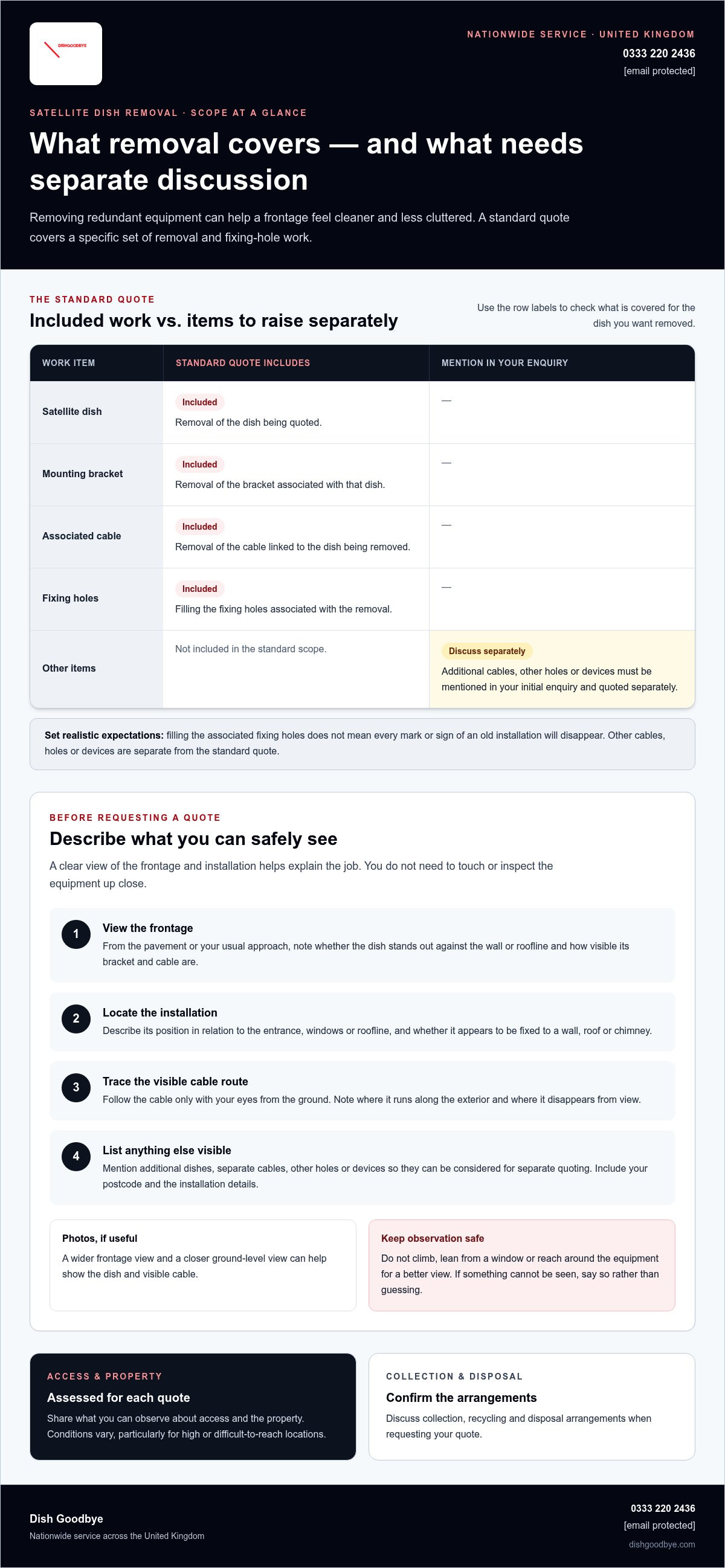
It’s understandable to wonder what will be left behind. Taking down a dish won’t necessarily make the wall look untouched, but Dish Goodbye’s standard quote includes removing the dish, bracket and associated cable, plus filling the fixing holes created by that removal. Other cables, holes or devices need to be mentioned in your initial enquiry and quoted separately.
This practical guide explains what to consider before arranging removal, why access and property conditions matter, and what details can help you request a quote. You’ll also learn how to set realistic expectations for the finish and remember to discuss collection, recycling and disposal arrangements when requesting your quote.
Dish Goodbye: 0333 220 2436 | [email protected]
Key Takeaways
- Removing satellite dish to improve kerb appeal can help create a cleaner, less cluttered-looking frontage.
- Take a look at the dish’s position and cable route, and note whether it’s fixed to a wall, roof or chimney.
- Understand what removal and fixing-hole filling can address, and what may need to be discussed separately.
- Share clear details about the installation and access when requesting a quote, especially for high or difficult-to-reach locations.
- Dish Goodbye provides insured satellite dish removal nationwide across the UK, with a standard quote covering the dish, bracket, associated cable and related fixing-hole filling.
Why removing a satellite dish can make your home’s frontage look more considered
Kerb appeal is the first impression made by a home’s visible exterior. It comes from how the frontage looks as a whole, including the entrance, windows, walls and any fixtures that stand out. The term is often written as “curb appeal” in US sources; Curb appeal describes the same idea.
A satellite dish can interrupt an otherwise tidy facade because it adds a large, distinct shape to the roofline or wall. Its bracket and cable add more visible lines and details. If your eye goes straight to the equipment rather than the doorway or the home’s features, removing it may make that area feel simpler and more balanced.
Removing redundant fixtures can simplify a frontage by clearing visual distractions from the home’s main exterior features. That’s a focused change, not a promise that every mark or sign of an old installation will disappear. The result depends on where the equipment sits and what else is visible around it.
Which parts of a satellite installation affect the exterior?
Look at the dish, the mounting bracket and the cable connected to that installation. Their position matters: a dish near the entrance, across a prominent wall or high against the roofline may catch attention before the front door or facade does. The associated cable is the cable linked to the dish being removed. Other cables are separate items, so mention them in your initial enquiry for separate quoting.
When might dish removal be part of an exterior refresh?
Removal can suit a frontage update, preparation for property viewings or a change in how you watch television. If the dish is no longer needed, taking it away can be one practical step towards a less cluttered exterior. It won’t replace broader work such as repainting or repairing other features, so treat it as one specific improvement within your plans.
Consider the overall view, not just the spot where the dish is fixed. A dish and cable may be especially noticeable against a freshly painted wall or near a carefully maintained entrance. In another setting, the dish may be less prominent. Stand back and notice what draws your attention first; this helps you decide whether removal would make the frontage feel more cohesive.
For homeowners planning a wider refresh, satellite equipment is just one element to consider alongside other visible details. Dish removal can help simplify the facade without turning a single task into a complete makeover. For a broader look at exterior presentation, explore the UK kerb-appeal guide.
How to assess your frontage before removing a satellite dish
A quick look from the ground can help you describe the installation clearly before arranging removal. If your goal is removing satellite dish to improve kerb appeal, start with the whole frontage, then focus on the dish and trace its visible cable route as far as you can see. You don’t need to touch the equipment or inspect it up close. The aim is to record useful details, not assess whether it’s safe to remove yourself.
What should you look for from the street?
View the house from the pavement or your usual approach. Notice whether the dish stands out against the wall or roofline, and whether its bracket and associated cable are also visible. Consider how these features sit alongside the entrance, windows and the rest of the facade. A wider view helps show whether the installation is prominent and gives a clearer picture than focusing on the dish alone.
What details help describe the installation?
Record whether the dish is fixed to a wall, roof or chimney, and note anything else visible nearby. This helps make your initial enquiry specific. Mention additional dishes, cables, holes or devices as well as the dish you want removed, since these need to be quoted separately. Access and property conditions are assessed for each quote, so share what you can observe safely.
Use this simple sequence to organise your notes:
- View the frontage. Note the angle from which the dish is easiest to see, such as the pavement, driveway or main approach.
- Locate the installation. Describe its position in relation to the entrance, windows or roofline, and whether it appears to be on a wall, roof or chimney.
- Trace the visible cable route. Follow it only with your eyes from the ground. Note where it runs along the exterior and where it disappears from view.
- List other visible items. Record any separate cables, extra dishes, holes or devices so they can be included in the initial enquiry.
Clear photos can make your description more useful. Take them from a safe position on the ground: one wider shot of the frontage and, if possible, a closer view from ground level showing the dish and visible cable. Don’t climb, lean from a window or try to reach around the equipment for a better angle. If part of the installation can’t be seen, simply say so rather than guessing.
Include your postcode and the installation details when requesting a quote. If you’re unsure whether a particular rule applies to your property, remember that overseas guidance may not apply in the UK: the FCC’s OTARD rule concerns US regulations, not UK requirements. For removing satellite dish to improve kerb appeal, clear notes and safe, ground-level photos are a practical starting point for describing the job.
Once you’ve gathered the details, use them to request a quote through the Dish Goodbye service website. That gives a clearer starting point for discussing the installation and the access involved.
What removing a satellite dish can, and cannot, change about kerb appeal
Before removal, a dish, bracket and cable can create a cluster of shapes and lines on a wall or roofline. Once they’re removed, that part of the frontage may look simpler, with less equipment drawing the eye. The change is focused: the rest of the facade, including its finish and condition, remains a separate matter. For a wider perspective on exterior presentation, see RICS on kerb appeal.
Fixing-hole filling addresses the holes created by removing the dish and bracket; it isn’t the same as restoring the whole facade. Keeping that distinction in mind helps you picture the likely result without expecting every trace of an old installation to vanish.
What does fixing-hole filling mean for the finished look?
The standard quote includes filling the fixing holes associated with removing the dish and its bracket. This is a defined part of the removal work, not a promise that the repair will be invisible or an exact match for surrounding paint, brickwork or other materials. Separate holes, marks or damage elsewhere on the wall aren’t automatically covered by this scope, so describe them in your initial enquiry.
Think of the result as two changes: the visible equipment is taken away, and the fixing holes made by its removal are filled. The appearance of the wall around that area can still depend on its existing finish. For example, a painted surface and exposed brick may show different traces after fixtures are removed. Don’t assume that filling the fixing holes includes repainting, replacing materials or blending the surrounding surface.
Which exterior changes may need separate planning?
Painting, rendering and broader masonry work are separate from satellite dish removal. So are additional holes, cables, dishes or devices beyond the dish installation being quoted. Mention these in your initial enquiry so they can be considered and quoted separately. The standard scope covers the dish, its bracket and associated cable, plus filling the fixing holes created by that removal.
If you’re planning a wider exterior refresh, list the work in stages. Removing redundant equipment can be one tidy, defined improvement, while painting or other facade maintenance can be considered separately. This makes it easier to distinguish the visual effect of taking away the dish from any changes that depend on further work.
For a realistic expectation, compare the area before removal with the specific work being arranged: equipment comes down, and the associated fixing holes are filled. The broader finish may still need its own attention. This clear boundary helps you plan a neater frontage without treating dish removal as a complete exterior makeover.
How to plan a safe satellite dish removal for a tidier exterior
A little preparation can make arranging removal more straightforward. If your goal is removing satellite dish to improve kerb appeal, gather details you can observe safely from the ground. You don’t need to climb, handle the dish or try to take anything apart. Clear information about the location and visible installation helps make the initial enquiry useful.
What to prepare before requesting an upfront quote
Have your postcode ready and note whether the dish is attached to a wall, roof or chimney. Add a short description of where it sits and any visible cable route. Mention extra dishes, cables, holes or devices in your initial enquiry, as these need to be quoted separately from the standard removal scope. If you want to understand what happens to removed items, ask about collection, recycling and disposal arrangements when requesting the quote.
- Postcode: Include it with your enquiry.
- Installation position: Say whether the dish is wall-, roof- or chimney-mounted.
- Other items: List any additional dishes, cables, holes or devices.
- Disposal arrangements: Ask about collection, recycling and disposal as part of the quote discussion.
Photos taken from a safe position can help illustrate what you’ve described. A wide view can show the dish in relation to the frontage, while a ground-level view may show its bracket and visible cable. Don’t put yourself at risk to get a closer picture. If part of the installation is out of sight, simply note that rather than guessing what it connects to.
Why access and safety need individual assessment
A dish fixed within easy reach is different from one on a roof or chimney. The installation, height and property conditions all affect how access is assessed for each quote. Dish Goodbye provides safe, insured removal using proper safety equipment and techniques. Same-day removal is available where feasible, but this isn’t a promise of a particular appointment.
Keep your role simple: describe what you can see and share relevant details. Don’t climb ladders or access a roof to measure, test or inspect the equipment. An experienced team can use the information in your enquiry to understand the installation and assess the access needed. If the property has an unusual layout or the dish is difficult to view from the ground, mention that too.
For a tidier result, be precise about the work you want arranged. The standard quote covers the dish, its bracket and associated cable, plus filling the fixing holes created by their removal. Any additional items should be outlined upfront, so they can be considered separately rather than assumed to be part of the same job.
Ready to put your notes together? Request a satellite dish removal quote with your postcode and installation details, and ask about collection, recycling and disposal arrangements as part of the enquiry.
How Dish Goodbye helps remove a satellite dish and tidy the frontage
Removing an obsolete dish can be a focused step towards a tidier-looking exterior. Dish Goodbye provides insured satellite dish removal nationwide across the UK, with an experienced team using proper safety equipment and techniques. Share your postcode and installation details to receive a free, no-obligation quote. The quote uses fixed pricing with no hidden fees, tailored to the individual job requirements.
What does the standard satellite dish removal quote include?
The standard quote covers removal of the satellite dish, its bracket and associated cable, plus filling the fixing holes created by removing the dish and bracket. This defined scope helps you understand what the removal addresses while keeping expectations clear about the finish.
- Included: removal of the satellite dish and its bracket.
- Included: removal of the cable associated with that dish.
- Included: filling the fixing holes created by removing the dish and bracket.
- Raise upfront: any additional cables, holes, dishes, aerials or devices, which are quoted separately.
Other old installation holes, unrelated marks, painting, rendering and broader masonry work aren’t part of this standard scope. If you can see extra equipment or know of other work needed, describe it in your initial enquiry so it can be considered separately. That way, the quote can reflect the details you’ve provided rather than assumptions about the rest of the frontage.
How can homeowners take the next step?
Gather your postcode and a short description of where the dish is mounted, such as on a wall, roof or chimney. Add any extra items you want included in the enquiry. Access and property conditions are assessed for each quote, so mention anything relevant that you can observe safely from the ground.
Same-day removal is available where feasible, but availability depends on the individual job. If you’d like details about what happens to the removed equipment, raise collection, recycling and disposal arrangements when requesting your quote.
For a straightforward start, submit your details through the Dish Goodbye quote enquiry. You can also call 0333 220 2436 or email [email protected]. A clear description helps set out the work requested and supports a more useful quote for your satellite dish removal.
Make your next exterior update a simple one
A tidier frontage doesn’t have to begin with a major makeover. If an unused dish is the detail that keeps catching your eye, removing satellite dish to improve kerb appeal can be a clear, focused next step. Gather your postcode and installation details, then decide whether there are any extra items you want included in the enquiry.
Dish Goodbye provides satellite dish removal nationwide across the UK. You can request a free, no-obligation quote to understand the work for your property. Same-day removal is available where feasible, with access and property conditions assessed for each quote. A little preparation now can help you move forward with a clearer plan for the frontage.
Request your free, no-obligation satellite dish removal quote and take the first step towards a cleaner-looking exterior.
Dish Goodbye: 0333 220 2436 | [email protected]
Frequently Asked Questions
Does removing a satellite dish improve kerb appeal?
It can make a frontage look less cluttered, especially if the dish or cable is prominent from the street. The visual effect depends on the home and its surroundings. A dish beside the entrance, for example, may attract attention that would otherwise go to the doorway. Removal is a focused exterior improvement, not a promise of increased property value or a complete transformation.
Will there be holes left after a satellite dish is removed?
The fixing holes created during removal are filled. That doesn’t guarantee an invisible repair or an exact match to nearby paint, rendering or masonry. If you know of other holes from an earlier installation, mention them in your initial enquiry because they’re quoted separately. Consider the existing wall finish when deciding whether further exterior work may be needed after the removal.
Can Dish Goodbye remove a satellite dish from a roof or chimney?
Yes, Dish Goodbye handles Sky dish removals from wall, roof and chimney installations. Access and property conditions are assessed for each quote, so describe the location and any relevant details you can observe safely from the ground. You can also share a ground-level photo if it helps show where the dish is fixed. Don’t climb or approach a roof to take a closer picture.
What information should I provide to get a satellite dish removal quote?
Provide your postcode and say whether the dish is mounted on a wall, roof or chimney. Mention any extra dishes, cables, holes or devices in your initial enquiry, as these are quoted separately. If a cable appears to lead to another device, describe what you can see instead of assuming it’s part of the dish installation. Ask about collection, recycling and disposal arrangements when requesting your quote.
Is same-day satellite dish removal available?
Same-day removal is available where feasible, but it isn’t guaranteed for every enquiry or installation. Access, height and property conditions are assessed for each quote. Share your postcode and the dish’s location so the job can be considered in context. If your plans are time-sensitive, mention that in your enquiry, but don’t make arrangements on the assumption that a particular appointment time is assured.