
Who actually gets to decide whether a developer-installed dish can come down? Removing developer-installed satellite dish equipment may seem like a simple tidy-up, but first you’ll want to establish who’s responsible and whether it serves a shared system. For Dish Goodbye, call 0333 220 2436 or email [email protected].
It’s sensible to be cautious. A dish may be fixed high on a wall or roof, and taking it down yourself can put you at risk or damage the exterior. If you own a flat or maisonette, check your lease and ask the freeholder or property manager about permission before arranging work.
This guide explains what to establish before requesting removal, how to think about DIY versus a professional, and what to clarify in your quote. Dish Goodbye’s standard quote covers the dish, its bracket and associated cable, plus filling the related fixing holes. Mention any other cables, dishes, aerials, devices or holes in your initial enquiry so they can be quoted separately. You can also ask about collection, recycling and disposal arrangements. For Dish Goodbye enquiries, call 0333 220 2436 or email [email protected].
Key Takeaways
- Before removing developer-installed satellite dish equipment, establish who can approve the work and whether the dish is part of a shared system.
- Note the dish’s location, associated cable and any visible access concerns from a safe position.
- Consider height and property conditions when deciding whether professional removal is the safer option.
- Give all relevant details in your enquiry, including any additional cables, holes, dishes, aerials or devices that need separate quotation.
- Clarify the removal and hole-filling scope, along with collection, recycling and disposal arrangements, before the work is planned.
Why a developer-installed satellite dish needs a few checks before removal
A developer-installed satellite dish is equipment fitted during a property’s development or handover. It may have been part of the original setup, but that alone doesn’t establish who owns it or whether it still serves a purpose. If you’re considering removing developer-installed satellite dish equipment, start by identifying what’s there and checking who should approve the work.
Taking away a redundant dish can leave the outside of a home looking neater and clear equipment that’s no longer needed. The result depends on the condition and finish of the surface beneath it, so don’t assume removal will include wider exterior repairs, repainting or restoration.
Begin with a safe visual check from the ground. Note the dish’s position, the cable you can see running from it, and any information you have about its installation. Don’t climb or reach towards a roof, chimney or high wall to investigate.
What counts as a developer-installed satellite dish?
The dish is the curved unit that receives a satellite signal. It’s attached to the building by a bracket, while an associated cable carries the connection into the property. A Satellite dish can be fitted to a wall, roof or chimney. Record which parts are visible, but don’t assume every cable on the exterior belongs to that dish.
Who should check before removal is arranged?
Look for property handover documents or installation records that might identify the equipment or explain its original purpose. If you rent, contact your landlord. If the property is managed, ask the property manager about approval before arranging work. Responsibility can depend on the property and its arrangements, so establish who needs to agree before proceeding.
Keep your observations practical. You don’t need to identify technical details or inspect the fixings up close. A clear description helps distinguish the dish from other equipment and gives a removal enquiry a useful starting point.
- Note whether the dish is on a wall, roof or chimney.
- Describe the visible cable route, if you can see it safely.
- Check any available handover or installation information.
- Record who has given approval, if approval is needed.
These checks help clarify what the equipment is and who should authorise its removal. They also make it easier to describe the installation accurately, rather than assuming the dish, bracket and every visible cable are all part of the same setup.
How to assess the dish, access, and property before arranging removal
A clear enquiry starts with a few simple checks, not a close-up inspection. Confirm that the person responsible for the property has approved the work, note where the dish is fitted, look for visible access concerns from a safe position, then gather the details you can share. This gives the removal team a clearer picture of the job before preparing a quote.
- Confirm approval. Make sure the landlord, property manager or other relevant person has agreed, if approval is needed.
- Record the location. Note whether the dish is on a wall, roof or chimney, and which side of the property it faces if you know.
- Observe from a safe position. Look for visible obstacles or access limitations without climbing, reaching or taking anything apart.
- Prepare the details. Gather the property postcode, your notes and any installation information you already have.
Record the installation details without climbing
Describe what you can see from the ground: the dish’s location, the route of its associated cable and any apparent access constraints. Don’t climb or dismantle fittings to get a better look. If you can’t tell whether another cable or fitting belongs to the dish, say so. Mention any uncertain property conditions, such as limited access around the building.
Photos taken safely from ground level may help show where the dish sits, but don’t put yourself at risk to take them. Keep the description factual. For example, “dish on rear roof slope, cable visible down the wall” is more useful than guessing how the equipment was installed.
Height and access matter. A dish fixed to a low wall presents different access considerations from one on a chimney or difficult-to-reach roof. The Health and Safety Executive’s Work at height regulations guidance explains why work involving a fall risk needs careful planning. Dish Goodbye assesses access, height and property conditions for each quote, so the details you provide help establish the job’s requirements.
Separate the dish removal from extra work
A useful removal enquiry identifies the dish location and any known additional items. The standard quote covers removal of the dish, its bracket and associated cable, plus filling the fixing holes associated with that installation. It doesn’t automatically cover unrelated holes or wider exterior restoration.
List anything else you want included at the outset. Additional cables, holes, dishes, aerials or devices need to be mentioned in your initial enquiry and quoted separately. Rendering, painting and masonry repairs aren’t part of the standard scope. Being specific now helps keep the agreed work clear and avoids confusion about what the quote covers.
- State whether the dish is on a wall, roof or chimney.
- Describe visible cable runs and access limitations.
- Identify any extra items or holes you want considered.
- Flag anything you’re unsure about instead of making assumptions.
With those details ready, you can use the Dish Goodbye service website to arrange a removal enquiry based on the actual installation and its access conditions.
DIY or professional removal: compare safety, access, and finish
It’s understandable to want redundant equipment gone without turning it into a big project. But removing a dish isn’t just a matter of taking a fitting off a wall. Its position, the surface it’s fixed to and the way you can safely reach it all affect how the job should be planned. A low, accessible wall installation is different from equipment on a roof or chimney.
Don’t attempt work at height to save effort or gather a closer look. A fall could cause serious injury, and working around external fixings can also damage the building if the installation or surface is uncertain. If you’re weighing up removing developer-installed satellite dish equipment yourself, consider whether you can safely access it and leave the exterior in the condition you want. If not, professional removal is a practical alternative.
When access or height changes the decision
Location makes a difference. A wall-mounted dish may be easier to assess from the ground, while a roof or chimney installation can involve more challenging access. Neither location automatically determines whether removal can go ahead. Dish Goodbye assesses access, height and property conditions for each quote, so share what you know rather than assuming a particular setup is suitable.
Visible factors can help explain the job: a narrow passage beside the house, an uneven area around the building, or fittings positioned above an extension. Don’t climb, lean out of a window or dismantle anything to check. Simply describe the constraint and let the removal team assess the information alongside the property conditions. This helps keep planning realistic and focused on safe access.
What professional removal and hole filling cover
Dish Goodbye provides safe, insured removal using proper safety equipment and techniques. The standard quoted scope is the dish, bracket and associated cable, with the fixing holes from that installation filled. This can leave the area tidier, but it isn’t a promise of a fully restored or repainted exterior.
Be clear about anything beyond that scope. Extra holes, cables, dishes, aerials or other devices must be listed in the initial enquiry and quoted separately. Rendering, painting and wider masonry work aren’t automatically included. If the surface looks damaged or you’re unsure whether a mark is an associated fixing hole, describe it rather than assuming it will be covered.
A professional approach can make the decision simpler: share the dish location and access concerns, then review the quote for the work it specifically describes. Clear scope helps you plan for both the removal and the finish, without confusing dish-related hole filling with broader exterior repairs.
How to prepare a clear removal enquiry for a developer-installed dish
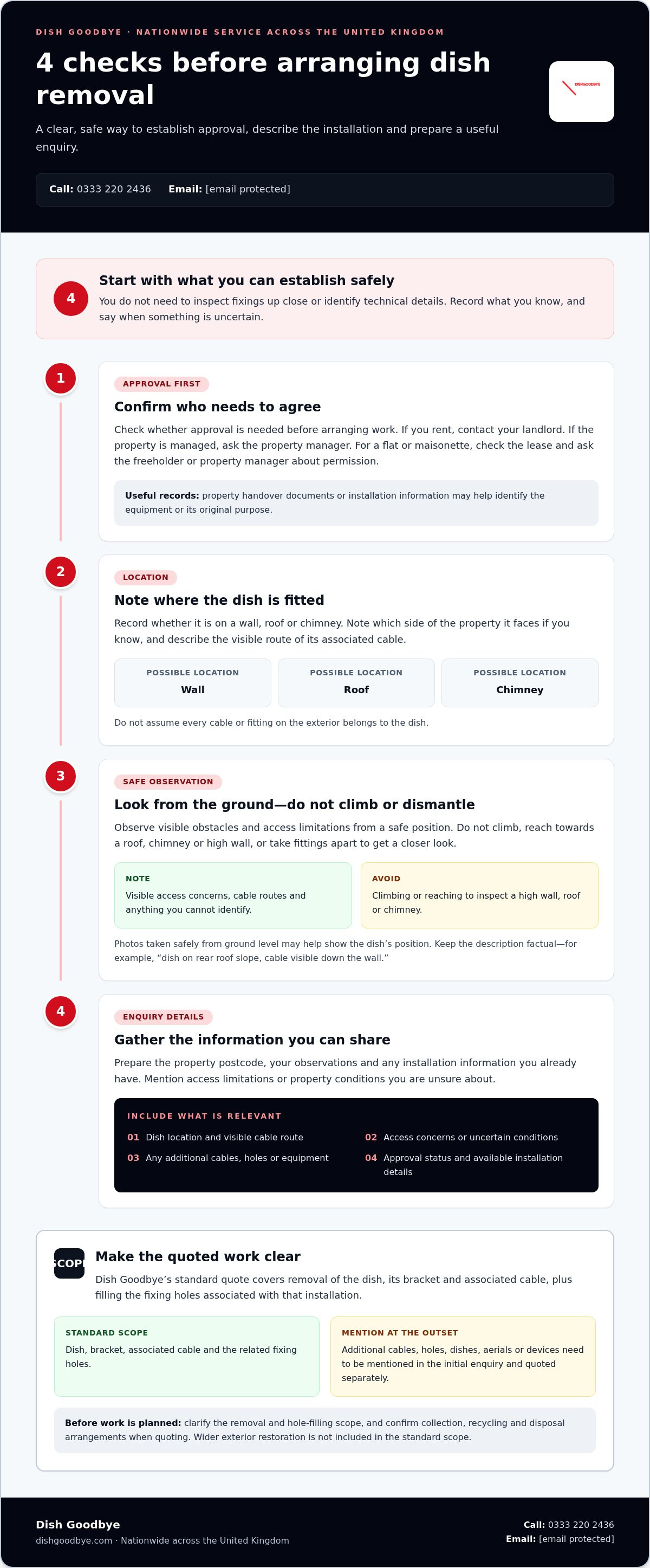
A well-prepared enquiry helps turn an unfamiliar installation into a clearly defined job. You don’t need technical knowledge. Share what you can see, note anything you’re unsure about, and list every item you’d like considered. That gives Dish Goodbye useful information to assess the access and property conditions for your quote.
Details to include in the initial enquiry
Start with the property’s UK postcode and the dish’s position. Say whether it’s on a wall, roof or chimney. Describe visible access conditions, such as a narrow route alongside the building or a roof extension beneath the dish. Don’t climb or dismantle equipment to gather details. If you can’t see the full cable route or aren’t sure which fittings belong to the dish, explain that rather than guessing.
Use this checklist to organise your message:
- Postcode: Give the full UK postcode for the property.
- Dish location: Identify the wall, roof or chimney, and which side of the building if known.
- Associated cable: Describe any cable you can see running from the dish.
- Access and property: Mention visible restrictions or conditions that may affect access or assessment.
- Additional items: List every extra cable, hole, dish, aerial or device you want included.
Be especially clear about extras. A standard quote covers removal of the dish, its bracket and associated cable, plus filling the fixing holes related to that installation. Additional cables, holes, dishes, aerials or devices must be mentioned in your initial enquiry and quoted separately. Don’t assume older holes, unrelated fittings, rendering, painting or wider masonry repairs are part of the same work. If you’re unsure what an item is, describe where it is and ask for it to be considered in the quote.
Dish Goodbye provides a free, no-obligation quote with fixed pricing and no hidden fees. An upfront quote sets out the work for the specific installation, so review its scope and raise any missing items before agreeing to proceed.
Clarify what happens to the removed dish
Include a question about collection, recycling and disposal arrangements when requesting the quote. Don’t assume a particular method or outcome. These details should be clarified as part of the quoting process, so you know what’s planned for the removed equipment before confirming the job.
Once your details are ready, request a satellite dish removal quote and include the full scope you want considered. A few precise notes now can make the work and aftercare easier to understand from the outset.
Arrange safe removal and leave the exterior tidier
Once approval and the installation details are clear, the next step is to agree the work and its limits. A precise enquiry helps Dish Goodbye assess where the dish is fitted, what access may involve and which items should appear in the quote. That clarity makes it easier to plan removal without assuming that every cable or mark on the exterior belongs to the same installation.
What to expect from the removal service
Dish Goodbye provides safe, insured satellite dish removal using proper safety equipment and techniques. The standard quote covers the dish, its bracket and associated cable, along with filling the fixing holes associated with that installation. Hole filling is part of the removal scope, but it doesn’t mean unrelated holes or wider exterior restoration are included.
Be specific about anything else you want considered. Additional cables, holes, dishes, aerials or devices must be mentioned in your initial enquiry and quoted separately. Rendering, painting and broader masonry repairs aren’t automatically part of the job. If you’ve spotted marks or old fixings elsewhere on the wall, describe them separately rather than assuming they’re connected to the dish.
Access, height and property conditions are assessed for each quote. A dish on a wall, roof or chimney can involve different requirements, so share its location and any access details you know. Same-day removal is available where feasible, but the property and job requirements still need to be assessed.
Before agreeing to proceed, read the quote scope carefully. Check that it reflects the dish, bracket, associated cable and related fixing-hole filling you expect, and that any separately requested items are identified. This simple check helps keep expectations clear and gives you a more straightforward plan for the removal and the exterior finish.
Request an upfront quote for your property
Ready to arrange removing developer-installed satellite dish equipment? Provide the property postcode, dish location and any relevant access or property details through the enquiry form. Include additional items in your first message so they can be assessed and quoted separately.
Request a free, no-obligation quote for your property. The quote is free, and the removal work is priced for the individual job requirements. Dish Goodbye provides fixed pricing with no hidden fees, so you can review the agreed scope before making arrangements.
For a direct enquiry, call 0333 220 2436 or email [email protected]. A clear description of the installation helps turn an uncertain job into a defined removal plan, with the associated fixing holes included in the standard quote and any extra work set out separately.
Take the next step towards a tidier exterior
Once you’ve established who can approve the work, you can move forward with a clear plan instead of guessing what the installation needs. Removing developer-installed satellite dish equipment can be a straightforward home-maintenance decision when the job is properly assessed and the agreed scope is clear.
Dish Goodbye provides safe, insured removal using proper safety equipment and techniques across the UK. The standard quote includes filling the fixing holes associated with the dish removal, helping leave the area neater without suggesting wider exterior restoration is part of the job.
Share your postcode and dish location to get an upfront quote tailored to the property. Request a free, no-obligation quote, or call 0333 220 2436 or email [email protected]. You’re one clear enquiry away from getting the redundant dish dealt with confidently.
Frequently Asked Questions
Can I remove a developer-installed satellite dish myself?
Possibly, but the decision depends on access, height, the property’s condition and whether you have approval. A dish that appears easy to reach can still be awkward to handle or leave fixings that affect the exterior. Don’t climb or dismantle fittings to test this. For removing developer-installed satellite dish equipment, Dish Goodbye offers safe, insured removal using proper safety equipment and techniques. Include the dish location and known installation details in a quote request.
Do I need permission to remove a satellite dish installed by a developer?
Check who needs to approve removal before arranging the work. Responsibility can depend on the property and its arrangements, so look through any handover information or installation records you have. If you rent, ask your landlord; for a managed property, speak with the property manager. This approval check is separate from the quote enquiry: once permission is clear, describe the dish location and requested work so the job can be assessed.
What does a satellite dish removal quote include?
The standard quote covers removal of the dish, its bracket and associated cable, plus filling the fixing holes created by that dish and bracket. For example, if you have a second cable or another dish you’d also like removed, list it in the initial enquiry so it can be quoted separately. The standard scope doesn’t automatically include painting, rendering, masonry repairs or holes unrelated to the dish removal.
Can a satellite dish be removed from a roof or chimney?
Yes, Dish Goodbye handles Sky dish removal from wall, roof and chimney installations. That doesn’t mean every setup is suitable: access, height and property conditions are assessed for each quote. Describe the location and any visible access constraints, such as an extension below the roofline. Removal is insured and safety-focused, using proper safety equipment and techniques, so you don’t need to climb up to inspect the installation yourself.
Will the fixing holes be filled after the dish is removed?
Yes, the standard quote includes filling the fixing holes associated with removing the dish and its bracket. If you’ve noticed other holes nearby, mention them in your initial enquiry because additional holes are quoted separately. Hole filling doesn’t mean painting, rendering or wider masonry repairs are included, and it doesn’t cover damp or water damage. Describe any separate marks or concerns clearly so the agreed work is easy to understand.
What happens to the dish and cable after removal?
Ask about collection, recycling and disposal arrangements when requesting your quote. Don’t assume a particular collection method or recycling outcome; agree the arrangements for your specific job. If you want the dish and associated cable handled as part of the removal plan, raise this before confirming the work. This gives you a chance to understand what happens to the removed equipment without relying on assumptions about certificates or disposal routes.
Can I get same-day removal of a developer-installed satellite dish?
Same-day removal is available where feasible. It isn’t a guaranteed appointment or completion time, as the property and job requirements need to be considered. To request a free, no-obligation quote, provide your postcode, the dish location and any installation details you know. Mention whether it’s on a wall, roof or chimney, and include any extra items you want considered so the enquiry reflects the full job.
For enquiries, call 0333 220 2436 or email [email protected].