
That oversized dish won’t come down safely by simply undoing a few bolts. If it’s heavy, awkwardly placed or fixed to a roof, chimney or high wall, the first step is assessing access and fixings, not applying force. For help across the UK, Dish Goodbye can be reached on 0333 220 2436 or at [email protected].
It’s reasonable to worry about damage as well as working at height. Rusted brackets, cables and fixing holes all need consideration, and the right approach depends on the dish and the property. This guide explains how to remove a very large old satellite dish safely, what site details affect the assessment, and what to share when requesting a quote.
You’ll also learn what a standard Dish Goodbye quote covers: removing the dish, bracket and associated cable, then filling the related fixing holes. Mention any extra cables, holes or devices in your initial enquiry, as these are quoted separately. Ask about collection, recycling and disposal arrangements when requesting your quote. For enquiries, contact 0333 220 2436 or [email protected].
Key Takeaways
- To understand how to remove a very large old satellite dish safely, consider its position, access, fixings and the condition of the property, not just its size.
- Roof, chimney and high-wall locations call for a safety-focused assessment before removal is planned.
- Help prepare a clearer enquiry with your postcode, the dish’s location and size, and photos where possible.
- Disclose any additional cables, holes, dishes, aerials or devices upfront so they can be quoted separately.
- Understand what the standard removal quote covers and request details of collection, recycling and disposal arrangements.
How to Assess a Very Large Old Satellite Dish Before Removal
A large, ageing dish can look like a straightforward job from the ground, but concerns about its size, height or worn fixings are worth taking seriously. You don’t need to climb up or start taking it apart to make a sensible first assessment. A few safe observations can help clarify the access and property details that matter before removal is planned.
Removal planning depends on the dish, its mounting position and safe access. Size alone doesn’t decide how difficult a job will be. A broad reflector may be awkward to handle, while a smaller dish can be challenging if it’s fixed above a high wall or in a difficult-to-reach spot. The condition of the mounting area and the route to reach it also affect the assessment.
What makes a satellite dish unusually difficult to remove?
Consider where the dish is fixed. A wall-mounted dish may be easier to view from the ground, but its height, the surface around its mount and any obstacles nearby still matter. A roof position can involve more complex access. A chimney-mounted dish may be especially awkward to approach because of its location and the surrounding roof structure.
The reflector, bracket and cable are visible parts of the setup, but they don’t show every fixing or condition behind the mount. Older or weathered hardware may look different up close, and the property surface may affect how the bracket can be removed. For a basic explanation of dish components, see Understanding Satellite Dishes. Don’t assume that visible bolts tell the whole story.
What can you safely check from the ground?
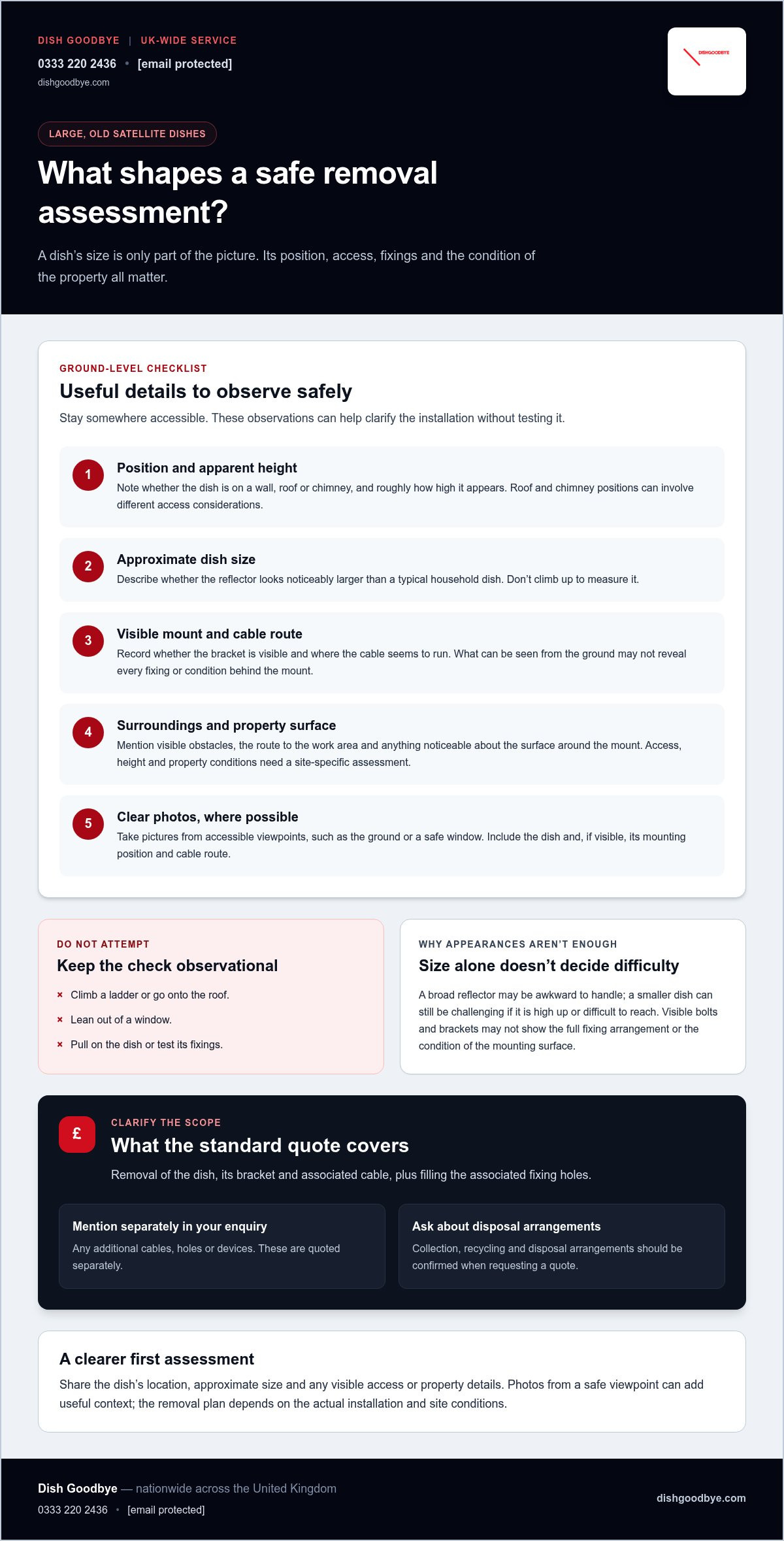
Stay in a safe, accessible place and note what you can see. You’re gathering useful details, not testing whether the dish is loose. A clear description can help shape a practical removal assessment without putting you or the property at risk.
- Position: Note whether it’s on a wall, roof or chimney, and roughly how high it appears.
- Size: Give an approximate visual description, such as whether the reflector looks noticeably larger than a typical household dish. Don’t climb up to measure it.
- Mount and cable: Record whether the bracket is visible and where the cable seems to run.
- Surroundings: Mention any visible obstacles or property features that could affect access.
- Photos: Take clear pictures from accessible viewpoints, such as the ground or a safe window. Include the dish and, if visible, its mounting position and cable route.
Don’t climb a ladder or onto the roof, lean out of a window, pull on the dish or try to test its fixings. A bracket that appears reachable may still be supporting a large, awkward object, and disturbing it could create a risk or damage the mounting surface. If you’re unsure how to remove a very large old satellite dish, keep your role to observation and share the details for a site-specific assessment.
Why Access and Fixings Shape Large Satellite Dish Removal
A removal assessment considers how the dish is mounted and what the property allows, not just whether the reflector looks reachable. The route to the work area, nearby features and condition of the mounting surface can all affect the plan. A clear view from the ground is useful, but it can’t show every practical constraint at the fixing point.
Safe access must be assessed, not assumed from appearances. A site-specific review helps identify what needs attention before removal begins. Dish Goodbye’s nationwide removal service, described on the Dish Goodbye service website, takes access, height and property conditions into account for each quote.
How wall, roof and chimney positions affect the plan
A wall-mounted dish may be visible and close to an accessible part of the property, but the height and surrounding space still matter. A roof installation can involve different access needs, while a chimney position may be affected by the roof layout and the route to the mounting point. These differences shape the assessment; they don’t provide a safe basis for attempting the work yourself.
For example, an otherwise clear wall may have an obstacle below the dish that affects access. On a roof, the position of the dish relative to the building can change how the work is approached. The method depends on the actual installation and site conditions. Technicians use proper safety equipment and techniques for professional removal, rather than relying on a guess based on what can be seen from the ground.
Why large brackets and old fixings need care
The bracket is the connection between the dish and the building. Its visible shape may not reveal the full fixing arrangement or the condition of the surface around it. With an older installation, weathering or past work may make the visible setup an incomplete guide. That’s why assessment should consider both the mounting point and the surrounding property, not simply the apparent size of the bracket.
It’s also useful to distinguish the fixing points associated with the dish from marks or holes left by earlier work. The standard quote scope for associated fixing holes has been explained earlier in the article. If you know of other holes or separate repairs you want considered, include that information in your initial enquiry so the requested work is clear.
Before making an enquiry, note anything you can safely observe about the surface around the mount, nearby obstacles and the dish’s position. Don’t test the fixings or try to judge their condition by pulling on the dish. A site-specific assessment is the sensible way to decide how to remove a very large old satellite dish while taking the building and access into account.
DIY or Professional Removal: Which Is Safer for a Very Large Dish?
A dish can look manageable from the ground, especially when its bracket is visible. But seeing a fixing doesn’t show how the dish will behave once work begins or whether there’s room to handle it safely. A large reflector can be awkward to control, and a high or confined position adds another consideration. Reachable-looking isn’t the same as straightforward.
A large dish in a high or awkward position calls for a site-specific safety assessment. Your part can be simple: describe what you can see and share photos taken from a safe place. Leave climbing, testing fixings and physical removal to the people carrying out the work. That keeps your enquiry useful without turning it into a hands-on inspection.
When should you avoid attempting removal yourself?
Don’t improvise if the dish is on a roof, chimney or high wall, or if access is awkward and the fixings are uncertain. The same applies if you can’t keep a safe position while observing it from the ground. Leave the dish untouched. There’s no need to get closer to make progress; a clear description of its location and surroundings is a useful starting point.
What professional removal changes
Professional removal means the job is approached with proper safety equipment and techniques, rather than relying on a homeowner’s guess about access or fixings. Dish Goodbye provides safe, insured satellite dish removal. The site and work are considered in relation to the particular setup, so the agreed task is understood before anyone begins. The table shows how the homeowner’s role differs from the removal team’s.
| Consideration | Homeowner’s role | Professional removal |
|---|---|---|
| Access assessment | Describe what’s visible from a safe place. | Assess the site and plan the work around its conditions. |
| Physical removal | Leave the dish and mount undisturbed. | Carry out the agreed removal using appropriate safety equipment and techniques. |
| Finishing work | Point out any concerns you can identify without approaching the mount. | Complete the finishing work set out in the agreed job. |
This distinction helps keep your preparation low-effort: you provide observations, not a diagnosis or dismantling attempt. If the dish is partly hidden by a roofline, for instance, say that you can’t see the mount clearly rather than trying to get a better angle from a ladder. Clear, honest details help describe the task without putting you in an unsafe position.
Choosing professional help means you don’t have to decide for yourself whether a large, awkward dish can be safely managed. Keep your distance, share what you know and leave the practical removal to the team. That’s a straightforward way to move towards a tidier exterior while avoiding unnecessary risk.
How to Prepare an Enquiry for a Very Large Satellite Dish Removal
A useful enquiry doesn’t need a technical diagnosis. It needs a clear account of what you can see and what you’d like removed. If a detail is unclear, say so rather than guessing. That helps keep the request accurate and gives the assessment a practical starting point.
Details to include in your initial enquiry
Share the information in a simple order. Keep to observations you can make safely:
- Postcode: Include the property postcode so the enquiry can be associated with the right location.
- Dish position: Say whether it’s mounted on a wall, roof or chimney. If you can’t tell exactly where the bracket sits, mention that.
- Size description: Use a visual comparison, such as “larger than a usual household dish”. An estimate is more useful than an uncertain measurement.
- Visible constraints: Note anything that may affect access, such as a narrow approach or an obstruction near the dish. Don’t climb or lean out to investigate.
- Photos, if safe: A clear view of the dish and its position can add context. Take pictures only from an accessible place, and don’t put yourself at risk to capture the bracket or cable route.
Separate what you know from what you’re unsure about. For instance, you might know the dish is on a chimney but not be able to see how it’s fixed. That’s useful information too. Avoid testing the mount or pulling at cables to fill in gaps.
Understand the quote scope before arranging removal
In your first message, list any additional cables, holes, dishes, aerials or devices you’d like considered. These details can be easy to overlook if they’re partly hidden or close to the main dish, so describe where they are if you can. The standard quote scope has been set out earlier; flagging extra items now helps make the request clear from the outset.
Ask about collection, recycling and disposal arrangements when seeking your quote. If you have a particular concern about an item, include it in the enquiry rather than assuming what will happen to it after removal.
A concise, honest description is enough to begin planning how to remove a very large old satellite dish safely. Gather the details from a safe place, include any uncertainties, and send them through the dish removal enquiry page. That gives the team a clearer picture of the job without asking you to inspect or dismantle anything yourself.
Arrange Safe, Insured Removal of Your Very Large Old Satellite Dish
A very large dish doesn’t have to become a risky DIY project. Dish Goodbye provides insured satellite dish removal across the UK, using proper safety equipment and techniques. For an unusually large or awkwardly positioned dish, the practical first step is a quote based on the actual property, access and installation.
The team is equipped for high-access removals, but the right approach depends on the specific site. Access, height and property conditions are assessed for each quote. This helps avoid assuming that a roof, chimney or high-wall setup can be handled in the same way as an easily reached wall-mounted dish. Same-day removal is available where feasible.
What to expect from Dish Goodbye
A standard quote covers removal of the dish, its bracket and associated cable, plus filling the related fixing holes. Any additional cables, holes, dishes, aerials or devices need to be listed in your initial enquiry and are quoted separately. This makes the agreed scope clear before removal is arranged.
Customer feedback describes the service as punctual, thorough and professional. Collection, recycling and disposal arrangements should also be discussed when requesting your quote, so you know what is planned for the removed dish and associated items.
Request a free, no-obligation quote
Make your enquiry easier to assess by sharing your postcode and where the dish is mounted. Say whether it’s on a wall, roof or chimney, describe its approximate size, and note any visible access or property constraints. Clear photos can help too, provided you can take them from a safe, accessible place. Don’t climb or disturb the dish to get a closer view.
Include any extra items you want removed in that first message. Mentioning them upfront helps ensure the quote reflects the work you’re asking for, rather than only the standard dish, bracket, associated cable and fixing-hole filling. If you’re unsure how to remove a very large old satellite dish, leave the physical work to the removal team and focus on sharing a clear picture of the site.
Ready to take the next step? Request a free, no-obligation dish removal quote, or contact Dish Goodbye on 0333 220 2436 or at [email protected]. A site-specific enquiry is a straightforward way to move towards safe removal without putting yourself or your property at risk.
Take the Safe Next Step
A very large dish can feel like a bigger job than it needs to be. You don’t have to work out how to remove a very large old satellite dish by experimenting with its fixings. Turn what you’ve learned into a clear enquiry: describe where it’s mounted, share your postcode and any safe-to-take photos, and mention anything else you’d like included.
That gives the removal team a useful starting point to consider the particular property and access. A free, no-obligation quote lets you understand the proposed work before deciding how to proceed. Same-day removal may be available where feasible.
Ready to move towards a tidier exterior without taking unnecessary risks? Request a free, no-obligation dish removal quote. A straightforward enquiry is a practical first step, and you can leave the difficult access and removal work to the professionals.
Contact Dish Goodbye on 0333 220 2436 or email [email protected].
Frequently Asked Questions
Can I remove a very large satellite dish myself?
It’s safer not to attempt removal if the dish is high, awkward to reach, or attached with fixings you can’t assess from the ground. A large reflector can be difficult to handle, and its visible bracket may not show how it is secured. Keep the dish untouched, note its position and take photos from a safe viewpoint. A professional assessment is a sensible next step.
Can a large satellite dish be removed from a roof or chimney?
Yes, roof and chimney-mounted dishes can be considered for removal, but the access and property conditions need assessing for each quote. Describe the location clearly, including whether the dish is on a roof slope or chimney, and mention any visible obstacles. Don’t climb up to inspect it. Sharing safe, ground-level photos can help show the setup without putting yourself at risk.
What is included in a standard satellite dish removal quote?
A standard quote includes removal of the dish, its associated bracket and cable, plus filling the fixing holes associated with that removal. It doesn’t automatically cover unrelated repairs or every mark from an earlier installation. For example, if you know of separate holes or other work you want included, describe them in your initial enquiry so they can be considered as additional items.
Do I need to tell the removal company about extra cables or holes?
Yes. Mention additional cables and holes in your initial enquiry, along with any extra dishes, aerials or devices you want addressed. These items are outside the standard dish-removal scope and are quoted separately. If you can’t tell whether a cable belongs to the dish, say where it runs or include a safe photo. Don’t pull or disconnect it to find out.
How do I get a quote to remove a very large old satellite dish?
Share your postcode, where the dish is mounted, an approximate size description and any visible access constraints. Add clear photos if you can take them safely from an accessible place. This information helps describe the particular installation and property. You can request a free, no-obligation quote through Dish Goodbye’s enquiry page, or provide the details by phone at 0333 220 2436.
Can same-day removal be arranged for a large satellite dish?
Same-day removal is available where feasible. For a large dish, the position and access are important details to include when making an enquiry, as the job needs to be considered in light of its specific site conditions. Share the postcode and whether the dish is on a wall, roof or chimney. This gives the team useful context when assessing the request.
What happens to the old dish after it is removed?
Ask about collection, recycling and disposal arrangements when requesting your quote. The arrangements should be discussed for the items being removed, rather than assumed. If the job includes extra equipment beyond the dish and its associated parts, list it upfront so it can be addressed separately in the quote. This gives you a clearer understanding of what happens after removal is complete.