
The cradle that looks like the obvious route may not be the right one. Cradle access for commercial dish removal depends on whether the equipment can reach the dish safely, as well as the building’s layout, height and surrounding conditions. Dish Goodbye provides commercial dish removal across the UK. Contact details: dishgoodbye.com, 0333 220 2436, [email protected].
It’s understandable to want a clear answer before planning work around occupants, building operations or other site activity. A site-specific assessment helps determine whether cradle access may suit the job or whether another access approach is more appropriate.
This guide explains the factors that affect access suitability, the site details that can help shape an individual quote, and what the standard removal scope covers. That includes the dish, its bracket, associated cable and filling the associated fixing holes. If there are extra cables, holes or devices, include them in your initial enquiry so they can be quoted separately. Dish Goodbye: dishgoodbye.com, 0333 220 2436, [email protected].
Key Takeaways
- Cradle access for commercial dish removal is one possible approach, not an automatic fit for every building.
- Access suitability depends on the building, dish position, surrounding space and project conditions.
- Describe the property, visible access constraints and requested removal scope in your enquiry. Photos of the dish and surrounding façade can help provide context.
- A standard quote covers the dish, bracket, associated cable and filling the associated fixing holes; list any additional cables, holes or devices separately in your initial enquiry.
Why cradle access for commercial dish removal needs a site-specific plan
A dish fixed high on a commercial building can be straightforward to identify but harder to reach. Planning access is therefore as important as defining the removal itself. Cradle access for commercial dish removal may be suitable for some sites, but it isn’t the automatic choice for every building. The right approach depends on where the dish sits, how the façade is arranged and what space is available around the property.
Access suitability depends on the building and the specific removal work. Height is only one part of the picture. A cradle may need to reach the dish’s position along the exterior, while the building layout, working area and conditions at the site can all shape the assessment. For example, a dish near a corner or above a busy entrance presents different planning considerations from one on an open, uninterrupted façade. These details call for a measured assessment, not assumptions about what equipment will fit.
What commercial clients need to decide before removal
Start with the outcome you need: removal of a redundant commercial dish. Keep that separate from the assumption that a particular access method must be used. In your enquiry, describe where the dish is located, what it appears to be fixed to and any associated cabling you can see. Also flag occupied areas, operating hours and site constraints, such as restricted space near the façade or activity around an entrance. This gives the access assessment useful context without asking you to select equipment yourself.
Why a cradle cannot be assumed to fit every site
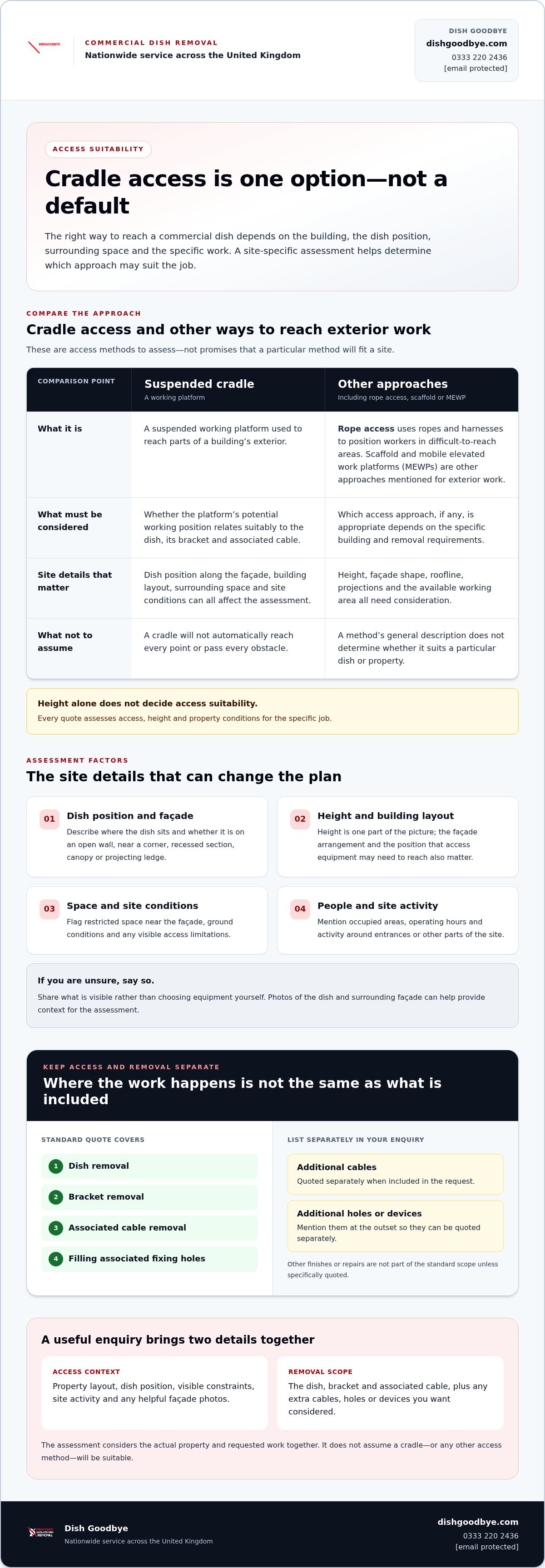
Every quote assesses access, height and property conditions for the specific job. A cradle may be considered alongside other ways of reaching the work area, but suitability depends on the details at that site. As a general point of comparison, rope access, also known as industrial climbing, is a work positioning method that allows workers to reach difficult areas using ropes and harnesses, often as an alternative to scaffolding or aerial work platforms. That description helps explain why different methods exist; it doesn’t determine which approach suits a particular dish or building.
Uncertainty is a reason to gather clear information, not to assume the work is impossible or promise that a cradle will be used. For a high-rise property, note the dish’s position in relation to the façade and describe any visible access limitations. If details are unclear, say so. A site-specific assessment can then consider the building and removal requirements together, helping set a practical plan around the actual job rather than a guess.
How cradle access works for a commercial dish removal assessment
A cradle is a suspended working platform used to reach parts of a building’s exterior. For dish removal, the question isn’t simply whether a platform can be positioned near the façade. The assessment also considers whether its working position relates suitably to the dish, its bracket and associated cable, so the removal can be approached as a defined piece of work.
The access platform is the means of reaching the dish; it isn’t the removal scope itself. That distinction helps keep the enquiry clear. A cradle may be considered as an access method, while the work requested is the removal of specified equipment and, where included, the associated fixing-hole treatment. One doesn’t automatically determine the other.
Cradle access for commercial dish removal therefore calls for a look at both the building and the task. The platform’s potential position in relation to the dish matters: is the dish on a broad, open wall, near a corner, or close to a projection? The answers help describe the working area without assuming the platform can reach every point or pass every obstacle.
What the building layout can change
Façade shape, roofline and features that extend from the wall can affect how access is considered. A dish close to a recessed section, canopy or projecting ledge may present a different positioning question from one on a flat elevation. The surrounding space and ground conditions also form part of the site picture. Share visible details in your enquiry, but leave the access decision to the individual assessment.
What the removal itself involves
Keep the requested work clear and specific. Dish Goodbye’s standard quote covers removal of the dish, its bracket and associated cable, plus filling the associated fixing holes. Extra cables, holes or devices should be listed in the initial enquiry and are quoted separately. Other finishes or repairs aren’t part of that standard scope unless specifically quoted.
It can help to think through the job in two parts: where the work needs to happen, and what items you want removed. For instance, a dish and bracket may be visible on one elevation, while cable runs or other equipment appear elsewhere. Identifying those separately avoids treating every visible item as part of the dish removal request.
A reference on suspended scaffolds outlines considerations such as load capacity and fall protection. It provides background on why suspended access involves more than simply placing a platform beside a wall. For a UK commercial dish removal, the practical starting point remains an assessment of the actual property and work requested.
To describe the removal job and its access context, visit the Dish Goodbye service website.
Cradle access versus other approaches: compare suitability, not promises
A suspended cradle, scaffold and mobile elevated work platform (MEWP) can each provide a way to reach exterior work areas, but they suit different site conditions. The useful question isn’t which method is best in general. It’s how the building layout, dish position, available working area and project conditions affect access for this particular removal.
The comparison below is a planning aid, not confirmation that any method is available for a specific job. Cradle access for commercial dish removal may be worth assessing when the dish’s position makes access along the façade a key consideration. A scaffold or MEWP may prompt different questions about where it can be placed and how it relates to the work area. None is a universal winner.
| Method | Potential fit | Site factors to assess |
|---|---|---|
| Suspended cradle | May be considered where access to an exterior section is central to reaching the dish. | Façade shape, dish position, projections, roofline, surrounding space and ground conditions. |
| Scaffold | May be considered where a fixed access structure could provide a suitable working position. | Building layout, space around the façade, the location of the work and project conditions. |
| MEWP | May be considered where a mobile platform could reach the relevant work area. | Dish position, available space around the building, ground conditions and access to the work area. |
When a suspended platform may be worth assessing
If the dish is high on an exterior wall or positioned where access along the façade is a central concern, a suspended platform may be one option to consider in the assessment. Its potential fit still depends on the specific building and working area. A clear description of the dish’s position and visible façade features helps explain why this approach is being considered, without assuming it will be selected.
When another access approach may need consideration
A building with restricted space around it, a complex façade or a dish in an awkward position can change which access approaches merit assessment. Scaffold and MEWP are comparison categories, not a recommendation that you arrange separate work. The aim is to describe the site and requested removal clearly so access, height and property conditions can be considered together.
For broader UK context, the Health and Safety Executive’s guide to the Work at Height Regulations 2005 covers planning work at height. Use it as general guidance, not as a decision about which method suits a particular building. An individual assessment remains the practical way to compare access options against the real façade, work position and site conditions.
Prepare a commercial dish removal enquiry with the right site details
A clear enquiry makes access planning easier to start. You don’t need technical drawings or precise measurements. Describe what you know about the property, where the dish is, what might affect access and what you want removed. This gives the assessment a practical picture of the site without asking you to decide whether cradle access for commercial dish removal is the right approach.
Information that helps describe the access challenge
Share the building’s location and type, then describe the dish’s position as clearly as you can. Approximate height is useful if known, but don’t guess at measurements. Mention which side of the building it’s on, whether it’s near a corner or roofline, and any visible projections or other obstacles. Note access restrictions around the property, occupied areas and operating considerations that could affect planning.
Photos can add helpful context. If practical, include a clear view of the dish and a wider view showing the surrounding façade and nearby access area. Images can’t replace an assessment of access, height and property conditions, so explain anything the photographs don’t show, such as restricted areas or building activity.
Make the requested removal scope explicit
State whether your request covers the dish, its bracket and the cable associated with it. If you can see other cables, extra fixing holes or additional devices, list each item in the initial enquiry. These are outside the standard quote scope and need to be quoted separately. Don’t assume that unrelated holes, masonry repairs, rendering or painting are included.
For a useful first enquiry, include:
- The property type and the general location of the dish.
- Its approximate height and façade position, if known.
- Visible obstructions and any restrictions around the building.
- Relevant occupied areas or operating considerations.
- Photos of the dish and surrounding façade, where practical.
- The items you want removed, including any additional cables, holes or devices.
Keep it straightforward. If you’re unsure whether a cable belongs to the dish or whether a visible item is another device, describe where it is and include it in your list rather than assuming it’s part of the standard scope. Collection, recycling and disposal arrangements can be addressed as part of quoting.
Once you’ve gathered the site details and requested scope, discuss a commercial dish removal enquiry with Dish Goodbye. A well-prepared description helps set out the work clearly, while access suitability is assessed for the individual property.
What to expect from Dish Goodbye's commercial dish removal process
For commercial dish removal, start with a clear description of the site and the work you want done. Access, height and property conditions are assessed for each quote, so cradle access for commercial dish removal isn’t assumed before the building and job have been considered.
The standard quote covers removal of the dish, bracket and associated cable, together with filling the associated fixing holes. If the job also involves other cables, holes or devices, list them in your initial enquiry so they can be quoted separately. This helps distinguish the main removal request from additional work, rather than leaving the scope open to interpretation.
How the individual quote reflects the site
Each job is priced according to its individual requirements. The assessment considers the access challenge, building height, property conditions and the removal scope you’ve described. A dish on an open section of façade may present different considerations from one positioned near a corner or above a restricted area. Sharing what you know helps make the requested work clear; you don’t need to select the access method yourself.
Removing redundant equipment can form part of wider property upkeep. Make sure the quote describes the requested work clearly, including any additional items beyond the standard dish, bracket, associated cable and fixing-hole scope. Collection, recycling and disposal arrangements are discussed when quoting, so don’t assume a particular disposal outcome before those arrangements are set out.
Choose a clear next step
Send the property location, a description of where the dish is mounted, any visible access constraints and the full list of items you want removed. Mention occupied areas or operating considerations that could affect planning. Photos of the dish and surrounding façade can also provide useful context, though they don’t replace an assessment of the site.
For broader property upkeep, consider how redundant exterior equipment fits into your maintenance plans. Keep your removal enquiry focused on the dish, bracket, associated cable and any additional items you want considered. A precise list helps avoid confusion about what the quote covers.
Ready to set out the site details and requested scope? Request a commercial dish removal quote.
Move from access questions to a clear plan
Use the next step to turn an uncertain access question into a practical project brief. Cradle access for commercial dish removal should be considered in the context of the actual building and work, not chosen by assumption. Sharing the site information you have gives the quote process a clear starting point and helps keep the removal request focused.
If other people need to coordinate around the work, bring their access or operational considerations into the discussion early. A clear brief can help everyone understand what’s being requested and where the remaining decisions sit, without committing to an access method before the property has been assessed. Keep the goal simple: describe the job, identify any additional removal items and move towards a plan shaped around the site.
Take that step with Dish Goodbye. Share your commercial site details and set the removal enquiry in motion.
For further information, visit the Dish Goodbye service website or contact 0333 220 2436 or [email protected]. A clear starting point makes the next steps easier.
Frequently Asked Questions
Is cradle access suitable for every commercial building?
No, there isn’t one access approach that suits every commercial building. For cradle access for commercial dish removal, the assessment considers the building’s height and façade, the dish’s position, available surrounding space and property conditions. A particular building type doesn’t automatically qualify or rule out a cradle. Dish Goodbye assesses access and site conditions for each quote, so share any features that could affect reaching the dish.
How is cradle access different from scaffold access?
A cradle is a suspended working platform, while scaffold is a fixed access structure assembled alongside a building. Each may relate differently to the dish and the work area. For example, the dish’s position on a façade and the space around the building may make different details relevant to each approach. This is a high-level comparison only; suitability depends on the particular property and requested work.
Can commercial dish removal be planned around building occupants?
Occupied areas and operating considerations are useful details to include in your enquiry. For example, mention if the dish is above a regularly used entrance or near a space where people work. Sharing these conditions early allows them to be considered alongside the access requirements and individual quote. It doesn’t guarantee a disruption-free job or a particular working time, but it gives a clearer picture of the site.
What photographs are useful for a commercial dish removal enquiry?
Useful images show the dish clearly, its position on the building and a wider view of the surrounding façade. Include visible access constraints, such as a nearby projection or restricted area, where possible. Photos can help explain what you can see, especially if the dish is difficult to describe. They don’t replace assessment of access, height and property conditions, so don’t assume images alone will always be enough to quote.
Can several dishes or other devices be included in one enquiry?
Yes, list every dish and identify each bracket, visible cable, device and fixing-hole request you want considered. The standard quote covers removal of the dish, its bracket and associated cable, plus filling the associated fixing holes. Additional cables, holes or devices must be raised in the initial enquiry and quoted separately. A clear item-by-item description helps distinguish the requested scope from equipment you haven’t asked to have removed.
Does a cradle access plan include disposal of the removed equipment?
No, access planning and collection or disposal arrangements are separate matters. The cradle describes a possible way to reach the work area; it doesn’t determine what happens to removed equipment afterwards. Collection, recycling and disposal arrangements are confirmed when quoting, without assuming a particular route or outcome. If your commercial site has relevant requirements for handling removed items, include them in the enquiry so they can be addressed.
What contact details should a commercial property manager use?
Use the Dish Goodbye service website, call 0333 220 2436 or email [email protected]. In your enquiry, include the building’s location within the UK, where the dish sits, any visible access constraints and the items you want removed. Adding these details at the outset gives the quote a useful starting point without requiring you to specify the access equipment.