

What if the dish on your new-build home isn’t for TV at all? Before deciding what to do with a dish on a new build home, find out whether it serves satellite TV or broadband, and whether it’s connected to the home’s wiring. Dish Goodbye provides satellite dish removal across the UK. Contact us on 0333 220 2436 or at [email protected].
It’s understandable to want an unused dish gone, especially if it spoils the clean look of a newer home. But removing it before checking its purpose or the property guidance could mean losing a service you rely on or overlooking estate requirements.
This guide will help you identify what the dish may be connected to, check the relevant developer or property guidance, and compare keeping it, investigating its setup or arranging removal. If removal makes sense, you’ll also learn what to include in an enquiry, such as the dish’s location and details of any extra cables or equipment, so the quote can reflect the job.
Key Takeaways
- A dish’s presence alone doesn’t show whether it’s active or connected. Check handover information and visible cabling before deciding.
- Review lease documents or estate guidance to understand any requirements for external changes.
- Use the comparison of keeping, investigating or removing the dish to decide what to do with a dish on a new build home.
- Before requesting removal, note the dish’s location, visible cable and any uncertainty about its use.
- Dish Goodbye’s standard quote covers the dish, bracket, associated cable and filling the associated fixing holes. Mention any additional items in your initial enquiry.
What does a dish on a new-build home tell you?
On its own, a dish tells you very little about the home’s current services. It doesn’t prove that the equipment is connected, working or still needed. An existing satellite dish is an outdoor antenna, usually a reflector with a small component positioned in front of it to receive signals. Its purpose and condition need checking before you decide what to do with a dish on a new build home.
It may have been fitted as part of the original property setup, or added later by someone who lived there. It could relate to satellite TV or another satellite service. The appearance of the dish alone won’t confirm which. A new-build home’s internal wiring and TV arrangements can vary, so don’t assume that a socket in one room, or a cable near the dish, tells the whole story. Satellite dish explains the equipment’s basic design and function.
Was the dish part of the home’s original setup?
Start with what came with the property. Look through handover documents, property information and any available installation records for references to a dish, satellite services or external equipment. If you have photographs from the handover or earlier marketing images, compare them with the exterior now. A dish shown in an original record may have been fitted before you moved in; one absent from earlier images may have been added later.
These clues can help establish when it appeared, but they don’t prove whether it still works. If the records are silent, note that as unknown rather than guessing. Keep any relevant paperwork handy for the next checks.
Could the dish still be connected to a TV system?
From a safe position, look for a cable running from the dish towards the house. Note where it seems to enter the building, and whether it might lead towards a room with TV equipment. Don’t climb onto the roof or try to trace a cable by pulling it; simply record what you can see from the ground or indoors.
A visible cable doesn’t prove that the dish is active, usable or connected to a television socket. It might be disconnected, unused or part of an older setup. Check the home’s TV arrangement, including any available information about satellite sockets and equipment, before treating the dish as redundant. If the purpose remains unclear, mark it for further investigation rather than removing it on assumption alone.
Keep your observations simple: when the dish seems to have appeared, where its cable runs and what the property documents say. That gives you a clearer starting point for deciding whether to retain it, investigate its connection or consider removal. The next step is to check the property guidance and establish what changes are appropriate for your home.
How to check a new-build dish’s purpose and property guidance
Use a simple sequence before making changes: review the paperwork, note what you can see from a safe position, then follow up on anything that remains uncertain. This keeps two separate questions clear: whether the dish is connected to a service, and whether your property guidance allows changes to it. One answer doesn’t automatically settle the other.
Which home documents are useful to check?
Look through the handover pack, property manual and any written estate guidance you received. If you rent or own a leasehold property, check the relevant lease documents too. Note references to TV connections, satellite equipment, external alterations or shared building services. Records may be incomplete, so treat silence as “not stated”, rather than proof that the dish is unused or unrestricted.
What should you establish before changing anything?
Check whether the dish appears to serve only your home or could form part of equipment shared with other homes. Look for visible clues, such as where its cable enters, but don’t treat appearance as confirmation. If the documents don’t make the arrangement clear, ask the developer, landlord or managing agent for guidance specific to the property.
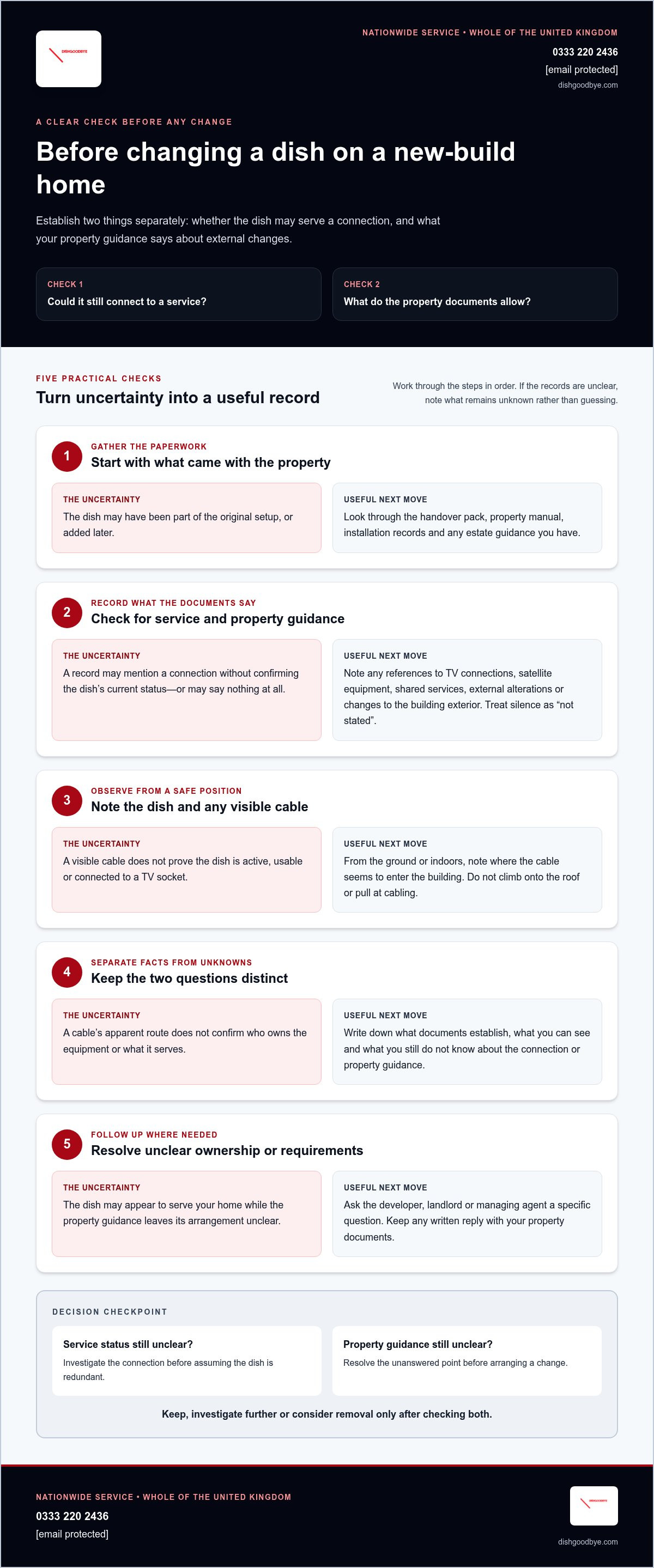
For a practical check, work through these steps in order:
- Gather the paperwork. Find handover information, property manuals, lease documents and any estate guidance you already have.
- Record what it says. Note any mention of satellite connections, external equipment, shared services or changes to the building’s exterior.
- Observe the dish and cable. From a safe position, note the dish’s location and where any visible cable appears to run. Don’t climb up or pull at cabling to investigate.
- Separate fact from uncertainty. Record what the documents establish, what you can see and what you still don’t know about the connection or property guidance.
- Follow up where needed. If the records are unclear, contact the developer, landlord or managing agent with a specific question. Keep their written reply with your property documents.
For example, a handover pack might describe a satellite TV connection but say nothing about the dish’s current status. That gives you a useful lead, not proof that the system works. Or the visible cable may seem to enter your home, while the property guidance leaves its ownership unclear. In either case, pause before arranging a change and resolve the unanswered point first.
There isn’t one rule that fits every new-build arrangement. The relevant documents and the dish’s connection both matter. If you’re deciding what to do with a dish on a new build home, keep a short record of your findings so you can choose to retain it, investigate further or move towards removal with fewer surprises.
If your checks point to removal, you can learn about the satellite dish removal service on the Dish Goodbye service website.
Keep, investigate, or remove the dish: compare your options
Once you’ve reviewed the available property guidance and gathered what you can about the dish, choose the next step that fits what you know. You don’t have to treat an unfamiliar dish as faulty or assume it must go. If its purpose or connection is still uncertain, pause and investigate before making a decision.
| Choice | When it may make sense | Next step |
|---|---|---|
| Keep it | You expect to use the satellite connection and the property guidance supports retaining it. | Check that your TV setup is suitable for the service you intend to use. |
| Check its setup | You don’t know whether the dish is connected, what it serves or whether it relates to shared equipment. | Review the available records and seek property-specific guidance before deciding. |
| Arrange removal | You’ve established that the dish is unwanted or no longer needed. | Consider professional removal and provide details of the dish and its location when requesting a quote. |
When might keeping the dish make sense?
Keeping it may be sensible if you expect to use a satellite connection and have checked the property guidance. Before relying on it, look into your own TV setup and establish whether it supports the service you plan to use. A dish and cable alone don’t confirm that your equipment will be compatible, so avoid assuming a particular receiver or socket will work.
If you’re still unsure, investigation is a valid choice, not a delay for its own sake. For example, you may know that a cable enters the property but not where it leads, or the paperwork may refer to a connection without explaining whether the dish serves your home alone. Note the unanswered question and seek information that relates specifically to your property before choosing keep or remove.
When is removal worth considering?
Removal is an option when you’ve decided the dish is no longer wanted or needed and have considered the relevant property guidance. It may help create a cleaner-looking exterior, although the result depends on the wall and any other equipment that remains. The decision is about clearing redundant equipment, not correcting an assumed defect. For a closer look at the practicalities, see Professional Dish Removal Service: Protecting Your Property from Redundant Tech.
To decide what to do with a dish on a new build home, weigh up its likely use, what you’ve established about its setup and any guidance that applies to your property. If removal is the right fit, Dish Goodbye’s satellite dish removal service is an option for unwanted equipment. Choose the next step based on what you know, and investigate anything that could change that decision.
A practical checklist before deciding what to do
A few clear notes can turn an uncertain decision into a straightforward next step. Gather the details you can see without climbing or disturbing the equipment, then check the property guidance before arranging any exterior change. This also helps make a removal enquiry more accurate if that’s the option you choose.
What information should you gather first?
Write down the property postcode and where the dish is fitted, such as on a wall, roof or chimney. From a safe position, note the visible dish, bracket and associated cable. Don’t assume nearby equipment or other cables are part of the same setup. Record anything you can’t identify, including whether the dish appears connected or may serve a shared system.
How can you make the next step straightforward?
Keep the property guidance and any information about the TV setup with your notes. If you decide to request removal, use those details to describe the job clearly. The standard quote covers the dish, its bracket, associated cable and filling the associated fixing holes. Mention any additional cables, holes, dishes, aerials or devices in your initial enquiry, as these are quoted separately.
Work through this checklist in order:
- Record the location. Note the postcode and whether the dish is on a wall, roof or chimney. Describe its position as clearly as you can.
- Note what’s visible. Record the dish, bracket and any cable you can see running towards the property. Don’t climb to inspect it or pull on the cable.
- List other items separately. Check from a safe position for additional dishes, cables, holes or devices that may need to be included in a removal enquiry.
- Write down what’s uncertain. Be specific: you might not know whether the dish is connected, what it serves, or whether it relates to shared equipment.
- Review property guidance. Check the relevant handover information, lease documents or estate guidance before changing anything on the exterior. Keep a note of any property-specific advice.
- Choose your next step. Retain the dish if you expect to use it and your checks support that choice; investigate further if key details remain unclear; or request removal if it’s no longer wanted or needed.
If removal is your choice, include your postcode, the dish location and the visible items in your enquiry. You can also ask about collection, recycling and disposal arrangements when requesting a quote. Clear details help set out the work being requested, without assuming that unrelated cables, devices or repairs are part of it.
Ready to take the removal step? Use your checklist to describe the job through the Dish Goodbye service website.
Arrange safe removal when a new-build dish is no longer needed
If you’ve checked the dish’s purpose and property guidance and decided it’s no longer needed, professional removal is a practical next step. Give attention to where it’s mounted and any access or height considerations when describing the job. That helps make your enquiry clearer and keeps the proposed work focused on the equipment you want removed.
What does the standard dish removal quote include?
Review the standard quote scope described earlier in this article so you know what the proposed work covers. If you want anything beyond that scope removed or addressed, list it clearly in your initial enquiry. Don’t assume extra equipment or separate repair work is included automatically.
Ready to take the next step? Request a free, no-obligation dish removal quote and share the details of your property and dish.
How do you request a quote?
Provide your postcode and say whether the dish is on a wall, roof or chimney. Describe what you can see, including any other items you’d like considered. You don’t need to climb up to inspect the installation. A clear description from a safe position is a useful starting point.
Before sending your enquiry, gather these details:
- Property location: provide your postcode.
- Dish position: state whether it’s mounted on a wall, roof or chimney.
- Visible equipment: describe anything else you want considered as part of the job.
- Property considerations: mention relevant access or height details and any guidance you’ve checked about exterior changes.
Be specific about items beyond the standard scope. For example, if another device is near the dish and you’d like it included, identify it in your first enquiry. If you can’t tell whether an item is connected, describe its location and say what’s uncertain.
Ask about collection, recycling and disposal arrangements when requesting your quote. With the postcode, dish location and job details ready, you can request an upfront quote and review the proposed work before deciding how to proceed. You can find more about the removal service on the Dish Goodbye service website.
For enquiries, call 0333 220 2436 or email [email protected].
Make your next step a simple one
Once you’ve decided what to do with a dish on a new build home, keep the next step practical. If you’re retaining it, save the relevant property and setup information where you can find it. If you’re still unsure, note the questions that need answering before you make a change. And if removal is your choice, having the dish location and job details ready makes it easier to move forward.
Dish Goodbye provides insured dish removal across the UK. Request a free, no-obligation dish removal quote and share the details of your property and dish. A clear decision can leave you with a home setup that better suits your needs.
For enquiries, call 0333 220 2436 or email [email protected].
Frequently Asked Questions
Do new-build homes normally come with a satellite dish?
There isn’t a universal rule; arrangements can vary by property and development. Check your handover information and property documents to establish what was provided at your home. A fitted dish is different from cabling that may be present without one, and neither arrangement should be assumed to be standard. If your records don’t mention either, ask the relevant property contact what was included when the home was handed over.
Can a satellite dish on a new-build home be used with any TV?
No, the dish alone doesn’t establish whether it will work with a particular television or service. Compatibility can depend on the dish, cabling, any receiver and the home’s setup. Before relying on it, check the equipment and service instructions you already have. For example, a socket in a room doesn’t by itself confirm that it connects to the dish or supports the service you want to watch.
Do Sky Glass or Sky Stream need a satellite dish?
Sky Glass and Sky Stream deliver TV over broadband rather than through a satellite dish. If you’re considering either, check the latest Sky guidance for your specific package and current setup before arranging dish removal. This is especially useful if you’re changing from another service or still use associated equipment. Dish Goodbye handles dish removal, not the supply or installation of TV services, so confirm viewing requirements with your provider.
Can a satellite dish be part of a shared system in a new-build property?
It’s possible, but the dish’s appearance won’t show whether it serves one home or a shared setup. If you live in a flat or managed development, check your property documents and speak to the relevant managing contact before changing equipment. Don’t assume that a dish mounted near your home belongs solely to you or that its cabling serves only your property. Establish the arrangement first.
What should I tell Dish Goodbye when asking for a dish removal quote?
Provide your postcode and describe where the dish is mounted, such as on a wall, roof or chimney. Include any access or height details you can observe safely, and mention extra items you’d like considered so they can be quoted separately. The standard quote scope is explained earlier in this article. If you’re unsure whether something is connected to the dish, describe its position and say what you don’t know.
Can I ask about recycling and disposal when requesting dish removal?
Yes. Ask about collection, recycling and disposal arrangements as part of your quote enquiry, and make a note of the answer for your records. This lets you understand how those arrangements apply to the job rather than assuming a particular collection method or recycling outcome. If you have a specific concern about handling the removed dish, state it clearly when you request the quote.
For enquiries, call 0333 220 2436 or email [email protected].