
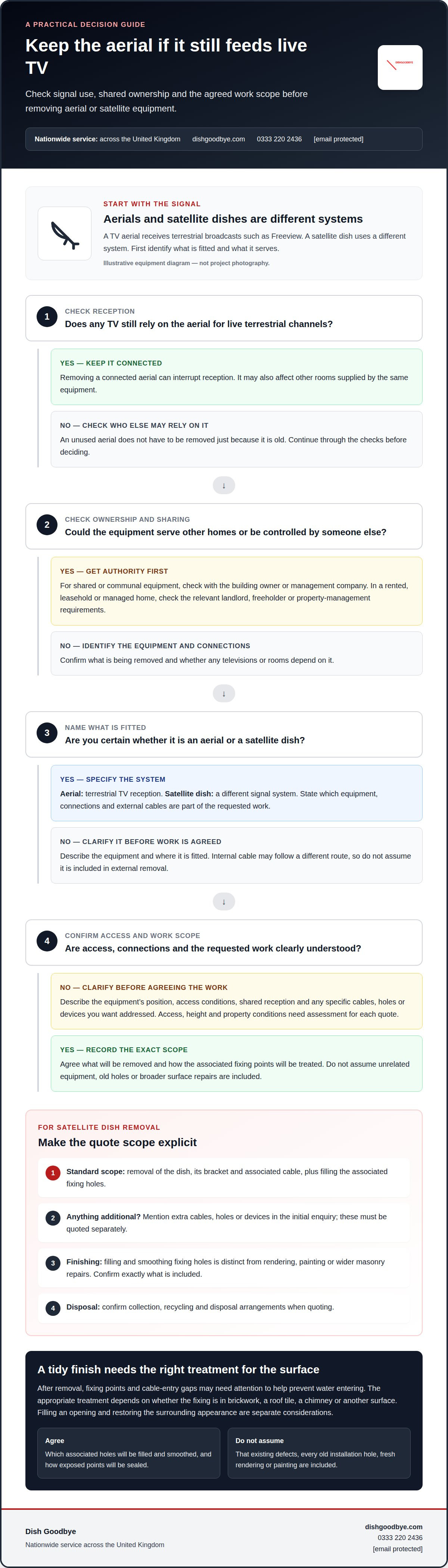
You don’t have to remove a redundant TV aerial just because it’s old. Removal makes sense when you no longer need the signal and want the equipment cleared, but an unused aerial isn’t automatically unsafe. If it’s still connected, removing it could affect Freeview reception or other rooms using the same aerial.
Keeping it may be the practical choice if you still rely on it for live TV. If it’s part of a shared or communal system, or your home is rented or leasehold, check who has authority over the equipment before arranging removal.
This guide explains how to decide whether to leave or remove an aerial, what professional removal involves, and how fixing holes are filled and smoothed. You’ll also learn what can affect access and why the agreed scope matters, so you can clear unwanted equipment without surprises.
Key Takeaways
- Keep an aerial if you still rely on it for live TV; removing a connected aerial can affect reception in other rooms.
- Find out whether the equipment is shared and who has authority over it before arranging removal.
- Professional removal involves more than taking down the aerial: access, fixings and the agreed work scope all matter.
- Learn what happens to fixing holes and how they can be filled and smoothed after removal.
- See when Dish Goodbye’s satellite dish removal services may be the right next step for unwanted dish equipment.
Professional removal of redundant aerials and satellites
An old television aerial isn’t automatically unsafe, so age alone doesn’t mean it must come down. The key question is whether it still serves your home. A television relying on Freeview needs an aerial for terrestrial channels. If the aerial remains connected, removing it can interrupt reception or affect other rooms fed by the same equipment. For example, a roof aerial may supply both the lounge television and a bedroom socket.
Before arranging removal, establish whether the aerial or satellite dish serves only your property. Shared or communal equipment should not be removed without authority from the building owner or management company. In a block of flats, one roof-mounted aerial may serve several homes, so removing it without permission could disrupt other residents’ reception. For a rented, leasehold or managed home, check the relevant landlord, freeholder or property-management requirements before authorising work.
A professional assessment starts by identifying the equipment, its connections and its position on the building. A television aerial receives terrestrial broadcasts; a satellite dish uses a different system. The removal plan should make clear which equipment is being taken down and whether it still supplies televisions elsewhere. It should also specify what happens to associated external cable, brackets and fixing holes. Accessible redundant cabling can be removed when included in the agreed scope. Internal cable may follow a different route through the property, so describe it separately rather than assuming it is part of external removal.
How do you find a reputable TV aerial removal service near you? Look for a clear explanation of the work, an assessment of access and a written scope stating what will be removed and how fixing holes will be treated. The service should also take shared-system ownership and the effect on connected televisions seriously before work begins.
For example, a householder who has stopped using Freeview may decide to remove a standalone aerial. A resident in a managed block needs the building’s authority first, even if the aerial appears unused from their flat. In either case, establish whether the equipment is an aerial or satellite dish, identify its connections and agree the removal scope before work starts.
Clear communication helps prevent a straightforward removal from becoming a surprise project. Describe the equipment and its location, mention shared reception or property-management arrangements, and identify any specific cables or devices you want addressed. The agreed plan can distinguish the aerial or dish from other equipment, define the work area and explain how exposed fixing points will be left. These details set clear expectations for the removal and the finished exterior.
Fixing holes and weatherproofing
Removing an aerial or satellite dish leaves fixing points where brackets or a pole met the building. These openings need attention because rain can enter through exposed gaps. The right repair depends on the surface: a hole in brickwork differs from a fixing through roof tiles or a chimney. A neat finish starts with identifying each fixing point and the material around it.
Does removing a TV aerial affect the roof, chimney or property warranty? Removal doesn’t automatically mean a warranty is void, but the outcome depends on its terms and how the work is carried out. Damage or exposed fixings may matter, so include the treatment of each opening in the agreed work.
A careful finishing process addresses each fixing after removal. The bracket or pole is taken out, then associated holes are filled and the affected area smoothed. On an external wall, the repair should suit the surrounding masonry. On a roof, the exposed point needs a weather-resistant finish appropriate to its location. Filling an opening and restoring its appearance are separate considerations, so don’t assume fresh rendering or painting is included.
For example, a bracket fixed to brick may leave several small holes, while a roof-mounted pole can leave a larger opening. The visible hole may not be the only point needing attention: cable entry points can also leave gaps through an external wall. These points can be sealed or made good when included in the agreed work. Specify which openings and cable routes need attention before work begins.
Weatherproofing means closing the route water could take, not simply covering a mark. A smooth surface can look tidy, but the repair must also address the opening itself. The material and finish should suit the surface, whether brick, mortar or a roof detail. If the surrounding surface is already cracked or loose, distinguish that condition from fixing holes created by the installation. Broader masonry repairs, rendering and painting are separate work unless specifically agreed.
Before work starts, make the scope precise: identify the aerial or dish, associated fixing holes, and any cable entry points. The agreed work should say which holes will be filled and smoothed, and how exposed points will be sealed against the weather. This avoids assuming that every old installation hole or existing defect is part of the same repair. If unwanted satellite equipment also needs removing, the Dish Goodbye service website outlines the relevant service.
Reasons to remove redundant aerials
The strongest reason to remove an aerial is that it no longer serves your household. A television using Freeview needs an aerial for live terrestrial channels, while a home relying exclusively on streaming may not. Check how each television receives its signal before deciding. For example, a lounge screen might stream programmes while a bedroom television still uses an aerial socket.
Redundant TV aerial removal can make sense when nobody relies on the signal and the fitting obstructs planned roof work. A roof-mounted pole can get in the way of access to nearby tiles, flashing or chimney areas. Clearing unused equipment may make those surfaces easier to reach and inspect. For instance, an unused pole could obstruct access to a section of roof being checked for a leak.
An aerial is fixed above ground, where loose or damaged equipment could fall. Removing it eliminates that particular object as a potential source of property damage or injury to someone below. This matters if an aerial appears bent, hangs loose or moves against its mount. Keep people clear of the area beneath unstable equipment, and don’t climb onto the roof to inspect it.
- Keep it if a television still depends on its signal for Freeview channels.
- Consider removal if nobody uses the aerial and streaming supplies the household’s viewing.
- Arrange an assessment if the equipment appears loose or obstructs roof maintenance.
Age alone doesn’t mean an aerial must come down. An intact fitting may remain useful if it still provides reception and doesn’t interfere with planned work. The decision changes if the household stops using terrestrial television or maintenance needs clear access to its mounting area. Base your choice on current use, condition and planned property work.
A decision about redundant TV aerial removal should account for how televisions receive their signal and whether roof work is planned. If damage is visible, keep away from the area below and avoid approaching the fitting. These practical checks help you decide whether the aerial still serves a purpose or has become an obstacle around the home.
This distinction can guide your decision: if standard live terrestrial channels are still part of your viewing, the aerial continues to serve a purpose. If viewing has switched exclusively to streaming, that need no longer applies. The question is whether the fitting still has a role, not simply whether it is present.
Where an aerial is redundant, removing it eliminates the risk of that fitting falling and damaging a home or injuring someone on the ground. It can also clear obstacles that interfere with roof maintenance and help avoid future leaks and maintenance issues. These benefits apply when the aerial is no longer needed, not merely because it is old.
What affects the price of TV aerial removal?
There isn’t one standard quote for every UK home. The work depends on the equipment, its position and how safely it can be reached. A small aerial on an accessible wall presents a different job from a pole fixed high on a steep roof. The quote should reflect the actual work rather than assume every installation is alike.
Equipment type is one factor. A television aerial and a satellite dish use different fittings, so the removal work should specify exactly which item is involved. A roof-mounted aerial may have a pole, bracket and several fixings; a dish may have its own bracket and associated cable. If both are present, identify them separately so the scope for each is clear.
Position and access can change the work required. An aerial fixed to a low, accessible wall differs from one above a chimney or on a difficult roof slope. The building’s height, the surface around the fixings and the available safe working position all matter. If access equipment is needed, that affects the work plan. A safe assessment considers the property conditions, not height alone.
The equipment’s condition also matters. A loose or damaged fitting may need a different approach from an intact aerial that can be reached directly. Nearby fragile materials or obstacles can affect how the work is carried out. Clear photographs taken from the ground can help show the aerial’s location and surrounding roof features. Don’t climb onto a roof to take them.
- Equipment: identify whether the job involves an aerial, dish, bracket or pole.
- Access: show where the equipment sits and note roof or property obstacles.
- Scope: state which external cables, fixing holes and devices need attention.
- Disposal: establish whether taking away removed equipment forms part of the agreed work.
Work beyond removing the named equipment can change the scope. Taking away accessible external cable, for example, differs from tracing internal wiring through a loft or behind walls. Internal cable may remain if removing it would mean lifting floors or disturbing decoration without practical benefit. Identify additional devices, old holes or wider masonry repairs separately rather than assuming they are included.
Ask for a written quote that describes the equipment, access plan and finishing work. A clear scope distinguishes removal from filling associated fixing holes and identifies extra cable or repair work separately. This makes it easier to understand what the job covers before work begins. The quote should reflect the individual requirements of the removal.
What are the steps for safely removing a roof-mounted TV aerial?
A roof-mounted aerial sits above ground level, so removal needs a safe access plan before any fixings are touched. Don’t climb onto the roof or attempt to remove equipment that’s damaged or loose. A fall, dropped pole or disturbed roof material could injure someone or damage the property. Keep clear of hanging equipment and take photos only from a safe position on the ground.
A professional job begins with an assessment of the aerial’s position and the surrounding roof. The installer considers the building’s height, roof shape, equipment condition and available access. Work at roof level proceeds only when suitable access and safe working conditions are available. If wind, rain or the building layout makes access unsafe, work must wait until conditions allow a safe approach.
The removal process can be understood in practical steps:
- Identify the equipment. Establish whether the fitting is a TV aerial or satellite dish, and note its position and visible cable route.
- Assess access. Consider the roof surface, height, nearby obstacles and the safest way to reach the fixing points.
- Inspect the work area. Look for damaged roof materials, fragile surfaces or suspected asbestos-containing materials that could affect access.
- Remove the equipment safely. Once access and conditions are suitable, the aerial and agreed fittings can be taken down without leaving loose equipment overhead.
- Finish the fixing points. Complete the agreed treatment of associated holes and cable entry points, then leave the area clear.
Some surfaces require extra care. A roof may contain fragile materials that cannot safely support access, while suspected asbestos-containing material needs specialist advice or suitable access arrangements. Work may need to stop until those concerns are addressed. This is a practical safety boundary, not a reason to improvise with a ladder or step across uncertain roof areas.
Before arranging the work, describe the aerial’s location and condition, and mention visible damage or unusual roof materials. Photos can help show whether the equipment sits near a chimney, roof edge or awkward slope, but take them from the ground. If equipment is hanging loose, keep people away from the area below rather than approaching it for a closer look.
Safe removal depends on matching the method to the property, the equipment and the available access. Roof height alone doesn’t determine whether a job can proceed; the roof condition, access route and working environment also matter. Work should pause if safe access cannot be established, rather than risk injury or damage to the roof.
Dish Goodbye
Dish Goodbye provides Satellite Dish Removal and Sky Dish Removal across the UK. If an unwanted dish is part of the exterior clutter you want cleared, the service includes removal of the dish, its bracket and associated cable, plus filling the associated fixing holes. Additional cables, holes or devices must be mentioned in your initial enquiry and quoted separately. Access, height and property conditions also shape the removal plan.
For a TV aerial, use the guidance above to decide whether it’s still needed and whether it belongs to a shared system. Dish Goodbye’s dish-removal service is relevant when satellite equipment also needs attention, not as a substitute for aerial removal.
Contact Dish Goodbye to discuss your property and the equipment you want removed. Call 0333 220 2436 or email [email protected].
Make your next step a clear one
Use your decision about redundant TV aerial removal to plan the exterior work that makes sense for your home. Keep the aerial if it still serves your viewing needs; if you’re arranging roof maintenance, consider how unused equipment fits into that plan. A clear list of what you want addressed helps keep the next conversation focused.
If a satellite dish also needs to go, Dish Goodbye provides Satellite Dish Removal and Sky Dish Removal. Share the property details and equipment involved to discuss the relevant removal work.
Contact Dish Goodbye about removal, or call 0333 220 2436 or email [email protected]. Take the next step when it suits your home, and make exterior upkeep easier to organise.
Frequently Asked Questions
Can you remove an aerial mounted on a chimney?
A chimney-mounted aerial can be removed when the equipment and access conditions allow safe working. A professional assessment considers the chimney’s position, roof layout, aerial condition and route to its fixings. Don’t climb onto the roof or approach a loose fitting yourself. If the chimney or nearby materials appear unstable or fragile, that affects the removal plan and must be addressed before work proceeds.
Can you remove old cables at the same time?
Old cables can be dealt with during removal when their location and scope are agreed beforehand. For example, an external cable clipped along a wall differs from internal wiring routed behind a loft hatch or through decorated rooms. Identify the cable runs you want included in your initial enquiry. For Dish Goodbye dish removals, additional cables must be mentioned in your initial enquiry and quoted separately.
Can I remove a TV aerial myself, or should I hire an aerial installer?
Don’t attempt to remove an aerial from a roof, chimney or other high position yourself. A damaged or loose fitting can shift unexpectedly, and working at height risks injury and property damage. Keep people away from equipment hanging overhead, and take photographs only from a safe position on the ground. A professional assesses access and working conditions before deciding whether roof-level removal can proceed safely.
How should holes and fixings be repaired after removing an aerial?
Repair each opening according to its position and surface. A fixing hole in brickwork needs a suitable fill, while a roof penetration needs attention suited to that roof detail. Ask for the agreed work to distinguish fixing holes from older cracks or unrelated damage. Dish Goodbye’s standard dish-removal quote includes removal of the dish, its bracket and associated cable, plus filling the associated fixing holes. Additional holes or broader repairs must be mentioned in your initial enquiry and quoted separately.
Do I need permission or building regulations approval to remove a TV aerial in the UK?
Get authority from the building owner or management company before removing shared or communal equipment. For rented, leasehold or managed homes, check the landlord, freeholder or property-management requirements before authorising work.