

An old satellite dish does not automatically have to come down just because it is no longer used. In general, there is no legal requirement to remove it solely because it is old or redundant.
Planning rules can still matter if you choose to remove it. In England, The National Archives explains that planning permission is required when proposed work meets the statutory definition of development under section 55 of the Town and Country Planning Act 1990, while section 57 provides that development requires permission.
It’s understandable to want a clear answer before dealing with a dish fixed to your home. Planning rules may affect whether permission is needed for particular work, but they do not create a general duty to remove an existing dish. The key question is whether any specific circumstances apply to your property.
Key Takeaways
- An unused satellite dish does not automatically have to be removed simply because it is old.
- In England, planning permission is required only when work meets the statutory definition of development in section 55 of the Town and Country Planning Act 1990, according to The National Archives.
- Before arranging removal, understand how planning rules may apply to the work and your property.
- Dish Goodbye’s Sky Dish Removal covers the dish, its bracket and associated cable, plus filling the related fixing holes.
- For a tidier exterior, consider professional removal when the dish is no longer needed or you’d rather not tackle the work yourself.
Is it a legal requirement to remove an old dish.
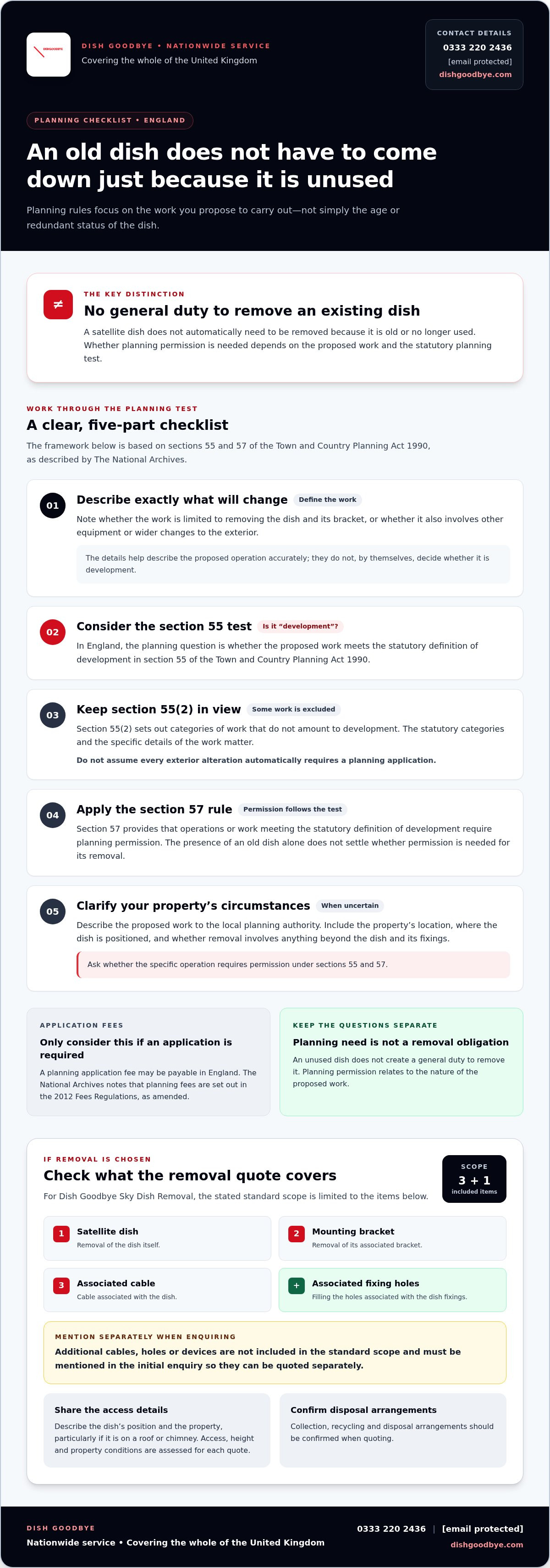
An old satellite dish does not have to be removed simply because it is unused or ageing. Planning rules concern whether particular work needs permission, rather than requiring you to take down an existing dish. So, if you’re asking whether it is a legal requirement to remove an old dish, its age alone is not the deciding factor.
In England, planning permission is required only when work meets the statutory definition of development in section 55 of the Town and Country Planning Act 1990, according to The National Archives. That distinction matters because removing a dish involves work to a building. The relevant question is whether the proposed operation falls within that legal definition, not simply whether the dish is redundant.
Section 57 of the Town and Country Planning Act 1990 provides that operations or work meeting the statutory definition of development require planning permission, according to The National Archives. Read alongside section 55, this means permission depends on the nature of the work. The mere presence of an old dish does not, by itself, answer whether permission is needed for its removal.
Section 55(2) of the Town and Country Planning Act 1990 sets out categories of work that do not amount to development, according to The National Archives. This is why it’s unwise to treat every exterior alteration as automatically requiring an application. The statutory categories and the details of the proposed work matter. A dish fixed to a wall and a larger installation may raise different questions about the work involved.
For a straightforward household removal, note what will actually change before making plans. Is the work limited to taking down the dish and its bracket? Will it also involve altering the building, removing other equipment, or making wider changes to the exterior? These details help describe the operation accurately. They do not, on their own, establish whether it is development under section 55.
If you’re unsure how the planning rules apply to your property, describe the proposed work to the local planning authority. Include the property’s location, the dish’s position, and whether removal involves anything beyond the dish and its fixings. Ask whether the operation requires planning permission under sections 55 and 57. Clear details make it easier to get an answer focused on your situation.
There is also a possible application cost to consider if permission is required. A planning application fee may be payable in England; according to The National Archives, planning fees are set out in the 2012 Fees Regulations, as amended. The fee point applies to an application, not to every old dish or every removal. Don’t assume that an unused dish means an application fee is automatically due.
A practical sequence keeps the decision clear. First, identify the work you intend to carry out. Next, consider whether it may meet section 55’s definition of development. Then establish whether section 57 requires permission for that work. If an application is necessary, account for the applicable fee rules. This separates the legal planning question from the separate choice to remove a dish for appearance or upkeep.
In short, an old dish isn’t automatically subject to a removal requirement because it has stopped being used. In England, the planning test relates to the proposed work and the statutory definition of development. Sections 55, 55(2) and 57 provide the framework, while the 2012 Fees Regulations, as amended, address planning application fees. Keep those distinct questions in view before arranging any work.
Dish Goodbye: Sky Dish Removal
Dish Goodbye provides Sky Dish Removal when an unused dish is ready to come down. The fixed, up-front quote includes removal of the dish, its bracket and associated cable, plus filling the associated fixing holes, with no hidden fees.
If you have additional cables, holes or devices, mention them in your initial enquiry so they can be quoted separately. Share clear details of the dish’s position and your property, particularly if it is on a roof or chimney. Technicians are equipped for high-access removals and use proper safety gear at all times.
For a straightforward next step, contact Dish Goodbye on 0333 220 2436 or at [email protected] to discuss your removal.
Make a Clear Plan for Your Home
If you’re still asking whether it is a legal requirement to remove an old dish, remember that the law does not require removal simply because it is unused. You can decide based on practical concerns, such as wanting a neater exterior or removing redundant fittings. Note the dish’s position and what else needs removing, then request a free, no-obligation quote from Dish Goodbye. Ask about collection, recycling and disposal arrangements when requesting a quote.
Dish Goodbye offers Satellite Dish Removal and Sky Dish Removal for homeowners ready to clear an unwanted dish. For a practical next step, visit the Dish Goodbye service website or contact the team at 0333 220 2436 or [email protected]. A little planning can make the change feel straightforward, and leave you ready to enjoy a tidier exterior.