

Yes, an old satellite dish can cause damp if rain enters through poorly sealed fixing holes or the cable-entry point. But the dish isn’t the only possible source: slipped tiles, faulty gutters or gaps in roof pointing can also let water in. Damp marks indoors don’t automatically show where a leak starts.
It’s frustrating to spot a stain and wonder whether the cause is above it, behind it or somewhere else. A careful check can help you trace likely water routes before deciding what needs attention.
Read on to find out what to check from the ground and inside the loft, how to assess the area around old dish fixings, and which clues can help distinguish a dish-related leak from other roof problems. You’ll also learn when it’s safer to leave the roof inspection to a professional.
Key Takeaways
- Look for possible water routes around dish fixings and cable entry points, but check other roof areas too.
- Use a ground-level view and loft inspection to compare exterior damage with the location of indoor damp.
- Check for slipped or missing tiles, gutter issues and failed pointing before settling on one cause.
- Rust on a bracket alone doesn’t prove that water is entering the roof; look for signs of moisture around the fixings.
- If an unused dish is part of the problem, removal and filling its associated fixing holes can help address that entry point.
Checking for roof damage from the ground and inside the loft
Start outside, but keep both feet on the ground. From a window or garden, look across the roof rather than climbing onto it. Check for slipped or missing tiles, damaged flashing, sagging gutters and gaps in chimney pointing. Any of these can let water into the building, even if an old dish is nearby. Use binoculars to see details more clearly, and take a photograph to compare later.
Look closely at the wall around the dish bracket and where its cable enters the building. Dark marks, crumbling mortar, open holes or staining below a fixing may help show where water is travelling. A rusty bracket is worth noting, but rust alone doesn’t prove moisture has entered the wall. Record each visible mark and compare its location with indoor damp patches.
Check the loft from inside, using a torch to inspect the underside of the roof near the dish’s position. Look for wet or darkened timbers, damp insulation, water marks and daylight between roof coverings. Trace visible water marks upwards: water can run along a rafter before appearing on a ceiling some distance from where it entered. Don’t step onto the ceiling or move across unsupported joists.
Before sealing an exterior fixing or cable-entry hole, check the inside wall and nearby rooms. Look for peeling paint, bubbling wallpaper, discoloured plaster or a musty smell around the corresponding area. Check the loft and the floor below the wall too. Sealing a hole before tracing the damp may hide a clue while water continues to enter elsewhere, such as through a slipped tile or leaking gutter.
After heavy rain, note whether a fresh mark appears or an existing patch grows. Compare its position with the dish, roof edges, chimney and guttering. Recording the weather and location can help distinguish a recurring leak from older staining. Avoid touching wet electrical fittings or cables. Keep clear and arrange a suitable inspection if water is near them.
Storms can also shift aerials, loosen mounts or damage exposed cables. From the ground, look for a dish or aerial that appears tilted, loose or differently positioned than before. Check visible cable sections for cracks, fraying, kinks or breaks. Damaged cable can let water in and affect the signal, while a shifted dish may indicate loose fittings. Don’t pull a cable or try to straighten equipment from a ladder.
Check dish fittings and mounts visually, especially after heavy storms, snowfall or high winds. Look for corrosion, missing-looking fixings, a shifted bracket or movement when the weather changes. Satellite dishes should be checked every three months and after severe weather. A ground-level inspection can reveal obvious changes, but it can’t show whether hidden fixings remain secure. Note what you can see, then compare it with indoor damp and loft evidence before deciding whether the dish is involved.
Inspecting and repairing roof damage around fixings
Arrange a roofer’s inspection if water is actively entering, roof coverings are damaged or damp keeps returning after rain. A damp specialist can investigate if the source remains unclear, especially when moisture appears inside wall cavities or beneath floors.
A dish bracket is often secured with four bolts. Each fixing point can become a route for water if the hole, seal or surrounding masonry has deteriorated. From a safe position, note cracked mortar, gaps around bolts, water staining beneath the bracket, and any loose or distorted metal. Don’t climb onto the roof or loosen fittings to investigate.
Rust needs context. Brackets often have a protective coating that wears with exposure, so surface corrosion alone doesn’t show that water has entered the wall. Check whether the coating is flaking, corrosion is spreading or the bracket has shifted. A loose mount can affect dish alignment and reception, but it doesn’t prove the fixing is the source of damp.
Trace the likely route indoors before arranging repairs. Compare the bracket’s position with damp patches, then inspect accessible parts of the nearby wall and floor. If floorboards are already lifted, look for dark staining, damp timber or a wet smell underneath. Don’t lift boards or open a wall cavity without knowing what lies behind it. Water can travel through a cavity or along timber before appearing on an indoor surface.
The repair should match the fault. A roofer can assess roof coverings, flashing, pointing and the area around a fixing, then decide what needs repair. A surface patch over a bolt hole won’t resolve a leak entering through cracked tiles or failed flashing. If the dish is no longer needed, removing its bracket and properly filling its associated fixing holes can eliminate that particular entry route. It won’t repair unrelated roof defects or damp already inside the structure.
UK repair costs depend on the work identified during inspection. Access, roof material, the extent of damage and whether tiles, flashing, pointing or fixings need attention all affect the job. Replacing a slipped tile differs from tracing water through a cavity or repairing a wider section of roof. Get the suspected fault and proposed work clearly described before agreeing to repairs.
Keep evidence useful and specific. Photograph the bracket, visible corrosion and any indoor marks from consistent positions. Record whether fresh damp follows heavy rain, and note changes to signal or dish alignment separately. That helps distinguish a reception issue from a water route. If the dish is redundant, the Dish Goodbye service website explains removal of the dish, bracket and associated cable, with filling of the associated fixing holes.
A contributor recommends placing a PTFE piece behind a satellite-dish bracket as a gasket to reduce moisture transfer.
A satellite dish as a possible source of damp
Can an old satellite dish cause damp? Yes, if water enters through its fixings or cable-entry point. The dish itself doesn’t create moisture. Instead, an installation can leave openings in a roof or wall, and failed seals may let rain reach the structure. A damp patch below a bracket is a clue to investigate, not proof that the dish caused it.
Dish fixings pass through an exterior surface, so worn sealant or cracked material around a fixing can create a route for rain. Water may then spread through masonry or along timber before appearing indoors. That’s why a stain directly beneath a bracket isn’t the only place to look. For example, moisture entering high on an outside wall may show lower down or inside an adjacent room.
The cable route matters too. A coaxial cable entering through an unsealed opening can provide a path from outside into a wall or loft. Cracked, frayed or animal-chewed cable can also be more vulnerable to water ingress, with possible signal loss at the receiver. Check where the cable enters, whether the opening is exposed and whether damp follows that route after heavy rain.
An old dish may remain mounted after its television service is no longer used. Look at the equipment as a whole: reflector, bracket, fixings, cable and entry point. Corrosion on a bracket may reflect weathering of its protective coating rather than water penetration. More useful evidence includes a gap around a fixing, damaged mortar nearby, staining below the installation or a wet mark indoors near the cable route.
Separate damp clues from reception problems. Heavy rain can affect satellite signals, while a damaged or poorly sealed cable may also cause signal loss. A picture breaking up at the receiver doesn’t establish that water has entered the building. Note whether the problem changes with the weather, then compare it with fresh indoor staining or visible moisture around the cable entry.
When investigating, compare these possible routes rather than assuming the dish is responsible:
- Bracket fixings: Look for open gaps, damaged mortar or staining close to where the bracket meets the wall.
- Cable entry: Check whether the opening is sealed and whether the cable covering is cracked or split.
- Roof coverings: Check for an unrelated route, such as a slipped tile near the installation.
- Inside surfaces: Compare the location of damp with the exterior fixing and cable route.
That comparison helps guide the repair. If water is entering around a fixing, the damaged opening needs attention; sealing a different point won’t stop the leak. If the cable entry is the route, both the opening and cable condition matter. If neither area shows a plausible path, investigate other roof or wall defects. A sound diagnosis follows the water route, not simply the nearest object.
A dish that remains in use may need its mount and cable checked while the problem is being addressed. A secure bracket supports stable alignment, while weather-rated coaxial cable and proper sealing help limit water ingress. Don’t paint over a wet mark or cover a suspect opening before tracing the route. These shortcuts can hide evidence while the underlying source remains active.
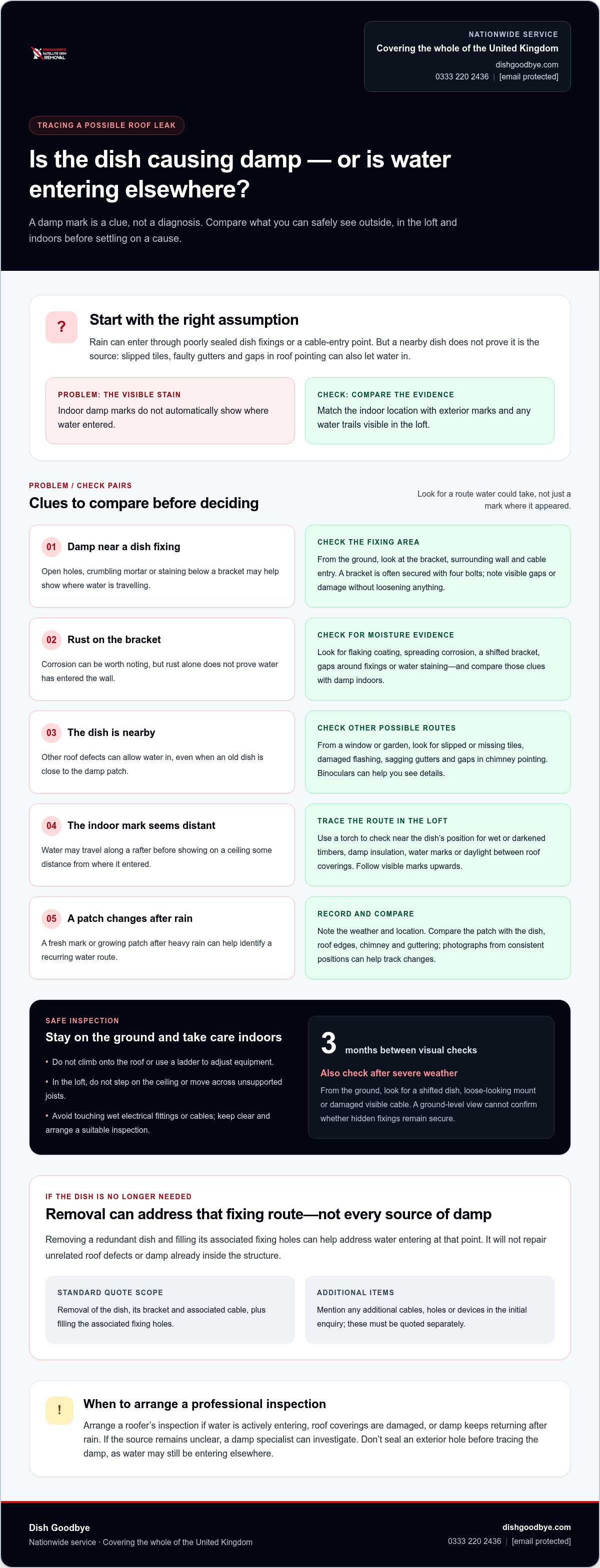
How to check whether a satellite dish fixing is causing a roof leak?
Look for a direct connection between the fixing and the damp, rather than relying on proximity alone. Note the indoor mark’s location, then compare it with the bracket, cable entry and roof surface outside. Water can travel along a rafter or through a wall before appearing indoors, so the stain may be some distance from the original opening.
Start with a visual check from a safe position. Look for a gap around each bracket bolt, cracked mortar, damaged sealant or staining directly beneath a fixing. Record and photograph visible defects. Don’t climb onto the roof, loosen a bolt or pull at the dish to test its security. These actions can damage the fixing or create a fall risk.
Next, compare the timing of fresh damp with the weather. Note when the indoor mark darkens, feels wet or spreads, then check whether this follows heavy rain. Repeat the visual check from the same ground-level position. If the bracket area stays dry while water appears after rain, investigate other routes, including roof coverings, gutters and the cable-entry opening.
A wooden dowel can be used as a simple moisture check in an accessible fixing hole: leave it there for a couple of weeks, then check whether it feels wet. Don’t remove a bolt or make a new hole to carry out this test. A wet dowel supports the possibility of moisture at that opening, but it doesn’t reveal how water entered or rule out another nearby leak.
Keep a short record to make the evidence easier to interpret. Include the date, rainfall, the indoor mark’s location and appearance, and any visible change around the bracket. For example, a mark that grows after rain while a nearby cable opening stays dry points to a different route than damp directly beneath the cable entry. Photographs taken from the same spot help show changes over time.
Check the interior as well as the exterior. Behind accessible areas near the damp patch, look for staining, softened plaster or a musty smell. In a loft, check roof timbers and insulation around the dish’s position. Water can run along a surface before appearing below, so trace visible marks towards their highest point. Don’t lift floorboards or open walls just to follow a suspected route.
Don’t seal the exterior fixing before checking inside and tracing the water path. Fresh sealant may hide evidence without resolving a leak from a slipped tile or failed pointing. If moisture continues, the roof covering is damaged or the source remains unclear, arrange a suitable inspection. A roofer can assess roof defects; a damp specialist can investigate moisture within walls or floors.
If the dish is redundant and its fixings appear to be the entry point, arrange its removal and filling of the associated fixing holes. Arrange satellite dish removal as a practical next step. This addresses the dish fixing itself, not unrelated roof defects or damp already within the building.
Dish Goodbye: Sky Dish Removal
Dish Goodbye provides Sky Dish Removal for an unwanted dish that’s no longer needed. The quote covers removal of the dish, its bracket and associated cable, plus filling the associated fixing holes. If you also need additional cables, holes or devices addressed, mention them in your initial enquiry so they can be quoted separately.
This can be a practical next step if you’ve traced a possible leak to an old dish fixing and no longer use the equipment. Removal addresses that installation point, but it doesn’t repair unrelated roof damage or damp inside the building, and it doesn’t include painting or rendering.
Contact Dish Goodbye on 0333 220 2436 or at [email protected].
Take the next step with confidence
Whether an old satellite dish can cause damp is best judged from the evidence at your property, not appearance alone. Keep your photographs and notes together, and use them to explain what you’ve noticed. A clear description of the damp’s location and the dish’s condition can help identify the right next step.
If the dish is redundant, arrange its removal separately from any roof or damp repairs. This keeps the work focused: removing unwanted equipment deals with the dish installation, while other causes of moisture need separate attention. Avoid climbing onto the roof or disturbing fixings to gather more evidence.
Ready to clear an unused dish from your property? Contact Dish Goodbye about dish removal. Taking one practical step at a time can help you move towards a tidier exterior and a clearer plan for your home.
Dish Goodbye: 0333 220 2436 | [email protected]
Frequently Asked Questions
What can be done?
First, identify whether water is still entering or the damp is leftover staining. Note when the mark changes, photograph it and keep the details together for an inspection. If an unused dish is near the affected area, include that in your notes. Avoid climbing up or disturbing roof fittings. Once you’ve identified a likely entry point, arrange the appropriate removal or building repair rather than treating only the visible stain.
Can an old satellite dish cause damp or water leaks?
Yes, an old satellite dish can cause damp if rain passes through an opening around its fixings or cable route. The dish doesn’t produce moisture, but its installation may leave a path through an exterior wall or roof. A damp patch near the dish is a reason to investigate, not proof of the cause. Compare the indoor location with the bracket and cable route, and consider other possible entry points.
How can a satellite dish mounting bracket let rainwater into a UK roof or wall?
A bracket is secured through the building’s outer surface, and rain can enter if a fixing hole or its surrounding seal has deteriorated. Water may then travel through masonry, a wall cavity or along roof timbers before becoming visible indoors. For example, a ceiling mark may sit below the roof route rather than directly under the bracket. The path depends on the building materials and where the fixing meets them.
What signs show damp is caused by an old satellite dish installation?
Look for a combination of clues: a gap or cracked material around a fixing, staining below the bracket, and an indoor damp patch near the same route. A wet cable-entry opening or damp appearing after rain adds useful context. Rust alone doesn’t establish a leak. Record where marks appear and whether they change after wet weather, then compare those observations with other roof or wall defects.
How to remove an old satellite dish and seal the fixing holes properly?
Don’t remove a roof-mounted dish yourself if reaching it requires climbing or disturbing roof coverings. Dish Goodbye’s Sky Dish Removal quote covers removal of the dish, its bracket and associated cable, plus filling the associated fixing holes. Any additional cables, holes or devices must be mentioned in your initial enquiry and quoted separately. This filling is for those fixing holes; it doesn’t include unrelated masonry repairs, rendering or painting.
How much does it cost in the UK to remove an old satellite dish and repair water damage?
Dish Goodbye provides a fixed, upfront quote for its removal work, with no hidden fees. The quote covers removal of the dish, its bracket and associated cable, plus filling the associated fixing holes. Additional cables, holes or devices must be mentioned in your initial enquiry and quoted separately. Water-damage repairs are separate work, and the amount depends on the affected materials and extent of damage. Ask about collection, recycling and disposal arrangements when requesting a quote.