
Could that unused metal aerial on your roof be inviting a lightning strike? If you’re wondering, “do old aerials attract lightning?”, the reassuring answer is no: an aerial doesn’t draw lightning from a distance. For enquiries about removal, contact Dish Goodbye on 0333 220 2436 or at [email protected].
It’s understandable to feel uneasy about a tall, metal structure above your home, especially when its cables run indoors. Height and metal construction can matter because an aerial may be struck and provide a route for electrical energy. That’s different from attracting lightning. Don’t handle aerial cables during a thunderstorm.
This guide explains what an old aerial can and can’t change, sensible steps to take while a storm passes, and how to decide whether an unused aerial should go. If removal makes sense, consider it a practical way to clear redundant equipment, not a guarantee against lightning. Dish Goodbye provides satellite dish removal across the UK. For enquiries, call 0333 220 2436 or email [email protected].
Key Takeaways
- Understand why “do old aerials attract lightning?” is the wrong way to frame the concern, and which parts of an aerial setup may be relevant.
- Compare roof aerials with other exposed features, indoor equipment and lightning-protection systems without assuming a one-size-fits-all level of risk.
- Use a before, during and after storm checklist to take sensible precautions and avoid handling aerial cables in unsafe conditions.
- Decide whether an unused aerial is worth removing based on its condition, usefulness and upkeep, not on a promise of lightning protection.
- Find out how Dish Goodbye’s UK-wide removal service handles redundant aerials, brackets, fixings and cabling, with fixing holes filled and smoothed.
Do old aerials attract lightning? The direct answer for homeowners
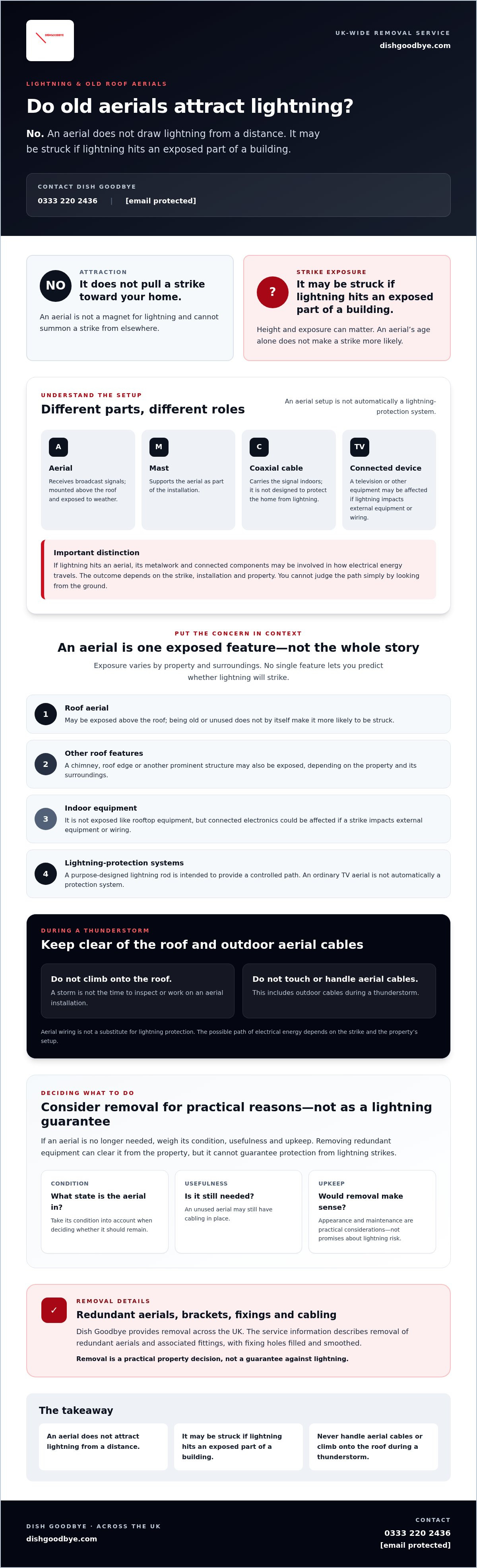
No. An old aerial doesn’t attract lightning like a magnet or pull a strike towards your home. It may still be struck if lightning hits an exposed part of a building. That’s strike exposure, not attraction, and it doesn’t make every rooftop aerial a special hazard.
It helps to distinguish between an object drawing lightning towards it and becoming part of the route electrical energy takes after a strike. An aerial can’t summon a strike from elsewhere. If lightning hits it, however, its metalwork and connected components may be involved in how the electrical energy travels. The outcome depends on the building and installation, so don’t assume an old or unused aerial is either dangerous by default or risk-free.
What does it mean to say an aerial attracts lightning?
In everyday speech, “attract” suggests that an aerial makes lightning more likely to hit your property. That isn’t a reliable way to describe the concern. Height and exposure can make roof features relevant during a strike, but an aerial isn’t a magnet for lightning. A chimney or another prominent roof feature may also be exposed, depending on the property and its surroundings.
A purpose-designed lightning rod is intended to provide a controlled path for electrical energy. An ordinary TV aerial isn’t automatically a lightning-protection system. For a plain-language explanation of how a lightning rod works, see the reference on lightning rods.
Can an old TV aerial still be struck?
Yes, it’s possible. An aerial mounted above the roof is exposed to the weather, but its age alone doesn’t make a strike more likely. Whether it’s connected or still used for television reception doesn’t change the basic distinction: the aerial is one part of the setup, the mast supports it, coaxial cable carries the signal indoors, and connected equipment sits inside the home.
If a strike hits an aerial, connected cabling or equipment may be relevant to the path of electrical energy. That doesn’t mean the cable will always conduct a strike into the house, or that every old aerial presents the same concern. Installation and the property’s overall protection matter. Don’t climb onto the roof or handle aerial cables during a thunderstorm. An unused aerial may be worth removing for upkeep or appearance, but removal isn’t a guarantee against lightning strikes.
How lightning interacts with roof aerials, cables, and buildings
To understand the practical concern, consider each part of the setup. The aerial receives broadcast signals. A mast supports it, coaxial cable carries the signal into the property, and a television or other connected device uses it. These parts have different roles and shouldn’t be mistaken for a designed lightning-protection system.
A roof aerial and its wiring aren’t a substitute for lightning protection, and shouldn’t be assumed to provide a safe route for a strike. You can’t judge the path lightning might take through or around a building simply by looking at an aerial from the ground.
Why height and exposure matter more than the aerial being old
An aerial’s age doesn’t, by itself, determine whether lightning will strike a home. Position and exposure are more relevant when considering why roof equipment may be involved: a feature standing above surrounding parts of a property is more exposed than indoor equipment. But height alone can’t predict a strike. A chimney, roof edge or other structure may also be exposed.
An Eos report on research on antenna towers describes findings about lightning strikes at towers. Those large structures aren’t the same as domestic TV aerials, so the research shouldn’t be used to claim a household aerial creates the same effect or a particular level of risk. It does underline the difference between a prominent structure and a guaranteed lightning attractor.
What role can aerial cables and connected devices play?
If an aerial is connected, its coaxial cable may run indoors to a television or other equipment. The cable carries a signal; it isn’t designed to protect the home from lightning. If lightning affects external equipment or wiring, connected electronics could also be affected, but the outcome depends on the strike and the property’s setup. An unused aerial may still have cabling in place, so not using it for TV doesn’t necessarily mean every part has been disconnected.
Don’t climb onto the roof, touch the aerial or handle outdoor cables during a thunderstorm. If a storm is approaching, follow current UK weather and safety advice. Avoid trying to unplug or disconnect outdoor equipment while conditions are active, and check equipment instructions for precautions to take before a storm.
So, do old aerials attract lightning? Their age doesn’t make them magnets for strikes. Their position and connections are the sensible things to consider, without assuming an aerial will be struck or that it protects the property. If a redundant satellite dish is also part of your roof setup, you can learn about satellite dish removal as a separate upkeep decision.
Old aerial versus other exposed objects: what changes the lightning concern?
A rooftop aerial isn’t the only feature to consider during a thunderstorm. Its position, exposure and connection to indoor equipment help explain the concern, but they aren’t enough to rank one home feature as categorically riskier than another. The table compares their roles without assigning risk scores.
| Feature | Location and exposure | Connection or purpose |
|---|---|---|
| Rooftop aerial | Outside and above the roof, so exposed to the weather. | May connect by coaxial cable to indoor equipment. It isn’t designed as lightning protection. |
| Chimney or other roof feature | Outside, with exposure shaped by its position and the surrounding building. | Usually not connected to household electronics in the way an aerial may be. |
| Indoor equipment | Inside the property, rather than exposed on the roof. | May connect to external wiring, including aerial cabling. A connection doesn’t make it a lightning-protection device. |
| Lightning-protection system | Installed as a designed system for a building, rather than being an incidental roof feature. | Its purpose is to manage lightning-related risk. An ordinary aerial doesn’t perform this role. |
Is an aerial riskier than a chimney or other roof feature?
There’s no reliable one-size-fits-all ranking based on an object’s name. Aerials, chimneys and other roof features differ in position and surroundings, and conditions at each property matter. Don’t assume an aerial is automatically more exposed than a chimney, or that a particular roof feature makes a home safe. A suitably qualified professional can assess a specific property.
Does an aerial protect a house from lightning?
No. A TV aerial is built to receive broadcasts, not protect a building. A purpose-designed lightning-protection system has a different function. Don’t treat a regular aerial and its cables as equivalent or rely on them to direct electrical energy safely.
If you’re concerned about protection for your property, ask a suitably qualified professional to assess the building and its existing setup. Don’t try to judge or alter roof equipment yourself during a storm.
So, do old aerials attract lightning in a way that makes them uniquely dangerous? No. Removing an unused aerial can be a practical upkeep or appearance choice, but it can’t guarantee that lightning won’t strike the property. Base the decision on whether the equipment is redundant, not on a promise of lightning-proofing.
Old aerial safety: Before, during, and after storms
Storm safety is about protecting people first, not assessing roof equipment in bad weather. The Met Office advises staying indoors during thunderstorms and taking care around electrical equipment. Stay inside during a thunderstorm, and don’t climb onto the roof or touch an aerial, mast or outdoor cable.
A simple before, during and after checklist
- Before: If a storm is forecast, check current advice from the Met Office. If you’re concerned about visible damage or loose equipment, arrange a professional assessment when conditions are safe. Don’t climb up to check it yourself.
- During: Stay indoors. Keep away from roof access and outdoor cables, and don’t adjust, disconnect or remove aerial equipment. Follow current official safety guidance about electrical equipment. Don’t try to unplug outdoor connections during the storm.
- After: Once the storm has passed, look for signs of damage from a safe position on the ground. If the aerial appears loose, damaged or out of place, keep clear and arrange a professional assessment rather than going onto the roof.
What should you do while a thunderstorm is overhead?
Put your safety ahead of protecting television equipment. Don’t handle aerial hardware or cabling, even if the television signal stops working. The aerial, mast and cable are outside the home, and reaching them during active storm conditions is an unnecessary risk. For indoor precautions, use the Met Office’s current thunderstorm guidance rather than relying on informal rules or trying to act on outdoor equipment.
When is it sensible to arrange an aerial inspection or removal?
A visibly unstable aerial is an upkeep concern, whether or not lightning has been forecast. Keep that issue separate from the question “do old aerials attract lightning?” Age alone doesn’t establish that an aerial is unsafe, and removal can’t guarantee protection from strikes. If you’re unsure about its condition, ask a suitably qualified professional to assess it when the weather is safe.
If the equipment is redundant, removal may be a practical way to clear the roof and deal with associated brackets, fixings and cabling. For more on the decision, see TV Aerial Removal: The Essential Guide to Clearing Redundant Equipment. Dish Goodbye provides removal of redundant equipment across the UK. To discuss satellite dish removal, visit Dish Goodbye’s removal service.
Should you remove an old aerial? Make a safe, informed decision
Contact Dish Goodbye: 0333 220 2436 | [email protected]
Remove an old aerial because it’s no longer needed, looks untidy or is part of planned property maintenance, not because removal can guarantee protection from lightning. An aerial doesn’t attract lightning like a magnet, and taking one down can’t prevent a strike elsewhere on your property.
What are reasonable reasons to remove an aerial?
Start with a practical check: do you still use the aerial for television reception, or is it redundant equipment on the roof? If you’re unsure, check how your household receives TV before deciding. A cleaner roofline and fewer unused fittings may be welcome, but treat these as upkeep benefits, not lightning protection.
A removal job may involve more than the aerial itself. Brackets, fixings and redundant cabling can also need attention, and fixing holes may need filling and smoothing. Ask what the work includes and how removed metal and electronic waste will be handled. Dish Goodbye’s removal service addresses associated brackets, fixings and cabling, fills and smooths fixing holes, and sends removed waste to approved recycling centres.
How can you arrange removal without taking unnecessary risks?
Don’t climb onto the roof or try to loosen equipment yourself. Roof access and fixings can make removal hazardous. The risk is especially clear during a thunderstorm, so leave the equipment alone and wait until conditions are safe before arranging professional help.
If the aerial looks loose or damaged, keep clear and seek a professional assessment rather than attempting a closer inspection. If it’s simply unused, make the decision based on reception needs, appearance and maintenance. Neither situation means removal will make the property lightning-proof.
Dish Goodbye provides removal of redundant aerials and associated equipment across the UK. If you’re also considering taking down an unused satellite dish, explore Dish Goodbye’s satellite dish removal service and ask about the work involved. Choose removal for a tidier, better-maintained roofline, not as a promise to prevent lightning strikes.
Contact Dish Goodbye: 0333 220 2436 | [email protected]
Make a calm, practical choice for your roof
So, do old aerials attract lightning? No, they don’t draw strikes towards a home. An aerial’s position and connections may matter if lightning strikes, but an ordinary aerial isn’t a lightning-protection system. During a thunderstorm, stay indoors and leave roof equipment and outdoor cables alone.
If an aerial is no longer useful, decide about removal for practical reasons such as tidiness and upkeep, not as a guarantee against lightning. If equipment looks loose or damaged, arrange a professional assessment rather than attempting roof work yourself.
Dish Goodbye provides satellite dish removal across the UK, including associated brackets, fixings and cabling. Fixing holes are filled and smoothed, and removed metal and electronic waste is processed through approved recycling centres. If you have a redundant satellite dish to clear, arrange satellite dish removal with Dish Goodbye.
Choose the option that suits your home, and leave roof work to professionals. For enquiries, call 0333 220 2436 or email [email protected].
Frequently Asked Questions
Do old aerials attract lightning?
No. The short answer to “do old aerials attract lightning?” is that an aerial doesn’t pull a strike towards your home like a magnet. An exposed aerial may be struck, but that’s different from attracting lightning from a distance. Age alone doesn’t show that an aerial is unusually hazardous, and removing it can’t guarantee that lightning won’t strike the property.
Can a TV aerial be struck by lightning?
Yes, a rooftop TV aerial can be struck, as can other exposed parts of a building. That possibility doesn’t mean a strike is certain. The aerial, mast, coaxial cable and indoor equipment are separate parts of the setup. If a thunderstorm is overhead, stay indoors and don’t climb up to or handle the aerial, mast or outdoor cables.
Is it dangerous to have an old aerial on the roof?
Not automatically. An old or unused aerial isn’t inherently dangerous just because of its age. Its condition and installation may matter for ordinary property upkeep. If it looks loose or damaged, keep clear and arrange a professional assessment when conditions are safe. If it’s stable but no longer needed, decide about removal based on usefulness, appearance and maintenance, not as a lightning safeguard.
Should I unplug my TV aerial during a thunderstorm?
Don’t handle an outdoor aerial cable or go onto the roof to disconnect it during a storm. Stay indoors and follow current thunderstorm safety advice from the Met Office. For precautions involving indoor electrical equipment, check official guidance and the manufacturer’s instructions before a storm. If the television signal drops during bad weather, leave the external equipment alone until conditions are safe.
Can an aerial act as a lightning rod for a house?
No. A standard TV aerial is designed to receive broadcasts, not protect a building from lightning. A purpose-designed lightning-protection system has a different role, so don’t rely on an aerial to direct a strike safely. If you’re concerned about protection for your property, ask a suitably qualified professional to assess the building and explain what options may be appropriate.
Does removing an old aerial reduce the risk of a lightning strike?
Removal gets rid of that particular piece of rooftop equipment, but it can’t make a property lightning-proof or guarantee that a strike won’t occur. Other parts of the building remain exposed to the weather. Consider removing an aerial if it’s redundant or you want to address property upkeep. For specific concerns about lightning protection, seek a professional assessment rather than treating removal as protection.
Can I remove a roof aerial myself?
Avoid climbing onto the roof or attempting removal if access, height or fixings make the work risky. The job may involve brackets and cabling, not just the aerial. Never attempt roof work during a thunderstorm. If the equipment is no longer needed, consider professional removal and check whether the work covers associated fixings and cables, as well as filling holes left behind.