

An old satellite dish isn’t automatically a planning breach. Whether old dishes are a breach of planning rules depends on whether the installation needed planning permission or broke a relevant planning condition. In England and Wales, an unregularised breach can be a criminal offence and result in an unlimited fine.
It’s understandable to assume that a dish installed on a roof years ago is settled. But age alone doesn’t answer the question. The type and timing of the work, any permission or conditions, and its effect on public amenity can all matter. A breach itself isn’t automatically illegal, but failing to comply with planning enforcement action can lead to prosecution.
This guide explains when an existing dish or other work may breach planning rules, what penalties can follow, and how retrospective planning permission may help. You’ll also learn why enforcement time limits matter and what removing a redundant dish can and can’t resolve, so you can identify a practical next step.
Key Takeaways
- An old dish isn’t automatically a planning breach. The key issue is whether permission was required or a planning condition was broken.
- Retrospective planning permission may help regularise unauthorised work, but the authority considers its effects on public amenity and land use.
- In England, enforcement time limits depend on the type and timing of the breach, and transitional rules may apply.
- Penalties can follow if someone fails to comply with enforcement action; in England and Wales, an unregularised breach can result in an unlimited fine.
- Removing a redundant dish can tidy the exterior, but it does not itself grant planning permission or resolve separate planning issues.
Retrospective planning permission
Retrospective planning permission is permission sought after development has already taken place. It can offer a route to address a planning breach, but approval depends on the effect of the work.
Retrospective Application Process
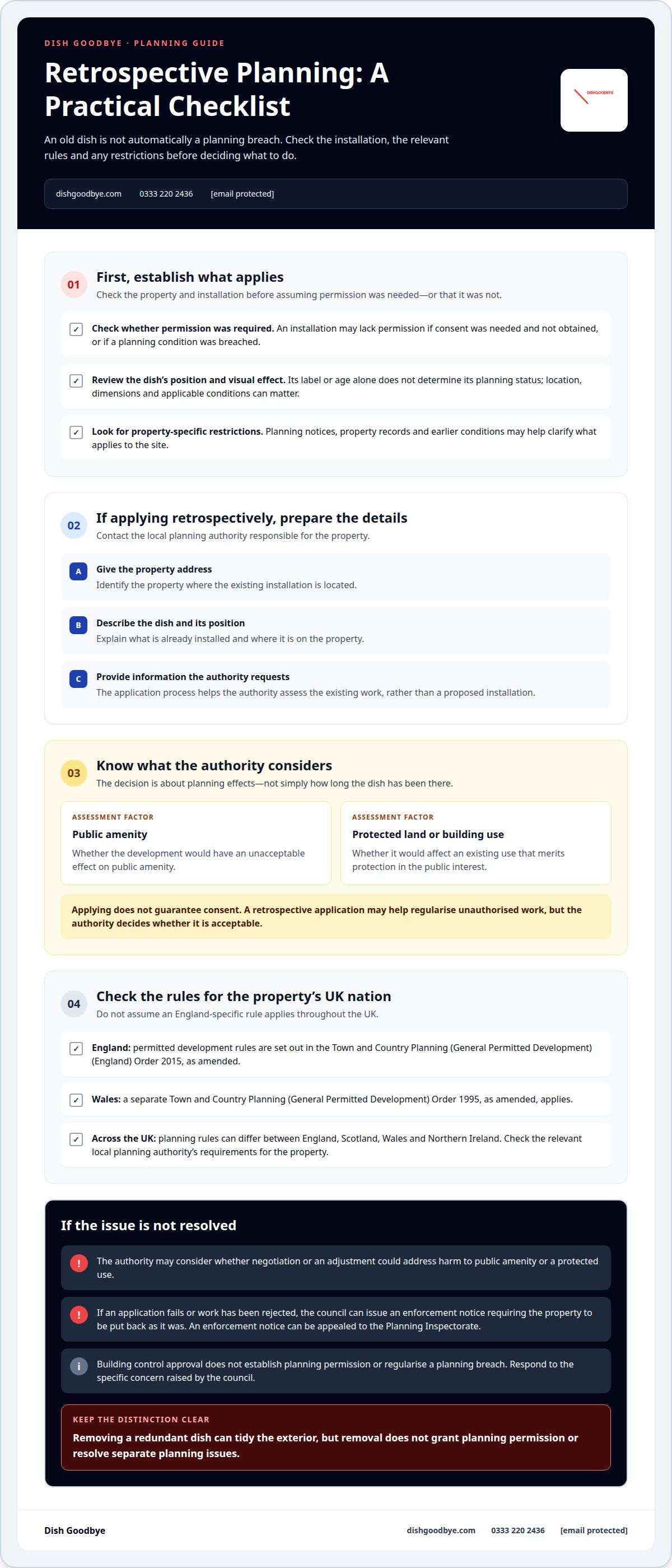
To apply for retrospective planning permission for a dish, contact the local planning authority responsible for the property and explain that the installation is already in place. Provide the property address, describe the dish and its position, and supply any information the authority requests as part of its application process. This helps the authority assess the existing work rather than a proposed installation.
The authority considers whether the development would unacceptably affect public amenity or an existing land or building use that merits protection in the public interest. A planning breach is not, in itself, illegal, and a retrospective application may resolve work carried out without permission. But submitting an application does not mean consent will be granted.
Negotiating a Retrospective Application
Negotiation means discussing changes or a resolution with the planning authority while addressing an existing breach. It may matter if a dish’s position, appearance or effects raise planning concerns, because the issue is the development’s impact, not simply its age.
In some enforcement cases, negotiation or a retrospective application can help resolve the breach. The authority may consider whether an adjustment could address harm to public amenity or a protected use. If the development has already been rejected, or a retrospective application fails, the council can issue an enforcement notice requiring the property to be put back as it was. An enforcement notice can be appealed to the Planning Inspectorate.
Retrospective Permission Across the UK
Yes, planning rules for dishes can differ across England, Scotland, Wales and Northern Ireland, so don’t assume an England-specific rule applies throughout the UK. The relevant planning system and local requirements depend on the property’s location.
For example, England’s permitted development rules are set out in the Town and Country Planning (General Permitted Development) (England) Order 2015 (as amended), while Wales has a separate 1995 order (as amended). These rules set limitations and conditions. Check the relevant local planning authority’s requirements for the property’s nation before relying on permitted development rights or making a retrospective application.
Keep planning permission separate from building control: a building control inspection or approval does not establish planning permission or regularise a planning breach. If a council raises an enforcement concern, respond to the specific issue it identifies. Explain the installation’s location and circumstances, and ask about the retrospective application process. The authority’s decision depends on planning effects and the protections relevant to the site.
Retrospective planning considers whether existing work can be accepted under planning control. It doesn’t mean every old installation needs consent or that an application will automatically succeed. If permission is refused, or the application doesn’t resolve the issue, an enforcement notice may require corrective action or restoration. Addressing the planning question promptly helps clarify whether consent, a change to the work or another resolution is needed.
When existing development may lack planning permission
An existing installation may lack planning permission if it needed consent and none was obtained, or if it breaches a planning condition. The dish’s appearance and location, permitted development rules and any restrictions on the property all matter.
Permitted Development for Dishes
Permitted development rights allow certain work without a planning application, provided the relevant limitations and conditions are met. This matters because an installation can appear minor but still fall outside those rights.
In England, the Town and Country Planning (General Permitted Development) (England) Order 2015, as amended, sets relevant limits and conditions. Wales has its own Town and Country Planning (General Permitted Development) Order 1995, as amended. A planning notice or property record can help establish whether restrictions or earlier conditions affect the site.
Types of Dish and Planning Rules
Planning control concerns the development and its effects, not simply whether an object is called a satellite dish, decorative plate or dish antenna. Its label alone doesn’t establish that permission is unnecessary.
Compare the installation’s position, dimensions and visual effect with the applicable permitted development conditions. For example, a decorative plate fixed to a building may raise a different question from an operational dish antenna, but its decorative purpose alone doesn’t prove it is exempt. A difference in size or location can also affect the council’s assessment.
Size and Number Limits
There is no single UK-wide size and number limit that can safely be applied to every satellite dish. Permitted development rules and restrictions differ by location, so the relevant nation’s rules and the property’s circumstances matter.
England’s 2015 order and Wales’s 1995 order set their own limitations and conditions. Check the local planning authority’s requirements for the property and review any planning conditions before relying on permitted development. A dish that appears acceptable on a neighbouring roof doesn’t establish that the same dimensions or number are allowed at your address.
Checking an Existing Dish’s Status
Search the council’s planning application records using the property address, then compare any permission and conditions with the dish’s current position and appearance. A building control inspection or approval does not establish planning permission or make a planning breach lawful.
Nearby development can provide context, but it isn’t automatic precedent: different permissions, conditions or site impacts may explain different outcomes. If the dish’s status remains uncertain, a Certificate of Lawfulness can formalise a claim that the development is lawful. In England, an application relying on the time limit must show at least ten years of continuous evidence of the unauthorised development or use.
Useful evidence may include dated photographs, installation records or documents showing when the dish was in place. Keep records in date order and ensure they relate to the same installation. Gaps can make it harder to establish continuous use, while a planning application or certificate gives the council specific information to assess. Nearby examples may provide context, but the property’s own planning history remains central.
Unauthorised building works and changes of use
In England, a breach of planning control includes carrying out development without required planning permission. It can also mean breaking a condition attached to permission.
Listed-Building Exceptions
Listed buildings are an important exception to ordinary enforcement time limits because unauthorised works to them require consent, regardless of how much time has passed. The usual enforcement period therefore cannot be assumed to make such work lawful.
A dish installation or other alteration affecting a listed building needs careful consideration of the building’s status and the work carried out. Planning permission and listed building consent are separate questions; one does not automatically settle the other. If the property is listed, identify the changes and gather dated photographs or other records before responding to a council’s enforcement enquiry.
Other timing exceptions can also matter. In England, the former four-year period remains available for qualifying operational development substantially completed before 25th April 2024. For later work, the usual enforcement period for building, engineering, mining or other operations is ten years from substantial completion, subject to transitional provisions, according to UK Parliament. The date and type of work both affect which period applies.
What Counts as a Planning Breach
Section 171A of the Town and Country Planning Act 1990 defines a breach in England as carrying out development without required planning permission. Section 55 defines development to include building or engineering operations and material changes of use.
For example, an extension built without required consent may be unauthorised development. Converting a building to a different use can also raise planning control issues if the change is material and permission is required. Subdividing a dwelling into separate homes is another example included in the statutory definition of development.
Permitted development rights can allow certain work without a planning application, but only when the applicable limitations and conditions are met. Work outside those rights may require permission. A building control inspection or approval does not establish planning permission or regularise a planning breach, so keep the processes separate.
Evidence helps establish what happened and when. Keep dated plans, photographs, planning decisions and records of construction or use together. For an extension, evidence of substantial completion can be relevant to the enforcement period; for a change of use, records should show when the new use began and whether it continued.
If a council considers that planning control has been breached, it can serve an enforcement notice requiring corrective action. Read the notice carefully: it identifies the alleged breach, required steps and the time allowed. A planning application may help resolve unauthorised work, but it doesn’t erase the distinction between permission, permitted development and listed-building consent.
Penalties for planning breaches
A planning breach doesn’t automatically mean prosecution or a fine. In England and Wales, however, an unregularised breach of planning control, including breaking a planning condition, can be a criminal offence and result in an unlimited fine. The practical risk often increases when someone ignores formal enforcement action instead of addressing the alleged breach.
A council may serve an enforcement notice when it considers that planning rules have been broken. The notice sets out the alleged breach and the steps required to remedy it. Disobeying an enforcement notice is illegal unless it is successfully appealed. If an appeal fails and the recipient still refuses to comply, prosecution may follow.
Read every requirement and deadline in a notice carefully. If you disagree with an enforcement notice in England, you can appeal to the Planning Inspectorate. An appeal may challenge the notice on available grounds, including whether the enforcement time limit has expired. Keep the notice, relevant planning decisions and dated evidence together so your response addresses the specific allegation.
A breach of condition can also trigger formal action. Pendle Borough Council may issue a Breach of Condition Notice when development has not followed its planning permission. Failure to comply with planning enforcement action in Pendle can lead to prosecution. This differs from simply discovering that an old installation may lack permission: the notice’s terms and your response matter.
Enforcement warning notices have counted as enforcement action in England only since 25th April 2024. That date can matter when working out the enforcement period for a breach. The applicable period depends on the type and timing of the development, including whether transitional provisions apply. A work being completed years ago does not, by itself, prove that it is lawful.
Planning enforcement action is not automatic in every case. Pendle Borough Council decides whether to act based on the details, including the breach and its effects. If a retrospective planning application is refused or fails to resolve the issue, a council can require the development to be restored. For an existing dish, the concern could be its unauthorised installation or failure to meet a planning condition.
If you receive a council notice, first identify the alleged breach, required action and appeal information. Then gather property records and evidence that directly relates to the work. Responding to the stated issue helps distinguish a planning disagreement from non-compliance, which carries a clearer risk of prosecution and an unlimited fine in England and Wales.
Do old dishes breach UK planning rules?
An old dish isn’t automatically a planning breach. Whether an old dish breaches planning rules depends on whether permission was required, permitted development conditions apply, or a planning condition was broken.
Start with the installation’s planning history, not its age. A dish installed under valid permission may remain lawful, while another fitted without required permission may raise an issue. A council’s assessment focuses on the site’s facts, including effects on public amenity and any existing use of land or buildings that merits protection in the public interest.
Consider three different examples:
- A dish installed within permitted development limits may not need a planning application, provided the relevant conditions are met.
- A dish installed under planning permission may breach control if it conflicts with a condition attached to that permission.
- A dish on a listed building raises a separate consent issue, because unauthorised works to listed buildings are not covered by the usual ten-year enforcement rule.
The physical presence of a dish doesn’t settle its status. Look for the property’s planning decision, any conditions, and records showing the installation’s location and age. A neighbour’s dish can provide context, but it doesn’t prove that your installation has the same permission or meets the same limitations. The buildings may have different planning histories or circumstances.
Time limits also depend on the type and timing of development. In England, the usual enforcement period for building, engineering, mining or other operations is ten years from substantial completion, subject to transitional provisions, according to UK Parliament. Qualifying operational development substantially completed before 25th April 2024 may still fall under the former four-year period. The precise completion date can therefore matter.
That period doesn’t itself make development lawful. If you rely on time to establish lawfulness in England, an application for a Certificate of Lawfulness must demonstrate at least ten years of continuous evidence of unauthorised development or use. Dated photographs, installation paperwork and property records can help establish the timeline. Gaps or conflicting records may make the history harder to demonstrate.
Keep planning questions separate from building control. A building control inspection or approval doesn’t establish planning permission or regularise a breach. If a council contacts you, compare its stated concern with your permission documents and the dish’s actual position. If no permission record appears, that alone doesn’t prove a breach; permitted development rights or other site-specific circumstances may apply.
Finally, planning systems and rules vary across the UK. England’s and Wales’s permitted development orders are distinct, and a rule for one nation shouldn’t be applied automatically elsewhere. Identify the nation and local planning authority for the property, then use its planning records and the relevant national rules to assess the installation.
Dish Goodbye: Sky Dish Removal
Dish Goodbye provides Sky Dish Removal for redundant dishes no longer wanted on a property. Removing an unused dish can clear the exterior, but it doesn’t determine whether planning permission was needed or resolve a separate planning issue.
The quote includes removal of the dish, its bracket and associated cable, plus filling the associated fixing holes. Mention any additional cables, holes or devices in your initial enquiry; they must be quoted separately. Access, height and property conditions also affect the work involved.
If you’ve established that you want a redundant Sky dish removed, visit the Dish Goodbye service website to find out more.
Choose the next step that fits your home
Decide whether your next step is addressing a planning concern or arranging removal. If you’re still considering whether an old dish breaches planning rules, keep the planning question separate from your decision about the property’s exterior.
For help arranging removal, contact Dish Goodbye about your dish and share the details of the work you need.
You can also call 0333 220 2436 or email [email protected]. Take the next step at your pace.
Frequently Asked Questions
Do planning breaches result in fines and/or penalties?
They can, particularly if someone ignores formal enforcement action. In England and Wales, an unregularised breach of planning control, including breach of a planning condition, can be a criminal offence and result in an unlimited fine. A council may require corrective work through an enforcement notice. If the recipient doesn’t comply and an appeal fails, prosecution may follow. The notice’s requirements and the response to it matter.
Is there a cost, and can you challenge the council’s view?
There isn’t one standard cost for resolving a planning breach. The amount depends on what is needed, such as an application, changes to the work or professional advice; any removal quote depends on the job and follows an enquiry. You can challenge an enforcement notice by appealing to the Planning Inspectorate. In England, section 174 includes a ground that the time for enforcement has expired. Check the notice for its deadline and appeal details.
What happens when planning laws are breached?
A council can investigate suspected unauthorised work, consider its effects and decide whether planning enforcement is appropriate. It may seek a resolution through an application or negotiation, or issue an enforcement notice requiring specified steps. For example, a notice could require unauthorised development to be removed or the site restored. If the recipient disobeys the notice without a successful appeal, prosecution may follow. Keep the council’s correspondence and property records together.
Are dishes or satellite dishes permitted development in the UK?
Some dish installations may fall within permitted development rights, but there isn’t one rule that applies identically across the UK. The relevant order and conditions depend on the property’s nation and circumstances. For example, England’s permitted development rules are set out in the 2015 order, while Wales has a separate 1995 order. Before relying on permitted development, compare the installation with the applicable rules and any conditions attached to the property.
Do listed buildings or conservation areas have stricter rules for dishes?
Listed buildings need particular care: unauthorised works to them require consent regardless of how much time has passed. Conservation-area status can also affect a property’s planning context, but the relevant limits depend on the applicable rules and site. Check the property’s designation, planning history and any conditions before altering or removing a dish. A dish that appears acceptable on an ordinary home may raise different consent questions on a protected building.
Can a local council require an old dish to be removed?
Yes. If a council takes enforcement action and serves a notice, it can require steps to remedy a planning breach, which may include removing the dish or restoring the property. The notice should identify the alleged breach, required action and compliance period. Read these details closely. If you disagree, use the appeal route and deadline stated in the notice; leaving the dish in place after an unsuccessful appeal can lead to prosecution.