

A surveyor-flagged satellite dish doesn’t automatically mean you need a planning application. In England, a dish may be permitted development if it meets the relevant conditions, but a surveyor’s note alone doesn’t establish whether permission or a certificate of lawfulness is needed.
It’s understandable to want a clear answer before arranging work or responding to a survey. The key is why the dish was flagged, and whether its position, the building and the applicable planning rules affect what can be done.
This guide explains what a surveyor’s note about a satellite dish does and doesn’t mean, when planning permission or a certificate of lawfulness may be relevant, and when specialist help can clarify the next step. You’ll also learn how dish removal can fit into resolving a property report, so you can address the issue without guessing.
Key Takeaways
- A surveyor flagging a satellite dish does not, by itself, establish whether planning permission is required. The property and the circumstances behind the note matter.
- Understand the difference between a planning application and a certificate of lawfulness, and when each may help clarify a proposed or existing dish.
- For an antenna installed on a chimney in England under Class H, the maximum length is 0.6 metres, according to The National Archives.
- A survey report may flag a dish because of its condition or position. Learn when a specialist assessment can help clarify the concern.
- If the dish is no longer needed, find out how professional removal can help tidy the exterior and address the fixing holes associated with the removal.
Planning applications and certificates of lawfulness
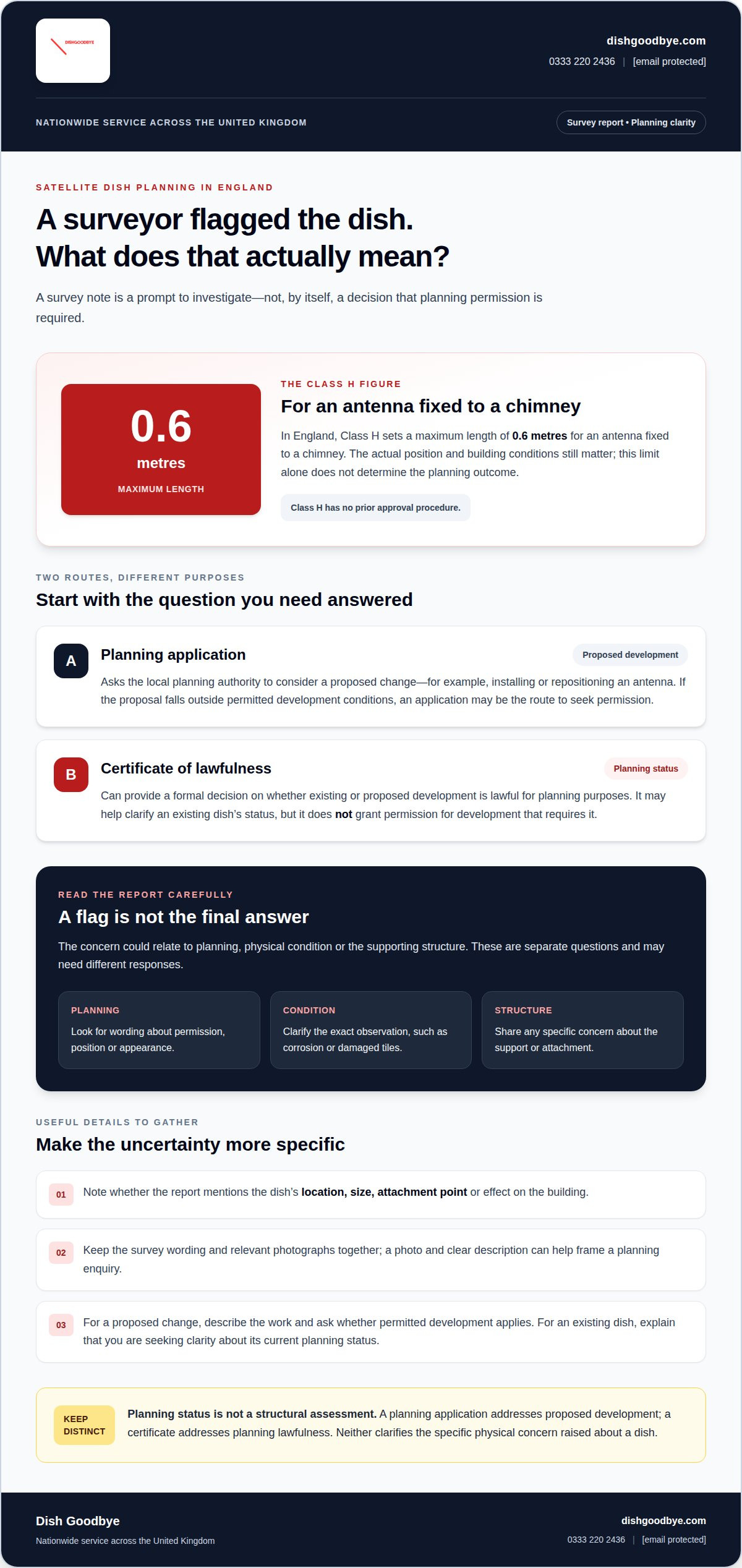
A survey report flagging a dish does not, by itself, establish that planning permission is needed. In England, the key question is whether the dish and its position meet the relevant permitted development rules, including Class H. A planning application and a certificate of lawfulness serve different purposes, so first distinguish a proposed change from a request to clarify the status of existing work.
A planning application asks the local planning authority to consider proposed development. For example, an owner planning to install or reposition an antenna may need to establish whether permitted development rights cover the proposal. Class H sets conditions for certain antennas in England. If a proposal falls outside those conditions, an application may be the route to seek permission. A surveyor’s note is a prompt to investigate, not a decision by the planning authority.
A certificate of lawfulness serves a different purpose: it provides a formal decision on whether existing or proposed development is lawful for planning purposes. It may be relevant when a dish is already installed and a survey report raises questions about its planning status. The certificate does not grant planning permission for development that requires it. Keep the two routes distinct: an application seeks consent for a proposal, while a certificate seeks a decision about lawfulness.
Class H is not a blanket approval for every dish. Its conditions can depend on where the antenna is placed and the building concerned. For instance, an antenna fixed to a chimney in England must be no more than 0.6 metres in length under Class H, according to The National Archives. If a survey identifies a chimney-mounted dish that appears longer, that detail may need closer planning review. It does not, on its own, determine the final decision.
Class H has no prior approval procedure, according to The National Archives. So prior approval is not an extra step in this particular permitted development route. This does not remove the need to consider whether Class H applies or whether another planning route is relevant. When reading a survey, distinguish a concern about the dish’s physical condition from one about its planning position. These are separate issues and may need different responses.
Use the survey wording as a starting point for clarifying the planning question. Note whether it identifies the dish’s location, size, attachment point or effect on the building. A report that simply says “satellite dish flagged” may not explain whether the concern is permission, appearance or condition. A photograph and a clear description of the proposed change can help frame an enquiry to the local planning authority. For an existing dish, explain that you’re seeking clarity about its current planning status.
- For a proposed installation or alteration, describe the work and ask whether permitted development applies.
- For an existing installation, consider whether a certificate of lawfulness would address the uncertainty.
- For a Class H question, compare the actual position and installation with the applicable conditions.
Keep the survey report and any planning decision with the property records. If the report describes a possible safety issue, don’t treat a planning decision as a structural assessment. A permission application addresses proposed development; a certificate addresses planning lawfulness. Neither clarifies the specific concern raised about the dish.
When to consult a specialist
Consult a planning specialist when the survey report questions whether an existing dish has planning permission or permitted development status. This can be especially useful if the report identifies the dish’s position, appearance or attachment as a planning concern. A specialist can help distinguish that issue from physical condition, so the next step addresses the point raised. For example, a dish fixed to a prominent roof slope may prompt a different planning query from one mounted discreetly on a rear wall.
Ask a building surveyor to clarify ambiguous wording in the report. “Dish requires attention” doesn’t explain whether the concern is loose fixings, roof damage or simply an outdated fitting. Ask what observation led to the flag and whether the report recommends further assessment. If photographs show corrosion around a bracket, that’s a specific observation to discuss. If the report only notes the dish’s presence, clarify whether the concern is its condition or planning status.
A roofing professional may be relevant when the survey describes damage around the mounting point. For example, cracked tiles, disturbed flashing or water staining near the fixing may need assessment as building issues rather than planning questions. Keep the survey wording and photographs together. Explain where the dish is mounted and what the report observed. This gives the professional a clear starting point and helps distinguish visible symptoms from assumptions about their cause.
Seek structural expertise if the report specifically raises concern about the supporting structure or how the dish is attached. A surveyor’s observation can identify an issue for further investigation without establishing its cause. Share the relevant extract, photographs and property details. A specialist can then focus on the concern named, such as movement at a fixing or damage to masonry, rather than treating every old dish as a structural defect.
- For a planning concern, identify the wording about permission, position or appearance.
- For a condition concern, note the exact defect described, such as corrosion or damaged tiles.
- For a structural concern, share the report’s specific observation and supporting photographs.
Some cases involve more than one issue. A report might mention a dish on a roof and staining inside the room below. That combination doesn’t prove the dish caused the staining, but it gives the surveyor a specific relationship to assess. Keep planning questions separate from repair questions. A decision about planning status doesn’t explain the cause of a leak, just as a repair assessment doesn’t determine planning lawfulness.
Before arranging work, use the report to define the problem and the specialist’s role. If the wording is unclear, ask the surveyor to identify the observation and recommend follow-up. If the report names a physical defect, focus the enquiry on that defect. If it raises planning status, focus on the property, dish position and relevant records. This targeted approach avoids treating a brief survey note as a complete diagnosis.
Can a surveyor report a satellite dish as a defect or safety risk?
Yes. A surveyor can record a satellite dish as a defect or safety concern when visible conditions warrant attention. The note should describe what was observed, such as a loose-looking bracket, damaged roof covering or corroded fixings. A surveyor-flagged satellite dish isn’t automatically proof that the dish is dangerous. The report records an inspection finding and may recommend further investigation if the cause or severity needs closer assessment.
Look for the specific observation in the report. “Dish present” describes an installation, while “bracket appears loose” identifies a possible defect. “Damaged tiles beneath dish” points to a separate roof concern. These phrases aren’t interchangeable. If the report doesn’t explain the basis for its concern, ask the surveyor to clarify the wording and identify any recommended follow-up.
Survey condition ratings can help show how seriously a report treats an issue. In the rating system described, Condition Rating 3 indicates serious and/or urgent defects. Condition Rating 2 indicates defects needing repair or replacement, but not classed as serious or urgent. Read the rating alongside the written observation. A rating without the associated detail does not explain whether the concern relates to the dish, its bracket, roof materials or another feature.
Separate a potential safety issue from evidence of damage. For example, a report might describe a bracket that appears insecure, but that observation alone doesn’t establish how it’s attached or whether the roof is affected. Another report might identify cracked tiles without linking them to the dish. Keep those findings distinct. The location, photographs and exact wording help a relevant specialist understand what needs assessment.
- Loose bracket: note whether the report describes movement, corrosion or a visible gap.
- Roof damage: record the named materials, such as tiles or flashing, and their position.
- Water marks: note where staining appears and whether the report connects it to a roof defect.
- Obstruction: identify what the dish appears to affect, such as access to roof maintenance.
If a report calls a defect serious or urgent, treat that wording as a priority for clarification. Don’t climb onto the roof or test a bracket yourself. Share the relevant report extract and photographs with a suitable professional. If a dish or fixing appears unstable from the ground, keep people away from the immediate area while arranging an assessment. Let the report’s stated concern guide the next step.
A surveyor’s report also has limits. A visual inspection can record accessible, visible evidence, but hidden fixings or concealed roof damage need a different assessment. For example, a photograph of a dish can’t show the condition of every fixing behind its mounting plate. Ask what the surveyor observed directly and what remains an assumption. This distinction helps prevent a property defect from being mistaken for a confirmed cause.
Use the report to decide which question needs answering first: is there a physical defect, a safety concern or simply an old fitting? A clearly described defect calls for an assessment of that specific condition. A vague note needs clarification before anyone assumes the dish caused damage. Keeping the survey wording, photographs and follow-up findings together creates a practical record for property decisions.
Satellite dishes
A satellite dish is an antenna, so its position and type matter when considering England’s Class H permitted development rules. A dish on a chimney, a microwave antenna on a house and equipment on a taller building raise different questions. Start by identifying the installation described in the survey: note its location, mounting point, approximate size and whether other antennas are present.
For a chimney installation, check the antenna’s length against the Class H limit. In England, an antenna installed on a chimney under Class H must be no more than 0.6 metres in length, according to The National Archives. This is a specific condition for chimney-mounted antennas. A dish fixed to a wall or another part of a building should not be assessed against that chimney measurement without considering its actual mounting position.
Building height and land designation can also affect the permitted development position. On article 2(3) land in England, Class H does not permit an antenna on a building that exceeds 15 metres in height, according to The National Archives. The survey should therefore be read alongside the building’s height and location. A dish on a low dwellinghouse and an antenna on a taller building in a designated area cannot automatically be treated alike.
Count microwave antennas across both the dwellinghouse and its curtilage. In England, Class H permits no more than 2 microwave antennas on a dwellinghouse and within its curtilage combined, according to The National Archives. The number is combined, not a separate allowance for the house and its grounds. For example, an existing antenna within the curtilage may matter when considering another on the building.
Position matters too. Under Class H in England, an antenna should, so far as practicable, be sited to minimise its effect on the building’s external appearance. So the dish’s location matters, not just its size. A survey photograph showing equipment on a prominent front elevation may help explain why its appearance was noted. The relevant condition concerns siting where practicable; it doesn’t mean every visible dish automatically needs an application.
Class H also addresses equipment that is no longer needed. In England, an antenna no longer needed for reception or transmission under Class H must be removed as soon as reasonably practicable. This condition is relevant when a dish has become redundant, not simply old. Check whether it still serves a reception purpose before treating its age alone as decisive.
Use these details to organise the planning question:
- Record whether the antenna is on a chimney, wall or another part of the building.
- Note the building height and whether the property is on article 2(3) land.
- Count microwave antennas on the dwellinghouse and within its curtilage together.
- Establish whether the dish remains needed for reception or transmission.
These are England-specific Class H considerations, not a complete answer for every property or antenna. If a survey flags an old dish, compare the report’s concern with the actual position, building and equipment. A planning question about Class H is separate from a survey finding about physical condition. Keeping the issues distinct makes it easier to identify what the report is asking you to resolve.
Dish Goodbye: Satellite Dish Removal
Dish Goodbye provides Satellite Dish Removal when a redundant dish needs to come down after a property survey. The standard quote covers the dish, its bracket and associated cable, plus filling the fixing holes left by the removal. Mention any additional cables, holes or devices in your initial enquiry, as these are quoted separately.
Share the property details and describe the dish’s position. Access, height and property conditions are assessed for each quote to define the work involved. Collection, recycling and disposal arrangements can also be discussed when requesting a quote. This gives you a clearer picture of the removal scope before deciding how to proceed.
For a redundant dish flagged in a survey, contact Dish Goodbye to discuss removal.
Move forward with a clear plan
A surveyor-flagged satellite dish can feel like one more loose end in a property decision. Turn the report into a practical plan by keeping its observations together with photographs, planning correspondence and notes from relevant assessments. This record helps explain what needs resolving and avoids confusing a planning question with a physical defect, or vice versa.
If the dish is redundant and removal is the chosen next step, Dish Goodbye offers Satellite Dish Removal and Sky Dish Removal. Removing an unused fixture can help leave the exterior clearer. The quote sets out the agreed work for the property, so include any additional cables, holes or devices in your initial enquiry for separate quoting.
Keep the relevant documents with your property records, especially if you’re preparing for a sale or future maintenance. A clear record makes it easier to explain what was flagged and what action followed, without relying on memory or a brief survey note.
Take the next step at a pace that suits your plans. Contact Dish Goodbye to discuss your enquiry and move towards a tidier exterior.
Dish Goodbye: 0333 220 2436 | [email protected].
Frequently Asked Questions
What Should I Do?
Start by finding the exact wording in the survey report and identifying whether it describes planning, condition or both. If it mentions a loose bracket or damaged roof covering, arrange an assessment of that specific issue rather than trying to inspect the roof yourself. If the dish is redundant, consider whether removal is the practical next step. Keep photographs and follow-up findings with the report for future property records.
Why would a surveyor flag a satellite dish on a UK property?
A surveyor may flag a dish because of visible concerns, such as a corroded bracket, damaged tiles nearby or signs of water ingress. The note might also raise a question about the dish’s position or planning status. For example, a report could mention a dish on a prominent roof area without identifying a physical defect. Read the wording carefully: a flag doesn’t automatically mean the dish is unsafe or unlawful.
Does a satellite dish need planning permission in the UK?
Not always. In England, a dish may fall within permitted development under Class H if the relevant conditions apply. If it falls outside those conditions, planning permission may be needed. Class H isn’t a single rule for every UK property, so the nation, building and dish position matter. For an existing dish, a certificate of lawfulness may help establish its planning status; it doesn’t grant permission for development that requires it.
What should I check if a survey flags a loose or damaged satellite dish?
Use the survey’s exact description to identify the concern. Note whether it mentions movement, rust, cracked roof coverings, damaged flashing or interior water marks. Don’t climb up or test the dish yourself. Ask the surveyor to clarify any unclear observation, then share the relevant report extract and photographs with a suitable professional. If the dish appears unstable from the ground, keep people clear of the immediate area while arranging an assessment.
What steps should a buyer take if a survey flags a satellite dish?
Before deciding how the finding affects your purchase, ask for the surveyor’s specific observation and any recommended follow-up. Separate a possible repair issue from a planning question, as they need different assessments. Request relevant records or correspondence from the seller if available, and keep the report, photographs and responses together. For a removal enquiry, contact Dish Goodbye on 0333 220 2436 or at [email protected].