

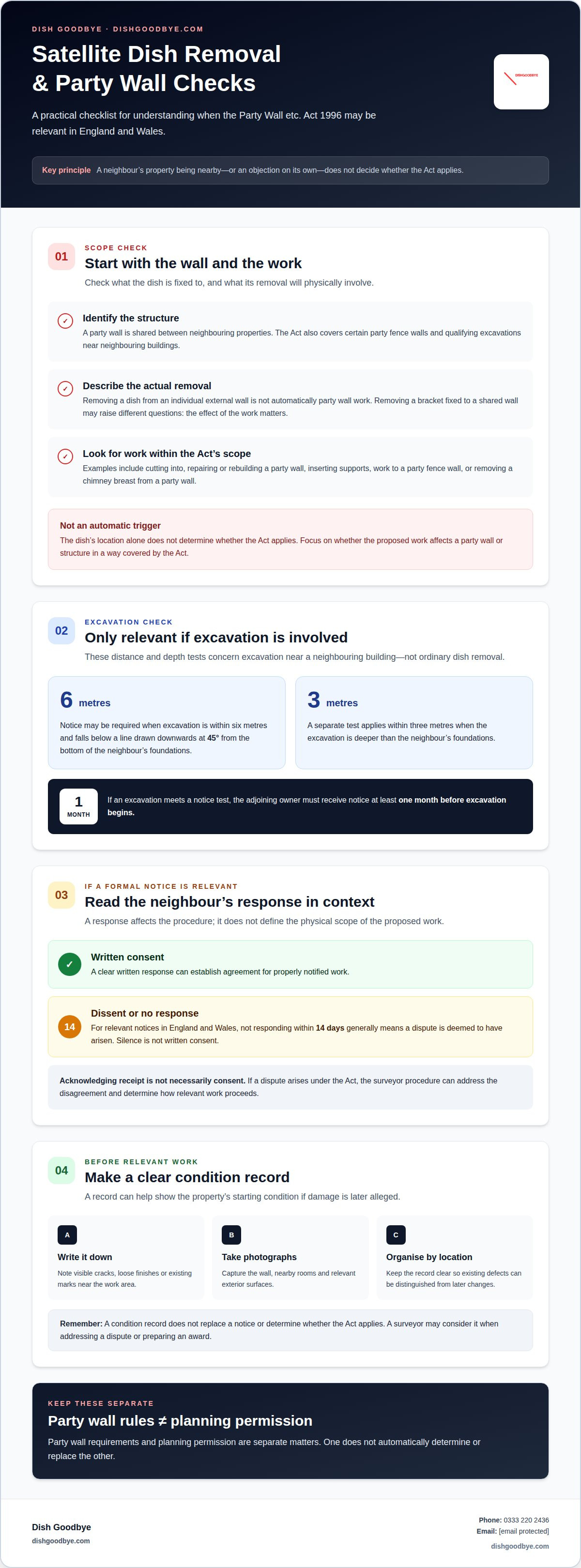
Removing a satellite dish does not automatically trigger party wall procedures. In England and Wales, a party wall agreement for dish removal is generally relevant only when the work affects a party wall or party structure. The dish’s location alone does not determine whether the Act applies.
It’s easy to assume that anything fixed near a neighbour’s property needs their agreement. The key question is what the removal involves and whether it affects a shared wall or structure. Party wall requirements are also separate from planning permission, so one does not automatically determine the other.
Here, you’ll learn what counts as a party wall, when dish removal may bring the Party Wall etc. Act 1996 into play, and how a neighbour can respond if formal notice is needed. You’ll also see how those rules differ from planning permission, helping you understand the next step before work begins.
Key Takeaways
- Learn why removing a dish doesn’t automatically mean party wall procedures apply; the nature of the work and the wall or structure affected matter.
- Understand how documenting a property’s condition before relevant work can help create a clear record.
- Find out how a neighbour’s response, or lack of response to a relevant notice, can affect what happens next.
- See why party wall requirements and planning permission are separate matters, so one does not replace the other.
- Understand how surveyors can help resolve a dispute and set out arrangements for relevant work.
Can my neighbour stop my building work?
A neighbour’s objection does not, by itself, determine whether the Party Wall Act applies. The key is whether the proposed work falls within the Act’s rules and, if notice is required, how the neighbour responds.
According to UK legislation, the Party Wall etc Act 1996 provides a framework for preventing and resolving disputes about party walls, boundary walls and excavations near neighbouring buildings in England and Wales. A dish removal is not automatically covered just because a neighbour lives next door. The work and the structure affected matter.
Neighbour Consent Responses
A consent response is the adjoining owner’s written reply to a formal notice about work covered by the Act. A clear response helps establish whether the work can proceed by agreement or whether the dispute procedure is needed. Acknowledging receipt of a notice is not necessarily the same as giving written consent to the proposed work, so consider the response in context.
For dish removal, focus on the physical work involved. Removing a bracket fixed to a shared wall may raise different questions from removing a dish fixed to a wall belonging solely to the building owner. The issue is whether the work affects a party wall or structure in a way covered by the Act, not simply whether the neighbour objects.
Excavation rules concern work near a neighbour’s structure, rather than ordinary removal of a dish from an exterior wall. In England and Wales, notice is required for certain excavations within six metres when they fall below a line drawn downwards at 45 degrees from the bottom of the neighbour’s foundations. A separate test applies within three metres when the excavation is deeper than those foundations.
These distance and depth tests help determine whether excavation notice is needed. If the work meets a test, the adjoining owner must receive notice at least one month before excavation begins. The rule is about excavation close to a neighbouring building; it should not be confused with the act of removing a dish or its fixings.
Effects of Neighbour Responses
A neighbour’s consent can allow properly notified work to proceed, while dissent or silence can trigger a formal dispute procedure. According to UK legislation, for relevant Party Wall Act notices in England and Wales, a failure to respond within 14 days generally means that a dispute is deemed to have arisen. That response affects the process, rather than deciding the work’s physical scope.
If a dispute arises under the Act, the matter moves beyond a simple exchange of acknowledgements. The surveyor procedure can address the disagreement and determine how relevant work proceeds. Silence is not written consent, and an objection alone does not establish whether the Act applies. First identify the work and any notice, then consider the neighbour’s response within the statutory procedure.
For example, a planned excavation beside a neighbour’s foundations may require notice under the relevant distance and depth tests. Removing a dish without excavation does not meet those tests merely because the property is close to another home. A neighbour’s response matters when notice is required, but that requirement depends on the work and its relationship to the neighbouring structure.
What is a party wall?
A party wall is a shared wall between neighbouring properties, such as the wall separating two homes. The Party Wall etc. Act 1996 also covers certain boundary walls and excavations near neighbouring buildings in England and Wales. It gives owners rights for defined work, rather than making every job beside a neighbour subject to the same procedure.
Work covered by the Act can include cutting into, repairing or rebuilding a party wall, and inserting supports. It also covers certain work to a party fence wall and excavations that meet the relevant distance and depth tests. Removing a chimney breast from a party wall is another example. By contrast, removing a dish fixed to an individual external wall is not automatically party wall work. The question is whether the proposed work falls within the Act’s scope.
A notice should describe the specific work that may be covered. A broad phrase such as “renovation works” may not give the neighbour enough information to consider the proposal. A clearer description identifies the affected wall or structure, the planned work and how it will be carried out. Plans or drawings can show how the work relates to the boundary. This gives the adjoining owner useful details instead of leaving them to guess what the project involves.
Recording the property’s condition before work creates a useful reference if damage is later alleged. A dated written schedule can describe visible cracks, loose finishes or existing marks near the work area. Clear photographs of the wall, nearby rooms and relevant exterior surfaces can support the record. Organise the material by location, and distinguish existing defects from changes noticed after the work. This is particularly useful where a shared wall or adjacent structure could be affected.
A condition record does not replace a notice or determine whether the Act applies. It clarifies the property’s starting condition. For example, if a crack appears near a party wall after construction, dated photographs and a written description can help establish whether it was visible beforehand. A surveyor may consider condition information when addressing a dispute or preparing an award.
Costs and damage are separate issues. Under statutory party wall procedures, the building owner proposing the work commonly bears reasonable costs, subject to the circumstances and applicable legal rules. In England and Wales, an owner is responsible for damage caused by work under the Act, including damage caused by their contractor. A clear description of the proposed work and a record of the property’s condition can help establish what was planned and what changed.
Adjoining owner's response and deemed dissent
For work covered by the Party Wall etc. Act 1996, the building owner must notify adjoining owners using the procedure set out in the Act. The notice should identify the proposed work clearly, so each adjoining owner can understand how their property may be affected. A neighbour’s reply then helps determine whether the work proceeds by consent or enters the dispute procedure.
According to UK legislation, for relevant Party Wall Act notices in England and Wales, a failure to respond within 14 days generally means that a dispute is deemed to have arisen. Silence is therefore not the same as written consent. The rule applies to relevant notices, so the type of notice and work proposed matter. A dispute arising does not itself establish that the work is prohibited; it changes the process for resolving the disagreement.
An adjoining owner may consent, dissent or, where the Act allows, propose additional work. For a Party Structure Notice, an adjoining owner may serve a counter-notice within one month of service, according to UK legislation. The counter-notice can set out work they want carried out alongside the proposed work. The building owner must consider the response under the statutory procedure.
The Act also sets out rights concerning repair of a party wall. Section 2 concerns repair and the rights of an owner, including specified work to a party wall. That does not mean either owner can carry out any alteration they choose. The proposed work must fit the relevant statutory rights, and notice requirements still matter. For example, a repair to a shared wall and a change affecting only one owner’s separate wall raise different questions.
Consent, dissent and a counter-notice have different effects. Written consent can allow properly notified work to proceed, while dissent or a relevant failure to respond brings the dispute procedure into play. If the adjoining owner requests additional work, the disagreement may concern its scope as well as the original proposal. Keep the notice, response and work details together: they show what was proposed and how the adjoining owner replied.
If a dish is fixed near a boundary, first establish whether removing it affects a party wall or structure covered by the Act. If it does, consider the adjoining owner’s response through the correct notice process. If it does not, the Act’s response procedure does not apply automatically just because a neighbour objects. This distinction separates a neighbour’s concern from a statutory dispute.
Party wall requirements compared with planning permission
Party wall requirements and planning permission are separate matters in England and Wales. The Party Wall etc. Act 1996 concerns certain work affecting party walls, boundary walls and nearby excavations. Planning permission is a different process, so a decision about one does not settle the other. A project may need consideration under both systems, depending on the work involved.
Treat these as separate questions. Does the proposed work fall within the Act’s rules for a party structure, boundary or excavation? Separately, does the development need planning permission? The first question concerns the relationship between the work and neighbouring structures; the second concerns planning controls. An answer on one does not provide consent or approval on the other.
For example, proposed building work near a boundary may raise questions about whether a notice procedure applies, but that does not by itself establish that a neighbour’s consent is needed. The notice does not itself grant planning permission. Equally, obtaining planning permission, if needed, does not replace a party wall notice when the proposed work falls within the Act. The processes address different matters.
The distinction also matters for construction near a neighbour’s property. Certain excavations may require notice under the Act because of their distance from, and depth relative to, a neighbouring structure. These tests concern excavation and foundations, not planning decisions. A project such as an extension may raise both questions: whether planning permission is needed and whether excavation or party structure work triggers statutory notice.
Surveyors have a role in the party wall procedure when a dispute arises, but they do not decide planning permission through that procedure. Likewise, a planning decision does not resolve a disagreement between adjoining owners about work covered by the Act. Keep correspondence, plans and notices for each process separate so one document is not mistaken for an answer to both questions.
For a dish fixed to an exterior wall, assess the physical work rather than assuming either process applies. Removing a dish does not automatically require planning permission or party wall procedures. The relevant party wall question is whether the work affects a structure or involves another activity covered by the Act. Planning permission remains a separate consideration, and the Act’s notice process is not a substitute for it.
Before work begins, identify the proposed work and the parts of the property it affects. If plans include a new boundary wall, work to a party structure or qualifying excavation, consider the party wall process separately from planning permission. Keeping these processes distinct makes it easier to understand which applies, what notices may be relevant and what decision each can provide.
Party wall work and disputes
A dispute under the Party Wall etc. Act 1996 changes how covered work is agreed and documented. According to UK legislation, when a dispute arises under the Act, the owners may appoint one agreed surveyor or each appoint a surveyor under section 10. The surveyor or surveyors resolve the dispute through the statutory procedure, rather than acting as either owner’s advocate.
The owners can agree on a single surveyor or each appoint one. Either route is intended to resolve the specific disagreement about the proposed work. For example, owners may disagree about how work to a shared wall should be carried out or what protections are needed. The surveyor considers the issues within the Act and prepares a Party Wall Award setting out the decision and relevant arrangements.
An award is a legally binding document issued by the appointed surveyor or surveyors. It can explain how covered work must be carried out and set out access arrangements where access is required under the Act. This gives both owners a written reference for the work’s scope and conditions. The details depend on the dispute and proposed work, not simply on the fact that neighbours disagree.
Access is a separate practical issue. According to UK legislation, access to a neighbour’s property for necessary work under the Party Wall Act is normally subject to 14 days’ notice. The need for entry must relate to work permitted under the Act. For instance, reaching a shared structure may require access, while work that can be completed entirely from the building owner’s property may not.
Notice timing also depends on the type of work. According to UK legislation, work to an existing party wall or party structure in England and Wales generally requires at least two months’ notice under the Party Wall Act. That period should not be confused with the separate notice period for access. Correct notice gives the adjoining owner time to respond before relevant work is carried out.
For dish removal, the central question is whether the physical work falls within the Act. If it is covered and a dispute arises, the owners follow the surveyor procedure. If it is not covered, this statutory dispute route does not automatically apply. First identify the affected structure, proposed work and any required access. Those details determine which procedure is relevant and what an award may need to address.
Dish Goodbye
Dish Goodbye removes redundant dishes to help leave your property exterior tidier. Its Sky Dish Removal service covers the dish, its bracket and associated cable, plus filling the fixing holes left by removal.
If you’re considering a party wall agreement for dish removal, the key legal question remains whether the proposed work affects a structure covered by the Party Wall etc. Act 1996. Removal alone doesn’t automatically mean a party wall procedure applies. Dish Goodbye covers the whole of the United Kingdom, and the work and property conditions inform each quote. Mention any additional cables, holes or devices in your initial enquiry so they can be quoted separately.
Contact Dish Goodbye to discuss removing your dish.
Make your next step a clear one
Before arranging removal, note where the dish is fixed and whether the wall is shared. If the work could affect a party structure, this information can help clarify whether a party wall agreement for dish removal is relevant. Keep any written response from the neighbour together with details of the proposed work, so the practical arrangements are clear.
For a straightforward enquiry, include the property location, the dish’s position and any extra cables, holes or devices you want addressed. Any additional cables, holes or devices must be mentioned in the initial enquiry and quoted separately. Dish Goodbye handles dish removal; whether the Party Wall Act applies depends on the structure affected and the work involved.
Discuss your dish removal with Dish Goodbye and take the next step towards a tidier exterior.
0333 220 2436
[email protected]
Frequently Asked Questions
As a building owner, what do I have to do?
If your proposed work falls within the Party Wall etc. Act 1996 in England or Wales, give the relevant adjoining owner written notice before starting. Describe the specific work and the affected wall or structure, rather than using a broad phrase such as “building works”. Keep a copy of the notice and any reply. If the work concerns only your own wall and falls outside the Act, this notice procedure may not apply.
Do I need a Schedule of Condition if my neighbour consents?
Not necessarily. Consent records agreement to the proposed work, while a Schedule of Condition records the property’s existing state. For a party wall agreement for dish removal, a written record may still help clarify the starting condition if nearby surfaces could be affected. For example, dated photographs and notes can show existing marks or cracks. Keep the record with the notice and consent so the documents are easy to refer to.
Example 3: What Should Be Included if the Neighbour Consents?
Keep the neighbour’s written consent alongside a clear description of the agreed work. Identify the wall or structure, describe what will be removed or altered, and record any agreed access arrangements. If the neighbour’s consent includes conditions or requested changes, keep those details in writing too. This helps distinguish the agreed proposal from later changes, which should not be assumed to form part of the original consent.
How much notice is needed?
In England and Wales, the notice period depends on the work. Work to an existing party wall or party structure generally requires at least two months’ notice under the Party Wall Act. Certain boundary or excavation notices generally require one month. These periods apply to work covered by the Act, not automatically to every dish removal. Identify the work first, then use the notice period relevant to that category.