

Dish Goodbye | 0333 220 2436 | [email protected]
Removing a Dish from a Party Wall When Your Neighbour Objects
What if your neighbour objects to removing a dish from a party wall? Their objection doesn’t automatically settle the matter: in England and Wales, the Party Wall etc. Act 1996 may apply if the work affects an existing party wall, and the Act provides a way to resolve disputes.
It’s understandable to want a redundant dish removed without creating tension or risking damage next door. First, establish whether the proposed work falls within the Party Wall process. Verbal agreement alone may not replace the statutory procedure where the Act applies.
This article explains how an objection can affect the next steps, what may happen if the process is skipped, and how damage to adjoining property can be addressed. It also explains why removing a dish from a party wall needs a different approach from removing one attached only to your property.
Key Takeaways
- Find out whether the dish is fixed to a party wall and whether the proposed work falls under the Party Wall process before removal begins.
- Understand how a neighbour’s objection can lead to a formal dispute process, rather than automatically preventing the work.
- See how notices, agreed arrangements and records of the adjoining property can help clarify how damage is handled.
- Consider the separate planning questions that may apply to listed buildings and properties in conservation areas.
- Learn what a standard dish-removal quote covers and which extra cables, holes or repairs need to be raised separately.
Risks of starting work without following the Party Wall process
Removing a dish from a party wall does not automatically trigger the Party Wall etc. Act 1996. In England and Wales, the Act covers specified work affecting an existing party wall or party structure. It also covers certain boundary work and excavations near neighbouring buildings. Whether the Act applies depends on the proposed work and the structure affected, not simply the presence of a dish.
Start by identifying what the dish and its fixings are attached to. A wall standing on land belonging to two or more owners may qualify as a party wall. A structure separating flats may also be a party structure. If removing the bracket involves work to that shared structure, the work may need to follow the Act. A dish fixed only to a wall belonging to one owner raises a different question.
The Act also covers work beyond dish removal, including building a new wall on or at a boundary, altering an existing party wall, and certain excavations near a neighbouring property’s foundations. These activities have separate notice rules. Dish removal alone should not be treated as excavation or boundary work, but those rules may be relevant if the removal forms part of wider building work.
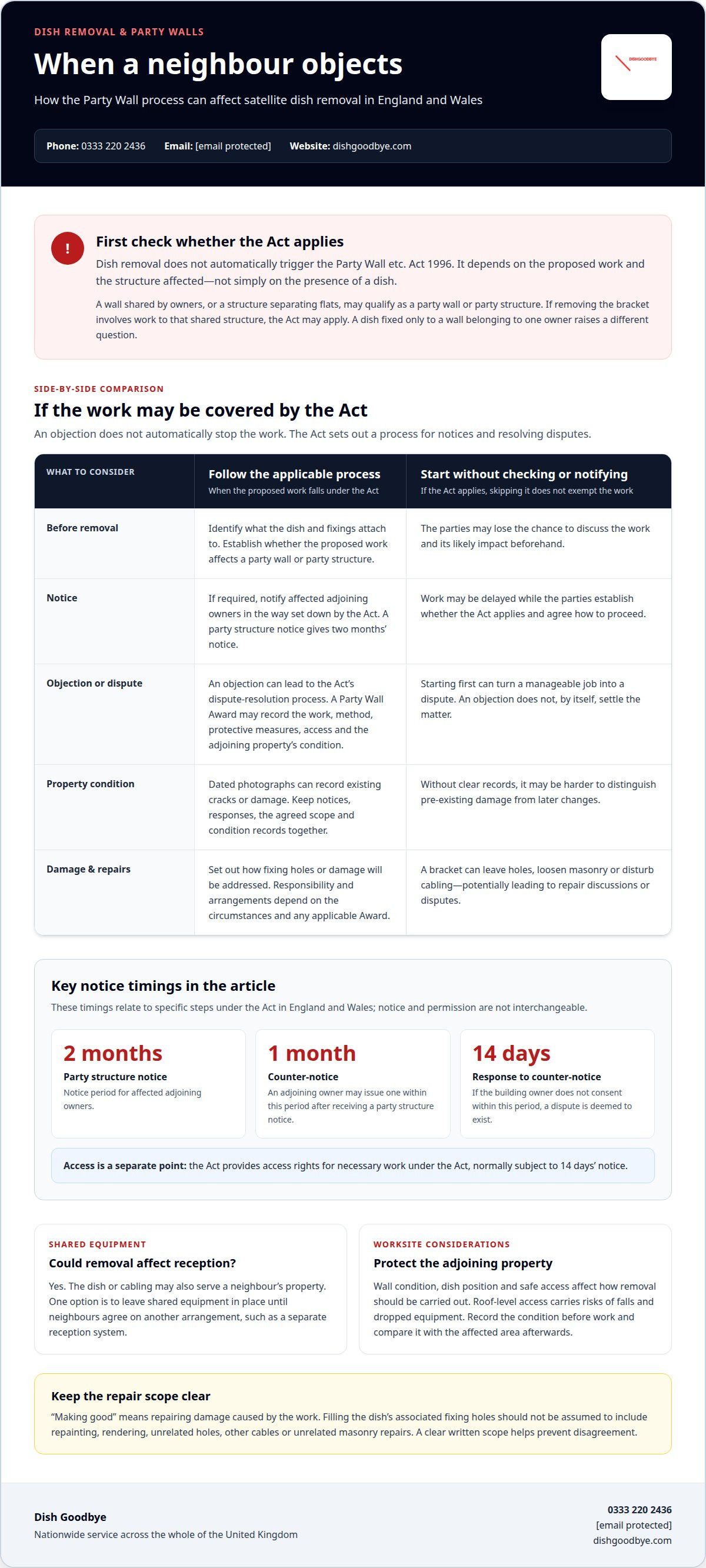
If proposed work may be covered, the building owner must notify affected adjoining owners in the way set down by the Act. A party structure notice in England and Wales gives the adjoining owner two months’ notice, according to The National Archives (UK legislation). The Act provides access rights for necessary work under the Act, normally subject to 14 days’ notice, according to The National Archives (UK legislation). Notice and permission are not interchangeable.
Starting work first can turn a manageable job into a dispute. An adjoining owner may object, and the Act provides a process for resolving disputes. Without notice, owners lose the opportunity to discuss the proposed work and its impact beforehand. Work may then be delayed while the parties establish whether the Act applies and agree how to proceed. Skipping the process does not exempt work that is covered by the Act.
Could removing a satellite dish affect a neighbour’s reception? Yes, if the dish or its cabling also serves their property. Removing shared equipment could interrupt reception. One option is to leave the shared system in place until the neighbours agree on another arrangement, such as a separate reception system.
What risks arise when removing a dish from a party wall? The work can damage masonry, loosen fixings or disturb shared cabling, which may lead to repair discussions or disputes. Roof-level access also carries a risk of falls and dropped equipment. The wall’s condition, the dish’s position and safe access all affect how removal should be carried out.
Protecting adjoining properties and making good damage
Good records and clear arrangements help protect adjoining owners when work affects an existing party wall. The Party Wall framework also provides a way to respond to objections and address damage.
Effects on Adjoining Properties
Structural effects are changes to a shared wall or adjoining property caused by building work. A dish bracket may leave holes, loosen masonry or disturb cabling, so the wall’s condition matters before removal. Dated photographs can record existing cracks or damage and help distinguish them from later changes.
For work covered by the Act, a Party Wall Award may document the work’s scope and method, protective measures, access arrangements and the adjoining property’s condition. This gives both owners a clearer basis for discussing damage. Excavation near neighbouring buildings, rebuilding a party wall or altering a chimney can raise different structural concerns from dish removal. Planning permission is separate from the Party Wall process.
Repairing Holes and Making Good
Making good means repairing damage caused by the work. Responsibility and arrangements depend on the circumstances and any applicable Award. The building owner proposing covered work should set out the scope, including how fixing holes or damage will be addressed. A dish removal quote should also distinguish the dish’s associated fixing holes from other holes, cables or repairs.
Record the wall’s condition before work, then compare it with the affected area afterwards. If a neighbour reports a new crack or loose brick, document its location and discuss whether it relates to the work. Don’t assume that filling fixing holes includes repainting, rendering or repairing unrelated masonry. A clear written scope helps prevent disagreement over what “making good” covers.
Where the Act applies, notify adjoining owners about the proposed work using the relevant notice. Under the Party Wall Act 1996 in England and Wales, an adjoining owner may issue a counter-notice within one month of receiving a party structure notice, according to The National Archives (UK legislation). A counter-notice can request changes or additional work to protect the adjoining property.
The response matters. Under the Party Wall Act 1996 in England and Wales, the building owner must consent to an adjoining owner’s counter-notice within 14 days, or a dispute is deemed to exist, according to The National Archives (UK legislation). If owners disagree, the Act provides a framework for resolving the dispute. The resulting arrangements can address protection, access, damage and responsibility for repairs.
Keep the notice, responses, agreed scope and condition records together. This helps adjoining owners see what was proposed, what was carried out and how any reported damage will be considered.
Does removing a satellite dish from a party wall require the neighbour’s consent in England and Wales?
Not automatically. There isn’t a single consent rule for every dish removal. The key question is whether the proposed work falls within the Party Wall etc. Act 1996 and affects an existing party wall or party structure. A dish fixed to a shared wall may raise different issues from one attached to a wall belonging solely to you.
First clarify what the dish, bracket and cables serve, and how they are fixed. For example, a dish may receive television signals for one home, while shared cabling also serves a neighbour’s property. Removing shared equipment could interrupt their reception. Leaving it in place until an alternative arrangement is agreed may avoid that interruption.
If the work may be covered by the Act, the building owner must give adjoining owners notice in the way the Act sets out. A neighbour’s verbal consent does not necessarily replace the statutory Party Wall procedure where the Act applies. Even a friendly conversation is not a substitute for required notice and process.
Notice gives the adjoining owner an opportunity to respond to the proposed work. They may consent, dissent or raise concerns about how the work could affect the wall or their property. An objection does not automatically prevent the work from proceeding. If the parties disagree, the Act provides a framework for resolving the dispute and setting out how covered work can be carried out.
Whether consent is needed depends on the attachment, the proposed removal method and any likely effect on the shared structure. Removing a bracket without affecting the wall may raise a different issue from work that disturbs masonry or alters the structure. The dish’s position alone does not determine whether the Act applies.
Separate property and planning questions may also matter. Ownership records can help identify who owns or shares the wall, but they do not determine by themselves whether the proposed work falls under the Act. Listed-building and conservation-area rules are separate considerations, not substitutes for the Party Wall process.
Before arranging work, establish whether the dish or cable serves another home, identify the wall and its ownership, and describe the proposed work accurately. If the Act applies, follow its notice procedure even if your neighbour has already agreed informally. If it does not apply, statutory consent under the Act is not the reason to seek agreement, although shared equipment or property arrangements may still need discussion.
Who pays for removing the dish, repairing holes and making good the party wall?
For a privately arranged removal, the person commissioning the work agrees to and pays the contractor’s charge under that arrangement. This does not automatically settle responsibility for damage to a shared wall. If the Party Wall process applies, an Award may address who pays for work, protection and making good damage.
Separate the removal task from repairs before agreeing to the work. A clear scope identifies the dish, its bracket, associated cable and the fixing holes left by those fixings. Additional cables, devices, holes or repairs must be listed separately. This helps prevent disagreement over whether an old cable run or unrelated crack formed part of the agreed job.
A Party Wall Award may set out the work’s scope and method, protective measures, making good damage and allocation of costs. It can clarify who is responsible for specified work. It should not be treated as covering every possible repair: the precise wording and the damage concerned matter.
Responsibility for a repair also depends on what caused the damage. A loose brick beside a new fixing hole raises a different issue from a crack recorded before removal. Dated photographs taken before and after the work can help owners compare conditions. A written record should note the location, appearance and timing of any reported damage.
- Removal: record who commissioned the dish and bracket removal, and what the agreed scope includes.
- Fixing holes: specify whether the holes left by those fixings will be filled.
- Other repairs: list extra holes, cables, rendering, painting or masonry work separately.
- Party Wall costs: use the Award’s wording where it allocates costs or requires damage to be made good.
Filling the bracket’s fixing holes is not the same as repainting a wall or repairing older masonry. Removing the dish also does not necessarily include other devices or cables on the same elevation. Make these distinctions clear in the written quote and any Party Wall document before work begins.
If a neighbour reports damage, compare the specific area with the earlier record and the agreed scope. Discuss whether the damage relates to the removal, then refer to any relevant Award terms. This keeps the conversation focused on evidence, responsibility and the repair needed, rather than assumptions about who should pay.
What permissions are needed to remove a dish on a listed building or in a conservation area?
There isn’t one permission rule for every dish removal. A listed building and a property in a conservation area raise separate planning considerations. The proposed work matters, including whether removal affects the building’s exterior or involves repairs that change its finish. Don’t assume the same permissions apply to both designations.
First establish whether the property is listed, lies within a conservation area, or has both designations. These are distinct status checks. A listed building may have protected features, while conservation-area considerations relate to the property’s setting. The dish’s location, fixings and surrounding surface help describe what removal would change.
Removing a dish may expose fixing holes or leave a visible difference in the wall’s finish. Filling the associated holes is different from rendering, repainting or repairing other masonry. Describe each proposed change accurately when considering permissions. A repair that changes the appearance may raise a different planning question from simply removing the dish.
Keep three issues separate:
- Planning: assess whether the property’s designation and proposed exterior changes raise planning requirements.
- Building Regulations: consider these separately from planning permission and Party Wall procedures.
- Party Wall: assess this separately if the work affects a shared wall or party structure.
Planning permission, Building Regulations and Party Wall requirements are separate matters. Addressing one does not automatically resolve the others. For example, agreement under the Party Wall process does not settle a planning question about a listed building. Likewise, planning considerations do not replace any Party Wall procedure that applies to work on a shared structure.
Before arranging removal, record the proposed work clearly: the dish and bracket to be removed, the associated fixing holes, and any intended surface repair. Note whether cables or other equipment will remain. This description helps distinguish removal itself from additional work that could affect the exterior’s appearance.
For a listed property or a home in a conservation area, use the designation and the exact proposed changes to determine what permissions may apply. If the work includes more than dish and bracket removal, describe those changes separately. This keeps the planning question focused and avoids treating hole-filling, rendering and painting as the same task.
Dish Goodbye
Dish Goodbye may carry out Sky Dish Removal where a shared wall or neighbour’s objection raises questions about the practical work. Availability depends on the property, access and job requirements. The quote covers the dish, its bracket, associated cable and filling the fixing holes left by those fixings. Additional cables, holes or devices must be mentioned in the initial enquiry and quoted separately. Rendering, painting and other repairs are outside that standard scope.
Share the property details and describe the dish’s position, wall and access. This helps shape a quote around the job’s requirements and keeps the agreed work clear. If you’re ready to discuss your removal, contact Dish Goodbye.
0333 220 2436 | [email protected]
Plan a clear next step
Before removing a dish from a party wall, bring the details together in one clear plan. Record the property status, the dish’s position, the neighbour’s concerns and the intended work. This gives everyone a shared understanding of what will be removed and which questions still need attention.
Where an objection has surfaced, keep the conversation focused on practical points: what the dish serves, how the wall may be affected and what the agreed work includes. A calm written record can help avoid crossed wires as arrangements progress. For a listed building or conservation area, keep planning considerations distinct from any Party Wall process.
For the removal itself, Dish Goodbye can carry out the practical work and clarify the quoted scope for your property. Share the dish’s location, access details and any extra items you want addressed. The quote can then reflect those requirements.
Contact Dish Goodbye to discuss your removal and take the next step with confidence. 0333 220 2436 | [email protected]
Frequently Asked Questions
What should you agree before work starts?
Agree on the exact equipment, access arrangements and finish before setting a removal date. Record whether the dish alone is being removed or whether its bracket and associated cable are included. Note which fixing holes will be filled, and identify any additional cable or wall repair separately. If a neighbour relies on shared cabling, agree how reception will continue before disturbing the equipment.
Does the Party Wall etc. Act 1996 apply to removing a dish or its brackets from a party wall?
The Act may apply if the proposed work affects an existing party wall or party structure. Calling the task dish removal does not settle the question: removing a bracket could involve disturbing the shared structure, while other fixings may not. The location of the fixings and the work needed to release them are relevant. If the Act applies, follow its notice and dispute procedures before covered work proceeds.
Who owns a satellite dish fixed to a party wall, and who is responsible for removing it?
A shared wall does not by itself establish who owns a dish fixed to it. The person who bought or arranged its installation may have relevant records, while a tenancy or property agreement may clarify who controls changes. If ownership is unclear, don’t treat a neighbour’s silence as proof. Establish who commissioned the equipment and whether it serves another home before agreeing who will arrange its removal.
What information should you provide when notifying a neighbour before a professional removes a satellite dish attached to a party wall?
Describe the dish’s position, the fixings to be removed and the work planned on the wall. Include whether the cable serves another property, which access area may be used, and how the fixing holes will be handled. A simple marked photograph can identify the exact location. Explain any separate cables or devices that will remain, so the neighbour understands what will and won’t change.
What is the safest way to remove a satellite dish and its fixings from a party wall?
First establish what the dish, bracket and cables serve, and whether removal will affect the shared structure. If the Party Wall Act applies, give the required notice and follow its process. Record the wall’s condition, agree the work scope and access arrangements, and clarify how damage or fixing holes will be handled.