
You can remove a Freesat dish if it’s no longer in use and you have permission, but Freesat needs a working satellite dish for reception. A sound bracket may be worth keeping if you might want another dish later.
It’s reasonable to want unused equipment removed without leaving the exterior untidy. First decide what should stay: the bracket or internal cabling may still be useful, while the dish and its external fittings can be taken down.
Check what equipment Freesat needs, whether anyone else relies on the installation, who must approve the work and what access the dish requires. With those details clear, you can choose a practical next step and decide whether to arrange professional removal.
Key Takeaways
- Keep a working satellite dish if you still use Freesat; decide whether you want to retain the bracket before arranging removal.
- Internal satellite cabling can often stay in place, avoiding unnecessary disruption to indoor decoration.
- Get permission from the landlord or building management before removing equipment from rented or shared property.
- Consider access, working-at-height risks and the condition of the mounting point when planning removal.
- Clarify which parts and fixing holes are included in the removal scope, and mention any extra cables or devices in your enquiry.
Whether Freesat requires a satellite dish
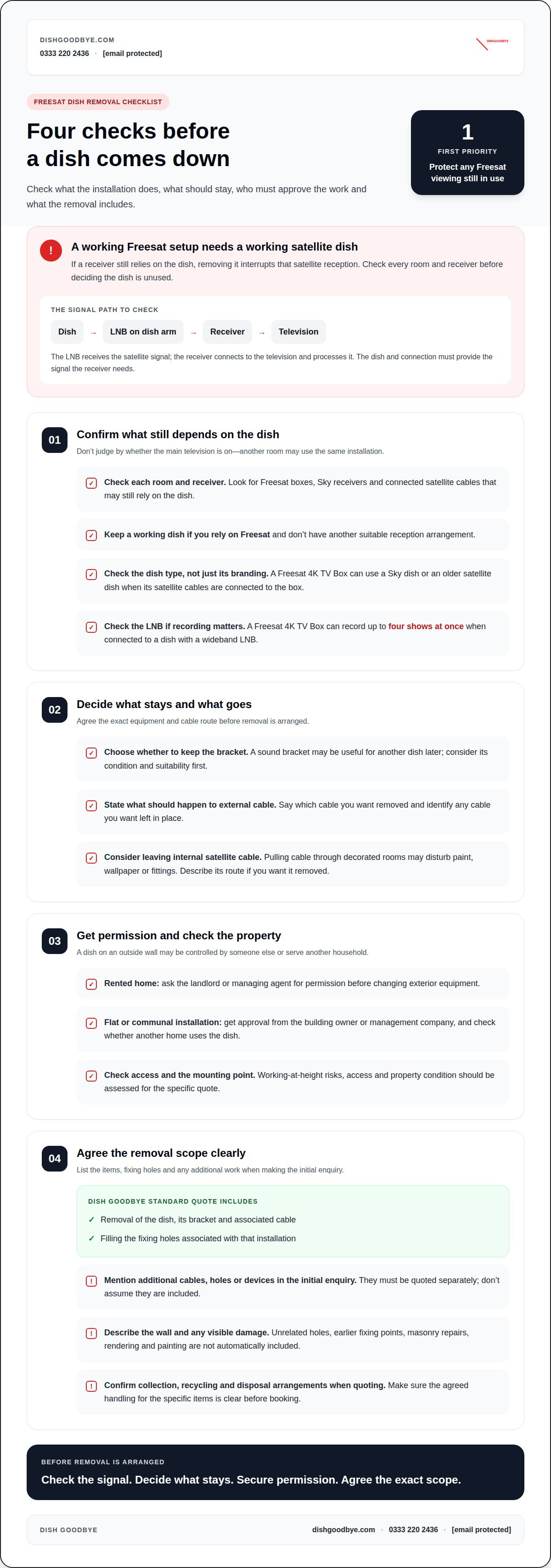
- Check whether Freesat is still in use before arranging removal. Reception requires a working satellite dish connected to a receiver. If the dish is removed, connected Freesat equipment won’t receive satellite television through it. A television in another room, for example, may still rely on a cable from the same installation. Check which rooms and receivers use the connection instead of judging by whether the main television is on.
- Decide whether you want to keep watching Freesat before removing the dish. A Freesat 4K TV Box can use a Sky dish or an older satellite dish when its satellite cables are connected to the box. The dish’s age or original branding alone doesn’t determine whether it can serve the receiver. What matters is whether the dish and its connection provide the signal the box needs. If you rely on Freesat, keep the working dish in place unless you have another suitable reception arrangement.
- Include the LNB and receiver when considering what the installation does. The LNB is the component on the dish arm that receives the satellite signal, while the receiver connects to the television and processes that signal. A dish without a working signal path won’t maintain Freesat viewing. The receiver also affects recording: a Freesat 4K TV Box can record up to four shows at once when connected to a dish with a wideband LNB. If you want that recording function, don’t assume every existing LNB supports it.
- Separate equipment you need from equipment that is simply still attached. If the Freesat receiver is disconnected and no household television depends on the dish, removal may make sense. If a Sky receiver or Freesat box still uses the same cables, removing the dish will interrupt that service. Check each receiver and cable route first. This simple inventory helps you tell an unused dish from an installation still serving another room.
- When requesting professional removal, ask about collection, recycling and disposal arrangements. Include the dish, LNB, bracket and associated cabling in your initial enquiry, and have the agreed arrangements confirmed before booking. Removed equipment may contain aluminium, steel and copper, but don’t assume every component will be collected or recycled. Confirm how the specific items from your property will be handled to avoid confusion about the scope of the work.
Leaving the bracket or internal cabling in place
- Tell the removal professional if you want to keep the wall bracket. A sound bracket may be useful if you plan to install another dish later. Leaving the bracket in place preserves the mounting point, but first consider its condition and suitability. A loose or damaged bracket, for example, may not be a sensible base for future equipment. Agree clearly whether the bracket is to be removed.
- Decide what should happen to the external cable before work begins. If you want it removed, say so in your initial enquiry. Dish Goodbye’s standard quote covers the dish, its bracket, associated cable and filling the fixing holes connected with that installation. Additional cables or holes must be mentioned separately and are quoted separately. Don’t assume every cable attached to the property is part of the same job.
- Consider leaving internal satellite cable in place if it runs through decorated rooms. Pulling it out may disturb paint, wallpaper or fittings, while a redundant cable can remain discreetly out of sight. Cable routed behind a television cabinet, for example, may cause little inconvenience. If you want internal cable removed, describe its route in your enquiry rather than assuming it is included in external dish removal.
- Clarify how the fixing holes will be finished. Dish Goodbye’s standard quote includes filling the holes associated with the removed dish and bracket. It doesn’t automatically cover unrelated holes, earlier installation points, masonry repairs, rendering or painting. Damaged brickwork or existing cracks may need work beyond filling those fixing holes. Describe the wall surface and any visible damage when requesting a quote.
- Discuss what happens to the removed dish, cable and bracket when requesting a quote. Collection, recycling and disposal arrangements should be confirmed before booking, not assumed. A dish or cable may contain recyclable materials, but that doesn’t establish how each item will be handled. List the equipment you want removed and make sure the agreed arrangements are clear before work starts.
- Use the agreed scope to avoid a half-finished result. A professional should remove the items included in the quote, fill the associated fixing holes and follow the agreed arrangements for the removed equipment. If you want the bracket or internal cabling left behind, state that before the work. For a clear starting point, use the Dish Goodbye service website when planning what stays and what goes.
Communal and rented property permissions
- Identify who controls the dish before arranging removal. In a rented home, ask the landlord or managing agent for permission first. A tenancy agreement or property arrangement may affect who can authorise changes to the exterior. Tell them where the dish is, what you want removed and whether you’d like to keep the bracket. Keep their written response with your property records.
- For a flat, house in multiple occupation or communal installation, get approval from the building owner or management company. A dish fixed to an outside wall may serve another flat, even if its cable enters your home. Ask which household or communal system uses it. Don’t assume the dish belongs only to the resident nearest it.
- Check whether the dish serves a shared aerial or satellite system before approving work. Removing a dish used by a Freesat receiver will interrupt that receiver’s satellite reception. A shared aerial system may use separate equipment, but identify the cables and connections before anything is removed. Ask the building manager which system the dish serves.
- Ask the relevant local planning authority whether planning permission or listed-building consent applies to your property and proposed removal. Requirements depend on the property’s status and circumstances, so don’t assume consent is always needed or never applies. If your home is listed, mention this before authorising external changes.
- Give the owner or manager a precise description rather than making a general request. State whether the dish alone should go, whether its bracket should stay and which cables are involved. For example, ask them to distinguish a private cable entering one flat from equipment serving several homes. This ensures the decision is based on the actual installation, not an assumption about its appearance.
- Wait for the relevant approvals before booking removal. If the landlord approves the work but the dish connects to a communal system, the building manager’s permission may also be needed. Keep the replies together and pass any conditions to the person carrying out the work. These might include retaining a bracket, protecting shared cabling or arranging access through a managed area.
- Include reception needs in the permission request. If anyone still watches Freesat through the dish, removal will affect their satellite television service. Name the affected receiver or flat and ask about the system before confirming the work. This check helps prevent a tidier exterior from disrupting someone else’s television connection.
Professional Freesat dish removal and working-at-height risks
- Share clear access details when requesting a removal quote. Describe where the dish is, such as on a ground-floor wall, roof edge or high-rise exterior. Mention obstacles, restricted access and visible damage around the mounting point. Height, access and property conditions affect how the work is approached, so the quote should reflect the actual installation.
- Take photos only from a safe position on the ground. A clear view can show the dish, bracket, visible cable and surrounding wall. Don’t climb a ladder or go onto the roof to take pictures. If the dish is partly hidden or the fixing point can’t be seen, explain that in your enquiry rather than risking an unsafe position for a better image.
- Have access equipment and outdoor working conditions assessed by a competent person. The Freesat installation guide advises that outdoor work at height should be carried out only by someone competent with ladders and related access equipment. A ladder may not suit every roofline or mounting position. The building’s height, the ground and the route to the dish all matter when planning safe access.
- Include overhead power lines in the access assessment. The Freesat installation guide warns installers to beware of power lines during outdoor work. Point out visible lines near the dish when describing the property. A dish mounted near a line needs careful assessment before work is planned. Don’t try to reach the equipment yourself or position a ladder close to overhead cables.
- Confirm the work and equipment connections before removal. Identify whether the dish still serves a Freesat receiver, and arrange for connected equipment to be safely disconnected. State whether the bracket and associated cable should be removed, and list any additional cables or devices separately. The agreed scope should include filling the fixing holes associated with the removal, not every mark or repair on the wall.
- Settle practical details before the visit. Explain whether access is through a shared entrance, whether a gate or parking restriction affects the approach, and whether the dish is on an extension or the main roof. These details help match the work to the property. If the position or access changes, the assessment may need to reflect the new conditions before removal proceeds.
- Keep the decision straightforward: professional removal is worth considering when the dish is high, difficult to reach or close to overhead power lines. A ground-level photograph and an accurate description give a useful starting point. The access method and property conditions determine how the work is assessed, so avoid treating a roof-mounted dish as a simple ladder task.
Can a professional legally remove a Freesat satellite dish from my home in the UK?
- If you’re asking, “Can I remove a Freesat dish?”, first establish who owns or controls the property. Work should proceed only with approval from the person with authority and after checking that the dish isn’t part of a shared system requiring separate permission. In a rented home, get approval from the landlord or managing agent first.
- Check whether the dish serves only your home. In a block of flats or house in multiple occupation, it may connect to equipment used by other residents. Ask the building owner or management company to identify its purpose. A cable entering your flat doesn’t prove the dish serves only your household.
- Ask the relevant local planning authority whether planning permission or listed-building consent applies to your property and proposed work. The answer depends on the property and the changes involved. A dish on a listed building may raise different considerations from one on an ordinary wall. Don’t assume consent is always needed or never required.
- Make the authorisation specific. State whether the dish, bracket and associated cable should be removed, or whether the bracket should stay. If the property owner wants it retained, include that condition before booking. Clear instructions help prevent the removal of equipment someone intended to keep.
- Identify any reception service that could be affected. Removing a dish used by a Freesat receiver interrupts its satellite signal. In a communal building, the dish may also form part of a shared arrangement. Ask the manager which connections serve your flat and other homes before authorising work.
- Keep the owner’s or manager’s response with the job details. Share conditions such as access restrictions or protecting shared cabling with the person carrying out the work. If several parties control the property or system, obtain the relevant approvals before setting a date.
- Describe the property and approved scope when requesting a quote. Include whether it is rented, listed or part of a managed block, and explain who has authorised the work. If you’re still deciding whether you can remove a Freesat dish, settle questions about ownership, shared connections and consent before booking.
Dish Goodbye
Dish Goodbye provides satellite dish removal services across the whole of the UK. The standard quote covers the dish, bracket, associated cable and filling the fixing holes connected with that installation. Mention any extra cables, holes or devices in your initial enquiry so they can be quoted separately. Access and property conditions are assessed for each quote.
For enquiries, call 0333 220 2436 or email [email protected]. To discuss your removal, contact Dish Goodbye.
Make your next step a clear one
If you’ve decided you can remove a Freesat dish, turn that decision into a clearly defined job. Be specific about what you want taken away and what you’d prefer to keep. A precise request helps align the work with your plans for the property and avoids uncertainty about the outcome.
Dish Goodbye offers Satellite Dish Removal and Sky Dish Removal. If you’re ready to discuss removing your dish, contact Dish Goodbye about removal. Include a brief description of the property and the equipment you want dealt with. This gives the conversation a useful starting point without committing you to a particular removal plan.
You can also call 0333 220 2436 or email [email protected]. Take the next step when you’re ready, and move towards a tidier exterior with a plan that suits your home.
Frequently Asked Questions
Can I keep the bracket in case I want a dish again?
You can ask for the dish to be removed while leaving a sound bracket in place. Tell Dish Goodbye before work is agreed, because the standard scope includes removing the bracket. Consider whether it is secure and suitable for future use, and whether it would look acceptable on the wall meanwhile. If it’s loose or damaged, keeping it may not help with a later installation.
Do you dispose of the old dish?
Discuss collection, recycling and disposal arrangements when requesting a quote, and have them confirmed before booking. Describe the dish and any other items you want removed, such as a separate LNB or cable. Don’t assume every item will be collected or recycled automatically. If the dish is already off the wall, mention that too, so the agreed arrangements reflect what remains.
Do I need landlord or freeholder permission to remove a Freesat dish?
If you rent, ask your landlord or managing agent before arranging removal. In a flat, contact the freeholder or building manager if they control exterior fixtures or the dish may serve shared equipment. A dish attached outside one flat, for example, could connect to a communal system. Explain what you want removed and keep the relevant approval with your booking details.
How do professionals safely disconnect and remove a Freesat dish and its cables?
A professional first identifies whether the dish connects to a working receiver or shared system, then plans the disconnection and removal around the property and access. The receiver and cable connections must be dealt with before dismantling. The agreed scope should specify which external cable is included. Tell Dish Goodbye about additional cables or connected devices so they can be considered and quoted separately.
What safety risks are involved in removing a satellite dish from a roof or wall?
Roof edges, unstable ladder positions, loose masonry and nearby overhead power lines can make removal hazardous. A dish can also be awkward to handle once its fixings are released. The access method depends on its height, mounting position and surrounding obstacles. Provide clear details and ground-level photos if requested, but don’t climb onto a roof or ladder to take them.
Can a professional remove my Freesat dish, and what should I provide?
Yes. For a useful quote, provide your postcode, the dish’s location and a brief description of access, such as a roof, extension or wall position. Share photos only from a safe position on the ground. Also specify whether you want the bracket or any cable left in place, and mention extra dishes, holes or devices. These details help define the work accurately.
Can a removed Freesat dish be reused or recycled?
A dish may be reusable if it’s in suitable condition and compatible with the intended satellite equipment. Its LNB, bracket and cables may also affect whether reuse is practical. Removed equipment can contain recyclable metals, but handling arrangements depend on what’s agreed for the job. If reuse or recycling matters to you, mention it when requesting a quote and have the arrangements confirmed before booking.
How much does professional Freesat dish removal cost in the UK?
The quote depends on access, mounting condition and the amount of making good required.