
A dangerous aerial is a safety issue first and a neighbour dispute second. If it looks loose, damaged or at risk of falling, keep clear and don’t try to inspect or move it yourself. Knowing how to deal with a neighbour’s dangerous aerial starts with assessing the immediate risk, then finding a safe way to raise your concern.
It’s understandable to want the problem resolved quickly, especially if the aerial is above a shared area or close to your home. A calm, factual approach can help, but don’t put yourself at risk to start a conversation. If you feel threatened, avoid face-to-face contact and seek appropriate local help.
This guide explains how to assess the hazard, record what you’ve noticed and speak with your neighbour when it’s safe. It also covers checking property rules and involving a managing agent or residents’ association, so you can choose a clear next step without unnecessarily escalating the situation.
Key Takeaways
- Keep clear of an aerial that appears loose or at risk of falling, and don’t try to inspect or move it yourself.
- Record what you’ve observed factually so you can explain the concern clearly if it continues.
- Check your lease, property rules and any relevant local requirements before proposing changes to shared or neighbouring property.
- If it feels safe, arrange a calm conversation and focus on the hazard and its impact rather than blame.
- If a direct conversation isn’t appropriate, use your building management or residents’ association’s process to raise the issue.
Setting boundaries and checking property rules
Set a clear boundary before asking anyone to move an aerial. Check ownership, property rules and the safest route for raising concerns.
-
Check who maintains the aerial
Start by identifying who owns or manages the property and aerial. The homeowner, landlord, managing agent or residents’ association may need to address the issue. Responsibility can depend on the tenancy, ownership arrangements and whether the aerial serves one home or a shared area. Ask the property manager who handles exterior fixtures rather than assuming the nearest resident is responsible.
Check the tenancy agreement, lease or building documents for maintenance responsibilities. If the aerial serves a shared system, ask the managing agent to identify the responsible party. Don’t climb onto your neighbour’s property, touch the equipment or arrange its removal yourself.
-
Identify whom to contact
Choose whom to contact based on the concern. For a local complaint, contact the council and explain the aerial’s location and the risk you’ve observed. Building control may be relevant if your concern involves building work. HSE is not a general route for neighbour issues; consider it only when the concern relates to work or workplace safety.
Give the organisation specific details, such as a loose fitting above a shared entrance or wires hanging over a path. If your first contact can’t help, ask which team handles this type of concern. If there’s immediate danger, keep people away and seek urgent local assistance.
-
Check regional rules
Check the local authority’s process and your property documents for the rules that apply where you live. Scotland and Northern Ireland have distinct legal and local-government systems, so don’t assume a process used in England or Wales applies there. The relevant council, landlord or property manager can explain the local complaint route.
For a flat or managed development, read the lease and association rules alongside local guidance. Note whether the property is privately owned, rented or shared. These details can help direct your concern without assuming one UK-wide process applies everywhere.
-
Resolve property-boundary disputes
Establish where the boundary lies before proposing a limit on the aerial. Compare the property plan or title documents with the fence, wall or other visible markers. These features can help you orient yourself, but they don’t prove ownership if it’s disputed. If it feels safe and practical, ask your neighbour to walk the boundary with you.
If the documents and visible markers don’t settle the issue, consider a property survey. Keep dated notes of what you observed and any discussions. Before proposing a boundary rule, check the lease, community rules and local requirements. Don’t install a barrier, enter your neighbour’s land or remove equipment to settle a disagreement.
Approaching a neighbour about a problem
You can ask your neighbour to repair or remove an aerial, but keep the request calm and specific. A safe first step in how to deal with a neighbour's dangerous aerial is choosing how to raise your concern. Don’t arrange emergency work yourself or assume your neighbour must pay. First protect people from immediate danger and seek appropriate local help.
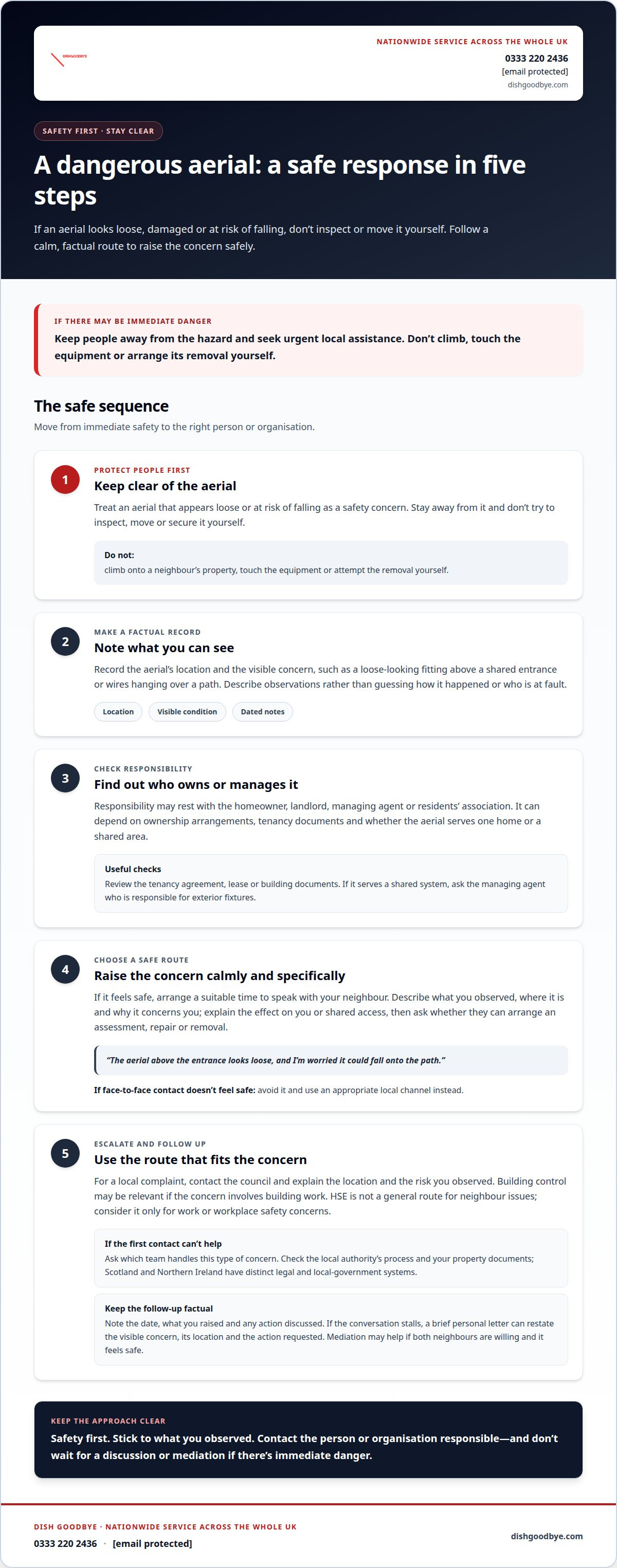
- Choose a safe time and place. Arrange a time in advance rather than confronting your neighbour unexpectedly. If it feels safe, speak on the pavement or near the property boundary. Don’t enter their home or garden. If you feel threatened, avoid meeting face to face and use an appropriate local channel instead.
Choose a quiet moment when neither of you is rushing. A brief conversation is more likely to be productive than raising the issue during an argument or as your neighbour is leaving home.
- Describe what you observed. Give a clear example, such as a bracket that appears loose or a wire hanging over a shared path. Explain where you saw it and why it concerns you. Stick to visible details instead of making assumptions about how it was installed or who is at fault.
For example, say, “The aerial above the entrance looks loose, and I’m worried it could fall onto the path.” This gives your neighbour a specific concern to consider without starting with an accusation.
- Explain the effect and suggest a practical next step. Describe how the aerial affects you, your household or shared access. Then ask whether your neighbour can arrange an assessment, repair or removal. Focus on resolving the hazard rather than demanding a particular outcome before responsibility is clear.
Ask what they think would address the concern. If the aerial serves a rented home or shared building, suggest contacting the landlord or managing agent. Don’t touch the equipment, climb towards it or try to secure it yourself.
- Agree how you’ll follow up. If your neighbour needs time to respond, agree on a practical way to check back. Record the date, what you raised and any action discussed. For example, note, “Neighbour will contact the property manager about the loose bracket.”
Knowing how to deal with a neighbour's dangerous aerial also means keeping follow-up factual. If the conversation doesn’t resolve the issue, send a brief personal letter. Restate the visible concern, its location and the action you’re requesting. Keep a copy, and avoid threats or claims about legal responsibility that you haven’t established.
- Use a neutral route if discussion stalls. If both neighbours are willing and it feels safe, mediation may help you reach a practical agreement. A mediator can explain whether the process suits the situation and outline its costs and steps. If there’s immediate danger, don’t wait for a meeting or mediation. Keep people clear and seek urgent local help.
A neutral discussion, for example, may help clarify whether the aerial should be inspected, repaired or removed. If your neighbour won’t engage, take your factual notes to the relevant property or local complaint process.
Assessing safety before speaking to a neighbour
Look for visible warning signs from a safe place, then decide whether a conversation is appropriate. If the aerial may fall, keep people away and seek urgent local help.
-
Assess whether the aerial is unsafe
Observe the aerial from the ground without touching it. Look for a visibly tilted mast, loose bracket, hanging cable or parts moving in the wind. These signs may indicate a hazard, but don’t climb up to check. Note the aerial’s position and what you can see, such as a loose-looking fitting above a shared entrance.
Keep your assessment factual. An old-looking dish or aerial isn’t automatically dangerous. Record visible changes, such as a wire hanging lower than before, rather than guessing about hidden damage or blaming your neighbour.
-
Respond to an aerial that may fall
Move away from the area beneath it and warn anyone nearby to use another route. Don’t approach the wall, roof or garden to secure the equipment. If the aerial looks likely to fall onto a path or entrance, contact the property manager or appropriate local authority promptly.
If people face immediate danger, seek urgent local assistance. Give a clear location and describe the visible risk, such as a loose mast above the main entrance. Don’t wait to speak with your neighbour before taking steps to keep people clear.
- Decide whether a conversation is safe. Consider your neighbour’s previous behaviour as well as the aerial. If they have threatened you or you feel intimidated, avoid a face-to-face approach. Ask a property manager, residents’ association or appropriate local authority to pass on your concern instead.
If you have no reason to fear contact, arrange a calm conversation. Choose a neutral place, such as the pavement near the boundary, and don’t stand beneath the aerial. Describe what you observed rather than presenting a guess as a confirmed fault.
- Record damage if the aerial falls. Keep people away from the fallen equipment, cables and affected area. Don’t handle parts or attempt repairs. Once it’s safe, take photographs from a distance and note the time, location and any visible damage to your property.
Contact the property owner or manager and explain what happened. If your home or belongings are damaged, notify your insurer and provide the photographs and factual notes. Don’t decide who must pay before the circumstances have been assessed.
- Keep a clear incident record. Write down the date, what you saw, where it happened and whom you contacted. For example, note that a bracket appeared loose above the shared path, then record the property manager’s response. Keep messages and letters together.
A precise record can help if the issue continues or causes damage later. Separate direct observations from assumptions, and update your notes if the aerial changes or someone responds. This gives your next contact a clear account without requiring you to inspect the equipment.
Residents’ association or block management involvement
Use your building’s formal process if an aerial affects shared areas or direct discussion hasn’t resolved the concern. A managing agent or residents’ association can help keep the issue organised.
- Find the right contact. Check your building handbook, lease or noticeboard for the managing agent, residents’ association or property manager. If the aerial is above a shared entrance, corridor or garden, contact whoever handles communal areas. If you rent, your landlord can direct your concern to the building’s management.
Keep your message focused. For example, explain that a loose-looking aerial is above the communal path instead of making a general complaint about a neighbour.
- Send clear, factual details. Include the aerial’s location, what you observed and why it concerns you. Describe visible signs, such as a tilted mast or hanging wire. Add when you noticed the issue and whether it affects a shared route. Don’t climb closer to gather more information.
If you have a photograph taken safely from the ground, offer it to the association. Keep the original and avoid adding assumptions about damage or responsibility.
- Ask the association to use its process. Request that the managing agent review the concern under the building’s lease, building rules or maintenance procedure. Ask who will assess the issue and how the association will update residents. If the aerial appears to serve shared equipment, make that clear.
A written request creates a record. Save your email or letter, along with any reply and notes about the aerial’s condition.
- Request a standard written notice. If your neighbour needs a formal prompt, ask the association to send its standard letter. It can identify the relevant property rule or by-law and explain the concern. The association should refer to a rule that applies to the building or location, not one that merely sounds relevant.
For instance, the letter might ask the resident to address an aerial that appears loose above a shared entrance. Keep the wording neutral and focused on resolving the hazard.
- Follow up through the agreed channel. If you receive no update, reply to the managing agent’s original message. Restate the location and visible issue, then ask about the next step. Don’t send repeated complaints to unrelated residents or contact your neighbour on the association’s behalf without agreement.
If the concern remains unresolved, ask which local complaint route or property procedure applies. If people face an immediate risk, keep clear of the area and seek urgent local assistance instead of waiting for routine correspondence.
What makes a neighbour’s TV aerial dangerous or unsafe?
- Look for visible movement from a safe place. A leaning, shifting or apparently detached mast may have unstable fixings. Compare its position with a nearby roof edge or chimney, but don’t treat the comparison as proof. Watch from the ground only. Don’t climb, use a ladder or lean out of a window to inspect the aerial more closely.
Aerials may move in strong wind, but movement alone doesn’t confirm a fault. Note what you saw and when, especially if it continues shifting after the weather changes.
- Notice damaged supports and fixings. Look for a bracket that appears separated from the wall, missing parts or a mast hanging at an unusual angle. Rust or visible damage around a fixing may also warrant raising a concern. You can’t assess the strength of a hidden fixing from the ground, so describe what you can see instead of diagnosing the problem.
For example, record “bracket appears to pull away above the side entrance”. Avoid saying it will fall unless that is plainly happening.
- Check whether parts could reach people or property. Consider what’s beneath the aerial, such as a doorway, pavement, parked vehicle or shared garden. A loose cable hanging over a route can create an obstruction even if the aerial itself looks secure. If you can do so safely, keep people away from the affected spot.
Note the exact location and any access affected. Don’t move a cable or stand beneath the equipment to judge how far it reaches.
- Watch for a worsening condition. Compare what you can see over time from the same safe viewpoint. A newly hanging wire, a shifted mast or a bracket visibly changing position may make the concern more urgent. Keep a brief dated record of these observations, including any changes after windy weather.
Take photographs only from a safe location. Don’t approach the building, enter your neighbour’s property or attempt a closer inspection.
- Respond to immediate danger without handling the aerial. If the mast is falling, parts are dropping or people face a direct risk, move away and keep others clear. Contact the relevant property manager or local authority and give the precise location and visible signs. Seek urgent local assistance if someone is in immediate danger.
If the aerial has fallen or damaged property, keep clear of the equipment. Once it’s safe, record the damage, then notify the property manager and your insurer. Don’t attempt repairs or decide responsibility on the spot.
Dish Goodbye
If your neighbour agrees that a redundant Sky dish should be removed, Dish Goodbye offers a practical next step. Its removal service includes the dish, bracket and associated cable, as well as filling the fixing holes associated with the dish removal. This service is for removing a redundant dish, not repairing an aerial that remains in use.
For a quote, describe the dish’s location, access and property conditions. Mention any additional cables, holes or devices in your initial enquiry, as these are separate from the standard removal scope. This helps clarify what work is being requested before arrangements are made.
If removal is the agreed solution, contact Dish Goodbye to make an enquiry.
Choose a clear next step
Knowing how to deal with a neighbour's dangerous aerial also means recognising when the next step is no longer a neighbourly conversation. If removal has been agreed, clarify that the work concerns a redundant dish and explain the access needed. Clear expectations can help prevent a safety concern from becoming a disagreement about access, responsibility or property damage.
Dish Goodbye offers satellite dish removal, including Sky dish removal. If that’s the agreed way forward, share the property details and describe the dish’s location and access. Mention any additional cables, holes or devices in your enquiry so the requested work is clear.
Contact Dish Goodbye to discuss an agreed removal. A calm, practical next step can help everyone move forward.
Phone: 0333 220 2436
Email: [email protected]
Frequently Asked Questions
What Legal Options Exist for Neighbor Disputes?
Start with written communication, your property’s complaint process or mediation. Keep copies of letters, messages and any evidence of damage. If threats or repeated targeted behaviour occur, contact the relevant local authority. Court action is generally a last resort in a neighbour dispute. Before taking that step, get advice based on your specific circumstances and the evidence needed to support a claim.
Can a local council force a homeowner to make a dangerous aerial safe?
Don’t assume the council can compel a homeowner in every case. Its response depends on the reported hazard and the powers or processes relevant to the situation. Give the council the aerial’s location, visible condition and any risk to people or property. Ask which team handles the concern and what action it can take. While waiting for a response, keep people away from any immediate danger.
What laws apply to dangerous aerials and hazards between neighbouring properties in England and Wales?
The relevant rules depend on the property, ownership or tenancy arrangements, and the nature of the hazard. Check the lease or tenancy terms, building rules and local council process before deciding what applies. A boundary disagreement may also require examining property documents. If the aerial has caused damage or the dispute continues, seek advice based on the specific facts rather than assuming one rule settles every case.