
dishgoodbye.com | 0333 220 2436 | [email protected]
Could a chewed aerial cable still be connected, even if the aerial looks old and unused? Squirrel damage may leave frayed, split or loose cabling, but a quick glance cannot tell you whether the system is still in use. If you’re considering storm damaged aerial removal, don’t tug at the cable or try to test it yourself.
Start by leaving the damaged equipment undisturbed and finding out whether the aerial system is still needed. This guide explains what possible squirrel damage can look like, why you can’t identify a cable’s status by appearance alone, and how to choose a sensible next step.
You’ll also learn when removing redundant aerial equipment and associated cabling can help clear your property’s exterior. Dish Goodbye removes redundant equipment across the UK, fills and smooths fixing holes, and sends removed metal and electronic waste to approved recycling centres. Removal is for equipment that is no longer needed, not a repair for an active or uncertain cable.
dishgoodbye.com | 0333 220 2436 | [email protected]
Key Takeaways
- Frayed-looking cable, exposed sections, loose clips or sagging may indicate damage, but they don’t confirm its cause or extent.
- An old-looking aerial or disconnected television doesn’t prove that every cable is redundant. Establish whether the system is still in use before arranging removal.
- If you spot possible damage, keep clear and note what you can see from a safe place. Don’t climb, pull, cut, tape or try to repair the cable.
- Storm damaged aerial removal can clear redundant equipment and associated cabling, with fixing holes filled and smoothed.
- Dish Goodbye removes redundant aerials, dishes, brackets, fixings and cabling across the UK. Removed metal and electronic waste is sent to approved recycling centres.
Squirrel Damage to Old Aerial Cables: Why It Deserves Attention
A cable that looks chewed, split or out of place may have been disturbed by an animal. Appearance alone cannot confirm the cause or show what is happening inside the cable. Treat visible damage as a reason to take care, not as proof that a squirrel caused it or that the cable is electrically damaged.
Ageing aerial wiring may still connect to equipment indoors. Until you know whether the system is in use, leave the cable alone. First establish its purpose, then decide whether the appropriate next step is to address a system that is still needed or arrange removal of equipment that is genuinely redundant.
Can squirrels damage outdoor aerial cables?
Yes, squirrel activity is one possible cause of damage to exposed materials. Squirrels gnaw on objects, and cable insulation or nearby fittings may show marks or disturbance. The disruptions caused by squirrels article describes examples of damage to electrical infrastructure, but it doesn’t show that a particular damaged aerial cable was affected by a squirrel.
From a safe position, you might notice rough-looking surfaces, displaced clips or a cable that appears pulled out of place. Weather, age and other physical disturbance can produce similar signs. These observations can help you describe what you’ve seen, but they aren’t a diagnosis of the cable’s condition.
Why old aerial wiring should not be assumed harmless
“Old-looking” and “unused” aren’t the same thing. A cable may still serve a television aerial or connected equipment, while an aerial system that is no longer used may have redundant cabling. A disconnected television or a neglected-looking aerial doesn’t establish the status of every cable, especially if wiring runs into the property or connects to equipment elsewhere.
Visible damage also doesn’t confirm electrical damage. The cable may be part of an aerial system, and some connected equipment may use a powered signal amplifier. Don’t try to determine its status by touching it, pulling it away from a wall or testing it yourself. If you can’t tell whether the system is active, treat its status as unknown rather than assuming it is safe to remove.
Keep clear of damaged or unclear wiring. Don’t pull, cut, tape or attempt to repair it. Storm damaged aerial removal is appropriate for redundant equipment and associated cabling, not as a substitute for dealing with an active or uncertain connection. Establishing whether the system is still in use helps you choose a sensible next step without creating a hands-on risk.
Signs That Squirrels May Have Damaged Old Aerial Cables
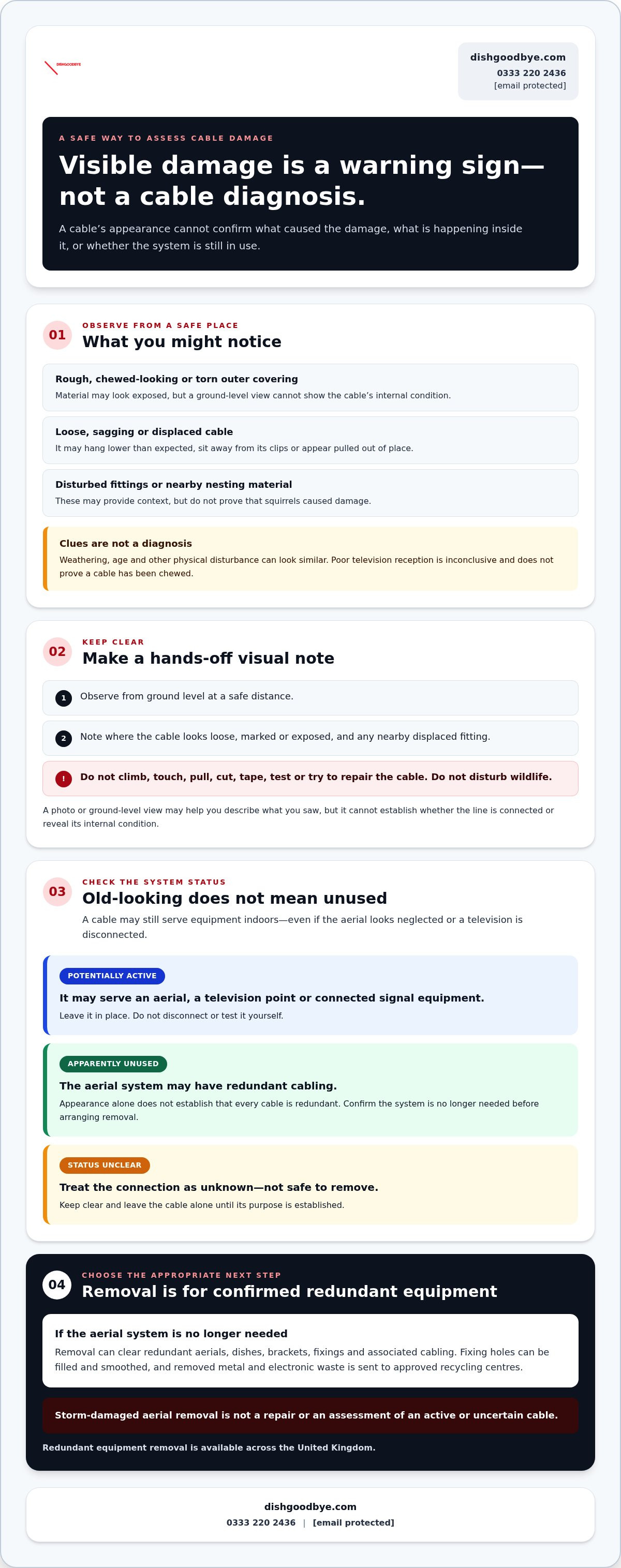
Marks or movement around an old aerial installation are worth noting, but none of these clues proves squirrels caused the damage. Weathering, loose fittings and other disturbance can look similar. Use what you can see to describe the situation, not to diagnose the cable or decide that it is safe to remove.
What visible cable damage can look like
From the ground, you might notice a chewed-looking surface, a torn outer covering or material that appears exposed. A cable may hang lower than expected, look loose along its route or sit away from the clips that once held it in place. These are visual observations only. Don’t touch the cable to check what has happened beneath its surface.
Other clues around an old aerial installation
A loose-looking aerial, disturbed fixings or nesting material nearby may provide context, but none confirms squirrel activity or cable damage. Poor television reception is inconclusive too. It can have several possible causes, so don’t treat a weak or missing signal as proof that a cable has been chewed.
Animal activity can affect electrical infrastructure. The Nature Conservancy discusses wildlife-related power outages, but that broader account doesn’t establish what caused damage at a particular home or whether an aerial cable is connected.
Visual damage cannot confirm whether a cable is live. A photo or ground-level view can help you note the location and visible condition. It can’t show whether the line still serves equipment or reveal its internal condition.
Keep your assessment simple and hands-off:
- Observe from a safe position at ground level.
- Note where the cable looks loose, marked or exposed.
- Record nearby clues, such as a displaced fitting or loose aerial.
- Don’t climb, touch, pull or move the installation, and don’t disturb any wildlife.
These notes can help you describe the issue without making the damage worse. If the equipment is confirmed redundant, redundant aerial removal can clear unwanted exterior equipment and associated cabling. Storm damaged aerial removal is for redundant equipment, not for repairing or assessing a cable whose status is uncertain.
Damaged Aerial Cable: Is It Live or Redundant?
An old cable on the outside of a house can look forgotten yet still serve equipment indoors. An unused aerial may also have cabling that no longer has a purpose. Age and appearance alone can’t settle the question, so don’t assume an exterior cable is safe to remove simply because the television seems disconnected.
Clues that an aerial cable may still be in use
A cable running towards a television point or connected aerial equipment may still have a purpose. Changes inside a home can leave wiring in place even after a television or room stops being used. You may not be able to tell from outside what the cable serves, and tracing it by pulling or disconnecting it could cause problems. Treat these clues as possibilities, not a remote diagnosis.
When damaged aerial equipment may be redundant
If an aerial or satellite dish is no longer needed, its associated brackets, fixings and cabling may also be redundant. But you can’t confirm a damaged cable’s status from its appearance alone. If you’re uncertain, don’t cut, pull or handle it. Professional removal is for redundant equipment and cabling, not repair of live wiring.
For a broader overview of clearing unwanted equipment, read TV Aerial Removal: The Essential Guide to Clearing Redundant Equipment. Once a system is established as redundant, storm damaged aerial removal can clear the exterior rather than leaving old equipment and loose cabling in place.
What to Do if You Spot Squirrel Damage to Aerial Cables
Suspected damage calls for a calm, hands-off response. A mark or loose cable is a reason to find out more, not proof of an immediate hazard or confirmation that the wiring is redundant. Take these steps without disturbing the installation:
- Keep clear. Don’t approach or touch loose, exposed or damaged cabling.
- Observe from a safe place. Stay at ground level and look for visible changes, such as a displaced clip or a cable hanging differently.
- Record what you can see. Note the location and visible condition, or take a photo from where you’re standing. Don’t climb to get a closer view.
- Establish the equipment’s purpose. Find out whether the aerial system is still in use before treating any cable as redundant.
This approach separates what you’ve observed from what you can’t determine by looking. A damaged-looking cable may still be connected, and visual clues alone can’t establish its status. Suspected damage doesn’t automatically mean there’s an immediate emergency, but uncertainty is a good reason not to handle the wiring.
What not to do around damaged exterior wiring
Don’t climb onto the roof, pull a loose cable, cut it, wrap it with tape or attempt a repair. Avoid moving the aerial, brackets or nearby fittings. A hands-on check won’t reliably tell you whether the cable is in use, and it may disturb the installation further. Leave it as it is while you work out the next step.
Choosing a sensible next step for redundant equipment
Repair and removal solve different problems. If equipment is still needed, removing it isn’t the answer to a fault. If an aerial is no longer wanted and its associated cabling is confirmed redundant, professional removal can clear the exterior without treating an active connection as waste. Dish Goodbye removes redundant aerials and associated cabling across the UK, and fills and smooths fixing holes.
For confirmed redundant equipment, see how professional removal clears redundant aerial equipment. Storm damaged aerial removal should focus on equipment confirmed as redundant, not on repairing uncertain or active cabling.
Professional Removal of Redundant Aerials and Damaged Cables
Once an aerial system is confirmed as redundant, professional removal can clear unwanted equipment and associated cabling from your property. Dish Goodbye provides removal across the UK for redundant aerials, satellite dishes, brackets, fixings and associated cabling. The service is for equipment that’s no longer needed, not for repairing live or uncertain cables.
What professional redundant aerial removal involves
Removal addresses the unwanted equipment and its associated parts. This can include dismantling an aerial or dish, removing its brackets and fixings, and clearing cabling that’s confirmed redundant. Fixing holes left behind are filled and smoothed to leave the affected exterior tidier. The work depends on the equipment and the property.
For more on clearing unwanted equipment, see Professional Dish Removal Service: Protecting Your Property from Redundant Tech.
Clearing the exterior and handling removed materials
Removing redundant equipment can reduce exterior clutter, though the change in appearance will depend on the property. The finishing work matters too: filling and smoothing fixing holes addresses the marks left by removed fixings. Removed metal and electronic waste is sent to approved recycling centres, rather than being left as unwanted material at the property.
Storm damaged aerial removal is a sensible next step only when the equipment and associated cabling are redundant. If a cable’s purpose is unclear or it may still be active, leave it untouched. Removal clears unwanted equipment; it isn’t a repair service for damaged live wiring.
If your aerial equipment is redundant, arrange professional removal of redundant aerial equipment for a tidier exterior.
dishgoodbye.com | 0333 220 2436 | [email protected]
Choose a Safe, Clear Next Step
Possible squirrel damage is a reason to look carefully from a safe place, not to climb up or handle the wiring. Frayed or displaced cabling can’t tell you whether a cable is live. Establish whether the equipment is genuinely redundant before considering removal, and leave uncertain wiring untouched.
For confirmed redundant equipment, storm damaged aerial removal can clear an unwanted aerial and its associated cabling, brackets and fixings. Dish Goodbye removes redundant equipment across the UK, fills and smooths fixing holes, and sends removed metal and electronic waste to approved recycling centres. It’s a practical way to deal with exterior clutter without confusing removal with repair of active cables.
Ready to clear redundant equipment? Arrange removal of your redundant aerial equipment and take the next step towards a tidier exterior.
dishgoodbye.com | 0333 220 2436 | [email protected]
Frequently Asked Questions
Can squirrels chew through aerial cables?
Yes, squirrels may gnaw at exposed cables and damage their outer covering. Marks or a split surface can be consistent with chewing, but they don’t prove squirrels caused the damage or show how far it extends. Weathering and physical disturbance may look similar. Don’t handle a damaged cable to inspect it more closely. Observe from a safe position and leave it untouched.
How can I tell if squirrels have damaged my old aerial cable?
From the ground, look for possible clues such as chewed-looking marks, a torn covering, exposed material, displaced clips or a cable that appears loose. These signs are reasons to investigate, not a confirmed diagnosis of squirrel damage or internal cable failure. Note where you see them, but don’t climb, move fittings or touch the wiring. Poor television reception alone doesn’t prove cable damage.
Is a damaged aerial cable dangerous if the aerial is no longer used?
Don’t assume a damaged cable is harmless just because the aerial looks old or unused. Its appearance can’t confirm whether it remains connected to equipment or serves another part of the home. Visible damage also doesn’t confirm electrical damage. Until the cable’s purpose is established, keep clear and don’t touch or move it. If its status is unknown, treat it as uncertain rather than redundant.
Can I cut or tape a squirrel-damaged aerial cable myself?
No. Don’t cut, tape, pull or attempt to repair damaged aerial wiring, and don’t climb to reach it. Handling the cable won’t establish its purpose or condition, and interfering with it may disturb the installation. Keep back and note what you can see from ground level. If the system is still in use, removal isn’t a substitute for addressing a fault.
What should I do if an old aerial cable is loose or exposed?
Keep clear, observe it from a safe place and record its location and visible condition without disturbing it. Don’t touch, pull, tape or cut the cable, and don’t climb to get a closer look. A loose or exposed section doesn’t tell you whether the wiring is active or redundant. Establish its purpose safely before deciding whether removal is appropriate.
Can redundant aerials and their cables be removed together?
Yes. When an aerial is confirmed as redundant, its associated redundant cabling, brackets and fixings can be included in professional removal. This is different from repairing a damaged cable that may still be in use. If you’re unsure whether the equipment is redundant, leave it in place until its status is established. Storm damaged aerial removal is for redundant equipment, not uncertain or active wiring.
What happens to aerial cables after professional removal?
Associated cabling is removed when it forms part of the redundant equipment being cleared. Dish Goodbye sends removed metal and electronic waste to approved recycling centres. Removal is intended for redundant aerial equipment and cabling, not for repairing live cables. If the cable’s purpose hasn’t been established, don’t treat it as ready for removal.
Does removing a redundant aerial include filling the fixing holes?
Yes. Dish Goodbye fills and smooths holes left by removed fixings as part of its removal service. This finishing step helps leave the affected exterior tidier after redundant equipment is cleared. Removal can include associated brackets, fixings and redundant cabling, but it doesn’t include repairing active wiring. Establish that the equipment is redundant before arranging its removal.