
Could a roof dish really come loose without warning? It isn’t automatically at risk, but anxiety about dish falling off roof is understandable when you spot movement, rust or damaged fixings. Dish Goodbye provides satellite dish and Sky dish removal across the UK. Contact the team on 0333 220 2436 or at [email protected].
You don’t need to climb a ladder to look for clues. From the ground, check whether the dish appears tilted or loose, whether any parts or cables are hanging, and whether there are damp marks below its fixings. These signs don’t confirm a fault, but they can help you decide what to do next. If anything looks unstable, keep clear of the area and don’t try to reach or secure the dish yourself.
This guide explains what you can look for safely, when to seek professional advice, and how removal may be a practical option if the dish is no longer needed. Dish Goodbye’s removal service includes associated brackets, fixings and redundant cabling, with fixing holes filled and smoothed. For satellite dish or Sky dish removal across the UK, contact 0333 220 2436 or [email protected].
Key Takeaways
- Anxiety about dish falling off roof can feel unsettling, but a dish overhead isn’t automatically in danger.
- Learn which visible changes may deserve attention, and what you can’t confirm just by looking from the ground.
- Use a simple, safe next-step checklist without climbing, pulling at the dish or attempting removal yourself.
- Know when to keep clear and seek suitable advice rather than taking risks around a potentially loose dish.
- If the dish is no longer needed, professional removal across the UK can include brackets, fixings and redundant cabling.
Worried a Satellite Dish Could Fall Off Your Roof? Start With What You Can See
Spotting a dish above your home can feel unsettling, especially if you’ve noticed a change or heard something fall. But seeing a dish on the roof doesn’t mean it’s about to come loose. Anxiety about dish falling off roof is understandable. Start by separating what you can see from what you fear might happen.
A dish is held by a bracket and fixings, and you may be able to observe the roof area around them from a safe distance. Weather can put force on exposed structures. You can read more about how wind load affects roof structures, but a general explanation can’t tell you whether a particular dish or its fixings are secure.
What can make a roof-mounted dish look concerning?
From the ground, note anything that looks different or damaged. These are observations to share, not proof that the dish is unsafe:
- The dish appears to move or sit at a new angle.
- The bracket looks bent, or a part seems loose or out of place.
- Roof materials look damaged, or there’s debris nearby that may have come from the roof.
One sign alone can’t confirm what’s happening with the fixings. If you see debris or damaged-looking roof materials, keep clear of the area below and seek suitable advice rather than approaching the roof.
How to steady your thoughts before deciding what to do
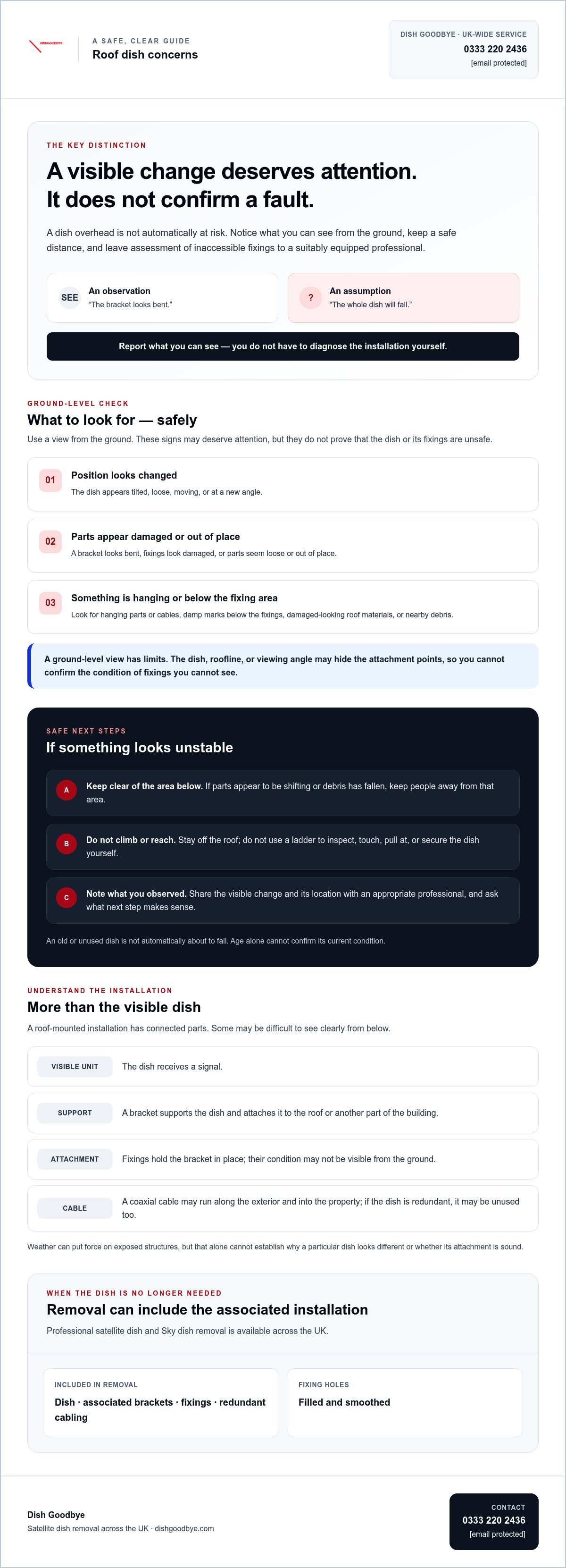
Make a simple distinction: “I can see a bracket that looks bent” is an observation; “the whole dish will fall” is a fear about what might happen. Both may feel real, but only the first is something you can report directly.
A dish’s age alone cannot confirm its current condition. An old or unused dish isn’t automatically about to fall. From ground level, note its location and any visible changes. If helpful, write down what you noticed once, then use that information to choose a next step instead of repeatedly checking or moving closer.
Stay off the roof and don’t use a ladder to get a better look. A ground-level view has limits, and trying to inspect the bracket or fixings yourself could put you at risk. If something appears to be shifting, parts are hanging, or debris has fallen, keep people away from the area below and seek suitable advice. You don’t have to diagnose the problem yourself to take a sensible precaution.
How Satellite Dish Brackets and Roof Fixings Can Change Over Time
A satellite dish is more than the round unit you can see from the ground. A bracket supports the dish and connects it to the building, while fixings secure the bracket. The mounting area and fixings are part of the installation, but they may be difficult to see clearly from below.
What are the dish, bracket, fixings, and cable?
The dish is the visible unit that receives a signal. Behind it, a bracket supports the dish and attaches it to the roof or another part of the building. Fixings hold the bracket in place. A coaxial cable may run from the dish along the exterior and into the property. If the dish is redundant, that cable may be part of the unused installation too.
These parts are exposed to the elements. Wind pressure and wind uplift are among the forces that can act on roofs and structures. The condition of the mounting area may also matter. That doesn’t establish why a particular dish looks different or whether its attachment is sound. A visible concern is a reason to pay attention, not confirmation of a structural problem.
Why a ground-level view cannot confirm every issue
From the ground, you may spot a changed angle, a bracket that looks bent, or a cable hanging differently. But the roof-level attachment points can be hidden by the dish, roofline or viewing angle. Even a clear view can’t confirm the condition of fixings you can’t see.
Don’t climb a ladder, access the roof or touch the equipment to get a closer look. If you’ve noticed a visible change, or can’t judge the condition safely, share what you observed with an appropriate professional and ask what next step makes sense.
A visible concern isn’t the same as a confirmed structural problem. This distinction can help ease anxiety about dish falling off roof: you don’t have to diagnose the installation yourself to take the concern seriously. Note what you can see and where it is, then leave assessment of inaccessible parts to someone suitably equipped to consider them.
If the dish is no longer needed and you’d prefer it gone, satellite dish removal across the UK is an option to explore. Removal can include the dish, bracket, fixings and redundant cabling, with fixing holes filled and smoothed.
Is the Dish Actually Loose? Separate Visible Warning Signs From Assumptions
It’s easy to jump from “something looks different” to “the dish is about to fall”. A measured check helps: describe what you can see, consider what it may warrant, and remember what a view from the ground can’t establish. The signs below are reasons to seek advice, not predictions of what will happen.
| What is visible | What it may warrant | What cannot be confirmed from the ground |
|---|---|---|
| The dish appears to have shifted or moves in the wind | Keep clear of the area below if you’re concerned, and seek advice from a suitable professional | Whether the bracket or hidden fixings are secure, or what is causing the apparent movement |
| A bracket or another part looks bent, damaged or out of place | Make a note of what you can see and avoid touching or testing it | How extensive the damage is or whether the attachment is affected |
| Debris is nearby, or roof materials look damaged | Keep people clear of the area below and seek suitable advice | Whether the debris came from the dish or roof, or whether there is further damage |
| The dish looks old, unused or weathered | Consider whether it’s still needed, and seek advice if you have a specific concern | The condition of fixings that aren’t visible, or whether the dish is loose |
Which visible changes deserve a closer professional look?
Focus on changes rather than guesses. You might notice that the dish looks newly tilted, a bracket appears bent, or a part seems to be hanging differently. Debris or damage to the nearby roof area also deserves attention. These observations don’t prove a fault, but they’re useful details to pass on. If parts look loose or debris is present, keep people away from the area below. Don’t pull or push the dish to see if it moves.
What does not prove a dish is about to fall?
Age, disuse and a weathered appearance can prompt questions, but none reveals the condition of hidden fixings on its own. Equally, a dish that looks unchanged from the ground can’t be declared safe based on appearance alone. A professional assessment may be needed to judge parts you can’t see or assess safely.
Concern is a reason to check safely, not proof of an imminent fall. If anxiety about dish falling off roof is taking hold, return to the observable facts: what changed, where you saw it, and whether there’s debris or visible damage. Share those details with a suitable professional, and leave testing or closer inspection to them.
What to Do If Anxious About a Dish Falling Off the Roof
If anxiety about dish falling off roof is making you check repeatedly, pause and choose one safe next step. You don’t need to diagnose the fixings yourself. Use this simple sequence:
- 1. Stay at ground level. Look from a safe position. Don’t climb onto the roof or use a ladder to get closer.
- 2. Note what you can see. Record a specific change, such as a dish that appears to have shifted or a part that looks damaged.
- 3. Keep clear if concerned. If debris is present or something appears loose, keep people away from the area below. Don’t stand beneath debris or approach equipment that looks unstable.
- 4. Seek suitable advice. Share your observations with an appropriate professional. Don’t pull, push, test or attempt to remove the dish.
If the situation appears immediately unsafe, keep people well away and contact an appropriate professional for advice. Avoid repeatedly returning to check or searching for more reassurance. One clear note of what you saw, followed by a practical next step, is more useful than taking risks for a closer look.
How to check from the ground without taking risks
Observe only what’s plainly visible from a safe position. Note whether the dish seems newly tilted, whether a part appears to be hanging, or whether debris is on the ground nearby. Don’t climb, touch the equipment or try to see whether anything moves. If you can’t judge the condition safely, leave that assessment to someone appropriately equipped.
When to consider removing a redundant dish
If the dish is no longer used or wanted, removal can be a practical way to clear the redundant equipment. A professional removal service may cover the dish, bracket, fixings and redundant cabling. Dish Goodbye provides satellite dish and Sky dish removal across the UK, with fixing holes filled and smoothed. Removed metal and electronic waste is processed through approved recycling centres.
For a redundant dish, you can explore satellite dish removal as a straightforward next step. This is a removal option, not an assessment of whether a particular dish is loose. Keep clear and seek suitable advice if you’re concerned about its condition.
How Dish Goodbye Can Help Remove a Redundant Roof Dish Across the UK
If the dish is no longer wanted, removal is one practical way to clear the redundant equipment. Dish Goodbye provides satellite dish and Sky dish removal across the UK. This is an option for unwanted dishes, not a diagnosis of whether a particular dish or its fixings are secure. If you’re worried about a visible change, keep clear and seek suitable advice about the concern.
What is included when a redundant dish is removed?
Dish Goodbye’s removal service covers the dish and associated parts, so redundant equipment doesn’t have to be left behind on the property. The work includes:
- Removing the dish, brackets and fixings.
- Removing redundant cabling.
- Filling and smoothing the fixing holes to help restore the exterior.
- Sending removed metal and electronic waste to approved recycling centres.
Taking care of associated fittings and cabling makes removal more complete than simply taking away the visible dish. Filling and smoothing the fixing holes helps leave a neater finish.
Removed equipment also needs a responsible route after it leaves the property. Dish Goodbye processes removed metal and electronic waste through approved recycling centres, helping ensure those materials are handled as waste rather than left to clutter the home.
Make the next step simple
If the dish is redundant, or you’d like it removed, you can ask Dish Goodbye about the service and what removal involves. You don’t need to climb up or attempt the work yourself. Make your request from the ground, and keep any separate safety concern clear when you seek appropriate advice. Removal is available across the UK.
If anxiety about dish falling off roof is part of why you want an unwanted dish gone, remember that arranging removal is different from seeking an assessment of its current condition. For a redundant dish, take the straightforward next step and ask Dish Goodbye about dish removal.
Contact Dish Goodbye: 0333 220 2436 or [email protected].
Choose a Safe, Simple Next Step
A dish on your roof isn’t automatically about to fall. Look from the ground, note specific changes, and don’t climb, touch the equipment or try to test its fixings. If you see loose-looking parts or debris, keep clear and seek suitable professional advice. Anxiety about dish falling off roof can feel overwhelming, but you don’t have to diagnose the dish yourself.
If the dish is redundant, professional removal can clear the dish, brackets, fixings and unused cabling. Dish Goodbye provides dish and aerial removal across the UK, fills and smooths fixing holes, and processes removed metal and electronic waste through approved recycling centres.
Ready to clear an unwanted dish? Ask Dish Goodbye about removing a redundant dish. Contact the team to discuss removal of the dish and its associated fittings.
Contact Dish Goodbye: 0333 220 2436 or [email protected].
Frequently Asked Questions
Can a satellite dish fall off a roof?
A dish can become loose, but age or appearance alone can’t confirm its condition. Look only from a safe position on the ground. If you notice apparent movement, damaged-looking parts or debris, keep clear of the area below and seek professional advice. Don’t climb onto the roof, use a ladder, pull the dish or try to test its fixings yourself. A ground-level view can’t confirm what’s happening at the attachment points.
How can I tell if a satellite dish is loose?
From the ground, you may notice apparent movement, a bracket that looks bent, damaged-looking parts or debris nearby. These are observations, not proof that the dish is loose or about to fall. The roof-level fixings may not be visible, so don’t approach or touch the installation to check. If something looks changed or concerning, keep people clear of the area below and ask a suitable professional to assess it safely.
Is it safe to leave an old satellite dish on the roof?
An old or unused dish isn’t automatically unsafe, but its age doesn’t confirm the condition of its fixings either. A view from the ground can’t establish whether hidden parts are secure. If you notice apparent movement or visible damage, seek professional advice and don’t try to inspect it from a ladder. If you no longer need the dish, professional removal is an option that avoids climbing or dismantling it yourself.
What should I do if I think my roof dish is about to fall?
Stay away from the roof and don’t stand beneath parts that look loose or any debris. If you’re concerned, keep other people clear of the area below and contact an appropriate professional for advice. Don’t use a ladder, touch the dish or attempt removal. From a safe position, note only what you actually observed, such as an apparent change in angle or debris, and share those details when seeking advice.
Can I remove a satellite dish from my roof myself?
Don’t climb onto the roof or try to pull a dish down yourself. Removal involves working at height and handling the dish, brackets, fixings and cabling, so arrange professional removal if it’s redundant. Dish Goodbye’s service includes removing associated fittings and redundant cabling, then filling and smoothing fixing holes, so you don’t have to dismantle the installation yourself.
Will removing a satellite dish leave holes in the roof or wall?
Removing the bracket fixings can leave holes where the dish was attached. Dish Goodbye’s removal service includes filling and smoothing fixing holes to help restore the exterior. The precise finish can depend on the surface and work required, so don’t assume it will match every exterior exactly.
Who can remove a redundant satellite dish in the UK?
Choose a suitable professional removal service that can take away the dish and associated brackets, fixings and redundant cabling without asking you to climb onto the roof. Dish Goodbye provides satellite dish and aerial removal across the UK. The service includes filling and smoothing fixing holes, while removed metal and electronic waste is processed through approved recycling centres. If you’re concerned about a dish’s condition, seek advice rather than attempting removal yourself.