

What helps when preparing for an exterior check is not making every mark disappear, but helping the surveyor see the property clearly. If you’re wondering how to pass a homebuyer report exterior checks, focus on safe access, accurate information and honest preparation, not a quick cover-up. For nationwide satellite dish removal, visit dishgoodbye.com, call 0333 220 2436 or email [email protected].
It’s understandable to worry that a visible issue could complicate a sale. A survey can flag concerns, but hiding them won’t resolve the underlying problem. A Level 2 survey is a visual inspection, so clear access and relevant records can help the surveyor understand what’s visible and what work has already been carried out.
This guide explains which exterior areas may be checked, from roofs, gutters and walls to visible fittings and signs of damp. You’ll learn what to review safely, how to prepare without concealing defects, and how to respond if the report raises a concern. If a redundant satellite dish is one exterior item you want removed, Dish Goodbye’s nationwide service includes associated brackets, fixings and cabling, with fixing holes filled and smoothed. Find details at dishgoodbye.com, call 0333 220 2436 or email [email protected].
Key Takeaways
- Prepare for homebuyer report exterior checks by making the property accessible and sharing accurate information, without trying to guarantee a particular result.
- Use a safe, ground-level walk-around to note visible maintenance concerns and decide which may need professional assessment.
- Clear practical access and gather relevant repair records so the surveyor can see what’s been addressed and what remains unresolved.
- Read report observations carefully, distinguish them from recommendations for further investigation, and seek clarification on technical concerns.
- Consider whether redundant exterior equipment needs attention, but treat removal as a practical choice, not a way to influence the report.
How to pass a homebuyer report exterior checks: understand what the survey can show
You can make an exterior inspection clearer by improving access and sharing relevant information, but you can’t guarantee a particular report. Good preparation helps the surveyor see the property as it is. Covering a defect makes it harder to assess and doesn’t fix the underlying issue.
Exterior checks are visual observations of accessible parts of a home. A surveyor may note the condition of visible roof coverings, chimneys, walls, rainwater goods such as gutters and downpipes, windows, doors and boundaries. The exact scope depends on the survey and what can be seen safely on the day. If a view is blocked or an area is inaccessible, that can limit what the surveyor is able to observe.
A report describes apparent condition; it doesn’t necessarily establish the cause of a problem. Where an observation raises questions, the surveyor may recommend further investigation. Understanding the role of a Chartered Surveyor can also help put the inspection in context. The practical goal isn’t to engineer a “pass”. It’s to make the property’s visible condition and any relevant history easier to understand.
What does a homebuyer report exterior check look at?
Expect observations of visible features, not an identical inspection of every component. Roof coverings and chimneys may be viewed from the ground or another accessible vantage point. Walls, windows, doors, gutters and boundaries may also be considered. Height, sightlines, weather and access can affect what is visible, so don’t assume an unseen area has been fully assessed. The report records what could be observed within its scope.
Is a homebuyer report exterior check a pass-or-fail test?
No. It’s a condition report, not a guaranteed pass-or-fail examination. A noted defect is an observation to understand, not automatic proof that a sale must fail. Depending on the issue, the buyer may want clarification or further investigation. Keep preparation straightforward: clear access and share relevant repair records, but don’t cover, disguise or misrepresent visible concerns.
So, how to pass a homebuyer report exterior checks is best approached as a question of honest preparation, not a promise of a particular outcome. If you spot something concerning, note its location and be ready to explain any known history or work completed. The rest of this guide covers practical checks you can make safely before the survey and what to do if the report flags an issue.
Check the roof, walls, and rainwater goods before the exterior survey
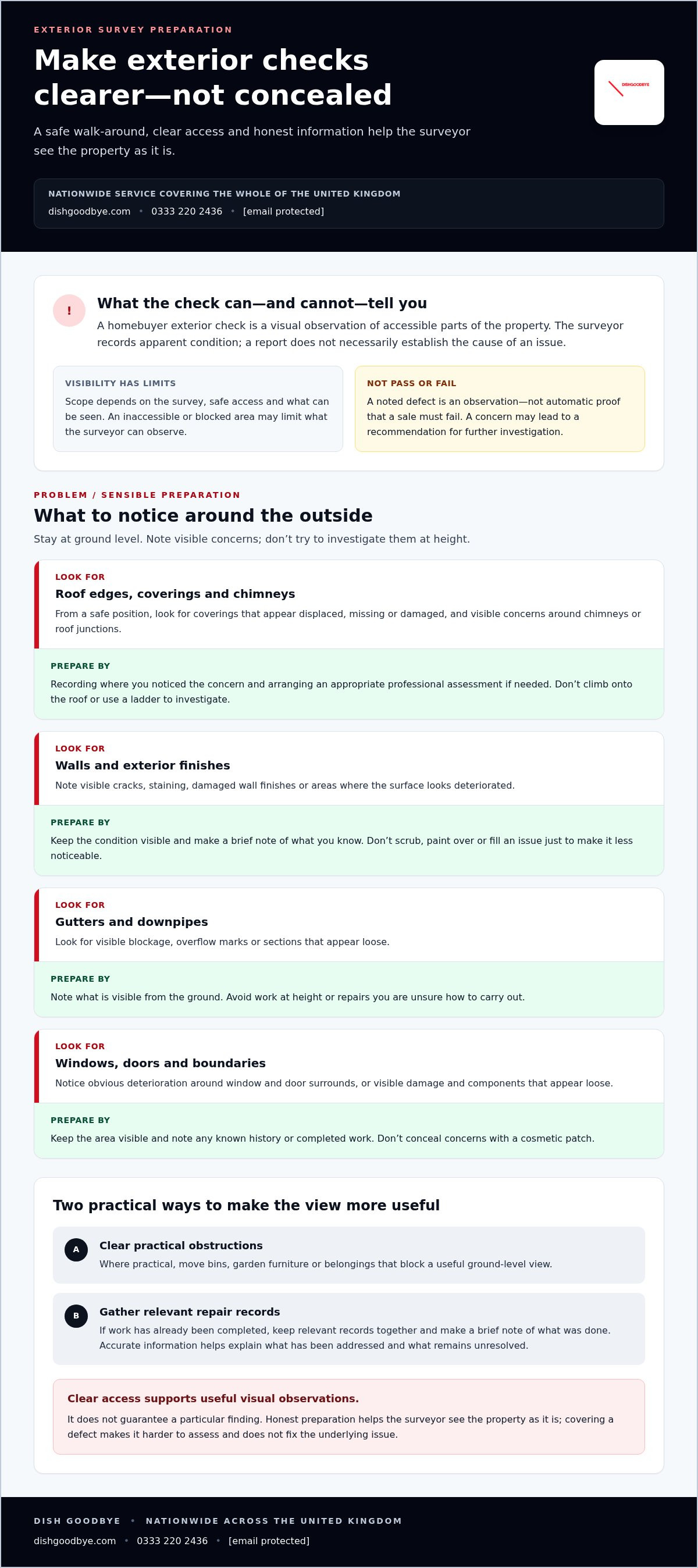
A walk-around can help you spot visible issues and make the outside of your home easier to view. Stay at ground level, follow a safe route around the property, and note anything that looks damaged or may need attention. Don’t climb onto the roof or use a ladder to investigate before the survey.
Look over roof edges, chimneys, and visible coverings
From a safe position, look for roof tiles or other coverings that appear displaced, missing or damaged. Check visible chimney areas and roof junctions for signs that may need closer attention, but don’t attempt a hands-on inspection. Ground-level views have limits. If you notice a concern, record where it is and arrange an appropriate professional assessment rather than trying to reach it yourself.
Review walls, windows, doors, gutters, and downpipes
Walk around the property and look for visible cracks, damaged wall finishes, loose-looking components or signs that water may be overflowing from gutters. Check window and door surrounds for obvious deterioration. Where practical, move bins, garden furniture or other belongings that block a useful ground-level view. Don’t scrub, paint over or fill a visible issue simply to make it less noticeable.
Use this simple checklist to keep your observations clear:
- Roof edges and chimneys: note visible damage or displaced materials from the ground.
- Walls and finishes: record cracks, staining or areas where the surface looks damaged.
- Gutters and downpipes: look for visible blockage, overflow marks or loose sections.
- Windows, doors and boundaries: note visible damage or components that appear loose.
Separate routine tidying from repairs that may need expert attention. Clearing leaves from a reachable ground-level area may be straightforward, but don’t attempt work at height or repairs you’re unsure how to carry out. If work has already been completed, gather any relevant records and make a brief note of what was done. Accurate information is more useful than a cosmetic patch that hides the original condition.
Clear access helps a surveyor make useful visual observations; it doesn’t guarantee a particular finding. This is a practical way to prepare while keeping the property’s condition visible. The survey is part of the wider official home buying process, but your walk-around is simply an opportunity to improve access and note what you already know. If a redundant satellite dish is among the exterior items you’re considering, nationwide satellite dish removal includes attention to associated fixings and cabling, with fixing holes filled and smoothed.
Common exterior concerns: damp signs, cracks, access, and redundant fittings
Visible marks can prompt questions, but a single sign rarely tells the whole story. A damp-looking patch, crack or overflow stain is an observation, not a confirmed diagnosis. If you’re considering how to pass a homebuyer report exterior checks, keep your notes factual: describe what you can see, where it is and any work already carried out. Don’t guess at the cause or rely on a photograph to diagnose a problem.
| Visible observation | Why it may be noted | Sensible next step |
|---|---|---|
| Damp-looking marks or staining | They may suggest moisture or past water ingress, but appearance alone can’t establish the cause. | Record the location and any known history or completed repairs. Arrange an appropriate assessment if the concern remains. |
| Cracks in walls or damaged finishes | The surveyor may describe their position and appearance as part of the visible condition. | Note whether they’ve been reviewed or repaired, and keep relevant records. Avoid filling or painting over them just before inspection. |
| Blocked or overflowing rainwater goods | Staining below a gutter or visible debris may raise questions about water flow and upkeep. | Only clear anything you can reach safely. Don’t climb or attempt work at height. |
| Areas hidden by belongings or dense growth | Limited visibility may restrict what can be observed. | Move items where practical to improve access, without disturbing anything unsafe. |
| Redundant dishes, aerials, brackets or cabling | These are visible exterior fittings and may leave fixings or cables in place. | Decide whether the equipment is still needed. Removal is an optional maintenance choice, not a way to guarantee a particular report. |
How should you handle visible cracks or signs of damp?
Keep your explanation simple and accurate. If a crack or damp mark has been assessed or repaired, note what you know and gather available records. Don’t claim a cause unless it’s been established. If you’re still concerned, seek an appropriate professional assessment; the survey’s observation itself isn’t a diagnosis.
Can old satellite dishes or fixings affect an exterior check?
A redundant dish or aerial isn’t automatically a defect, but its fittings and cabling are part of the visible exterior. If you want it removed, a professional dish removal service can remove associated brackets, fixings and cabling, with fixing holes filled and smoothed. That can leave the area tidier, but it can’t determine or guarantee the survey outcome. For wider context on surveys in a property purchase, see the official government guide to buying a home.
How to prepare your home exterior before the survey: a safe step-by-step checklist
A little preparation can make the exterior easier to view and help you share useful information. Keep the purpose clear: you’re improving access and clarity, not trying to influence the report. This sequence can help you get organised without taking on risky work.
- Walk around from ground level. Use accessible paths to look over the outside of the property. Note visible concerns such as damaged finishes, cracks or signs of water overflow. Don’t climb onto the roof or use a ladder to inspect hard-to-reach areas.
- Make a factual note of anything you spot. Record its location and what you can see, without guessing at the cause. For example, write “staining below the gutter” rather than assuming what caused it.
- Clear sightlines where it’s safe and practical. Move bins, garden furniture or other movable items that block views of external walls. Don’t shift heavy or awkward objects, or disturb anything that could be unsafe.
- Make accessible areas easier to reach. Keep paths and entrances clear where possible. Don’t force access to restricted or unsafe areas, and don’t remove fixtures or attempt repairs just to change what the surveyor sees.
- Gather relevant repair records. Put together available invoices, photographs or notes about completed exterior work. Keep them easy to find so you can explain what was done, and when, if asked.
- List unresolved concerns honestly. Note issues that remain outstanding and any steps already taken. If you don’t know why something has happened, say so rather than offering an unsupported explanation.
Stay within your abilities. Leave roof access, unsafe ladder use and repairs beyond your competence to an appropriate professional. A quick tidy can help, but a risky or cosmetic fix isn’t worth attempting just before an inspection.
For anyone researching how to pass a homebuyer report exterior checks, the most useful preparation is clear access, accurate records and an honest account of known issues. If a redundant satellite dish is part of your exterior preparation, Dish Goodbye removes dishes and associated brackets, fixings and cabling, and fills and smooths fixing holes. Explore nationwide satellite dish removal as an optional practical step, not a way to guarantee a particular report.
Post-exterior checks and redundant equipment care
Once the report arrives, focus on what it says rather than trying to read between the lines. An observation describes something the surveyor saw. A recommendation for further investigation means more information may be needed. A repair record can show that work was completed, but it doesn’t automatically prove that a concern noted in the report has been resolved.
How should you respond if the report flags an exterior issue?
Read the wording carefully and note whether the surveyor recommends further investigation. Compare the finding with relevant invoices, photographs or repair notes, remembering that the report describes the condition visible during the inspection. Don’t dismiss a concern or claim it’s fixed unless you have a sound basis for saying so.
If the wording is unclear, ask the surveyor to explain what was observed and what further checks are being suggested. For technical concerns, seek an assessment from a relevant professional. Keep the report, your records and any follow-up advice together. This makes it easier to understand the next step and share accurate information with the people involved in the sale.
When professional removal can tidy redundant exterior equipment
A redundant satellite dish, aerial, bracket or cable may simply be an unwanted fitting rather than a defect. If you’d like a cleaner exterior, Dish Goodbye provides nationwide UK removal of redundant dishes, aerials, antennas, brackets, fixings and cabling. The service includes filling and smoothing fixing holes, with removed metal and electronic waste processed through approved recycling centres. Removal is an optional property-maintenance choice, not a way to secure a favourable report.
A tidy, uncluttered finish can improve the exterior’s appearance, but keep the survey’s findings separate from cosmetic improvements. If you’re considering how to pass a homebuyer report exterior checks, respond accurately to observations and follow up on recommended investigations rather than assuming a particular outcome.
If redundant equipment is something you’d like removed, explore nationwide satellite dish removal. Visit dishgoodbye.com, call 0333 220 2436 or email [email protected].
Prepare with confidence, then respond clearly
The best approach to how to pass a homebuyer report exterior checks is to make visible areas accessible, keep useful repair records and describe known concerns honestly. A survey records what could be seen; an observation isn’t automatically a diagnosis or a reason a sale must fail. If the report recommends further investigation, focus on understanding that advice and taking a sensible next step.
Redundant dishes, aerials, brackets and cabling are optional items to address if they’re no longer wanted. Dish Goodbye provides removal across the United Kingdom, including associated fixings and cabling. Fixing holes are filled and smoothed, and removed metal and electronic waste is processed through approved recycling centres. Removal can tidy the exterior, but it can’t guarantee a particular survey result.
If redundant equipment is ready to go, arrange professional removal. For a practical next step, visit dishgoodbye.com, call 0333 220 2436 or email [email protected]. Prepare honestly, handle concerns calmly, and move forward with confidence.
Frequently Asked Questions
Can you fail a homebuyer report exterior check?
No. An exterior check is a visual assessment of the property’s condition, not a pass-or-fail test. The report may record concerns or recommend further investigation, but an observation doesn’t automatically mean a sale must fail. Read the wording carefully and consider what action, if any, is suggested. Clear access and honest information help the surveyor make useful observations, but they can’t guarantee a particular report.
What do surveyors check on the outside of a house?
Surveyors may observe accessible exterior features such as visible roof coverings, chimneys, walls, gutters and downpipes, windows, doors and boundaries. What they can assess depends on the survey’s scope and what’s safely visible on the day. A blocked view or inaccessible area may limit observations. Don’t assume every component will be inspected in the same way, or that a visual check confirms the cause of a defect.
How do I prepare my house for exterior checks?
Walk around the property from a safe, ground-level position and note visible concerns without guessing at their cause. Move bins or garden items that block views if it’s safe and practical, and gather available records of relevant repairs. Don’t climb onto the roof, use a ladder for survey preparation, cover defects or attempt work beyond your competence. The sensible way to approach how to pass a homebuyer report exterior checks is to make access and information clear.
Can a homebuyer report identify damp or structural problems?
A report can describe visible signs, such as damp-looking marks, staining or cracks, and may recommend further investigation if needed. A visual observation alone doesn’t necessarily establish the cause or confirm the extent of a problem. Share relevant repair history and records, but avoid presenting a guess as a diagnosis. If the report raises a technical concern, ask the surveyor to explain the finding and seek an appropriate professional assessment where advised.
Should I remove an old satellite dish before a homebuyer report?
Only if it’s redundant and you want it removed. An old dish, aerial, bracket or cable is a visible exterior fitting, but its presence doesn’t automatically mean there’s a defect or that a surveyor will flag it. Dish Goodbye provides satellite dish and aerial removal across the UK, including brackets, fixings and cabling. Fixing holes are filled and smoothed, and removed metal and electronic waste is processed through approved recycling centres.
What should I do if the report recommends further investigation?
Read the recommendation closely and identify what the surveyor suggests investigating. If the wording isn’t clear, ask the surveyor to explain the observation and proposed next step. Compare it with relevant repair records, but don’t assume previous work has resolved the issue without evidence. For technical concerns, seek an assessment from a relevant professional. Keep reports, repair documents and follow-up advice together so you can refer to them as needed.
Does clearing the outside of my home guarantee a better survey report?
No. Clearing items that block accessible views can help the surveyor see more clearly, but it can’t guarantee a better report or change the property’s condition. Keep preparation proportionate: tidy sightlines where practical, share relevant repair information and leave visible concerns uncovered. Avoid removing fittings or making cosmetic changes solely to influence the report. Honest preparation helps create a clearer picture, while the survey findings remain based on what the surveyor observes.
Visit dishgoodbye.com, call 0333 220 2436 or email [email protected].