
A redundant aerial can be more than an eyesore on a commercial roof. Removing old aerials from commercial buildings requires careful planning for roof access, work at height and the risk of damaging roof coverings, walls or shared equipment.
It’s understandable to want unused poles and cables cleared away, especially when they complicate maintenance or look untidy. This guide explains how professionals assess access, plan safe removal and account for the building’s condition and any connected equipment before work begins.
You’ll also learn why an aerial may need to stay if it is part of a communal system, what affects the work involved and how fixing holes and other property risks are addressed. Dish Goodbye provides removal services across the UK.
Key Takeaways
- See how roof access, building condition and work-at-height risks shape a safe removal plan.
- Learn why it’s important to establish whether an aerial serves a communal or shared system before taking it down.
- Understand how professionals approach redundant poles, cables and fixing holes without assuming every item is part of the same job.
- Find out when scaffolding or other access equipment may be needed and how the site affects that decision.
- Explore the planning considerations that can apply when removing or replacing rooftop aerials on commercial buildings in England.
Assessing safe roof access and working at height
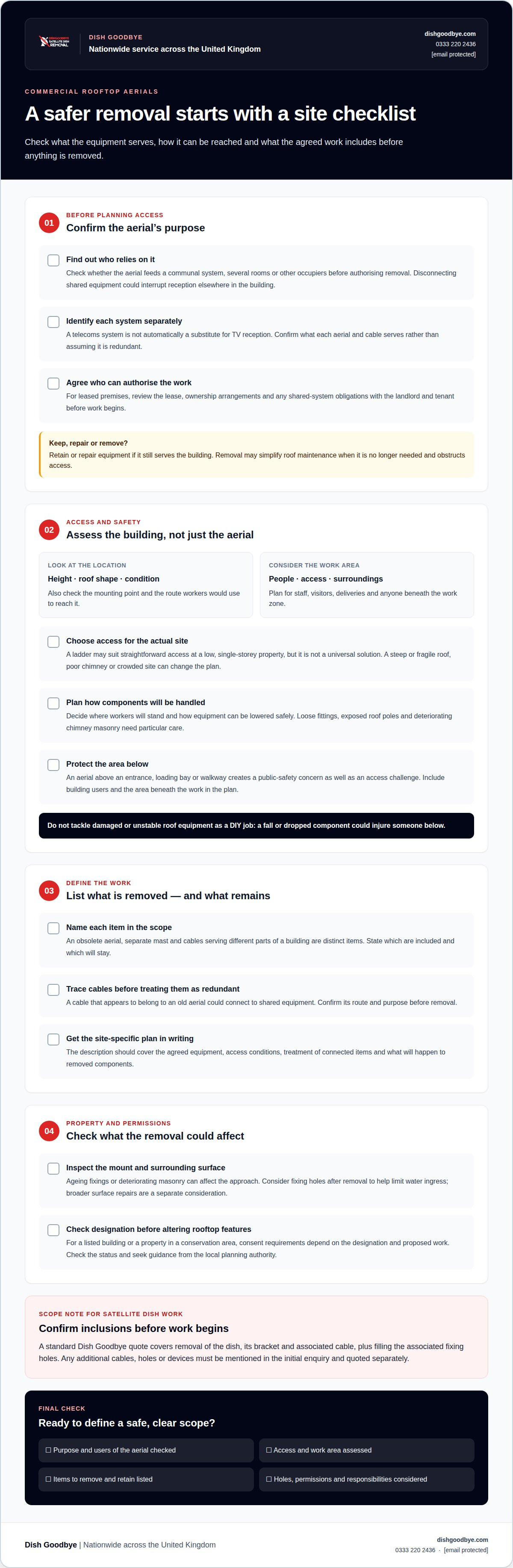
Start with the building, not the aerial. A professional assessment considers the roof’s height, shape and condition, the mounting point and the route to reach it. A loose aerial on a high roof presents different risks from a wall-mounted unit accessible from ground level. Don’t tackle damaged or unstable roof equipment as a DIY job: a fall or dropped component could injure someone below.
Access planning considers where workers will stand and how equipment can be lowered safely. A ladder may suit straightforward access at a low, single-storey property, but it is not a universal solution. A steep roof, fragile surface, poor chimney or crowded commercial site can change the plan. Professionals assess the location before choosing equipment or deciding whether additional access arrangements are needed.
Chimney-mounted aerials need particular care because the mount may be fixed to deteriorating masonry. Roof-mounted poles can be awkward to handle in exposed positions, while wall-mounted aerials may sit above entrances, loading bays or walkways. A busy shop entrance below a wall fitting, for example, creates a public-safety concern as well as an access challenge. The removal plan should account for building users and the area beneath the work.
Rooftop aerials may still serve a purpose. A TV aerial can provide standard live terrestrial television, and a commercial property may have a shared system feeding several rooms or occupiers. Before removal, establish whether the equipment serves a communal system. Disconnecting the wrong aerial could interrupt reception elsewhere in the building. If the property relies exclusively on streaming, an unused aerial may no longer be needed, but its connections still require careful assessment.
Removing redundant equipment can simplify roof maintenance. An old pole may obstruct inspections of roof coverings or put extra strain on a chimney or wall in bad weather. Clearing it can also improve the building’s appearance, particularly when an obsolete mast is visible above the frontage. Address fixing holes left after removal to help limit water ingress. Broader surface repairs are a separate consideration.
For a leased commercial building, responsibility depends on the lease, ownership arrangements and any obligations relating to shared systems. The landlord and tenant should review the relevant terms and agree who will authorise the work before removal begins.
For a listed building or a property in a conservation area, consent requirements depend on the designation and proposed work. Check the building’s status and seek guidance from the local planning authority before altering rooftop features, especially if the work could affect a listed building’s character.
Professional removal of redundant aerials, poles and cables
A professional removal plan starts by identifying what the equipment serves and defining the agreed work. This helps avoid disrupting reception or removing cables that are still in use.
Removing Redundant, Unwanted or Damaged Equipment
An aerial is not automatically unsafe just because it is old. A professional can assess whether a redundant, unwanted or damaged aerial, pole, bracket or cable should be removed. The condition of the mount and surrounding roof or wall matters, as does whether the equipment is still connected. Loose or visibly damaged equipment needs particular care because components could shift during handling.
Define the work clearly before it starts. A roof might have an obsolete aerial, a separate mast and cables feeding several parts of a building. These are distinct items, so the agreed scope should identify what will be removed and what will remain. Consider fixing holes, additional cables and other devices separately rather than assuming every removal includes them.
Choosing a Qualified Removal Contractor
For a commercial property, choose a contractor with relevant aerial-removal experience and a clear plan for the site’s access conditions. Ask for a written description of the items covered, how connected equipment will be treated and what will happen to removed components. The quote should reflect the actual height, mount, property layout and additional work, rather than assume every roof is alike.
A contractor also needs to understand how the site is used. An occupied office or shop, for example, may have staff, visitors and deliveries moving below the work area. The proposed approach should account for these activities and explain how the removal will avoid unnecessary disruption. Clear communication about the scope helps the property manager arrange access and notify affected occupants.
Whether to remove, repair or retain an aerial depends on its condition and purpose. Remove equipment that is no longer needed; repair or retain it if it still serves the building. If a shared TV system is being considered, assess the existing connections and occupiers’ needs before changing anything. A telecoms system is not automatically a substitute for TV reception, so identify each system separately.
Keeping a redundant aerial may make sense if it provides useful backup or feeds rooms that still rely on terrestrial television. It may also belong to a communal system rather than one tenant. Find out who uses it before authorising removal to help prevent avoidable reception problems. If it serves no one and obstructs roof maintenance, removal may simplify future access to the area.
During removal, the professional should handle the identified components without treating every cable on the building as redundant. A cable that appears to run from an old aerial, for instance, could connect to shared equipment. Confirming its route and purpose is part of defining the work. Address any remaining fixing holes within the agreed scope to help reduce the risk of water ingress.
Property and safety risks from ageing aerials
Ageing aerials can become a concern when fixings loosen or supporting masonry deteriorates. Wind, rain and age can weaken an aerial’s structure, leaving a pole less secure than it looks from the ground. On a commercial building, a falling component could strike a pavement, entrance or parked vehicle. A property owner could face a claim if a falling aerial injures someone.
From a safe position, look for visible changes such as a leaning mast, loose-looking brackets or cracked masonry around a fixing. These signs don’t prove failure is imminent, but they can help identify equipment that needs prompt professional attention. Movement at a chimney mount, for example, may mean both the bracket and chimney surface need careful assessment before removal.
Consider the parts of the building below the aerial, not just the roof. A pole above a shop doorway, office entrance or delivery bay creates a risk for people using that area. A professional assessment should consider the equipment’s condition, its mounting points and the likely path of components during work. If the aerial appears unstable, keep people away from the immediate area until it has been assessed.
Water ingress is another property risk. Fixing holes left open after removal can let water reach the roof or wall beneath. For example, holes in masonry around an old bracket may need filling as part of the agreed work. The visible aerial is only one part of the job; the mounting surface also matters to the building’s ongoing condition.
An aerial or mast is not automatically hazardous simply because it is old. Attached devices, unusual materials or damaged components may require specific handling, so identify them before removal. Agree disposal arrangements for the items being taken down. Don’t assume every cable or device on the roof belongs to the aerial or has the same disposal requirements.
If equipment is damaged, don’t pull or cut it from the ground. A cable may still be attached to a bracket, roof feature or another system, and force could make the aerial shift unpredictably. A commercial site manager can help by identifying access restrictions and keeping occupants clear of the work area. The removal team can then assess the equipment and plan how to handle it.
After removal, review the roof and mounting area for visible damage and remaining fixings. A bracket may have left holes, for example, while an old pole has obscured the surrounding surface. Agree in advance which holes and repairs are included. Masonry restoration, rendering or painting may require separate work, so don’t treat removal as a full exterior refurbishment.
Scaffolding and additional access equipment
Scaffolding is not needed for every aerial removal. The access method depends on the building’s height, roof layout, mounting position and surrounding space. A wall-mounted aerial above a clear, accessible area presents different conditions from a mast beside a narrow roof edge. A site assessment helps determine whether standard access is suitable or additional equipment is needed.
Scaffolding may be considered when an aerial is high above ground, the roof cannot be reached safely by a simpler method, or workers need a stable position beside the fitting. A commercial frontage with a tall wall and busy entrance below, for example, may need a planned access arrangement. Equipment must suit the actual site, not just the type of aerial.
Other access methods may suit some buildings, but roof shape, obstacles and safe working positions affect the choice. A confined courtyard, fragile roof covering or equipment mounted above an extension can complicate access. High-rise, cradle, rope-access and industrial broadcast removals are not automatically suitable for every job. The building’s specific conditions determine which approach can be considered.
Planning involves more than reaching the aerial. The removal team needs to assess how tools and components can be handled at height and how the area below will be managed. At an office, for instance, an entrance or delivery route may sit directly beneath the roof edge. The access plan should account for staff, visitors and normal building activity.
Before work, the property manager can help by sharing practical site details. Useful information includes the aerial’s position, available access routes, restricted areas and relevant arrangements for building use. Photographs can illustrate the location, but they don’t replace an assessment of roof condition and access. A clear description helps define the job’s scope.
Additional access arrangements, such as scaffolding, are assessed case by case. Factors include the building’s height, aerial location, condition of the mounting area and available space around the structure. A narrow pavement or active loading area may affect where equipment can be positioned. These conditions can change the work plan and should be considered before preparing a quote.
Keep the scope specific. A quote should identify the aerial and associated items to be removed, plus any agreed work to address fixing holes. Don’t assume extra cables, separate devices, other holes or broader surface repairs are included. If scaffolding or another access arrangement is needed, make sure the proposed work clearly reflects the access requirements.
Good planning ties access decisions to the building, not guesswork. Two aerials on the same property, for example, may require different approaches if one is on a low wall and the other above a roof obstruction. Assessing each position helps match the access method to the task and surrounding site.
Planning rules for commercial rooftop aerials in England
The words “commercial rooftop aerial” alone aren’t enough to determine whether planning permission is needed. In England, the property’s status and the exact work proposed matter. Removing an existing aerial differs from installing or replacing equipment, so describe the intended work accurately when seeking guidance from the local planning authority.
Start by identifying the building and its location. Record its address, whether it is listed and whether it lies within a conservation area. These details help the local planning authority assess the planning context. Commercial use alone doesn’t answer every question about permission. If the building is listed, ask specifically whether listed building consent is relevant to the proposed alteration.
Explain the scope clearly. For removal, state whether the aerial, mast, brackets and visible cables will all be taken away or whether some equipment will remain. For replacement, describe the new equipment’s position and appearance, including any proposed change in size or mounting location. Replacing a small wall-mounted aerial with a larger rooftop mast, for example, differs from removing an unused fitting.
Send the authority clear photographs of the building and aerial’s position, along with a brief description of the work. Include the affected roof elevation and whether the equipment is visible from a public street. These details help distinguish a discreet rear-roof fitting from a prominent mast on a street-facing frontage. Ask the authority which permissions or applications, if any, apply before setting a work date.
For listed buildings and conservation areas, don’t assume that a minor-looking change has no planning implications. The building’s designation, the aerial’s location and the effect of the proposed work can all inform the decision. If a property manager or tenant is arranging removal, establish who can authorise alterations under the lease as well. Planning questions and landlord approval are separate issues, so resolve both before work begins.
Keep the authority’s response with the project records, alongside the removal scope and any landlord or owner approval. If the authority says an application is needed, follow its instructions before proceeding. Being outside a designated area alone isn’t a definitive answer for every proposed change. Ask about the specific removal or replacement and retain the authority’s written guidance.
This sequence keeps the decision tied to the actual property: identify the site, describe the removal or replacement, provide photographs and ask the relevant local planning authority. A listed town-centre office with a street-facing mast, for example, may raise different considerations from an unlisted warehouse with a rear-mounted aerial. The authority can assess the circumstances rather than rely on a general assumption.
Dish Goodbye
Dish Goodbye can help when a commercial roof also has an unwanted satellite dish. A quote covers the dish, its bracket and associated cable, plus filling the fixing holes left by that installation. Mention any extra cables, devices or holes in your enquiry so they can be quoted separately. Roof access and building conditions are assessed for each job.
If you’re planning roof maintenance and need a satellite dish removed, contact Dish Goodbye to discuss the work. Call 0333 220 2436 or email [email protected].
Make the next roof-maintenance step clear
Before scheduling roof work, bring the property owner, site manager and maintenance team onto the same page. A concise work brief can identify the equipment involved, affected parts of the building and any access arrangements already being planned. This gives everyone a clearer basis for coordinating the task with other maintenance and reducing avoidable disruption.
Planning for removing old aerials from commercial buildings also means separating the equipment’s purpose from the removal decision. If a satellite dish is part of the work, Dish Goodbye offers Satellite Dish Removal and Sky Dish Removal. Share the property details and items involved to discuss the next step.
Contact Dish Goodbye to discuss removal, or call 0333 220 2436 or email [email protected]. A clear brief is a practical start towards a tidier, better-organised roof.
Frequently Asked Questions
How is commercial aerial removal assessed in the UK?
Each commercial aerial-removal job is assessed and quoted individually, based on the equipment, its mounting position, access requirements and any additional work. For satellite dish removal, the standard quote covers the dish, bracket and associated cable, plus filling the related fixing holes. Raise other items in your initial enquiry so they can be quoted separately.
What affects the scope of commercial aerial removal?
Key factors include the aerial’s height and position, the type and condition of its mount, and how workers can reach it safely. A roof with restricted access may need different arrangements from a low wall fitting. The amount of equipment, cable routing and any separately requested work can also affect the scope. A clear description and photographs of the building and equipment can help explain the job.
What UK health and safety rules apply to working at height on commercial buildings?
Work at height needs suitable planning and risk controls for the specific building and task. The assessment should consider access, roof surfaces, weather exposure, falling objects and people below. Removing an aerial above an occupied entrance, for example, calls for careful management of that area. The work plan should identify suitable access equipment and how the job will be supervised, rather than defaulting to a ladder.
How should contractors assess asbestos, fragile roofs and other hazards before removing aerials?
Contractors should review available building information and assess the roof and mounting area before disturbing equipment. If asbestos-containing material is suspected, work should pause until an appropriate specialist assesses its presence and safe next steps. Fragile roofing, damaged masonry and concealed services also need consideration. An aerial fixed near rooflights, for example, may require a different access route to avoid vulnerable surfaces.
What steps are involved in safely removing and disposing of old rooftop aerials?
A safe process starts by identifying the aerial, its connections and whether it serves other parts of the building. The contractor then assesses access, hazards and the work area before agreeing which items are included. During removal, equipment is dismantled and handled according to its position and condition. The scope should also specify how removed materials will be managed. Ask about collection, recycling and disposal arrangements before work starts rather than assuming they are included.
For enquiries, call 0333 220 2436 or email [email protected].