

Contact Dish Goodbye on 0333 220 2436 or at [email protected].
Do satellite dishes affect a house survey? They can, but their presence alone does not mean there is a problem. A surveyor may note the dish, its fixings or cables, or holes left in the exterior. The key questions are the condition of the installation and whether property rules apply.
It is understandable to worry that a dish could complicate a sale or remortgage. The survey finding is only part of the picture: permissions, restrictions and the property’s condition can also matter. A dish that is no longer needed may leave brackets, cables or fixing holes behind.
This article explains what a surveyor may flag, how estate rules can affect a dish, and what a finding could mean for a sale or remortgage. A survey comment does not automatically put a transaction in trouble. You will also learn when removing a redundant dish may help leave the exterior tidier.
Key Takeaways
- A satellite dish doesn’t automatically cause a survey or sale problem. Its condition, installation and any applicable property rules help determine whether it needs attention.
- In England, planning conditions or an Article 4 direction may remove permitted development rights for a dish, so estate and local planning restrictions can matter.
- Survey comments may highlight fixings, cables or damage around the installation. Understand what the survey actually identifies before deciding what action is needed.
- Keep relevant installation, permission and repair information clear when selling, and respond to survey concerns with useful supporting documents.
- If a redundant dish is the issue, removal can help tidy the exterior. The work and quote depend on what needs removing and the property’s access and conditions.
Checking estate handbooks and management company policies
Before treating a satellite dish as a simple exterior fixture, check the property’s estate handbook, lease and management-company rules. These documents may set conditions for equipment fixed to roofs, walls or balconies. Rules can cover appearance, position, the number of dishes or consent before installation. For example, a handbook may require written permission even if the dish is attached to a privately owned house.
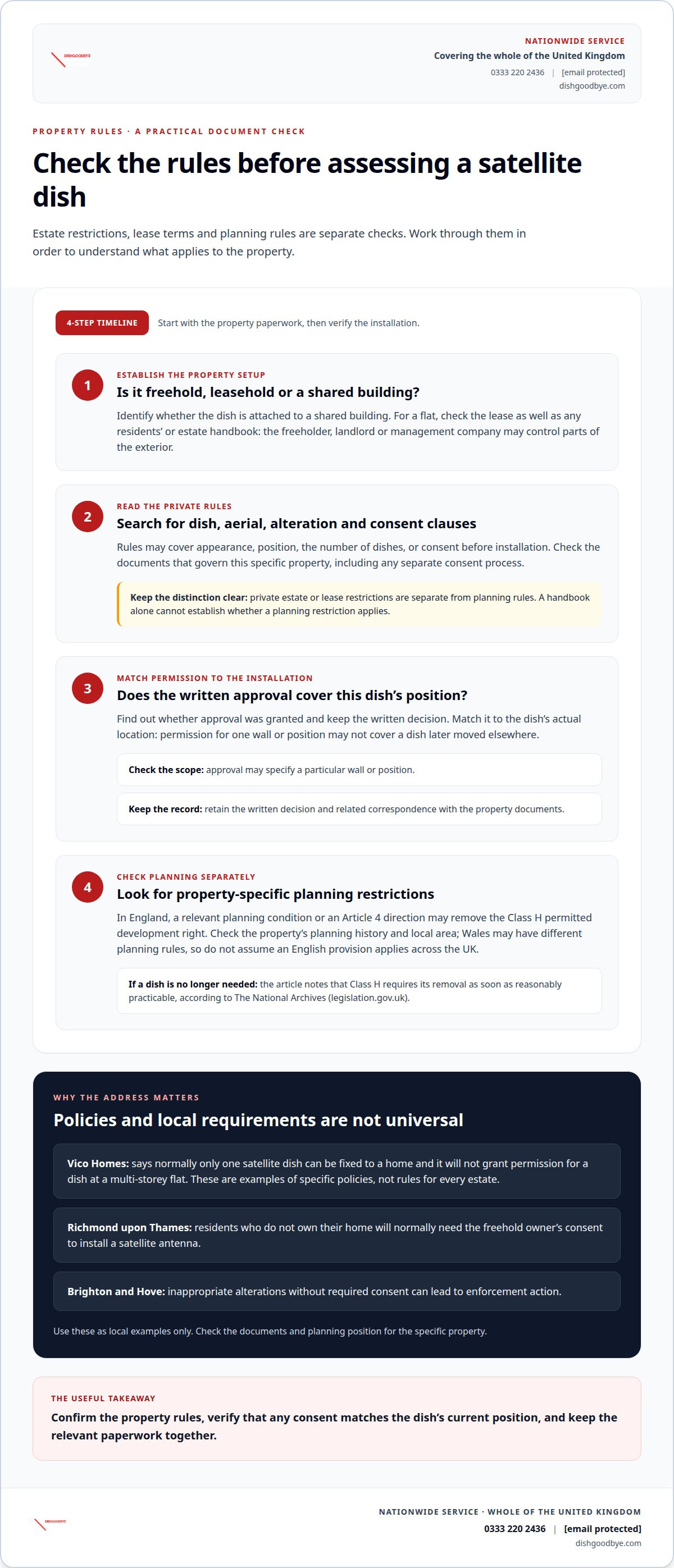
Start with the paperwork that governs the specific building. Look for clauses about satellite dishes, aerials, external alterations and shared areas. If the handbook refers to a separate consent process, find out whether approval was granted and keep the written decision. For a flat, check the lease as well as any residents’ handbook: the freeholder, landlord or management company may control parts of the building’s exterior.
In England, a leaseholder may need permission from the landlord, freeholder or management company to install a dish. The exact wording matters. A permission letter may specify a particular wall or position, so it may not cover a dish later moved elsewhere. Vico Homes says normally only one satellite dish can be fixed to a home, and it will not grant permission for a dish at a multi-storey flat. These are examples of specific policies, not rules for every estate.
Planning rules are separate from private estate restrictions. In England, a relevant planning condition or Article 4 direction may remove the Class H permitted development right, according to The National Archives (legislation.gov.uk). An estate handbook cannot establish whether an Article 4 direction applies; the property’s planning history and local area are relevant. Wales may have different planning rules, so don’t assume an English provision applies across the UK.
Use a focused document check before drawing conclusions:
- Identify whether the property is freehold or leasehold, and whether the dish is attached to a shared building.
- Search the lease and handbook for dish, aerial, alteration and consent clauses.
- Match any permission granted to the dish’s actual position and installation.
- Look for planning conditions or an Article 4 direction affecting the property.
Local examples show why the address matters. In Richmond upon Thames, residents who don’t own their home will normally need the freehold owner’s consent to install a satellite antenna. In Brighton and Hove, inappropriate alterations without required consent can lead to enforcement action. If a dish is no longer needed, Class H requires its removal as soon as reasonably practicable, according to The National Archives (legislation.gov.uk).
Potential sale and remortgage complications
A satellite dish can become a conveyancing issue if its installation conflicts with property restrictions or has left visible damage. During a sale, an unauthorised dish may be flagged through a compliance certificate. This can prompt questions about consent, possible delays to completion or a request for retrospective consent. The dish itself does not automatically prevent a sale, but unresolved paperwork can give the buyer’s solicitor another matter to investigate.
For a seller, the practical concern is often evidence. A buyer may want to know who approved the installation, whether permission covered its current position and whether related damage was repaired. Keep relevant letters, emails and documents together. For example, written approval for a dish on a rear wall may not cover one now fixed to a front elevation. Clear records help show whether an installation was authorised or still needs attention.
Retrospective consent may be an option if permission was required but not obtained. It is not the same as proving consent was granted before installation, and the responsible party may consider the property’s rules and circumstances. Avoid promising that a later application will resolve every concern. The buyer’s conveyancer may still ask about the installation and any conditions attached to approval.
A remortgage can raise similar questions if a valuation or property report notes an unauthorised fixture, damaged masonry or an untidy cable route. Depending on its assessment of the report, the lender may seek clarification before proceeding. For instance, a dish fixed securely with no visible damage presents a different issue from loose brackets and water staining around fixing points. The report’s wording and available consent documents shape the next discussion.
A listed building needs particular care. Installing a satellite dish on a listed building may require listed building consent. If a sale or remortgage raises uncertainty, the key question is whether the installation had the necessary consent, not simply whether the dish looks old. Keep any consent decision and related correspondence with the property records.
To keep a transaction moving, focus on the specific concern raised:
- Ask the conveyancer to identify whether the issue is planning, estate permission, lease consent or physical damage.
- Provide existing approvals and records of any repair relevant to the dish.
- If permission is missing, discuss the appropriate response with the conveyancer before making claims to the buyer or lender.
- If the dish is no longer needed, consider whether removal addresses the physical concern; it won’t by itself resolve missing consent records.
A survey note is a prompt to clarify the facts, not proof that a sale or remortgage must fail. A precise response supported by relevant documents gives the buyer, conveyancer or lender a clearer basis for deciding what happens next.
What issues with a satellite dish should a RICS surveyor report?
A surveyor’s comments should focus on visible condition and its effect on the property. A dish that appears secure, with no obvious damage around its fixings, may warrant only a brief description. A loose bracket, cracked masonry or staining near cable entry points gives the surveyor more to record. The report helps the buyer understand the observed condition, not just whether a dish is present.
Fixings deserve attention if they appear loose, corroded or attached to damaged brickwork. For example, a bracket pulling away from a wall could leave gaps around its screws. Depending on what is visible, a surveyor may note the defect and recommend further investigation or repair. A report should distinguish an observed issue from a possible cause, rather than treating every old fixing as proof of water penetration.
Roof-mounted equipment can prompt different observations. A surveyor may record visible damage to roof coverings near a dish, displaced tiles or cables crossing a roof surface. The report’s detail depends on what is visible during the inspection. A survey does not turn a visual observation into a detailed assessment of concealed fixings or wiring.
So, do satellite dishes affect a house survey? Their visible condition and any effect on nearby building materials are what matter. Look for comments about open fixing holes, cracked render, loose pointing, damaged fascia or staining around a cable’s route into the property. These details matter more than the dish’s age alone. Read the report’s location and recommended action carefully. A note about “satellite equipment” differs from a specific concern about a loose bracket or damaged surface.
Survey level affects the amount of detail. A RICS Level 1 survey gives a basic overview of the property’s condition. A RICS Level 2 Home Survey uses a traffic-light system to rate defects. A RICS Level 3 building survey is more thorough and provides detailed information about defects and recommended next steps. The report type therefore shapes how much explanation appears about a dish and nearby fabric.
A surveyor’s report may also identify a concern that needs another kind of review. Physical condition and permission are separate questions: a secure dish can still raise a paperwork issue, while an approved installation can still have damaged fixings. The survey describes the property; it does not establish whether estate consent or planning permission was granted.
When reviewing the report, note the exact observation and its location:
- Check whether the comment concerns the dish, bracket, cable, roof covering or wall surface.
- Separate visible damage from a recommendation for further investigation.
- Compare any repair recommendation with the survey’s condition rating and stated next steps.
- Keep permission questions separate from defects recorded on the building.
Do satellite dishes affect a house survey simply by being present? Not necessarily. A useful survey comment identifies the issue, such as “loose bracket above the rear window”, rather than merely noting a dish on the roof. Use the surveyor’s specific wording to understand what needs attention before deciding how to respond.
What should sellers disclose about satellite dish installation or damage?
Give the buyer a clear account of the dish’s installation, permissions and any damage you know about. A practical starting point is to tell your conveyancer what equipment remains, where it is fixed and whether it is still used. For example, distinguish an active dish on the rear wall from an old dish removed before marketing.
Share relevant records rather than relying on memory. These may include an estate or management-company consent letter, installation correspondence, or invoices and photographs of completed repairs. If permission was granted for a particular position, make that clear. A document about a dish on one elevation may not relate to a later installation elsewhere.
Describe known damage plainly. Examples include cracked render beside a bracket, water staining near a cable entry point or holes left after equipment was removed. Explain what happened and what work followed. If a repair addressed only the fixing holes, do not describe it as a full repair to the surrounding masonry or decoration.
Separate what you observed from what you know. A damp mark near a cable, for instance, does not by itself establish that the dish caused damp. Explain when you noticed the mark and whether anyone inspected or repaired it. If you have a contractor’s report or repair receipt, give it to your conveyancer with the other property records.
Answer the conveyancer’s property questions accurately and consistently. If a form asks about alterations, consent or disputes, describe the relevant dish installation and provide supporting information. Do not assume an old installation is irrelevant just because it still works or has been in place for years. Equally, avoid presenting an unverified assumption as a confirmed planning breach.
A useful record pack can include:
- Any written permission or correspondence about the dish’s position.
- Photographs showing the installation or the exterior after removal.
- Receipts, reports or other records relating to known damage and repairs.
- A short note explaining whether the dish remains in use and what equipment was removed.
If the dish has been removed, state what was taken away and what remains. Removal may leave its bracket, cable or fixing holes behind, so describe these accurately. Do not imply that removing the visible dish also resolved every exterior issue.
For a listed building, include any records relating to consent for the installation or later work. If you do not hold the paperwork, tell your conveyancer what you do know, such as who arranged the work or which part of the building it affected. Clear, specific answers help the buyer understand the property’s history and identify any questions that still need resolving.
What steps should a buyer take if a survey flags a satellite dish?
Start with the surveyor’s exact wording. A note about a loose bracket needs a different response from a concern about planning or estate consent. Identify the dish’s location, the visible defect and any recommended next step. For example, “fixing holes in rear wall” describes a physical issue, while “consent unclear” points to paperwork.
Ask the seller’s conveyancer for relevant installation records. These might include written estate approval, correspondence with a management company or documents about work on the building. Match each record to the dish shown in the survey. Permission for equipment on one wall may not relate to a dish attached elsewhere.
If the report mentions possible damage, establish what evidence exists before negotiating. A photograph, repair receipt or contractor’s report can help clarify whether work was done and what it covered. For example, a receipt for filling fixing holes does not necessarily show that cracked render was repaired. Buyers negotiating after a poor survey should seek evidence that remedial work was completed to a good standard and in line with regulations, alongside receipts or warranties.
Planning concerns need a separate check from physical defects. In England, a local planning authority’s website or planning portal can confirm whether an Article 4 direction applies to a postcode. If the property is in an affected area, consider whether the dish installation raises a planning question. An Article 4 direction may remove permitted development rights, so don’t treat estate consent as a substitute for planning status.
Use a clear sequence to keep enquiries focused:
- Ask the conveyancer to separate physical damage, planning concerns and estate or lease consent.
- Request the seller’s relevant approvals, repair evidence and available records.
- Use the local planning authority’s portal to check for an Article 4 direction in England.
- Discuss any unresolved point with the conveyancer before agreeing a response or revised terms.
If removal or repair is proposed, establish its scope in writing. A dish may have a bracket, cable and fixing holes, while a survey may identify separate damage to masonry or finishes. These are distinct items. Clarify which work addresses the survey finding, then retain the resulting paperwork for the transaction.
Keep the response proportionate to the report. A survey comment does not, by itself, establish whether the dish has permission or whether a repair is needed. Use the specific observation and supporting evidence to decide whether the next step is clarification, remedial work or a discussion between conveyancers. This gives everyone a defined issue to resolve rather than treating the dish as an automatic barrier to purchase.
Dish Goodbye: Satellite Dish Removal
Dish Goodbye provides Satellite Dish Removal and Sky Dish Removal for redundant dishes affecting a property’s exterior. It can be a practical next step when a survey flags an unused dish, bracket or associated cable. A standard quote covers removal of the dish, its bracket and associated cable, plus filling the related fixing holes. Mention any additional cables, holes or devices in your initial enquiry so they can be quoted separately. Access, height and property conditions are assessed for each quote.
For a clear quote, include the property location and describe what needs removing. Dish Goodbye serves homes across the United Kingdom. Contact details: 0333 220 2436 or [email protected].
Contact Dish Goodbye to discuss a redundant satellite dish.
Make your next property decision with clarity
So, do satellite dishes affect a house survey? Focus on the specific issue recorded and the decision in front of you. A buyer can raise a clear question through their conveyancer, while a seller can organise relevant records before they become a last-minute request. If a redundant dish is the practical concern, removing it can help leave a tidier exterior and clarify what work was carried out.
Dish Goodbye offers Satellite Dish Removal and Sky Dish Removal across the UK. Whether you are preparing for a sale or responding to a survey comment, include details of the dish, any additional cables, holes or devices, and the property conditions in your enquiry to receive a no-obligation quote.
Contact Dish Goodbye about your dish and take the next step with confidence.
Call 0333 220 2436 or email [email protected].
Frequently Asked Questions
Can a satellite dish affect a UK house survey or valuation?
Yes, a surveyor may report a dish if its condition or installation raises a visible concern. A loose bracket, damaged roof covering or marked wall could prompt comments about repair or further investigation. A valuation considers the property as a whole, so the presence of a dish alone does not establish its effect on value. The survey’s wording and the condition of nearby surfaces provide useful context.
Does a satellite dish affect a property's value or saleability in the UK?
Usually, the relevant question is whether the dish creates a practical issue for the buyer, such as visible damage or unresolved permission concerns. A dish in good condition may simply remain as an exterior fixture. If a buyer objects to its appearance or needs clarification about its installation, the parties can discuss removal or other terms during conveyancing. The dish alone does not determine whether a property can be sold.
Who is responsible for removing or repairing a satellite dish when selling a house?
The seller and buyer should agree who will arrange any removal or repair, then record that agreement through their conveyancers. Responsibility may depend on who owns or controls the dish, the property’s tenure and any lease or estate rules. For example, a flat’s external wall may be managed under different terms from a householder’s own wall. Clarify the work and its scope before completion.