

For nationwide service across the UK, contact dishgoodbye.com at 0333 220 2436 or [email protected].
A 2024 survey revealed that 72% of UK homeowners consider an abandoned, rusting dish the single biggest distraction from a property's exterior kerb appeal. If you've embraced modern streaming, removing a satellite dish from a chimney breast is the most satisfying way to reclaim your roofline and bid a permanent goodbye to ugly, redundant hardware.
Looking up at precarious heights and dangling coaxial cables naturally causes hesitation. Chimney stacks endure the worst of British weather, and worrying about cracking aged mortar, shearing rusted fixings, or letting winter damp into your flue is completely justified. You don't have to risk structural damage or personal safety to get a clean finish. This complete UK guide reveals exactly how to safely strip away redundant brackets, seal exposed masonry holes against driving rain, and ensure all extracted metals and wiring are responsibly recycled.
Key Takeaways
- Chimney stacks face extreme wind loads, turning redundant hardware into heavy levers that loosen fragile mortar joints over time.
- Identifying whether your installation relies on lashing wire kits or drilled anchor bolts makes removing a satellite dish from a chimney breast far safer for surrounding brickwork.
- Unsealed fixing voids act as funnels for driving rain, making prompt silicone and mortar restoration vital for protecting interior flues against damp.
- Extracting trailing coaxial cables and rusted brackets restores your home's exterior kerb appeal while keeping electronic waste out of landfill.
- Evaluating height hazards and access requirements helps you decide when to avoid risky roof ladder work in favour of seamless, specialized extraction.
Why Removing a Satellite Dish from a Chimney Breast Requires Extra Care
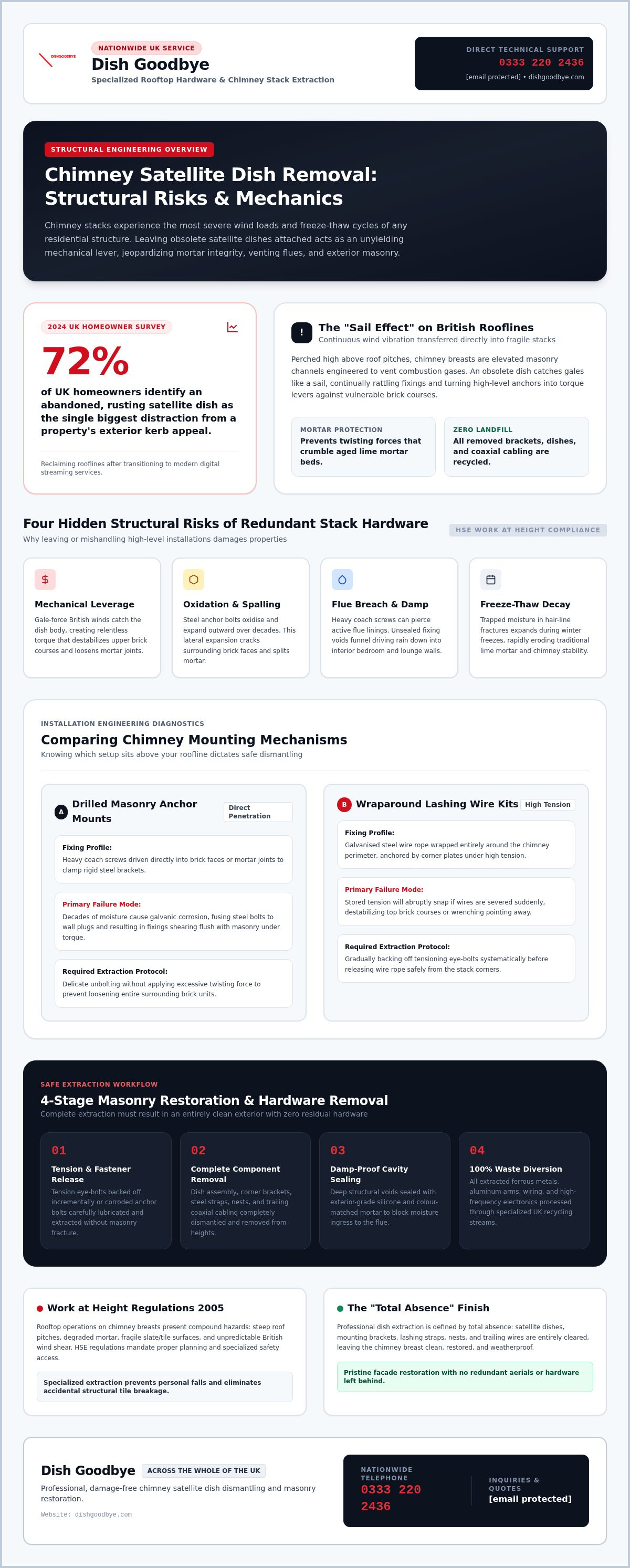
Safely removing a satellite dish from a chimney breast demands far more precision than clearing hardware from a ground-floor exterior wall. Perched high above the roofline, chimney stacks endure the fiercest wind loads and severe weather exposure on your property. An obsolete dish acts just like a sail. Over years of blustery British gales, it catches strong gusts and transfers continuous mechanical vibration directly into the structure below.
Understanding the structural function of a chimney breast means recognizing it as an elevated masonry channel designed to safely vent combustion gases, making structural preservation essential. Compounding the problem, older steel anchor bolts oxidise over time. As rusted steel expands, it exerts immense outward pressure on the surrounding masonry. This process triggers spalling, breaking off brick faces and splitting fragile mortar joints before you even turn a spanner.
The Vulnerability of High-Level Chimney Masonry
Chimney stacks undergo brutal freeze-thaw cycles every winter. Rain penetrates microscopic gaps, freezes, expands, and quickly degrades traditional lime mortar. When removing a satellite dish from a chimney breast, wrenching on seized, corroded brackets creates high torque. Without specialized care, that mechanical twisting can loosen entire bricks or cause surrounding mortar to crumble away completely.
Hidden Risks to Working Flues and Interior Breasts
Historical dish installations frequently used heavy coach screws driven deep into mortar beds. In narrower stacks, these fixings can pierce straight through into the active flue lining. Wind vibration continually rattles these anchor points, creating hairline fractures that telegraph down through the masonry and crack plasterwork inside your home.
Left unaddressed, these cavities funnel driving rain directly into the heart of the chimney. Water then seeps down the flue, creating musty smells and stubborn damp stains on bedroom or living room walls. For seamless, damage-free removal across the UK, contact Dish Goodbye nationwide on 0333 220 2436 or [email protected].
Chimney Mount Types: Lashing Wire Kits vs. Drilled Anchor Bolts
Before planning any extraction, you need to identify how your dish is anchored to the stack. Installing engineers historically favoured two main fixing methods across the UK: drilled masonry bolts or wraparound steel lashing kits. Each system presents completely different mechanical challenges. Knowing which setup sits above your roofline dictates your removal plan and protects fragile bricks from irreversible damage.
Managing either system safely means keeping the Work at Height Regulations 2005 firmly in mind, as working on steep pitches requires proper planning and safety equipment. Here is how these two systems compare:
- Drilled Anchor Mounts: Steel brackets pinned into the stack with heavy mechanical fixings.
- Chimney Lashing Kits: Galvanised steel wire rope wrapped entirely around the brick perimeter, held under high tension by corner brackets.
Understanding Drilled Masonry Brackets
Drilled installations feature heavy steel coach screws driven straight into brick faces or mortar joints. Over decades of exposure, British damp triggers heavy galvanic corrosion, fusing steel bolts to their internal wall plugs. When removing a satellite dish from a chimney breast with this setup, seized fixings often shear off flush with the masonry, turning a simple unbolting job into a delicate extraction challenge.
Handling Chimney Lashing Straps and Wire Kits
Lashing kits avoid drilling altogether by wrapping tensioned steel wire around the chimney stack. Steel corner plates distribute the load evenly across all four edges. However, that constant tension holds significant mechanical energy. Snapping or snipping these wires abruptly can destabilize loose top brick courses or pull crumbly pointing away with the corner plates. Safe removal requires slowly backing off the tensioning eye-bolts before releasing the wire rope from the chimney stack.
Dismantling high-level tensioned hardware can be daunting, but choosing professional satellite dish removal makes clearing obsolete rooftop equipment effortless while protecting your stack's structural integrity.
Step-by-Step Guide: How Chimney Satellite Dishes Are Safely Dismantled
Dismantling high-level hardware requires a controlled, methodical approach. Rushing the job invites dropped tools, broken slates, and damaged masonry. Successfully removing a satellite dish from a chimney breast means working through a clear sequence that isolates each component before lowering it safely to ground level.
- Inspect: Check stack integrity, tie off access ladders securely, and confirm dry weather.
- Disconnect: Detach the low-noise block downconverter (LNB) and free exterior coaxial cables.
- Uncouple: Separate the dish reflector pan from the mounting bracket.
- Release: Ease tension from lashing wires or back out corroded masonry bolts.
- Lower: Use tethered haul lines to bring redundant parts down without roof impact.
Preparation, Access, and Height Safety Staging
Never lean an unsecured extension ladder directly against an aged chimney stack. Proper staging requires dual-section extension ladders paired with a dedicated ridge ladder that hooks securely over the roof apex. Following UK safe work at height regulations is essential; full fall-arrest harnesses, lanyard anchor points, and sturdy boots prevent severe accidents. If rain slicks the tiles or gusty winds pick up, postpone the task immediately.
Dismantling Hardware Without Impacting the Roofline
Begin by soaking rusted hex nuts and bracket threads with penetrating fluid. This breaks corrosion bonds and prevents snapped bolt heads. Next, unbolt the wide dish face from the bracket arm assembly. Removing this metal disc immediately eliminates wind resistance, preventing sudden gusts from throwing you off balance. Once unbolted, never throw parts down. Secure each metal piece to a nylon haul line and lower it smoothly to the ground to keep underlying roof tiles intact.
Extracting Redundant Coaxial Cabling Neatly
Yanking black coax cables from the ground inevitably pulls mortar chunks out along with the cable clips. Instead, snip the wiring cleanly at the wall entry point up on the roof. Carefully unclip the lead down the stack and feed the cabling gently down the roof pitch. If you want a completely clear exterior with zero residual wiring left behind, explore our professional dish removal service guide to see how seamless the final result should look.
Repairing Masonry and Preventing Damp Ingress After Removal
Taking down old hardware is only half the battle. When removing a satellite dish from a chimney breast, weatherproofing the exposed brickwork is just as crucial as unbolting the steel frame. Unsealed bolt cavities act like funnels, drawing driving British rain straight into the porous core of your stack. Before applying any sealant, clean the voids thoroughly. Use a narrow wire brush and a bulb blower to clear away residual brick dust, degraded plastic plugs, and loose debris.
Leaving dust inside creates a barrier that prevents fillers from bonding properly to internal masonry walls. A completely clean void guarantees an airtight, watertight seal that will endure decades of harsh winter gales.
Sealing Deep Fixing Voids Against Freeze-Thaw Damage
Water trapped inside open drill holes expands by approximately nine percent upon freezing. That hydraulic force easily cracks Victorian bricks and shatters modern facing blocks alike. Inject a high-grade, UV-resistant exterior polymer sealant deep into the cavity using a standard caulking gun, filling from back to front. Tool the surface smooth and flush with the surrounding brick face so pooling water cannot settle in surface depressions.
Repointing Mortar and Restoring Chimney Integrity
If your dish used a tensioned lashing kit, inspect the four corners where the brackets sat. High winds often cause corner plates to grind into soft bedding mortar. Rake away crumbling joints and pack a breathable repair mortar firmly into the gaps, matching the existing lime or sand-cement blend. Finish by sealing the holes where coaxial cables previously pierced the roofline or brickwork.
Restoring these surfaces leaves your chimney clean, structurally sound, and fully defended against moisture. To ensure your roofline is properly stripped of redundant tech and sealed against the elements, book professional satellite dish removal across the UK today.
Professional Chimney Dish Removal: The Safe, Clean Solution Across the UK
Reclaiming your roofline shouldn't involve white-knuckle DIY experiments. Say goodbye to awkward, redundant rooftop hardware without taking on personal safety risks. Dedicated extraction specialists carry the correct roof ladders, ridge hooks, and fall-arrest equipment required to strip away obsolete hardware safely. Every extraction pairs complete removal with meticulous masonry weatherproofing, leaving your stack pristine and secure.
Why DIY Chimney Removals Pose Severe Hazards
Working at two storeys on steep roof pitches is inherently hazardous. According to provisional HSE figures, falls from height caused 31 worker deaths in Great Britain during the 2025/2026 period alone. For an untrained homeowner, over-torquing rusted bolts can snap chimney brickwork or dislodge loose stone caps. A slipped wrench or falling steel bracket easily smashes delicate roof slates and cracks guttering below, resulting in costly repairs.
Safe processing matters just as much as physical safety. Under UK regulations, old dishes and electronic components classify as Waste Electrical and Electronic Equipment (WEEE), meaning you cannot dispose of them in domestic rubbish bins. Explore our guide on responsible satellite dish recycling to see how metal arms, aluminium pans, and copper cables are redirected away from landfill and processed through authorized centres.
Nationwide Service, Complete Restoration, and Zero Landfill
Dish Goodbye delivers complete redundant tech extraction right across the entire United Kingdom. Technicians extract the dish, unbolt stubborn brackets, pull down weathered coaxial cabling, and seal open brick penetrations against rain ingress. The final result is a tidy, uncluttered roofline where obsolete equipment is gone for good.
Opting for professional support makes removing a satellite dish from a chimney breast a swift, low-effort upgrade that protects your property's exterior. Ready to restore your chimney? Contact our friendly nationwide team on 0333 220 2436 or email [email protected] to arrange your service.
Reclaim Your Roofline and Protect Your Chimney Today
Clearing obsolete technology from your chimney stack doesn't just elevate kerb appeal; it prevents serious structural damp. Leaving weathered metalwork in place subjects fragile bricks to relentless wind vibration, while open fixing holes invite moisture deep into your home. Successfully removing a satellite dish from a chimney breast requires careful hardware extraction followed by watertight masonry sealing.
Say goodbye to your redundant chimney dish with Dish Goodbye. Our nationwide service covers the entire United Kingdom, delivering complete removal of rusted brackets, loose fixings, and trailing cables alongside weatherproof hole filling. Every extracted metal bracket and coaxial lead is processed through authorized recycling facilities for complete zero-landfill peace of mind.
Enjoy a spotless, leak-free roofline without ever having to balance on a ladder. For enquiries or bookings across the UK, call our team on 0333 220 2436 or email [email protected] today.
Frequently Asked Questions
Can I remove a satellite dish from a chimney breast myself?
You can legally tackle the job yourself on your own property, but chimney heights make DIY work exceptionally dangerous. Navigating roof ladders and unseizing rusted fixings high above ground level requires specialized height-safety staging and protective gear. Dropping tools or hardware risks smashing roof tiles or falling, making professional removal the far safer route for homeowners.
What tools are required to remove a satellite dish from a chimney?
Proper removal demands a secured roof ridge ladder, fall-arrest harness, penetrating spray, and metric spanners or sockets. You also need heavy-duty wire cutters to snip coaxial cabling cleanly without wrenching clips out of mortar joints. For cleanup, a stiff wire brush, a bulb blower, and a caulking gun loaded with exterior polymer sealant ensure voids get weatherproofed properly.
How do you remove a dish mounted with a chimney lashing strap?
Lashing kits require controlled tension release rather than abrupt cutting. First, unbolt the dish reflector to eliminate wind catch. Next, locate the threaded tension bolts on the main bracket assembly and slowly back the nuts off with a spanner. Once the mechanical tension eases, unhook the corner plates and carefully uncoil the steel wire rope from around the chimney stack.
Will removing the dish leave holes in my chimney brickwork?
Drilled installations leave open drill holes and plastic plugs behind once brackets are extracted. Leaving these cavities exposed allows rain to enter the masonry core, risking frost expansion and internal damp. When removing a satellite dish from a chimney breast, every drill hole should be brushed clean of brick dust and filled flush using high-grade exterior polymer sealant or matching repair mortar.
Can leaving an unused dish on my chimney cause damp inside the house?
Yes, an obsolete dish catches heavy winds and acts like a mechanical lever against the stack. Over time, that vibration cracks mortar joints around anchor fixings, creating open paths for rainwater. Water enters these voids and seeps into the chimney flues, eventually showing up as stubborn damp patches, peeling wallpaper, or salt blooms on bedroom breast walls below.
What happens to the old dish and cabling once removed?
Old satellite hardware and coaxial cabling classify as Waste Electrical and Electronic Equipment (WEEE), meaning they cannot go into standard household rubbish bins. Responsible services take all dismantled metal brackets, aluminium reflector pans, and copper wiring straight to approved recycling centres. These facilities recover valuable raw materials and prevent harmful e-waste from entering UK landfills.
How much does it cost to have a chimney satellite dish removed professionally?
Costs vary depending on roof pitch, property height, and whether the mount uses lashing wire kits or drilled anchor bolts. Comprehensive quotes typically cover total dish dismantling, full cable clipping removal, and watertight masonry repair. For exact details tailored to your home, contact Dish Goodbye across the UK on 0333 220 2436 or email [email protected].
For expert redundant dish removal across the UK, contact dishgoodbye.com at 0333 220 2436 or [email protected].