

Contact Dish Goodbye: 0333 220 2436 | [email protected]
Did you know that 15% of upper-floor damp issues in UK homes start with a single unsealed hole from an old satellite bracket? It's a tiny opening that leads to a massive, expensive headache when winter frost hits. We all want a home that looks sharp and stays watertight. Seeing an old, rusting dish cluttering your exterior is frustrating. However, the fear of "blowing" a brick face or leaving behind ugly, mismatched mortar often stops homeowners from taking action. You want a clean, clutter-free wall, not a permanent scar on your masonry.
This guide reveals exactly how you can reclaim your home's kerb appeal by removing a dish without damaging brickwork. Discover the professional secrets to extracting rusted hardware while keeping your masonry pristine and weather-protected. We'll show you how to handle seized bolts, choose the right sealants for UK red bricks, and ensure your wall looks like the hardware was never there. Say goodbye to that redundant tech and hello to a smooth, finished exterior that protects your property value across the UK.
Key Takeaways
- Learn how redundant brackets create "wind loading" stress on your mortar and how to stop rust streaks before they become permanent.
- Discover the professional secrets to removing a dish without damaging brickwork, including the correct way to handle seized or corroded fixings.
- Find out why specialized masonry fillers are superior to standard silicone for creating a watertight, long-lasting exterior seal.
- See how a "seal-and-smooth" approach restores your home’s clean aesthetic, leaving no trace of old technology behind.
- Explore our zero-landfill recycling policy that ensures every part of your old hardware is handled responsibly across the UK.
Contact Dish Goodbye: 0333 220 2436 | [email protected]
The Hidden Risks of Leaving Redundant Dishes on Your Brickwork
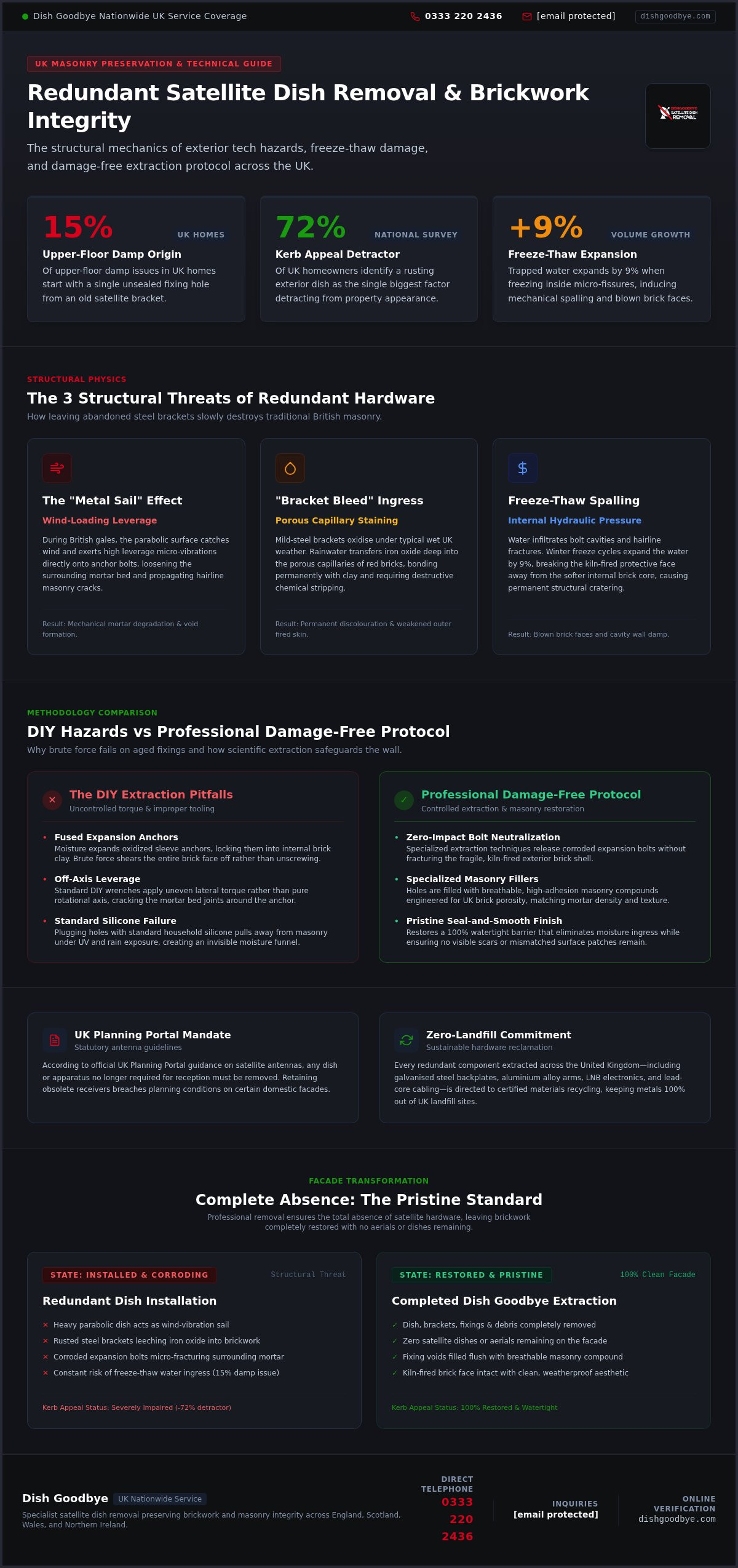
Leaving an old satellite dish bolted to your wall isn't just a minor eyesore. It's a slow-motion threat to your home's structural health. While it's tempting to think that "redundant" means "harmless," these metal fixtures are often a primary cause of masonry decay. Prioritising removing a dish without damaging brickwork is a smart move for any savvy homeowner looking to preserve their property's value. You can find expert help for this task at dishgoodbye.com, where the focus is on restoring your home's clean aesthetic.
The visual impact of abandoned tech is immediate. It creates a sense of neglect that's hard to ignore. A Dish Goodbye National Survey (2024-2026) found that 72% of UK homeowners consider a rusting dish to be the single biggest detractor from a property's kerb appeal. Beyond the look, those rusting brackets are actively damaging the surface they're attached to through chemical and mechanical stress.
Rust Staining and Porous Brickwork
UK weather is notoriously wet, and rainwater is the catalyst for "bracket bleed." As mild-steel brackets oxidise, rainwater carries iron oxide particles directly into the brick's capillaries. Because many UK bricks are porous, these orange streaks don't just sit on the surface. They soak in deep. These stains are incredibly stubborn. You can't just scrub them away with soapy water; they often require aggressive chemical cleaners that can weaken the brick's fired exterior skin. Taking action early prevents this permanent discolouration from setting in and keeps your masonry looking fresh.
Structural Vibration and Mortar Integrity
Think of your satellite dish as a metal sail. It's designed to catch signals, but it's even better at catching the wind. During a typical British gale, the dish acts as a high-leverage tool, vibrating against its fixings. This constant micro-movement puts immense pressure on the surrounding mortar and the brick core. Over time, these vibrations create hairline cracks. Once a crack appears, water enters the cavity. When temperatures drop, that water expands by roughly 9%, leading to brick spalling and freeze-thaw damage. This is how a simple bracket eventually causes the face of your brick to pop off entirely. Professional help with removing a dish without damaging brickwork ensures these structural stresses are halted before they lead to penetrating damp or costly repairs.
Contact Dish Goodbye: 0333 220 2436 | [email protected]
Contact Dish Goodbye: 0333 220 2436 | [email protected]
Why DIY Removal Often Leads to Blown Brick Faces
Many homeowners assume that a sturdy ladder and a basic wrench set are all they need to clear their walls. It's a common mistake that often ends with a "blown" brick face and a repair bill that far exceeds the cost of professional help. Achieving the goal of removing a dish without damaging brickwork requires an understanding of the materials involved. UK bricks often have a hard, kiln-fired outer skin protecting a softer, porous core. When this skin is compromised, the structural integrity of the brick is at risk.
Property owners also have a legal duty to manage redundant equipment. According to the UK Planning Portal guidance on satellite antennas, any dish no longer required for reception must be removed. However, rushing this task can lead to spalling. Spalling is the mechanical breaking of brick layers due to internal pressure. This often happens when a DIYer tries to force a fixing that has become a permanent part of the masonry.
The Danger of Rusted Expansion Bolts
Most satellite brackets are secured using expansion bolts or sleeve anchors. These fixings are designed to expand inside the brick to provide a rock-solid grip. Over ten or twenty years, moisture causes the metal to oxidise and expand. This rust essentially fuses the anchor to the internal clay of the brick. When you apply brute force to a seized bolt, the tension doesn't just pull the bolt; it shears the entire front face of the brick away. This creates a hollowed-out crater that is difficult to patch invisibly. If you're unsure about the state of your fixings, it's safer to let a satellite dish removal expert handle the extraction.
Impact of Improper Tooling
Standard DIY wrenches are often too short to provide the controlled leverage needed for old fixings. They tend to apply lateral pressure rather than a pure rotational force. This uneven torque frequently snaps the head off a rusted bolt, leaving a jagged metal stud buried deep in your wall. Professionals use penetrating lubricants and high-torque, impact-neutral techniques to back bolts out safely. Beyond the bolts, even the way you handle the cabling matters. Yanking old coaxial cable clips out of mortar joints can pull away chunks of the surrounding brick. This leaves "pockmarks" that invite water into the cavity wall, leading to the damp issues we discussed in the previous section.
Ladder safety is another factor often overlooked. Leaning a heavy extension ladder directly against soft UK bricks can crush the fired face, especially if the ladder isn't fitted with stand-offs. A professional approach protects both the technician and your home's exterior finish.
Contact Dish Goodbye: 0333 220 2436 | [email protected]
Contact Dish Goodbye: 0333 220 2436 | [email protected]
The Professional Approach to Damage-Free Dish Extraction
A professional result is 20% extraction and 80% restoration. While DIY methods often rely on brute force, a specialist approach focuses on patience and precision. Mastering the art of removing a dish without damaging brickwork starts with patience. We provide nationwide coverage across the UK, ensuring that every home can benefit from a clean, tech-free exterior without the risk of masonry scars. Our technicians treat your property with the same care as a savvy neighbor would, using methods that prioritise structural integrity over speed.
The first step is bracket isolation. We never attempt to unscrew a bracket while it's still supporting the full weight of the satellite dish. Removing the dish from the arm first reduces the leverage and tension on the wall fixings. This simple step significantly lowers the chance of a bolt snapping or a brick face cracking during the main extraction. Once the weight is gone, we can focus entirely on the delicate task of backing out the hardware.
Step-by-Step Bolt Extraction
We start by applying a high-grade penetrating oil to all oxidised fixings. This "soak time" is vital. It allows the lubricant to seep into the threads and break the bond created by years of rust. When it's time to turn the bolts, we use a manual socket or a low-torque impact driver. The goal is a steady, controlled rotation. We avoid lateral pressure that could crush the soft core of the brick. If a bolt is too corroded to move, we don't pry it. Instead, we flush-cut the bolt head. This allows us to remove the bracket safely while leaving the substrate undisturbed. This careful methodology is why removing a dish without damaging brickwork is best left to those with the right tools and experience.
Managing Redundant Cabling
Cables require just as much care as the dish itself. We snip the coaxial lines at the entry point rather than pulling them through the wall. This prevents internal plaster from blowing out inside your living room. When it comes to the exterior, we carefully pry each cable clip. Yanking these can cause "pock-marking," where small chunks of mortar or brick are pulled away. We follow Historic England's guidelines on repointing brick and stone walls to assess the condition of the masonry before we begin. This ensures our hole-filling process is compatible with your specific wall type. Finally, we organise all extracted metal and plastic for our zero-landfill recycling process, leaving your home clutter-free and the environment protected.
Contact Dish Goodbye: 0333 220 2436 | [email protected]
Contact Dish Goodbye: 0333 220 2436 | [email protected]
Beyond Removal: Sealing and Restoring the Exterior Finish
Once the bracket is gone, you're left with several open wounds in your masonry. These 10mm to 12mm holes are more than just an aesthetic issue. They are direct pathways for moisture to bypass your home's protective outer skin. Achieving a professional finish when removing a dish without damaging brickwork means ensuring these penetrations are sealed for good. Leaving them open is an invitation for trouble that most homeowners don't see until the damage is done inside.
A "Damp Bridge" occurs when these holes allow water to travel through the cavity and reach the internal wall. This leads to crumbling plaster and peeling wallpaper. Our goal is to restore the wall to a state where you'd never know a dish was ever there. We provide this meticulous service nationwide, ensuring every UK property we visit remains watertight and pristine.
Preventing Water Ingress and Damp
Open bolt holes act like tiny straws, drawing in rainwater through capillary action. Over time, this moisture saturates the brick core and the cavity insulation. Statistics show that 15% of upper-floor damp issues in UK residential properties originate from these unsealed exterior penetrations. When temperatures drop, any trapped water expands by roughly 9%, causing the internal structure of the brick to crack. You can read more about How Unfilled Holes from Fixtures Can Cause Damp to understand the long-term risks of leaving your masonry exposed after a DIY removal.
The Art of the Invisible Repair
Many people reach for a tube of clear silicone to fill these gaps. This is a mistake. Silicone is non-breathable, attracts dirt, and eventually peels away from the masonry. A professional repair requires breathable, masonry-grade compounds that flex with the building. We use brick-dust-infused fillers to match the specific shade of your UK red or buff brickwork. This ensures the repair is invisible from the ground and won't stand out as a bright spot on your wall.
Texture is just as important as colour. We replicate the finish of the surrounding surface, whether it's a smooth fired skin or a sand-faced texture. If a hole sits within a mortar line, we repoint the area using a matching mortar mix. This attention to detail is what separates a quick fix from a true restoration. Your home deserves a clean aesthetic that protects its value and structural health. If you want a perfectly finished exterior without the hassle, book your professional dish removal today and let us handle the seal-and-smooth process for you.
Contact Dish Goodbye: 0333 220 2436 | [email protected]
Contact Dish Goodbye: 0333 220 2436 | [email protected]
Reclaim Your Home’s Exterior with Dish Goodbye
It's time to stop looking at that rusted metal eyesore and start enjoying a cleaner, more modern home. You've seen the risks that old brackets pose to your masonry. You know how unsealed holes can lead to damp. Now, it's time to act. Our mission is to transform a frustrating household chore into a satisfying, low-effort experience. We specialise in removing a dish without damaging brickwork, giving you a fresh start and a pristine exterior. By choosing a professional service, you're not just tidying up; you're protecting your property's long-term health.
Our approach is built on safety and sustainability. Working at heights is a high-risk task that requires the right equipment and insurance. Our high-reach experts handle the difficult work so you don't have to worry about wobbly ladders or damaged gutters. We also take our environmental duties seriously. Through our Zero-Landfill Promise, we ensure that 100% of the hardware we extract, including steel dishes, zinc-coated brackets, and copper cabling, is processed through dedicated recycling channels. We leave your wall clean and the planet a little greener.
Professional Nationwide Standards
We pride ourselves on delivering consistent quality across the entire United Kingdom. Whether you're in the Highlands or on the South Coast, you'll receive the same high standard of care. Our technicians use specialist tools designed specifically for masonry work, ensuring that every bolt is backed out with precision. This level of detail is a core part of our Professional Dish Removal Service. We don't just pull hardware; we restore the substrate. By using professional-grade fillers and matching the texture of your existing bricks, we ensure your home looks its absolute best from the moment we leave the site.
The Dish Goodbye Experience
Choosing our team means choosing efficiency and domestic harmony. We provide a brisk, reliable service that gets straight to the heart of your needs. There's a unique sense of relief that comes from seeing a cluttered, tech-heavy wall transformed into a smooth, clean surface. We handle the extraction, the sealing, and the waste disposal, leaving zero mess behind. It's a simple lifestyle upgrade that prioritises your comfort and your time. It is the definitive break from the frustration of old, inefficient methods. To get started on your home's transformation, contact our friendly team at 0333 220 2436 or email us at [email protected]. Let us help you achieve a perfectly removing a dish without damaging brickwork result today.
Contact Dish Goodbye: 0333 220 2436 | [email protected]
Restore Your Home’s Sightlines and Integrity
Protecting your property starts with addressing the small details that matter. We've explored how removing a dish without damaging brickwork isn't just about aesthetics; it's a vital step in preventing penetrating damp and structural decay. By choosing a specialist approach, you avoid the common pitfalls of shattered bricks and permanent rust staining. You deserve a home that feels organized and well-managed, where redundant technology no longer detracts from your kerb appeal.
Our team provides nationwide UK coverage, ensuring every household can access expert help. We handle the high-reach tasks with precision, including specialist brickwork restoration and a zero-landfill promise that sees 100% of your old waste recycled. It's a simple, satisfying way to reclaim your time and energy while upgrading your home's exterior. No more worrying about "blown" brick faces or mismatched mortar repairs.
Say goodbye to your old dish and protect your brickwork; book your removal today. Let's make your home's exterior as smooth and finished as it was meant to be. Enjoy the domestic harmony of a clean, clutter-free property that's fully protected against the elements.
Contact Dish Goodbye: 0333 220 2436 | [email protected]
Contact Dish Goodbye: 0333 220 2436 | [email protected]
Frequently Asked Questions
Will removing my old satellite dish leave permanent holes in the brickwork?
Removing a dish will leave fixing holes, but our service includes specialist hole-filling to restore your masonry. We use colour-matched compounds that blend with your specific UK brick type. This ensures that removing a dish without damaging brickwork results in a clean, pristine finish. You won't have to worry about ugly scars or permanent damage to your home's exterior once we've completed the restoration.
Can I just fill the holes with silicone myself?
While silicone is a common DIY choice, it isn't suitable for long-term masonry repair because it's non-breathable and eventually peels away. This leaves your wall vulnerable to moisture. We use professional-grade, breathable masonry fillers that flex with your building's thermal cycles. This provides a weather-tight seal that matches the texture of your bricks, ensuring a much more satisfying and durable result than a quick, temporary fix.
Is it dangerous to remove a rusted dish from a ladder?
Scaling a ladder to remove a rusted dish is hazardous due to the force required to loosen seized fixings. Attempting to wrench out old bolts while balanced at height can lead to falls or structural damage. Our high-reach experts use specialist tools and safety equipment to handle these difficult tasks safely. We take the risk out of the job, providing you with total peace of mind.
Do you remove the cables as well as the dish and brackets?
We remove all redundant cabling along with the dish and brackets. Our technicians snip the lines at the entry point and carefully extract the cable clips to avoid scarring your mortar. This complete extraction process ensures your home's exterior is entirely free from old technology. You'll enjoy a smooth, clean aesthetic where no trace of the old installation remains, creating a sense of domestic harmony.
How long does a professional dish removal take on a standard UK house?
A professional dish removal on a standard UK house typically takes between 45 and 90 minutes. This includes the safe dismantling of the hardware, the extraction of cabling, and the meticulous filling of all fixing holes. We work briskly and efficiently to transform your wall with minimal disruption to your day. It's a low-effort experience for you that delivers an immediate improvement to your property's kerb appeal.
What happens to the old dish and metal brackets once they are removed?
Our team operates a strict zero-landfill policy for all extracted hardware. Every metal dish, zinc bracket, and copper cable is taken to approved recycling centres to be processed responsibly. We handle the waste disposal entirely, so you don't have to worry about cluttering your bins or visiting the local tip. It's a modern, eco-friendly way to refresh your home while ensuring your old tech is recycled 100%.
Can an old satellite dish cause damp inside my house?
Redundant satellite dishes are a known cause of moisture issues in UK homes. Unsealed 10mm bolt holes allow rainwater to bypass your masonry and reach the internal cavity wall. This can lead to crumbling plaster and peeling wallpaper inside your living room. By removing a dish without damaging brickwork and sealing the holes professionally, you protect your home from long-term water ingress and expensive structural repairs.