
Redundant exterior cable removal can involve more than taking down an untidy wire. If it belongs to an old satellite dish or aerial, brackets, fixings and holes left by the installation may need attention too. For help with satellite dish or aerial removal across the UK, contact Dish Goodbye on 0333 220 2436 or [email protected].
Pause before deciding a cable is redundant. It may still be connected or serve another purpose, and removing fixings carelessly could damage brickwork or leave an opening where moisture can enter. This guide explains what you can check safely from the ground and how to weigh up a cautious DIY approach against professional help. It does not provide instructions for working at height.
You’ll also learn what a complete exterior clear-up can involve, from removing cabling associated with dish or aerial equipment to filling and smoothing installation holes and handling removed waste. Dish Goodbye provides satellite dish and aerial removal across the UK. For enquiries, call 0333 220 2436 or email [email protected].
Key Takeaways
- Focus on cables linked to old satellite dishes or TV aerials. Don’t assume a cable is unused until you’ve checked its visible route and connections.
- From the ground, note any attached equipment and visible fixing points to help clarify what may need attention.
- Use what you can safely observe to weigh up DIY against professional help, especially if access, fixings or wall condition are uncertain.
- A tidy result considers associated fixings and any holes left by the installation, not just the cable.
- Dish Goodbye handles associated dish and aerial cabling, fixings and making good as part of its removal service across the UK.
Redundant exterior cable removal: what counts as an unused dish or aerial cable?
Loose wires crossing an exterior wall, curling around a bracket or ending beside old equipment can make a property look unfinished. But a cable’s age or untidy appearance doesn’t prove it is redundant. This guide focuses on exterior cabling associated with satellite dishes or TV aerials, and on how to make an informed decision before arranging removal.
A cable may run between equipment and the inside of a property, or follow a less obvious route along a wall. A television aerial, also called a Television antenna, can take different forms. Don’t identify a cable’s type or purpose by appearance alone. Confirm what it connects to before treating it as unused.
How can you tell whether an exterior cable is redundant?
Start with a visual check from a safe position on the ground. Look for a visible connection to a dish or aerial, note where the wire runs and ends, and check whether equipment is still attached. Don’t disconnect anything to test it. A cable that appears to lead to old equipment may have a hidden connection or another use.
If the route disappears into a wall, runs alongside other cables or appears to serve shared building equipment, its purpose may not be clear. Treat that uncertainty as a reason to arrange an assessment rather than guess. Never cut or pull a cable unless its purpose has been established.
Which cables are covered by this guide?
This section covers exterior wires associated with redundant satellite dishes or TV aerials. It doesn’t cover live electrical wiring or unrelated utility cables. Those require separate assessment by someone qualified to deal with that type of wiring.
Even within this scope, confirm a cable’s type and function before drawing conclusions. Similar-looking wires can serve different purposes, and a visible endpoint may not tell the whole story. Keep your checks observational: note the route, visible connections and any attached equipment without disturbing the cable or its fixings.
That’s the starting point for redundant exterior cable removal: identify the equipment the cable may belong to, then confirm whether it is genuinely no longer needed. Once the likely scope is clear, you can consider the next step with less guesswork. A complete tidy-up may involve associated cabling and fixings, as well as attention to holes left by an earlier installation. The aim is a neater exterior, not a risky DIY removal tutorial.
What to check before removing redundant exterior cables
Before deciding what should come down, build a clear picture from the ground. Note where the cable runs, what it appears to connect to and whether dish or aerial equipment is still attached. This simple record can help describe the job and highlight anything that needs checking before removal is considered.
- Route: Follow the visible cable along the wall, noting where it disappears or changes direction.
- Endpoints: Record any visible connection to a dish, aerial or other equipment. Don’t disconnect it to test what it does.
- Fixings: Note clips, brackets and old screw points that may remain after the cable is removed.
- Wall entry: Look for a cable passing through the wall and any visible gap around it. Don’t probe or disturb the opening.
A cable entry may need suitable making good once redundant equipment is removed. An opening doesn’t automatically mean there is a damp problem, but its condition is worth considering. The appropriate repair depends on the opening and the wall, so don’t assume that removing the visible wire alone will leave the exterior finished.
How do cable routes and fixings affect the removal decision?
Clips and brackets can leave marks or fixing holes, while a cable may cross different wall surfaces. From the ground, note the wall material and any visible openings so the overall finish can be considered, not just the wire. Don’t pull at clips or probe a hole to investigate it. For a broader look at the equipment and fixings, read about satellite dish bracket and wire removal.
When should you stop and ask for an assessment?
Pause if the cable’s purpose or connection points aren’t clear, if it is inaccessible, or if it may be shared with another part of the building. Working at height adds practical risk, so this guide doesn’t recommend ladder or tool methods. If you can’t establish what the cable serves, seek an appropriately qualified professional rather than cutting or pulling it.
These checks help you describe the work without taking unnecessary risks. If the cabling is associated with a redundant dish or aerial, Dish Goodbye’s removal service includes associated cables, brackets and fixings. Technicians also fill and smooth holes left by previous installations. Find out more about satellite dish and aerial removal across the UK.
DIY or professional redundant exterior cable removal: how to weigh your options
You can do useful groundwork without touching the cable. A ground-level visual check helps you describe what’s there, but it can’t confirm that a wire is disconnected or safe to remove. The decision is less about whether a cable looks old and more about how certain you are of its purpose, access, fixings and the condition of the wall.
What can a homeowner check without disturbing the cable?
From a safe position, note the visible route, endpoints, attached dish or aerial equipment, and any clips or brackets. Record anything you can’t see clearly, such as where the cable disappears into a wall. If you’re unsure what it serves, ask someone who may know, such as a previous owner, landlord or property manager. Don’t pull or cut it to test your theory.
When is professional removal the more practical choice?
Consider professional help if the cable’s purpose or connection points are unclear, access looks difficult, or there are several fixings and wall openings to assess. These details can affect both the removal and the finished appearance. A professional can consider associated hardware and holes left by the installation, rather than focusing only on the visible wire.
Removing the cable alone doesn’t always complete the tidy-up. Clips, brackets or exposed fixing points may remain, and a cable entry through the wall may need suitable making good. That doesn’t mean every opening causes damp, but its condition should be considered as part of the job. Dish Goodbye’s service includes associated redundant dish or aerial cabling and fixings. Technicians fill and smooth holes left by previous installations. The work involved depends on what’s found, so don’t assume a particular result before the scope is clear.
For redundant exterior cable removal, a sensible split is simple: identify and document what you can observe, then leave uncertain connections, awkward access or concerns about the wall for assessment. That lets you explain the issue without taking on removal you’re not confident about. If the cable is linked to redundant dish equipment, read the professional dish removal service guide and consider a complete exterior clear-up through a service available across the UK.
What happens during exterior cable removal and wall making-good?
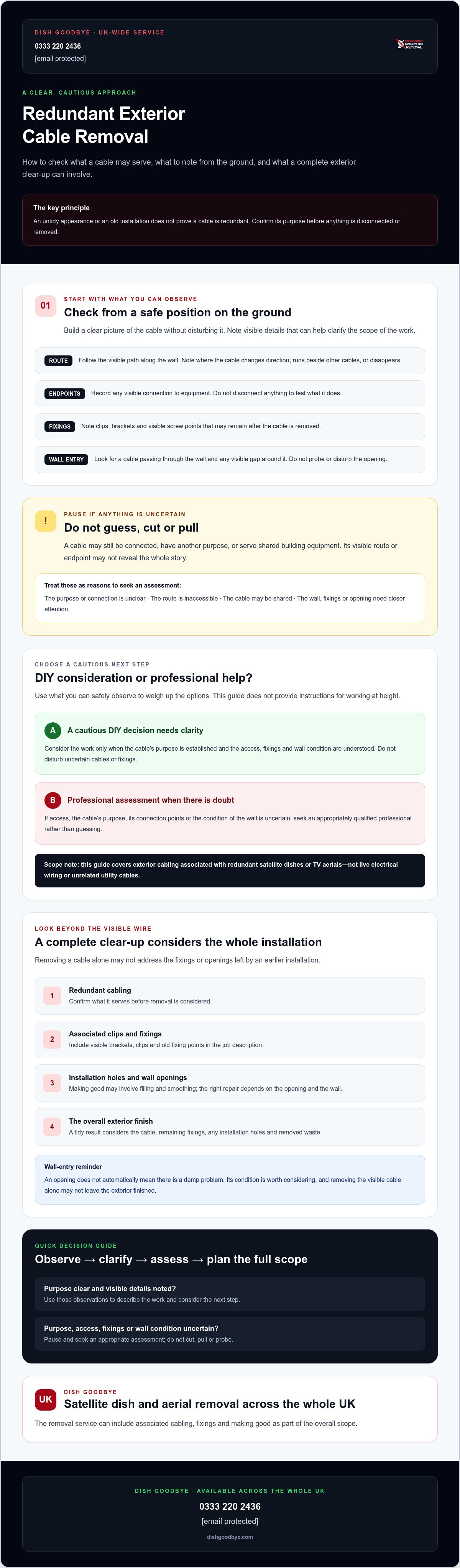
A tidy result takes more than taking away a visible wire. For redundant exterior cable removal linked to a satellite dish or TV aerial, the work should consider the equipment, associated cabling and fixings, and any marks or openings left on the wall. The exact scope depends on what is confirmed at the property.
A high-level process is straightforward:
- Confirm the scope: Establish which dish or aerial equipment and associated cabling and fixings are included.
- Remove the redundant items: Take away the confirmed cabling and associated hardware.
- Assess the wall: Check what holes or openings remain once the equipment and fixings have been removed.
- Make good: Address holes left by the previous installation to help leave the exterior neater.
This order matters. Until the equipment and fixings are gone, it may not be clear what needs attention on the wall. Removing only the cable can leave visible clips, bracket points or an opening where it entered the property.
Why should removal include fixing points and cable entry holes?
Old fixing points can make a cleared wall still look unfinished. A cable opening may also merit attention, since it could provide a route for moisture depending on its condition. That doesn’t mean every hole causes damp; it means the opening should be assessed rather than ignored. Dish Goodbye fills and smooths holes left by previous installations, helping complete the exterior clear-up without promising an invisible finish.
What happens to the removed cable and associated equipment?
Removed metal and electronic waste is processed through approved recycling centres. This describes the handling of those waste categories, not a claim that every part of every cable can be recycled or follows the same route. If responsible disposal is part of your decision, ask what’s included for the items being removed.
Dish Goodbye’s satellite dish and aerial removal service includes associated redundant cabling, brackets and fixings, as well as filling and smoothing installation holes. The service is available across the UK. For a neater finish, arrange satellite dish removal with the associated exterior clear-up considered as part of the job.
Arrange redundant exterior cable removal across the UK
Dish Goodbye serves customers across the UK. Its satellite dish and aerial removal service includes associated redundant cabling, brackets and fixings, plus filling and smoothing holes left by previous installations. To enquire, call 0333 220 2436 or email [email protected].
A clear description of what you can see helps explain the work you’re considering. You don’t need to identify an unfamiliar cable yourself. Point out what’s visible and mention anything that’s uncertain.
What information should you have ready when enquiring?
Describe the cable’s visible route and where it appears to end. Mention any dish or aerial equipment still attached, the part of the exterior affected, and visible brackets or fixings. If the cable disappears into a wall or its purpose isn’t clear, say so. That uncertainty is useful context, not something you need to resolve by pulling or disconnecting it.
Also mention if the equipment or cable appears difficult to access. There’s no fixed set of photos or details required here; start with what you can safely observe from the ground. Clear notes help distinguish the visible issue from assumptions about what the cable does.
How can you request help from Dish Goodbye?
Contact Dish Goodbye by phone on 0333 220 2436 or email [email protected]. Explain that you’re asking about redundant cabling associated with a dish or aerial, and include any concerns about fixings, access or wall openings. You can ask about the relevant removal scope without needing to plan the work yourself.
The practical benefit is a joined-up exterior clear-up: redundant dish or aerial equipment and its associated cabling and fixings can be considered together, with holes from previous installations filled and smoothed. The aim is to address more than the visible wire, while the work itself depends on the confirmed scope.
If you’re ready to explore the UK-wide service, Explore UK-wide removal help. A short enquiry is a straightforward next step towards having redundant exterior equipment, associated fixings and installation holes addressed.
Contact Dish Goodbye: 0333 220 2436 | [email protected]
Leave your exterior ready for a fresh start
A neater wall starts with knowing what a cable serves. Trace what you can see from the ground, but don’t assume an unclear wire is disconnected or redundant. If its route, access or connection is uncertain, have it assessed before deciding what should be removed.
For redundant exterior cable removal linked to dish or aerial equipment, consider the whole finish, not just the visible cable. Dish Goodbye removes associated cabling, brackets and fixings, fills and smooths holes left by previous installations, and sends removed metal and electronic waste to approved recycling centres. The service is available across the UK.
Ready to clear away redundant exterior equipment with the associated fixings and holes considered too? Ask Dish Goodbye about UK-wide redundant cable removal. Contact the team to discuss what you can see and ask about the removal scope.
Call 0333 220 2436 or email [email protected].
Frequently Asked Questions
How do I know if an exterior cable is redundant?
You can’t confirm a cable is redundant from its appearance alone. From a safe position, note whether it visibly connects to an old satellite dish or aerial, where it runs and where it disappears from view. Don’t disconnect, cut or pull it to test its purpose. Hidden connections or shared building cabling can make the route unclear, so seek an assessment if you can’t establish what the cable serves.
Can I remove a satellite dish cable from an outside wall myself?
Only consider removal once the cable’s purpose is established and you’re confident about access and the wall condition. A visual check from the ground can help you document the route, but it doesn’t prove the cable is disconnected. Don’t attempt work at height if you’re unsure or uncomfortable. If connections, fixings or access are uncertain, arranging professional removal as part of a dish removal service may be the more practical option.
Can redundant exterior cables cause damp?
A cable itself doesn’t automatically cause damp, but an opening where it enters a wall may deserve attention. Its condition and the surrounding wall matter, so don’t assume there’s a problem just because you can see a cable or hole. Don’t probe or disturb the opening. If the cable is confirmed redundant, consider having any remaining entry point assessed and included in plans for making good.
Should the brackets and wall holes be dealt with when removing an old cable?
Yes, consider them as part of the same exterior tidy-up if they belong to the redundant dish or aerial installation. Removing a cable alone can leave brackets, fixings or holes visible on the wall. Dish Goodbye’s removal service includes associated brackets and fixings, and technicians fill and smooth holes left by previous installations. The result depends on the wall and existing installation, so don’t expect every mark to disappear.
What happens to cables removed with an old satellite dish or aerial?
Dish Goodbye sends removed metal and electronic waste to approved recycling centres. The service includes redundant cabling associated with satellite dish and aerial removal, alongside related equipment and fixings. That doesn’t mean every cable component can be recycled or follows an identical disposal route. If you’re arranging a removal, you can ask how the waste from the items included in your job is handled.
Does Dish Goodbye remove redundant exterior cables across the UK?
Yes. Dish Goodbye serves customers across the UK, removing redundant cabling associated with satellite dish or aerial equipment as part of its removal service. The scope also includes associated brackets and fixings, with holes left by previous installations filled and smoothed. If you’re unsure whether a cable is included, describe the equipment it appears to connect to when you enquire, rather than assuming it’s redundant.
What information should I provide when arranging exterior cable removal?
Describe what you can see: the cable’s visible route, any attached dish or aerial, and the part of the exterior where it’s located. Mention visible brackets or fixings, difficult access, and anything unclear about the cable’s purpose. You can contact Dish Goodbye on 0333 220 2436 or email [email protected]. You don’t need to identify an unfamiliar cable or disturb it before making an enquiry.