

dishgoodbye.com | 0333 220 2436 | [email protected]
An old aerial noted on a building survey is not automatically a serious defect or an instruction to remove it. The note records what the surveyor observed; the wording, photographs and any recommendations determine what to consider next.
Check whether the report mentions loose parts, visible damage, the condition of the fixings or cables, or a need for further investigation. A general note that an aerial is present is different from a specific concern about its condition. The report may not show what is concealed behind a bracket or beneath an exterior finish.
This guide explains how to interpret the note, compare leaving the aerial in place with removal, and decide whether to clarify the survey findings. If the aerial is redundant, complete removal can include the brackets, fixings and cabling, with holes filled and smoothed afterwards. Base your next step on the report and your plans for the property, not on the mention alone.
dishgoodbye.com | 0333 220 2436 | [email protected]
Key Takeaways
- An old aerial noted on a building survey is an observation, not automatically an instruction to remove it or proof that it is unsafe.
- Look for specific comments about loose parts, visible damage or redundant cabling, and note any recommendation for follow-up.
- Use the report wording and photographs, along with your plans for the property, to decide whether to leave the aerial, clarify the note or arrange removal.
- If an aerial is redundant, complete removal can include its brackets, fixings and cabling, with installation holes filled and smoothed.
- A visual survey note does not necessarily assess hidden fixings. Avoid assuming they are either defective or sound if they were not visible.
What Does an Old Aerial Noted on a Building Survey Actually Mean?
An old aerial noted on a building survey is usually an observation about equipment visible on the property, not an instruction to remove it. The note alone does not establish whether the aerial works, whether it is securely fixed or whether it presents a safety concern.
Read the wording in context. Note where the equipment is mounted, what the surveyor could see, and whether the report describes loose parts, damaged materials or other concerns. A simple record of an aerial is different from a recommendation to investigate or address a defect. Look for the specific action, if any, that the surveyor recommends.
What might a surveyor be referring to?
The word “aerial” may refer to the television antenna itself, but the installation can also include mounting brackets, fixings attached to the building and external cables. For an overview of the equipment and its purpose, see Television antenna.
A surveyor may record what is visible without assessing every fixing beneath or behind the equipment. Check the exact wording and any accompanying photographs. Does the report simply identify an aerial on the roof, or does it describe a loose bracket, exposed cable or visible damage nearby? Those details help distinguish what the surveyor saw from what remains unknown.
Does a mention mean the aerial must be removed?
No. A mention alone does not necessarily mean immediate removal is needed. Separate a general observation from a stated defect or recommendation. If the report says an aerial is present but identifies no problem, that is not the same as reporting unstable fixings or recommending further investigation.
If the wording is unclear, ask the surveyor what they observed and whether they recommend a particular follow-up. Use the report and photographs as context, not as proof of hidden conditions. Your next step depends on the aerial’s visible state, the report’s recommendations and whether the equipment is still needed. With those points in mind, weigh leaving it in place against further assessment or removal if it is redundant.
How to Read the Survey Note: Condition, Fixings and Possible Exterior Damage
Focus on what the surveyor actually observed. The note might simply record an aerial on the roof, or describe a loose bracket, corroded-looking parts, damage to surrounding materials or redundant cabling. Each detail raises a different question. Keep the report’s wording and recommendations separate from assumptions about parts that may be hidden from view.
What details in the report deserve closer attention?
Look for specific descriptions of the equipment’s condition, movement, corrosion and the surface around its fixings. Check whether the survey includes photographs and recommends further investigation. A photograph can show what was visible, but it cannot reveal the condition of fixings concealed beneath a bracket or behind the exterior finish.
Do not infer a hidden defect just because the equipment is old. If the report identifies a concern but does not explain its extent, ask what was seen and what remains uncertain. This helps you distinguish an observed issue from something that would need closer assessment.
Can old aerial fixings affect the exterior?
Fixing holes can be a maintenance concern if left open or inadequately sealed. Moisture may enter through openings in an exterior surface, so pay attention to any holes the survey specifically identifies. That possibility does not prove water has entered the building or that damp is present. Look for evidence in the report rather than treating the aerial itself as proof of damage.
A recorded observation is not the same as confirmed damage. Use the survey’s description, photographs and recommendations to understand what is known. If fixings were inaccessible, do not treat them as assessed.
If the report raises a separate question about planning status, the Planning Portal explains permitted development rights for TV aerials in England and Wales. Keep that question separate from the survey’s comments about physical condition.
Once you understand the note, consider whether the aerial is still needed. If it is redundant and you want the exterior cleared, professional aerial removal can include the associated brackets, fixings and cabling, with installation holes filled and smoothed afterwards.
Leave It, Remove It or Investigate Further? Compare Your Options
An old aerial mentioned in a survey is not automatically dangerous, and the note alone does not mean it must come down. Choose your next step based on what the report says, whether the aerial is still needed and what you plan to do with the property.
Use this comparison to weigh the options:
| Option | When it may fit | Practical next step |
|---|---|---|
| Leave it in place | The aerial is still in use and the report raises no specific concern. | Keep the survey note for reference. Do not assume it confirms the equipment is safe. |
| Clarify or investigate | The report mentions a defect, recommends follow-up or uses unclear wording. | Ask the surveyor to explain the observation and what needs checking. |
| Arrange removal | The aerial is redundant and you want the exterior cleared. | Choose complete removal that addresses associated brackets, fixings and cables too. |
When might leaving the aerial in place be reasonable?
If the aerial is still being used and the report records no specific defect, leaving it in place may be reasonable. Consider whether you or someone in the household relies on it. A brief survey mention does not establish the aerial’s condition, so do not treat the absence of a defect in the report as confirmation that every part is secure.
When might removal be the more practical choice?
If the aerial is no longer needed, removal can clear the visible equipment and the parts attached to it. Brackets, fixings and redundant cabling may remain even after the aerial itself is taken down, so consider the whole installation rather than just the mast. Filling and smoothing the installation holes also addresses the fixing points as part of the tidy-up.
Your plans matter too. If you are preparing the property for exterior maintenance or want a cleaner finish, removing redundant equipment can be a practical way to clear the installation. For an overview of complete aerial removal, see how the service covers aerials, associated fixings and cabling. Dish Goodbye provides removal across the United Kingdom.
If the survey describes movement, visible damage or another specific concern, do not decide based on the aerial’s age alone. Clarify the report first, then choose whether to retain it, investigate further or remove it. The right option is the one that fits the evidence and your plans for the property.
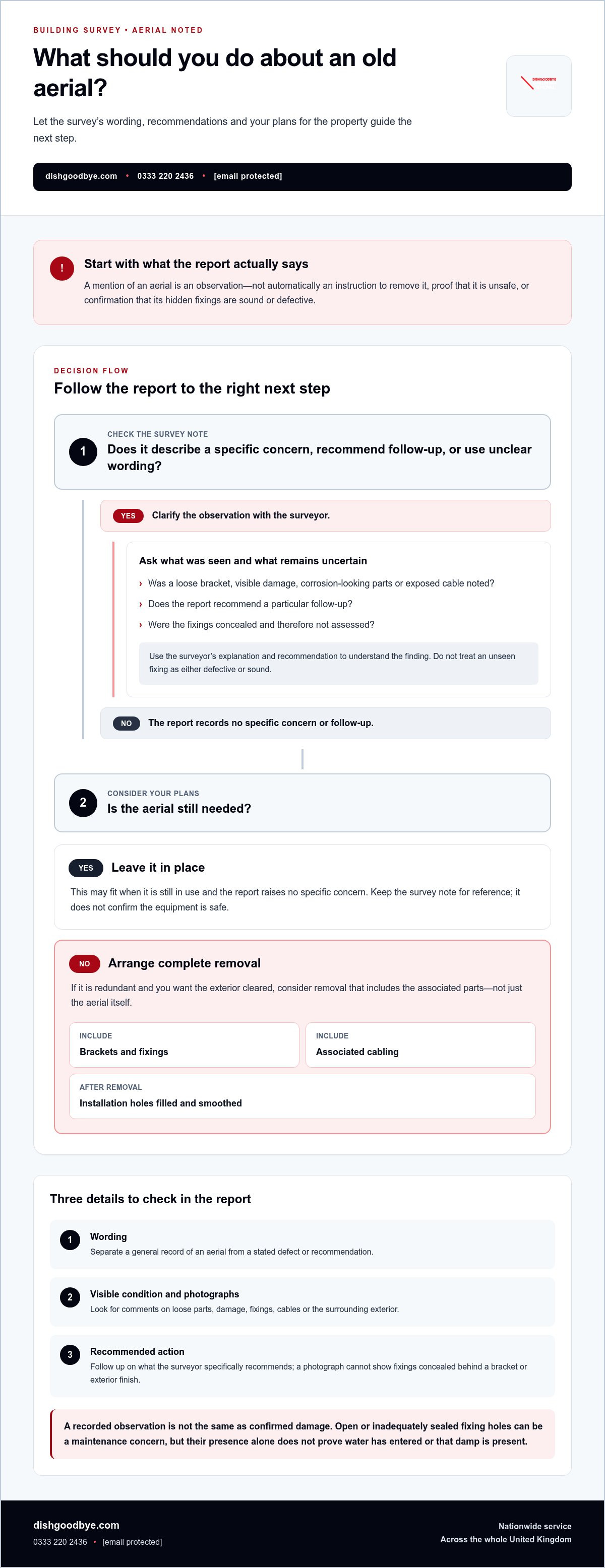
What to Do After Finding an Old Aerial in Your Survey
Turn the survey note into a clear next step instead of guessing from the word “old”. Reread the description, identify which parts of the installation it refers to, check whether the surveyor recommends action, then decide whether to leave the aerial, clarify the concern or arrange removal.
A simple checklist for reviewing the report
- Record the exact wording. Note whether the report simply identifies an aerial or mentions a concern and recommends follow-up.
- Identify the equipment. Check whether the observation refers to the aerial, its brackets and fixings, external cabling or the surrounding surface.
- Consider whether it is redundant. If you are unsure whether the aerial is still used, find out before treating the equipment as unnecessary.
- Review the photographs. Keep relevant survey images to hand and compare them with what is safely visible from the ground.
- Decide what remains unclear. If an important point is uncertain, ask the surveyor to explain what they observed and what they recommend.
Photographs and visible condition can help you understand the context, but they cannot assess parts that are out of sight. For example, an image may show a bracket without showing the condition of fixings behind it. Do not climb up to inspect anything yourself.
How to think about DIY versus professional removal
Taking down an aerial can involve more than removing the visible equipment. It may be mounted above ground level, with brackets and fixings attached to the exterior and cables running across the building. Working at height and dealing with those attachments can make the job more involved than it first appears.
Avoid turning a survey note into a DIY job that requires reaching a roof or working from a ladder. If the aerial is redundant and you want it removed, professional removal can take away the equipment and associated brackets, fixings and cabling. The installation holes can also be filled and smoothed, addressing more than the visible fixture.
Once you have reviewed the report, use its recommendations and your plans for the property to choose a proportionate response. If you are ready to clear redundant equipment, explore the guide to professional aerial removal. Dish Goodbye provides removal across the United Kingdom.
Professional Aerial Removal: Clear the Exterior and Address the Fixings
If the aerial is redundant and you have decided it should go, look beyond the mast itself. Complete removal should deal with the connected parts too, so you are not left with unused brackets, exposed fixings or old cables on the exterior. It clears the installation and addresses the points where it was attached.
What does complete aerial removal address?
Dish Goodbye removes redundant aerials along with associated brackets, fixings and cabling. Technicians also fill and smooth holes left by previous installations.
Removed metal and electronic waste is processed through approved recycling centres. If you are viewing or sharing project photos, make sure any “after” images show the cleared exterior, with no satellite dish or aerial visible.
How to take the next step with Dish Goodbye
An old aerial noted on a building survey may simply be an observation. If you have established that the equipment is no longer needed, removal can leave the exterior clearer and tidier. Dish Goodbye provides removal across the whole of the United Kingdom, including the associated fixings and cabling.
For a straightforward next step, explore professional aerial removal. Use the report to understand what was observed, then choose removal if it suits your plans for the property.
Website: dishgoodbye.com
Telephone: 0333 220 2436
Email: [email protected]
Choose the Next Step That Fits Your Property
dishgoodbye.com | 0333 220 2436 | [email protected]
An old aerial noted on a building survey is a prompt to review the report, not proof that the equipment is dangerous or must be removed. Check the wording, photographs and any recommendation. If a key detail is unclear, ask the surveyor to explain what they observed before deciding.
If the aerial is still needed and the report raises no specific concern, you may choose to leave it in place. If it is redundant, professional removal can clear the aerial along with brackets, fixings and cabling. Holes left by the installation are filled and smoothed, and removed metal and electronic waste is processed through approved recycling centres.
Ready to clear redundant equipment? Arrange professional aerial removal with Dish Goodbye. The service covers the whole of the United Kingdom. Take a practical next step towards a tidier exterior.
dishgoodbye.com | 0333 220 2436 | [email protected]
Frequently Asked Questions
What does an old aerial noted on a building survey mean?
An old aerial noted on a building survey means the surveyor recorded equipment they observed on the property. The wording and context matter: the report might simply identify an aerial or mention visible concerns such as loose parts or nearby damage. The note alone does not confirm whether the aerial works, whether its fixings are secure or whether it is unsafe. Check photographs and recommendations before deciding what to do.
Does an old TV aerial mentioned in a survey have to be removed?
No, a survey mention alone does not establish that an old TV aerial must be removed. Check whether the report makes a specific recommendation or describes a defect, rather than simply noting that the equipment is present. If the surveyor recommends follow-up, take that advice into account. If you are unsure what was observed or what action is suggested, ask the surveyor to clarify before choosing your next step.
Can an old aerial cause damp in a property?
Fixing holes can be a route for moisture to enter if they are left open or inadequately sealed, but an aerial mentioned in a survey does not prove damp is present. Look for specific comments about the exterior or signs of moisture in the report. If a redundant aerial is removed, Dish Goodbye fills and smooths holes left by previous installations, helping address potential moisture concerns at those fixing points.
Should I remove an old aerial before selling a house?
Not necessarily. Use the survey findings, whether the aerial is still needed and your plans for maintaining the property to guide your decision. A general observation does not make removal necessary in every case. If the report identifies a concern, follow its recommendation or ask the surveyor to clarify. If the aerial is redundant and you want a clearer exterior, professional removal can also address associated brackets, fixings and cabling.
Is it safe to remove an old aerial myself?
Removal can be more involved than taking down the aerial itself. Access at height, attached brackets and fixings, and cabling all add practical risks and complexity. Avoid attempting work that requires reaching a roof or using a ladder without appropriate competence and equipment. Professional removal is a practical option for dismantling redundant equipment and addressing the fixing holes afterwards.
What happens to the holes after an aerial is removed?
Dish Goodbye fills and smooths holes left by previous installations as part of removal. Addressing these openings tidies the exterior and helps reduce potential moisture concerns around old fixing points. The finished surface may not match the surrounding material or colour exactly, so do not assume the repair will be invisible. If your survey mentions damage beyond the fixing holes, consider that separately when deciding what further attention the exterior may need.
dishgoodbye.com | 0333 220 2436 | [email protected]