
Could your business show what happened to a satellite dish after it was removed? A general recycling claim may not provide a clear record of its onward route. Dish Goodbye removes commercial dishes and associated hardware across the UK. Contact the team on 0333 220 2436 or at [email protected].
It’s reasonable to want more than a promise that equipment was recycled. You need to know which records to retain, what they demonstrate and how to connect the equipment’s removal with its next destination. You’ll also want the building exterior left tidy, with redundant brackets, fixings and cabling removed and fixing holes filled and smoothed.
This guide explains the difference between a general recycling claim and disposal evidence, and sets out practical details to record and verify against current guidance for your part of the UK. It also explains how commercial satellite dish recycling can be arranged alongside a professionally managed removal. Dish Goodbye provides removal across the UK. Call 0333 220 2436 or email [email protected].
Key Takeaways
- Understand why a general recycling claim may not show what happened to a specific commercial dish.
- Separate removal details, waste movement information and downstream processing evidence to build a clearer record.
- Understand how reuse, recycling and residual disposal differ, and why the route depends on the equipment and receiving facility.
- Use a practical record-keeping approach for commercial satellite dish recycling, while checking current guidance for your UK nation.
- Learn how Dish Goodbye removes dishes and associated hardware across the UK, then fills and smooths fixing holes for a neater exterior.
What Commercial Satellite Dish Recycling Means for Your WEEE Records
For a property or facilities manager, the question isn’t only whether redundant equipment was removed. It’s whether the records show what was taken away and what happened next. Commercial satellite dish recycling can involve several parts, so a useful record distinguishes the removal itself from evidence about later handling or processing.
What does WEEE-compliant disposal mean for a satellite dish?
WEEE stands for waste electrical and electronic equipment. In plain English, it refers to electrical or electronic equipment that has become waste. A satellite dish setup may include a reflector, bracket and fixings, as well as electronic parts such as an LNB and associated cabling. These parts can differ in function and material, so don’t assume the whole assembly has the same composition or follows one identical handling route.
The term WEEE describes a broad category. By itself, it doesn’t tell you which specific duties apply to a particular business or item. The WEEE Directive provides background on the framework behind the term, but it isn’t a substitute for checking current UK guidance. Requirements may depend on the UK jurisdiction, the circumstances and the waste involved. Verify the applicable rules before treating any document or process as a legal requirement.
Responsible disposal means arranging an appropriate route for redundant equipment and keeping clear information about its removal and subsequent handling. That’s different from simply describing an item as recycled. A general recycling statement may not show that a particular dish or its components entered a specific recycling route. Don’t assume a particular certificate exists unless one has been issued.
Why commercial properties benefit from a clear disposal trail
A concise record connects the practical job with the business processes around it. Facilities teams can note which equipment was removed and from where. Asset managers can update records so redundant hardware isn’t mistaken for equipment still in use. Contractor records and sustainability reporting can also be easier to organise when removal details and any available downstream information are kept together.
A clear trail can reduce uncertainty later. During a property handover, internal review or compliance check, staff may need to establish when equipment was removed and how its disposal was managed. A dated removal note and relevant handover or processing information can help answer those questions, without overstating what the records prove.
For broader background on disposal options, read the Satellite Dish Recycling guide. The rest of this guide focuses on the commercial evidence trail: separating removal records, waste movement details and available information about downstream processing, while checking current requirements for your circumstances.
Tracing Commercial Satellite Dishes: Removal to Recycling
A useful disposal trail follows the equipment through distinct stages. Identify the redundant items, record their removal, retain relevant handover information and file any available evidence about downstream processing. This makes it easier to understand what each record shows, without treating a collection note as proof of recycling.
What information can help identify the removed equipment?
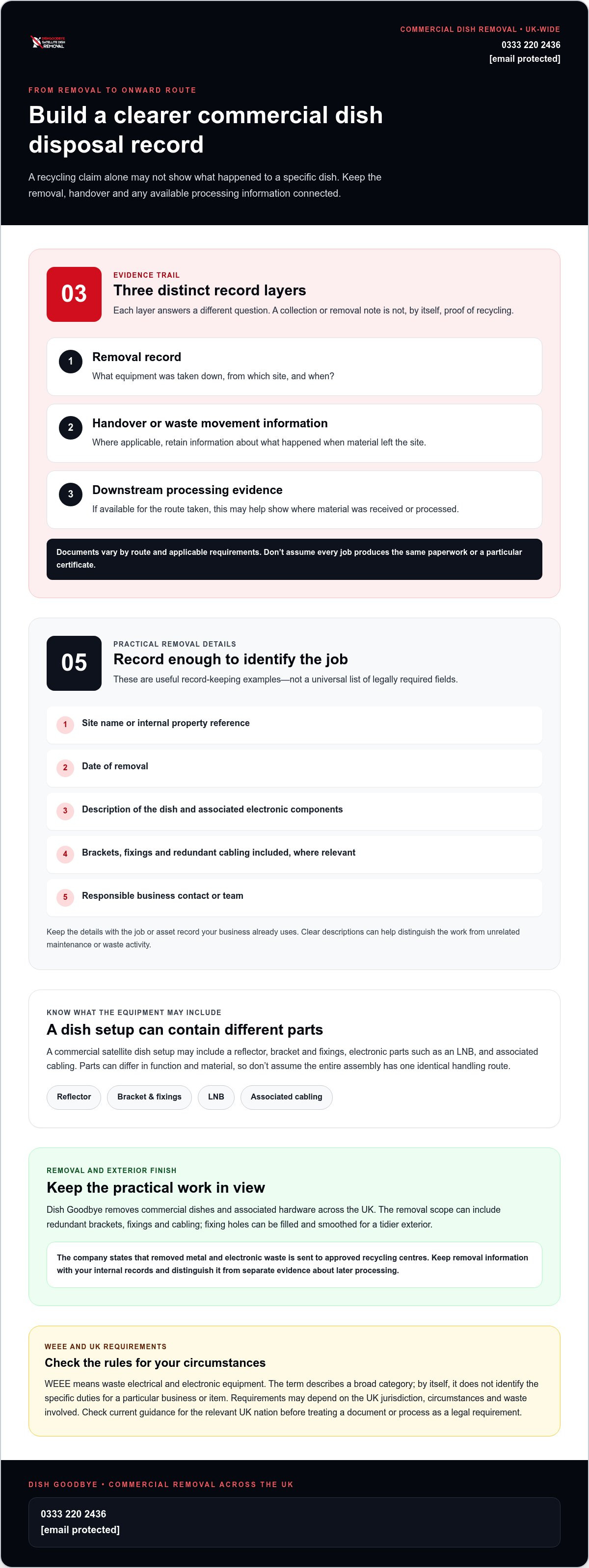
As a practical record-keeping step, capture enough detail to connect the removal with the right property and equipment. For example, note:
- Site name or internal property reference
- Date of removal
- Description of the equipment, such as a satellite dish and associated electronic components
- Brackets, fixings and redundant cabling included in the removal, where relevant
- The responsible business contact or team
These are practical examples, not a universal list of legally required fields. Keep the details with the job or asset record your business already uses. If several dishes are removed from one site, clear descriptions can help distinguish this work from unrelated maintenance or waste activity.
How can businesses connect removal with downstream processing?
Organise the paperwork in three layers. A removal record describes what was taken down and when. Handover or waste movement information, where applicable, helps show what happened when material left the site. Downstream processing evidence, if available for the route taken, may help show where material was received or processed. The records available depend on the route and applicable requirements, so don’t assume every job produces the same documents.
Dish Goodbye removes redundant commercial dishes and associated hardware across the UK. Removed metal and electronic waste is sent to approved recycling centres. Keep any information provided about the removal with your internal records, and distinguish it from separate evidence about later processing. For legal context, consult the WEEE Regulations 2013 and verify current requirements for the relevant UK nation and circumstances.
Traceability means keeping a clear link between the equipment removed, its handover and any available information about its subsequent route. This supports a more organised account without implying guaranteed recovery rates or a particular certificate. For a practical next step, see commercial dish removal from Dish Goodbye.
Reuse, Recycling, and Disposal Evidence for Commercial Dish Equipment
Not every redundant dish follows the same route. An item suitable for continued use is different from equipment sent for material processing, and neither should be confused with residual disposal. For commercial satellite dish recycling, describe the route that actually took place rather than using “recycled” as a catch-all term.
When might reuse or recovery differ from recycling?
Reuse extends an item’s life in its existing or another suitable function. Recycling involves processing waste to recover or use materials. Some telecom equipment may be assessed for continued use or value recovery before recycling, as part of a broader asset-lifecycle approach. That doesn’t mean a satellite dish follows the same pathway. Its condition, materials and the receiving facility’s capabilities all affect which route is suitable.
Be precise in your records. If equipment is reused, describe it as reuse. If it is sent for recycling, record that route based on the information available. A recycling claim should reflect the actual destination and handling, not just the fact that the dish was removed from the property.
What should a commercial disposal comparison show?
Use this comparison to organise the questions your records should answer. It’s a practical guide, not a statement that every route has identical paperwork or legal requirements.
| Route | Intended outcome | Useful traceability information | Possible record source |
|---|---|---|---|
| Reuse | Keep suitable equipment in use | Identify the item and note its onward use or recipient, where known | Asset or handover records |
| Recycling | Send suitable waste for material processing | Connect the removed equipment to the collection and the stated recycling route | Removal, handover and any available processing information |
| Residual disposal | Manage material that isn’t reused or recovered through recycling | Record the route and the information available about its destination | Handover or receiving-route records |
Check current official guidance for the relevant UK nation before treating a document or process as legally required. Where a record describes downstream treatment, compare it with information available from the receiving facility. Don’t assume every component is recyclable or that a record for one route proves another occurred.
Dish Goodbye removes commercial dishes and associated hardware across the UK, with removed metal and electronic waste sent to approved recycling centres. For details of the removal process, see the Dish Removal Service.
A Practical Checklist for Proof of WEEE-Compliant Disposal
A well-organised evidence file makes it easier to explain what was removed and what information supports its onward route. For commercial satellite dish recycling, keep records your organisation already receives or creates, then add any processing information actually supplied. The checklist below is good practice, not a universal list of legally required documents.
What should a business keep in its disposal file?
- Identify the equipment: Note the site or property reference and describe the dish and any associated components included in the removal, such as brackets, fixings or cabling.
- Record the removal: Keep the removal date and relevant job or facilities record so the work can be matched to the correct location.
- File handover information: Save any information created or received about the handover or movement of the removed material.
- Add processing evidence if supplied: Keep information identifying a receiving site or downstream route when it’s provided. Don’t imply that a specific certificate or record exists if it wasn’t issued.
- Check the rules that apply: Verify mandatory documents and retention periods against current official guidance for the relevant UK nation and circumstances.
A collection or removal record can help show that equipment left the property. By itself, it may not establish what happened after handover. Label each record according to what it demonstrates, and don’t describe a general recycling claim as item-specific processing evidence.
How can teams make the evidence easy to audit?
Use the same site reference across facilities, asset, contractor and waste records. Choose a consistent file name that includes the property reference and removal date, then store the documents together where your team keeps property or contractor records. This simple habit makes them easier to retrieve during a handover or later review.
If your organisation keeps photographs, use them to document the cleared exterior after removal. Frame the building surface and any filled, smoothed fixing holes, with no satellite dishes or aerials visible. This provides colleagues with a visual record of the completed exterior without suggesting anything about the waste’s downstream route.
For broader disposal background, read the Satellite Dish Recycling Guide. To arrange commercial dish removal across the UK, contact Dish Goodbye about commercial removal.
Arrange Commercial Satellite Dish Removal and Responsible Recycling Across the UK
Redundant equipment can leave a commercial exterior looking cluttered and add work for facilities teams. Dish Goodbye provides commercial satellite dish removal across the UK, including the dish and associated hardware. The service clears the property while keeping removal and responsible processing together.
What happens during a commercial dish removal?
The removal includes redundant satellite dishes, brackets, fixings and cabling. Clearing the associated hardware leaves the outside of the building tidier, rather than removing the dish and leaving loose cables or unused fittings behind. Fixing holes are filled and smoothed to help protect the exterior.
Removed metal and electronic waste is sent to approved recycling centres. This describes the destination for the removed materials, but it shouldn’t be taken as a promise that every component follows an identical route or that a particular certificate is issued. Keep any information provided about the work with your property records, and distinguish removal details from any separate evidence of downstream processing.
The finished exterior is left without the redundant dish or aerial, with fixing points filled and smoothed. This gives property and facilities teams a cleaner result to record and maintain.
How can a business take the next step?
If you manage a commercial property, gather the site reference and a brief description of the redundant dish and associated hardware. This gives you a clear starting point for arranging removal and linking the work to your facilities records.
Dish Goodbye provides removal and responsible processing for businesses across the UK. For more service details, visit the professional satellite dish removal service. To discuss removing redundant commercial dishes, call 0333 220 2436 or email [email protected].
Make Commercial Dish Removal Easier to Track
Responsible commercial satellite dish recycling involves more than a broad recycling claim. Keep a clear record of what was removed, when it left the property and any handover or processing information provided. Check current guidance for your UK nation and circumstances before deciding which documents are required or how long to retain them.
Dish Goodbye removes commercial dishes, brackets, fixings and redundant cabling across the UK. Removed metal and electronic waste is processed through approved recycling centres, and fixing holes are filled and smoothed to leave the exterior neater. One managed removal can help simplify the property and the disposal record you keep.
Arrange commercial dish removal across the UK and take a practical next step towards a clear exterior and a more organised disposal trail.
Telephone: 0333 220 2436
Email: [email protected]
Frequently Asked Questions
What counts as proof of WEEE-compliant disposal for a satellite dish?
A useful disposal file links the equipment to its removal, handover and any available information about its onward route. It might include a site or equipment record, a dated removal record and relevant handover or processing information. Don’t assume one certificate is universally required or supplied. Check current official guidance for the relevant UK nation and circumstances, and make sure each record accurately describes what happened.
Does a commercial satellite dish count as WEEE?
WEEE means waste electrical and electronic equipment, and electronic parts associated with a dish may be relevant to that category. The treatment of a particular item or component can depend on its nature and circumstances, so avoid relying on a broad label alone. Identify what was removed, describe its materials carefully and check current official guidance before stating a legal classification or duty.
What records should a business keep after a satellite dish is removed?
Keep practical details that help identify the job, such as the site reference, removal date and a description of the dish and associated equipment. File any handover information and downstream processing details actually received or created during disposal. These are useful record-keeping examples, not a universal list of legal requirements. Check current guidance for applicable documents and retention periods, then store the records where your team can retrieve them.
Can a recycling claim prove that a dish was disposed of responsibly?
A recycling claim alone may not show the journey of a particular dish. Stronger traceability connects the equipment and its removal with the handover and any available information about the downstream route. Keep claims proportionate to the evidence: don’t state a specific processing outcome unless the records support it. For commercial satellite dish recycling, separate what a removal record confirms from what later processing evidence may demonstrate.
How can a business verify that removed satellite dish waste reached a recycling centre?
Build a job file from the removal record and any handover or downstream information available for that route. Read each record for what it actually says, rather than assuming every disposal route produces identical paperwork. Dish Goodbye states that removed metal and electronic waste is processed through approved recycling centres. This doesn’t imply that a particular certificate or recovery rate is guaranteed.
Do WEEE disposal requirements differ across the UK?
Businesses should check current official guidance for the UK nation relevant to the property and waste route. Don’t assume that one document list, process or retention period applies in every circumstance. Keep practical record-keeping examples separate from statements about legal duties, and verify those duties before relying on them in compliance or sustainability reporting. This helps keep internal guidance accurate as requirements or official advice change.