

Dish Goodbye: 0333 220 2436 | [email protected]
Could an old dish fixing be letting rain into your home? If you’re concerned about a satellite dish causing damp, it’s reasonable to check. Damaged or poorly sealed fixings may provide a route for water, but a damp patch nearby doesn’t prove the dish is the source.
Moisture can have other causes, and damage may not be visible from indoors. This checklist explains what to look for safely, how to record what you see, and what information may be useful when contacting your insurer or a property professional. It also covers when to seek an assessment and why removing hardware or sealing holes yourself may not be the right first step.
Dish Goodbye provides satellite dish removal across the UK, including associated fixings and redundant cabling, and fills and smooths holes left by previous installations. This service doesn’t diagnose or repair existing damp. First, record what you can see and consider suitable advice about the moisture.
Dish Goodbye: 0333 220 2436 | [email protected]
Key Takeaways
- Satellite fixings can be a possible route for water, but nearby damp alone can’t confirm the cause.
- From a safe position, check the visible exterior fixing area, the corresponding indoor wall and any visible cable entry. Don’t climb onto a roof or handle loose equipment.
- Use the location and pattern of damp as clues, not a diagnosis. Signs along a cable route or away from the installation may point to other possibilities worth investigating.
- Keep a clear record: photograph visible signs, note where and when you saw them, and describe changes without presenting suspicions as facts.
- If you’re concerned about satellite dish causing damp, consider an appropriate assessment. Removing redundant hardware and filling its fixing holes addresses those installation points, but may not resolve other sources of moisture.
Can a satellite dish cause damp? Understand the possible connection
An old satellite dish could be linked to an indoor damp patch if water gets in around a fixing or cable entry. However, the presence of fixings doesn’t establish the cause. Damp means unwanted moisture in a building, and a mark on a wall alone can’t show where that moisture came from.
Possible connection: Water may enter around a damaged or poorly sealed dish fixing or cable entry.
Important caveat: Damp near an installation is a reason to investigate, not proof that the dish caused it. There may be another source.
How can satellite dish wall fixings be linked to moisture?
A dish bracket is secured to the outside wall with screws or bolts, and a cable may enter the property nearby. If a fixing or cable entry looks exposed, damaged or poorly sealed, it may warrant closer inspection. That doesn’t mean every fixing hole leaks, or that removing the bracket alone will solve a damp problem.
Rain entering through a defect in an external wall is one possible form of penetrating damp. An indoor mark can’t confirm the route or cause. Treat the fixing, surrounding wall and cable entry as details to record, not as a diagnosis.
What other signs could point to a damp problem?
Look for visible changes near the fixing area or on the corresponding indoor wall, such as staining or peeling paint or wallpaper. Note any visible marks around a cable entry too. These signs may indicate a moisture concern, but they don’t identify its source. Checking the wider context may also help a property professional assess the issue.
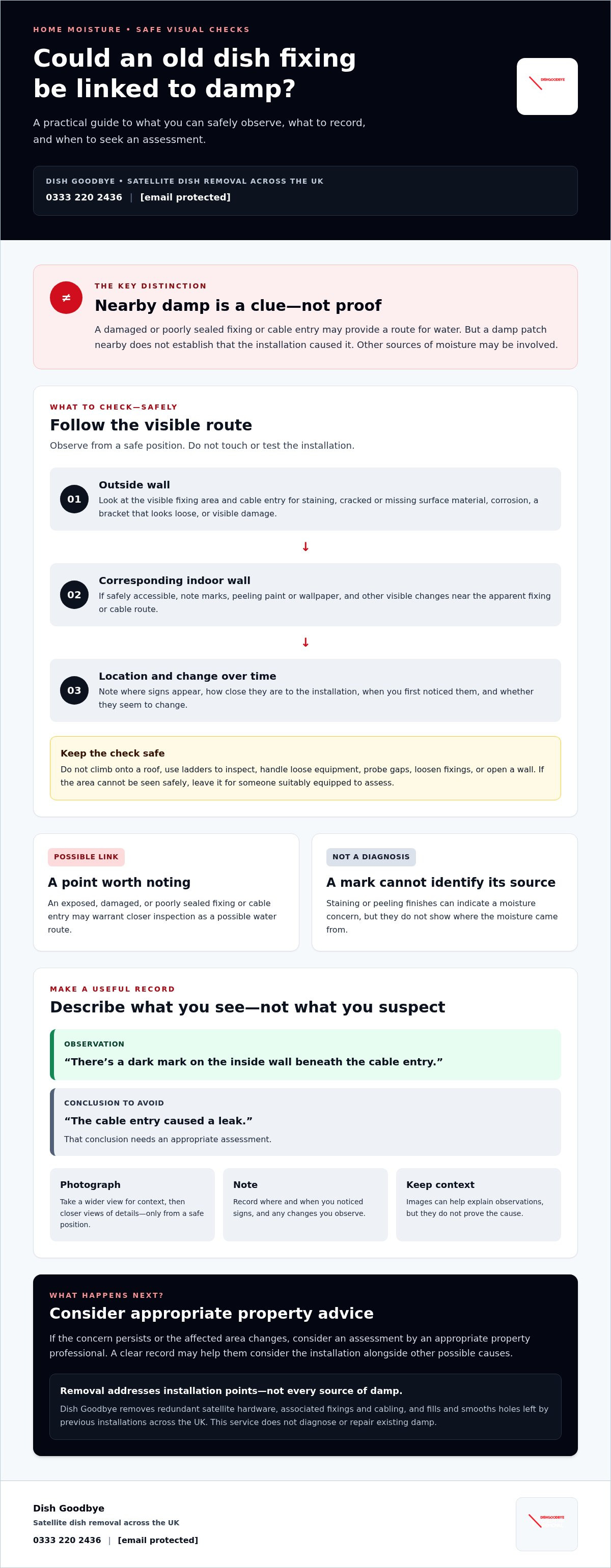
Keep the check simple and safe. From a position on the ground, note:
- Where indoor and outdoor signs appear, including how close they are to the fixing or cable route.
- What you can see, such as a stain, peeling finish or change to the wall surface.
- When you first noticed the signs and whether they appear to change over time.
If you’re investigating the possibility of satellite dish causing damp, keep observations separate from assumptions. “Staining visible below the cable entry” is a useful description. “The cable caused a leak” is a conclusion that still needs assessment. Don’t climb onto a roof or handle loose equipment to check. A clear record gives a suitable professional useful information to consider alongside other possible causes.
Where to check for damp around a satellite dish installation
Follow the installation from outside to inside without touching it. Look at the visible wall fixing area, any cable entry and the indoor wall that appears to correspond with them. This can help you describe what you’ve noticed if you need advice, but it can’t confirm whether the installation is linked to damp.
What should you look for outside?
From a safe position on the ground, visually check the wall around the fixings and any visible cable entry. Note cracked or missing surface material, staining, signs of corrosion, a bracket that looks loose, or damage where a cable enters the wall. Record what you can see. Don’t probe gaps, loosen fixings or test whether equipment is secure.
Stay clear of ladders, roof access and equipment that looks unstable. If you can’t see the area safely, leave it for someone suitably equipped to assess.
What should you check inside?
If it’s safely accessible, look at the indoor wall opposite or near the exterior installation and visible cable route. Note marks, peeling paint or wallpaper, or other changes to the finish. Write down where they appear and when you first noticed them. Don’t move fixed items, open the wall or try to trace a cable behind a surface.
If the concern persists or the affected area changes, seek appropriate property advice. Indoor signs may provide useful context, but they can’t identify the source on their own.
How can you record what you see?
Take a wider photo to show the location in context, then closer photographs of visible details from a safe position. If the area is too high or obstructed, don’t climb or reach to photograph it. Note that you couldn’t inspect it. Keep the date and a short description with each set of photos. Images can help explain your observations, but they aren’t proof of what caused them.
- Visible observation: “There’s a dark mark on the inside wall beneath the cable entry.”
- Conclusion to avoid: “The cable entry caused a leak.” That needs suitable assessment.
A simple record can include the location, what you can see, when you first noticed it, and whether it appears to have changed. Keep visible facts separate from suspicions. If redundant equipment or its fixings also need attention, satellite dish removal across the UK may be relevant. Removal and filling fixing holes address those installation points, not every possible cause of damp.
Could a satellite dish explain the damp, or is something else responsible?
A mark near an old installation can make the fixings worth checking, especially if there are visible changes around the outside wall or cable entry. But location is only a clue. It can’t tell you whether the satellite dish is causing damp or rule out another source. Use the comparison below to organise your observations, not to diagnose the problem.
| What you notice | What it may suggest | What it can’t confirm |
|---|---|---|
| Damp signs close to a wall fixing | The fixing area may be worth checking, particularly if the outside surface looks damaged. | That water is entering through the fixing. |
| Marks near or along a visible cable route | The cable entry and nearby wall may warrant closer inspection. | That the cable or entry point is the source. |
| Signs far from the installation, or across a wider area | It may be useful to consider the property as a whole and seek advice. | That the dish is connected to the moisture. |
Which observations make the old installation worth checking?
A stain on the indoor wall that seems to line up with an exterior fixing or cable entry is a reason to investigate, not proof of a link. If you can compare the two areas safely, note whether their positions seem to correspond. Record when you first noticed the mark and whether it has changed. Timing and location help describe the issue, but neither establishes its cause.
Keep your notes factual. “The mark is below the indoor wall area nearest the cable entry” describes what you see. “The cable caused the damp” assumes a cause that still needs assessment.
When should you consider another source of moisture?
If the affected area is widespread, appears well away from the installation, or continues to change, don’t attribute it to the dish without further assessment. Visible signs alone may not distinguish between an installation-related problem and other possible sources, such as plumbing, condensation, the roof or the wider wall. Avoid trying to diagnose the cause remotely from a photograph or a single sign.
Seek advice from a qualified property or damp professional if the source remains unclear, the signs persist or the affected area grows. Share your dated observations and photographs, and explain what you’ve noticed without presenting a suspected cause as fact. This gives the professional a clearer starting point to assess the property and decide what to check next.
What to document before contacting an insurer or property professional
A clear record helps you explain what you’ve noticed without assuming the old installation is responsible. Keep it factual and straightforward. Notes and photographs can provide useful context, but they don’t prove the source of moisture or guarantee a particular insurance outcome.
How can you make a useful visual record?
Take photographs from safe, accessible positions. Start with a wider view showing where the affected area is, then take closer shots of visible marks or changes. If the exterior fixing or cable entry can’t be seen safely, don’t climb or reach to photograph it.
Follow this order:
- Photograph: Capture the area in context and any visible details. Keep the original images where possible.
- Note the location and date: Record which room or wall is affected and when you noticed the signs.
- Describe changes: Note whether the visible area seems to be spreading, staying the same or changing in appearance.
- Seek appropriate advice: Share your record with your insurer or a property professional, depending on your concern.
Separate what you can see from what you suspect. “A mark has appeared on the inside wall below the cable entry” is a neutral observation. “The cable is letting in water” is an unconfirmed explanation. If you’re concerned about satellite dish causing damp, this distinction helps you ask for an assessment without presenting a possible cause as fact.
What should you ask an insurer or property professional?
For policy questions, contact your insurer directly and ask what information it needs for your circumstances. Policy terms and decisions vary, so don’t assume damage will be covered or that particular photographs or reports are required. Keep copies of relevant messages, documents and assessment details for your records.
If the source of moisture is unclear, ask a suitable property professional to assess it rather than presuming the dish is responsible. Share when the signs began, where they appear and any changes you’ve recorded. For general exterior-maintenance ideas, consult a guide relevant to your property and location.
If redundant equipment and its associated fixings need attention, explore satellite dish removal across the UK. Removal and filling the holes left by previous fixings address those installation points, but don’t diagnose or resolve every possible source of damp.
When redundant dish removal may help protect the exterior
If equipment is no longer needed, its exposed fixings or redundant cabling may be worth addressing as part of exterior maintenance. Removal clears the installation points for attention, but it can’t confirm whether they caused moisture or resolve every possible source of damp. If the affected area persists or spreads, arrange an appropriate assessment as well.
What can professional dish removal include?
Dish Goodbye provides satellite dish removal across the UK, including removal of associated brackets, fixings and redundant cabling. The service includes filling and smoothing holes left by previous installations. Removed metal and electronic waste is processed through approved recycling centres.
This may be relevant if the equipment is redundant, a fixing looks exposed, or you want the old cable route and installation points dealt with. Filling holes addresses the fixing points, not a separate moisture issue elsewhere in the property. If you’re investigating whether a satellite dish is causing damp, keep removal and damp assessment as distinct steps. Read the professional dish removal guide for more context on dealing with redundant equipment.
What is a sensible next step for UK homeowners?
Start with what you know. If moisture is persistent, spreading or has no clear source, seek advice from a suitable property or damp professional. Share your observations and photographs, and ask them to assess the moisture rather than assuming the installation is responsible.
If the dish is redundant and its fixings or cabling need attention, professional removal may be a practical next step. Dish Goodbye’s service is available across the UK. It covers the equipment and associated installation points, but shouldn’t be treated as a diagnosis or cure for existing damp.
Ask about UK-wide dish removal: contact Dish Goodbye about satellite dish removal, call 0333 220 2436 or email [email protected].
Take a clear next step towards a drier, better-kept home
Old dish fixings can be a possible route for water, but nearby signs of damp don’t prove the cause. Check and record what you can see safely, including where marks appear and whether they change. If the moisture persists, spreads or has no clear source, seek an appropriate property assessment rather than assuming a satellite dish is causing damp.
If redundant equipment and its installation points need attention, Dish Goodbye provides satellite dish removal across the UK. The service includes associated brackets, fixings and redundant cabling, plus filling and smoothing holes left by previous installations. This can address the installation points, but it doesn’t diagnose or resolve every possible source of damp.
Ready to discuss removal? Ask about nationwide satellite dish removal. You can also call 0333 220 2436 or email [email protected]. Record what you’ve observed, seek an assessment where needed, and contact Dish Goodbye about removing redundant equipment and its fixings.
Frequently Asked Questions
Can satellite dish bracket holes let water into a wall?
Yes, a bracket hole may provide a route for water if the opening or its seal is damaged or deteriorated. That doesn’t mean every fixing hole leaks, or that a hole is necessarily behind nearby damp. The wall, fixing and any visible cable entry can be checked as part of an assessment. Don’t probe or dismantle fixings yourself, especially if equipment looks loose or is out of reach.
Can an old satellite dish cause damp inside a house?
It’s possible for water to enter around a damaged or poorly sealed fixing or cable entry, but the installation alone can’t confirm the source. If you’re concerned about satellite dish causing damp, look for visible signs and note their location without assuming a cause. Damp can have other explanations, so persistent or spreading moisture should be assessed by a suitable property professional.
How can I tell whether damp is coming from satellite dish fixings?
You can’t reliably confirm the source from appearance alone. A mark on an indoor wall that seems to line up with an exterior fixing or cable entry may be a reason to investigate, not proof. Record where the signs appear, when you noticed them and whether they change. Compare inside and outside only where safely accessible, then ask a suitable professional to assess the cause.
What should I photograph before contacting my insurer about damp?
Take a clear overview showing where the affected area is, then closer photographs of visible marks or peeling finishes. Photograph outside details only from a safe, accessible position. Note the date, location and any changes you’ve observed. Keep descriptions factual, such as “staining below the cable entry”, rather than stating a suspected cause as certain. Ask your insurer directly what information it needs for your policy and circumstances.
Will removing a satellite dish stop existing damp?
Not necessarily. Removal and filling the holes left by previous installation fixings address those points, but they don’t diagnose or resolve every possible source of moisture. If damp remains, spreads or has no clear cause, seek an appropriate assessment. Dish Goodbye provides removal across the UK, including associated brackets, fixings and redundant cabling, and fills and smooths holes left by previous installations.
Can I seal satellite dish holes myself?
Don’t rush to seal a hole before you understand what needs attention. If the equipment is high up, loose or difficult to reach, avoid climbing or handling it. A repair that only covers the visible opening may not address the underlying issue. Consider suitable professional help for removal and fixing holes, and seek a separate damp assessment if moisture is already present or continues to appear.
When should I call a professional about damp near an old satellite dish?
Seek advice if the affected area is spreading, persists or has no clear source. A property or damp professional can assess the moisture rather than relying on proximity to the installation as proof. If redundant equipment or its fixings need removal, Dish Goodbye provides satellite dish removal across the UK. The service includes associated brackets, fixings and redundant cabling, and filling and smoothing installation holes.