
A rooftop dish doesn’t automatically make removal the landlord’s responsibility. If you’re asking who is responsible for the satellite dish on my roof, start with the tenancy agreement and any written record of who installed it, who owns it and what should happen when you leave.
It’s easy to assume the landlord, tenant or satellite company should take the lead, but that can leave the dish, cables or fixing holes unaddressed. In the UK, US landlord rules don’t govern your tenancy. The practical starting point is the agreement between landlord and tenant. In Scotland, the Scottish Government’s tenancy agreement requires written permission before adding an external aerial or satellite dish.
This guide explains how to clarify responsibility and agree who arranges removal, stores the equipment and organises reinstallation if needed. Once removal is agreed, you can request a quote and plan the work. It also explains what to put in writing before moving out or starting roof work, so everyone understands the arrangements.
Key Takeaways
- US landlord restrictions come from US rules and should not be treated as the rules for a UK tenancy.
- A dish’s ownership and removal arrangements can depend on who provided it and what the tenancy agreement says.
- In Scotland, the Scottish Government’s tenancy agreement requires written permission before adding an external aerial or satellite dish.
- Agree in writing who will arrange removal, handle any damage and decide whether equipment will be stored or reinstalled.
- Before roof work or moving out, clarify responsibilities and make sure connected equipment and cables are accounted for.
US landlord restrictions on satellite dishes
US rules provide background, but they don’t decide who handles a dish on a UK roof. Under US Federal Communications Commission rules, landlords may not prevent tenants from getting a satellite dish if it meets the commission’s criteria, though they may set reasonable restrictions on its location and installation. Those are US rules, not a template for a UK tenancy.
For a UK property, the relevant planning and building rules are UK rules, not US landlord restrictions. The US Federal Communications Commission’s criteria don’t determine whether permission is needed here. Keep this distinction in mind if a landlord, tenant or contractor relies on overseas advice when discussing removal or roof work.
US guidance also distinguishes a satellite dish from equipment a provider may ask a customer to return. A dish installed on a property may not have to be returned, while a provider may ask for leased receivers back when service ends or charge a fee. Cancelling service doesn’t mean the provider will collect the dish or send someone to remove it. Receiver returns and roof-mounted equipment are separate matters.
That distinction matters when planning removal. A customer may need to arrange removal of a dish installed on their property, while a US landlord agreement may set conditions around installation and damage. Some landlords may require renters insurance that covers damage caused by a dish. For instance, the agreement might address responsibility for installation damage, while the policy covers specified damage costs. Don’t assume one arrangement replaces the other.
Roof work creates another handover point. Some roofers remove a dish during a new-roof project and reinstall it afterwards, but this isn’t automatic. Before work begins, agree who detaches the equipment, where it will be stored and who arranges reinstallation. Identify exterior cables for the roofer. Don’t cut, disconnect or reroute unfamiliar cables yourself.
IKO advises homeowners to expect television interruptions if satellite or TV dishes need to be removed during roofing work. Confirm the timing with everyone involved, including household members who rely on the equipment. A written plan can state whether the dish will return to its former position or stay off the roof, and help coordinate roof work with separate arrangements for the dish.
So, if you’re asking who is responsible for the satellite dish on your roof, distinguish it from leased receivers and read the applicable agreement. For a UK rental, agree in writing with the landlord who will arrange detachment, storage and reinstatement, and who is responsible for any damage. US landlord restrictions don’t answer UK tenancy questions; they explain only how arrangements may work in the US.
Who owns a satellite dish installed on a rented property in the UK?
Ownership can be unclear when a dish is fixed to a rented home. UK guidance reflects two views: a mounted dish may be treated as the property owner’s personal property, or as the tenant’s once they become a satellite company customer. Don’t assume either view settles ownership in every tenancy.
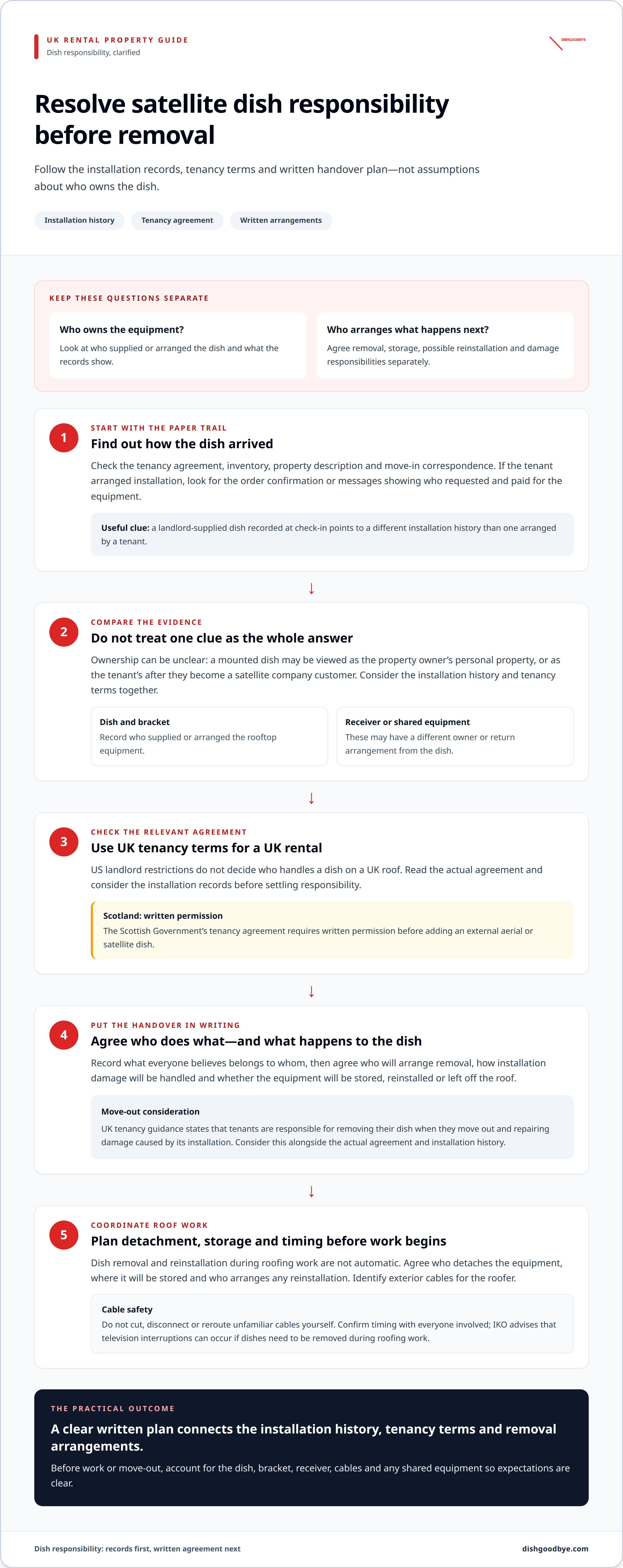
Start with the installation history. If the landlord supplied the dish before the tenancy began, look for it in the inventory, property description or move-in correspondence. If the tenant arranged installation, find the order confirmation or messages showing who requested and paid for the equipment. These records help explain how the dish arrived, even if they don’t settle every ownership question.
Separate ownership from responsibility. A tenant may own the equipment but still need to follow the tenancy terms when removing it. Likewise, a landlord’s ownership of a dish doesn’t by itself show who will arrange removal or address installation damage. UK tenancy guidance states that tenants are responsible for removing their dish when they move out and repairing damage caused by its installation. Consider that alongside the actual agreement and installation history.
Consider a common example: a tenant orders satellite service and an installer fixes a dish to the roof. The tenant’s customer relationship may support the view that the equipment belongs to them. But if the landlord supplied the dish, recorded it at check-in and arranged its installation, the circumstances point the other way. Consider these details together rather than relying only on the name on the viewing or subscription account.
Before agreeing to removal, record what everyone believes belongs to whom. Include the dish, bracket, cable, receiver and any shared equipment. A receiver inside the home may have a different owner or return arrangement from the rooftop dish. If a move-out is approaching, agree who will arrange removal, what happens to the equipment afterwards and how fixing damage will be handled. A brief written record can prevent conflicting expectations at checkout.
For the question “who is responsible for the satellite dish on my roof?”, ownership is only part of the answer. The installation records, tenancy terms and move-out arrangements all matter. If everyone agrees that the dish should go, satellite dish removal can be the next practical step. Describe the equipment and its position clearly when arranging the work, especially if other cables or devices are nearby.
That distinction also matters if the dish is loose or left behind. The page states that a satellite dish does not have to be returned after it is placed on a property, so agree who will keep or remove it rather than assuming it must go back to a provider. If it is dangling, do not treat it as secure: a homeowner said the dish had been installed on November 16 and was dangling 18 days later. A forum participant advised taking photographs of the dangling dish and installation.
A former satellite installer recommended 7/16 x 3 wood lag bolts for a roof-mounted dish and advised that its centre bolts should go into a supporting 2x4. The former installer also advised checking whether the roof feels spongy, as that may indicate rotten boards. These details can help describe concerns when arranging suitable help, without settling who owns the dish or who must deal with it.
Does a UK landlord have to maintain a satellite dish provided with the property?
A dish supplied with a rented property doesn’t, by itself, explain who must maintain it. Check the tenancy agreement and any written arrangements for terms about the dish, its condition, repairs, service interruptions or removal. An inventory can show that the dish was present, but doesn’t necessarily say what maintenance was agreed.
Keep rooftop equipment separate from the television service. A dish, bracket and cable are physical fittings; a receiver and subscription are separate parts of the setup. For example, a tenant might report that the dish appears loose, while a separate issue concerns the receiver inside the home. Describe the specific problem in writing so the landlord can respond to the right concern.
Look for clear wording rather than assuming the landlord’s provision of the dish settles responsibility. The agreement might say who arranges repairs, who pays for work, whether the tenant can request removal and what happens at the end of the tenancy. If it says nothing about maintenance, don’t treat the inventory alone as a promise to repair or replace the equipment. Ask for any arrangement to be recorded in writing.
Condition matters too. A securely attached dish that no longer provides a useful signal raises a different practical issue from damaged equipment or a bracket that appears loose. Don’t climb onto the roof or handle unfamiliar cables to investigate. From a safe position, describe what you can see, such as movement, a damaged cable or a dish the household no longer uses.
Before agreeing to work, distinguish maintenance from removal. Keeping a dish for future viewing requires a different arrangement from taking it down before moving out. Put the decision in writing, including whether the dish stays, who organises any work and what happens to the equipment afterwards. If roof work is planned, record whether the dish will be detached and reinstalled as part of the project.
For example, a check-in inventory might record a dish while the tenancy agreement says nothing about servicing it. The tenant can ask the landlord to clarify responsibility before arranging changes. Keep the response with the agreement, along with any later decisions about repairs or removal. This gives both parties a shared record rather than leaving them to rely on different memories.
In short, a UK landlord’s provision of a satellite dish doesn’t by itself settle who maintains it. Read the tenancy terms, note the equipment’s condition and put any agreement about upkeep or removal in writing. That makes the next step clearer, whether the dish remains in use or is taken down.
Can a tenant install or remove a satellite dish without landlord permission in the UK
Installing a dish means fixing equipment to the building, so treat it differently from placing a television indoors. Check the tenancy agreement before arranging installation. Look for terms covering external fixtures, alterations, aerials, satellite dishes and written consent. If permission is required, get it in writing before an installer attaches a bracket or cable.
In Scotland, the Scottish Government’s tenancy agreement requires a tenant to get written permission before adding an external aerial or satellite dish. That fact concerns the named Scottish tenancy agreement; it shouldn’t be presented as a single rule for every UK tenancy. Across the UK, read the agreement that applies to your home and follow its wording.
A landlord’s response can clarify practical details as well as permission. Ask to record the approved position, exterior cable route, responsibility for installation damage and what must happen when the tenancy ends. For example, written consent might identify a wall position, while a separate note says whether the tenant must arrange removal before moving out.
Removal depends on who supplied the equipment and what the tenancy says. UK tenancy guidance says that if a tenant installed the dish, they are responsible for removing it when they move out and repairing damage caused by installation. This doesn’t settle every situation, particularly where the landlord supplied the dish or the agreement gives different instructions. Put the agreed plan in writing before arranging work.
Don’t assume that removal is always permission-free simply because installation permission was granted. The dish could belong to the landlord, serve another household, or be connected to shared equipment. Before it comes down, agree who authorises the work, who keeps or disposes of the dish, and whether any equipment must stay in place. A tenant leaving a Leeds council home must arrange and pay for safe removal of the satellite dish, according to the UK Government. That example applies to that specific housing situation, not automatically to every UK tenancy.
Before deciding a dish is redundant, check which receivers and services use it. Sky Q, Sky+ and satellite Freesat still use a dish; Sky Stream and Sky Glass use broadband. A smart television or broadband upgrade alone doesn’t show that rooftop equipment is unused. Don’t cut or disconnect unfamiliar cables, as they may serve other equipment.
Keep the tenancy clause, written consent and removal plan together. Record who arranged the dish, who owns it and who will address installation damage. These details give landlord and tenant a clearer basis for deciding whether permission is needed before installation or removal.
What does a UK tenancy agreement usually say about satellite dishes?
UK tenancy agreements differ, so don’t expect every contract to contain the same satellite-dish clause. A useful agreement records who may arrange installation, what permission is needed and who handles removal. It can also explain what happens to the dish at the end of the tenancy. Put these points in writing rather than relying on an informal conversation.
Start with the installation terms. Look for wording about external fixtures, alterations, aerials or satellite equipment. If the agreement requires the landlord’s consent, record approval before fitting a dish. A written note can identify the permitted position, cable route and responsibility for installation damage. In Scotland, the Scottish Government’s tenancy agreement requires written permission before adding an external aerial or satellite dish.
Next, clarify ownership and upkeep separately. The agreement or a signed inventory can record whether the dish came with the property or was added by a tenant. It can also state who will arrange any agreed maintenance. For example, a landlord-provided dish might be listed at check-in, while a separate written arrangement explains who handles a reported fault. An inventory alone may not settle every maintenance question.
Give removal its own clear wording. Record who arranges it, when it must happen and what happens to the equipment afterwards. If the tenant installed the dish, state whether it must be removed before moving out. If the landlord supplied it, record whether it stays or is taken down. UK tenancy guidance recommends putting installation, removal and repair responsibilities in writing.
Include damage and reinstatement details. Removing a dish can leave fixing holes, so specify who will address damage associated with installation. If roof work is planned, note whether the dish will be detached, stored and reinstalled, and who will organise each step. Don’t assume a roofer or satellite provider is responsible simply because they’re involved in another part of the work.
A practical written record can cover:
- Who supplied or installed the dish, and who owns it.
- Whether written permission is needed for installation or removal.
- Who arranges agreed maintenance and removal.
- Whether the equipment stays, is stored or is taken away.
- Who handles installation-related damage and any agreed reinstatement.
Before signing, make sure the agreement reflects the equipment at the property. If it mentions a dish, check that shared equipment and cables are considered too. Clear wording shows who makes each decision and gives landlord and tenant a record to follow when moving out or arranging roof work.
Check the roof’s condition and agree how the dish will be handled if roofing work is planned. Homeowners should confirm how rooftop additions such as satellite dishes will be managed and when they will be removed before work begins. One former installer said he had about a dozen screws on his roof and worried about possible water leaks in the rain. This illustrates why fixing points and any resulting damage should be considered.
Some people remove satellite dishes themselves; others hire a professional. In either case, agree beforehand who is responsible for safe removal and addressing any roof damage, so everyone understands the arrangement before work starts.
Dish Goodbye: Satellite Dish Removal
Dish Goodbye is a practical next step when you’ve agreed a rooftop dish should be removed. Its Satellite Dish Removal and Sky Dish Removal services cover the dish, bracket and associated cable, with the related fixing holes filled. Access and equipment condition are assessed for each enquiry.
Mention any additional cables, extra dishes, aerials, extra holes or other devices in your initial enquiry, as these must be quoted separately. Ask about collection, recycling and disposal arrangements when requesting your quote. This makes the agreed work clear before removal begins.
Once the landlord and tenant have agreed what happens to the dish, keep the arrangement with the tenancy records. It gives everyone a clear reference for removal and any agreed follow-up.
Make the next step clear
Before arranging work, turn the decision into a simple handover plan. Record who has agreed to the work, when access is available and what should happen to the equipment afterwards. If roof work or a move is approaching, coordinate the timing with the people responsible for the property. A clear plan helps everyone understand the next steps.
If you’re still asking who is responsible for the satellite dish on your roof, keep ownership and permission separate from the practical removal arrangements. Get agreement in writing before work is booked, and describe the equipment and access clearly when making an enquiry. That gives the next conversation a useful starting point without leaving important details to guesswork.
When you’re ready to discuss the removal, contact Dish Goodbye. Take the next step with a clear plan and a little less uncertainty.