

Replacing a brick isn’t always the best way to disguise a bracket mark. For invisible brick repair after bracket removal, a professional can assess whether the fixing holes and surrounding brick can be filled and blended. Replacement may be appropriate if a brick is severely damaged.
It’s natural to want the wall to look as though the bracket was never there. The finish depends on more than filling the holes: mortar colour, texture, brick condition and the light on the wall all affect how noticeable a repair is.
This guide explains how a professional assesses the brickwork, prepares the repair area and builds a finish that blends with the surrounding wall. You’ll learn when damaged bricks can be repaired in place, when replacement may make more sense, and why a perfectly invisible result can be difficult to achieve. For removal of the dish and bracket, request a quote from Dish Goodbye.
Key Takeaways
- Know what a dish-removal quote covers, and mention any extra cables, holes or devices in your initial enquiry.
- Understand why filling fixing holes may leave a visible mark and where the removal work ends.
- Check connected receivers and shared equipment before arranging removal, as some TV services still rely on a dish.
- Learn what can affect a brick repair’s appearance and when a damaged brick may need replacing.
- Request an individual quote based on the equipment, height, position, access and work required.
What a Dish Goodbye removal quote includes
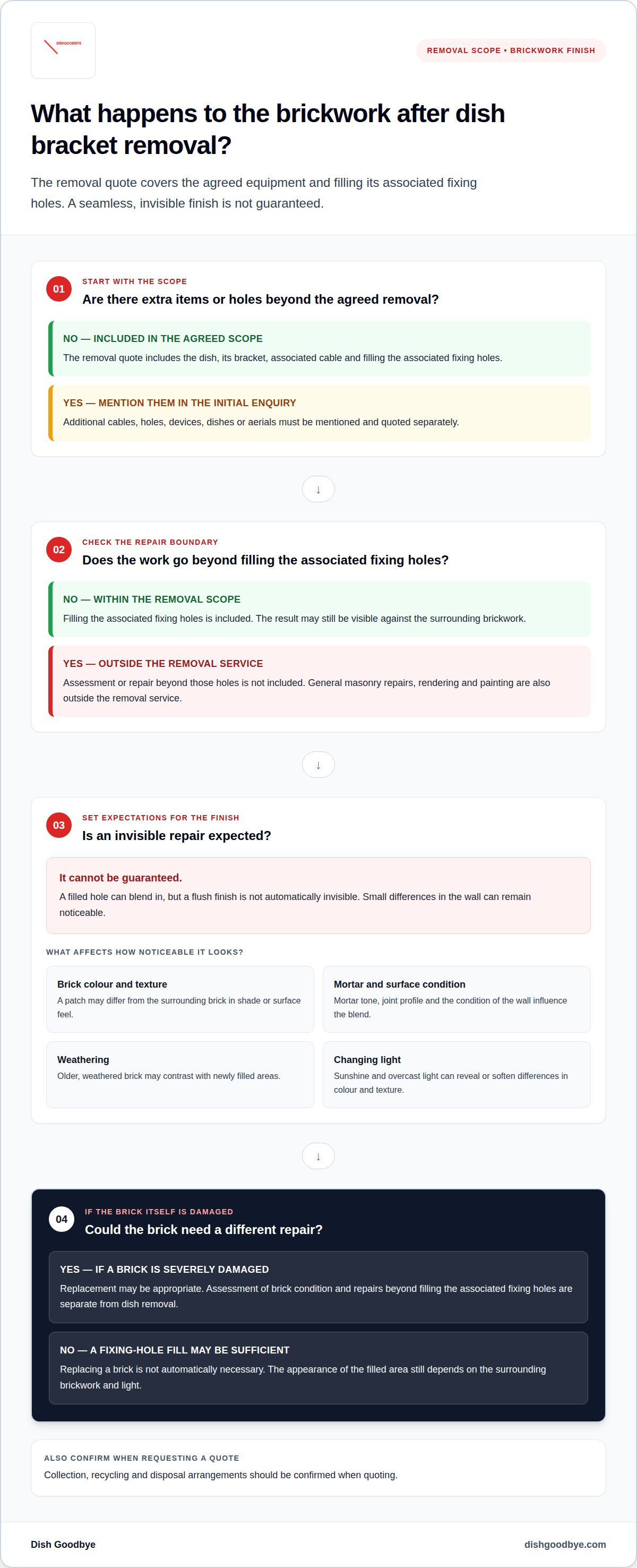
A Dish Goodbye quote covers the agreed equipment removal and filling the associated fixing holes. Assessment or repair beyond filling those holes is outside the removal service. The appearance of the filled holes depends on the existing brick, mortar, surface condition and finish.
-
Removal of plugs and screws
Dish Goodbye’s removal includes the dish, bracket, associated cable and filling the associated fixing holes. Mention any additional cables or devices in the initial enquiry; they must be quoted separately. Any assessment or repair beyond filling the associated fixing holes is outside the removal service.
For listed or rented property, explain the property’s status and agree the work with its owner or manager before alterations begin. The European Committee for Standardization identifies EN 771-1 as the specification for clay masonry units; the British Standards Institution identifies BS EN 845-1 as the specification for masonry ties, tension straps, hangers and brackets.
-
Filling the associated fixing holes
Small fixing holes may be filled, but a flush finish is not automatically invisible. Recessed mortar joints can cast shadows that disguise minor differences, while changes in brick colour or texture may remain noticeable. Assessment or repair beyond filling the associated fixing holes is outside the removal service.
Cleaning should suit the brick. Low-pressure washing is a lower-risk option for modern brickwork, while older, softer bricks may need a gentler method, such as steam cleaning. Chemical cleaning carries greater risk and requires controlled use. A small on-site trial can show how old brickwork responds before a method is used more widely. Inspect the repair in overcast conditions and direct sunlight, at different times of day, because changing light can reveal differences in texture or colour.
A Dish Goodbye removal quote includes the dish, bracket, associated cable and filling the associated fixing holes. It does not include general masonry repairs, rendering or painting. Additional holes, cables, devices, dishes or aerials must be mentioned in the initial enquiry and quoted separately. Ask about collection, recycling and disposal arrangements when requesting your quote.
-
Curing time for filler and mortar
Follow the chosen filler or mortar manufacturer’s curing instructions. There is no single curing period that suits every product, repair depth and weather condition. Fresh mortar may need protection from rain while it cures; painting too early can affect the finish. Confirm when the repair is ready for exposure or any later decoration.
For a brick repair, the finish should match the wall’s texture as well as its colour. Paint and colourless water-repellent coatings are generally inadvisable on brick walls because they can trap moisture and contribute to deterioration. Any such assessment or work is outside the Dish Goodbye removal service.
Replacing a brick is not automatically necessary for a fixing hole. Assessment of brick condition or repairs beyond filling the associated fixing holes are outside the removal service. On listed brickwork, a conservative repair helps retain historic fabric; on rented property, agreed permission can help avoid disputes about changes to the wall.
Why brick repairs may remain visible
A filled fixing hole can blend with nearby brickwork, but an invisible finish isn’t guaranteed. Colour, texture, weathering and light all affect how the repair looks across the wall. Invisible brick repair after bracket removal depends on matching these details, not just filling the opening.
A DIY repair may remain visible if the filler’s colour, texture or finish differs from the surrounding brickwork. A repair does not automatically blend in simply because the fixing hole has been filled.
-
When a professional may add micro-texture to a repair
Ask the professional to compare the repair’s surface with the surrounding brick before finishing it. A smooth filler patch can catch light differently from rough, weathered brick, so subtle texturing may help soften the contrast. The finish should follow the existing surface, not create a conspicuous pattern or damage sound brick around the hole.
Look at the wall from nearby and from the usual viewing distance. A texture that seems close at arm’s length may still stand out across the whole façade.
-
Can a professional use brick tinting or mortar recolouring to disguise repaired holes?
Yes, tinting or recolouring may reduce a colour mismatch, especially where the repair is small and the surrounding brick remains sound. The professional needs to consider the brick and mortar separately: a close brick colour won’t hide a joint that differs in tone or finish.
Matching the colour and finish of the brick and mortar takes care. Paint or coatings may also change the appearance of the surrounding wall, so discuss how they could affect the local repair before deciding whether to use them.
- Check the repair under changing light before judging how well it blends. Direct sunshine can make a smooth patch or different shade more obvious; overcast light may soften the contrast. Recessed mortar joints cast shadows that can disguise minor mismatches, but they won’t conceal a large difference in brick colour or texture.
For a useful review, look at the finished area from different angles and at different times of day. If a patch still draws the eye, identify what differs: surface texture, mortar colour, joint profile or the brick itself. That helps determine whether further blending is suitable or whether the repair needs a different approach. These checks help a professional judge whether invisible brick repair after bracket removal is realistic for that wall.
- Distinguish a local fixing-hole repair from wider masonry work. Filling the associated holes does not guarantee an invisible result and does not include general masonry repairs, rendering or painting. A damaged brick beyond the fixing area may need separate assessment; widespread cracks or crumbling faces are different from a small filled hole.
Mortar makes up to 40% of the visible surface area of brickwork joints, so its colour and profile can strongly affect the overall appearance. Compare the new joint with nearby mortar, rather than judging the filled hole alone. A mismatch in either can make a careful repair noticeable.
- Compare the filled hole with the surrounding brickwork rather than assuming every visible mark means the filler has failed. Differences in colour, texture or the profile of the mortar joint can affect how the repair looks. Consider the size and position of the local mark when judging whether it blends with the wall.
Filling a bracket hole addresses the fixing hole, not the appearance of surrounding damaged brickwork. A well-blended patch can improve a local mark, but it cannot make a different repair or finish to the surrounding wall part of the fixing-hole work.
Check connected equipment before removal
Before arranging dish removal, identify every receiver and any shared equipment connected to the system. A newer television or broadband service doesn’t, by itself, show that the dish is redundant.
- List the connected TV services. Check the receiver beside each television and note its service name or model. Sky Q, Sky+ and satellite Freesat services still use a dish. Sky Stream and Sky Glass use broadband. This distinction helps separate satellite equipment from services that rely on an internet connection.
Include televisions in less-used rooms, spare rooms and shared living areas. A receiver that’s rarely switched on may still depend on the dish. If you’re unsure what a device is for, record its visible label and location rather than guessing from its appearance.
- Ask everyone who uses the property. A dish or its associated cabling may serve another room or household. Check with other residents, tenants or household members before treating it as unused. In a shared building, ask the relevant property manager or owner whether other occupants rely on the equipment.
Look for satellite receivers in every area where people watch television. Include equipment tucked into a cabinet or connected to a television that isn’t used daily. A list of rooms and receiver names gives a clearer picture than checking only the main television.
- Trace the system visually, without disturbing cables. Note which receiver cables appear to run towards the dish or shared equipment, and take photographs of visible devices if useful. Don’t pull out, unplug or cut an unknown cable to test whether it’s active. The cable may serve another receiver or form part of shared equipment.
Keep the outside dish, bracket and cable distinct from other wiring. A television aerial cable, internet cable or unrelated wire may follow a similar route, but that doesn’t make it part of the dish removal. Point out uncertain equipment when describing the job.
- Don’t rely on a broadband upgrade or smart TV alone. Either may change how someone watches television, but neither establishes that every satellite receiver has stopped using the dish. Match the service at each television to its receiver, and account for shared equipment before making a decision.
For example, a household might use Sky Stream in one room while a Sky Q receiver remains connected elsewhere. The broadband-based service doesn’t replace the dish connection used by that satellite receiver. Similarly, a smart television may offer internet-based viewing while a separate satellite receiver remains in use.
Once you’ve mapped the connected services, include the receiver list and details of uncertain cables or shared equipment in your removal enquiry. This helps describe what should be assessed and avoids treating a dish as redundant based on one television alone. If no receiver or shared system depends on it, you’ll have a more informed basis for arranging removal.
Sky Dish Removal from Dish Goodbye
Dish Goodbye provides Sky Dish Removal when you’ve decided the equipment is no longer needed. The service offers a clear way to arrange removal, with your property details considered when preparing the quote.
Each enquiry is assessed individually. The assessment considers the equipment, height, position, access and requested work. These details help describe the job accurately: a dish mounted within easy reach presents different access conditions from one placed high on a wall or above an extension. Every position is assessed on its own circumstances.
When describing the equipment, explain where it sits and what surrounds it. Mention a sloping roof, narrow side passage, extension beneath the mounting point or any other feature that affects access. Clear information helps make the initial assessment relevant to the property, rather than relying on assumptions about a typical installation.
Photographs can help show the position and surrounding area. Choose views that show the dish in context, including nearby rooflines or visible obstacles. If you can’t safely get a useful view, describe what you can see from the ground. Don’t climb or reach towards the equipment to provide enquiry details.
Be specific about the work you want considered. If other items are beside the dish, describe them separately rather than assuming they’re included. If you’re unsure what a visible cable or fitting does, say so. This gives the enquiry a more accurate starting point and distinguishes the requested job from unrelated exterior equipment.
Access information matters too. Explain whether the dish is above a conservatory, beside a narrow access route or near other roof features. These examples help describe the setting, but the assessment is based on the actual equipment and property. Height, position and access are considered together with the requested work.
Once the details are clear, the quote can be tailored to the enquiry. If the scope changes, for example, because another device is identified, include that information rather than assuming it is already covered. A precise description keeps the discussion focused on the work you want arranged.
Dish Goodbye handles the removal enquiry, not a promise that brickwork around a bracket will disappear from view. The appearance of the wall after removal depends on its condition and the finish achieved. Keep expectations about the wall separate from the decision to remove the dish, and describe any separate masonry concern plainly.
Share the relevant details about the equipment, its location, access and requested work to begin the assessment. Request a quote from Dish Goodbye.
Frequently Asked Questions
If necessary, when might a professional recommend replacing bricks?
Replacement may be considered when a brick’s damaged face cannot be repaired while retaining a sound, stable surface. In some cases, a brick can be carefully removed and reversed to conceal damage, if its other face is suitable and it can be reset correctly. That option depends on the brick’s condition and position in the wall, not just how visible the mark is.
What might professional brickwork repair entail?
Brickwork repair can involve investigating why cracks or bulges appeared before deciding what masonry work is appropriate. Possible causes include tree-root damage, a rotten timber lintel or removal of an internal load-bearing wall. Historic cracks may sometimes be addressed with tile stitching, particularly where horizontal joints no longer align. Identifying the underlying issue helps distinguish a local surface repair from a wider masonry problem.
How might a professional repair brickwork after removing a wall bracket?
The location of each fixing helps determine the repair approach. A hole within a mortar joint calls for attention to the joint’s profile, while damage in the brick face needs a finish suited to that surface. If a fixing has caused a crack extending beyond the opening, the assessment should consider that wider damage too. The repair can then address the affected area rather than disguising only its centre.
How can a professional assess brick colour, texture and mortar when filling fixing holes?
Alongside shade, compare the brick’s surface grain, the size and distribution of visible particles, and the profile of nearby joints. Bricks on one wall may weather differently depending on their exposure, so a close colour match alone may not blend the repair. Looking at these details separately helps identify whether the main contrast comes from the brick face or the mortar.
What materials might a professional use to fill holes in UK brickwork?
A suitable filler or mortar depends on the masonry and the repair location. For a listed building, the UK Government states that sand-cement-based mortars will not be permitted. The chosen material should suit the existing brickwork rather than simply create a hard, smooth plug. A professional can account for whether the hole lies in a brick face or mortar joint when selecting and finishing the repair material.
When might a professional recommend replacing damaged brick instead of filling it?
Replacement may make more sense if the damage affects a brick’s integrity rather than just its appearance. But a cracked or bulging wall can have causes beyond an individual brick, including tree roots or a failing lintel. In those situations, replacing one brick may not address the wider movement or damage. The key distinction is whether the defect is isolated or part of a broader masonry problem.