
The fact that a dish is fixed to your house doesn’t, by itself, establish that you own it. Whether you own the Sky dish on your house depends on how it was installed and what the relevant agreement or property rules say. You may be able to keep a sound bracket when the dish is removed, but first check that you have authority to do so.
You may want to leave the bracket in place in case you use a dish again. Before deciding, review any Sky or installation agreement and consider whether you rent, live in a flat, or are subject to leasehold or estate rules that restrict changes to the property. A broadband upgrade or smart TV alone doesn’t show that the dish is no longer needed.
This guide explains what to check about ownership, when you may need permission, and how to decide whether the bracket can stay. It also covers what to consider before removal, so you can plan without disturbing equipment that is still in use. If you decide removal is the right next step, request a quote from Dish Goodbye.
Key Takeaways
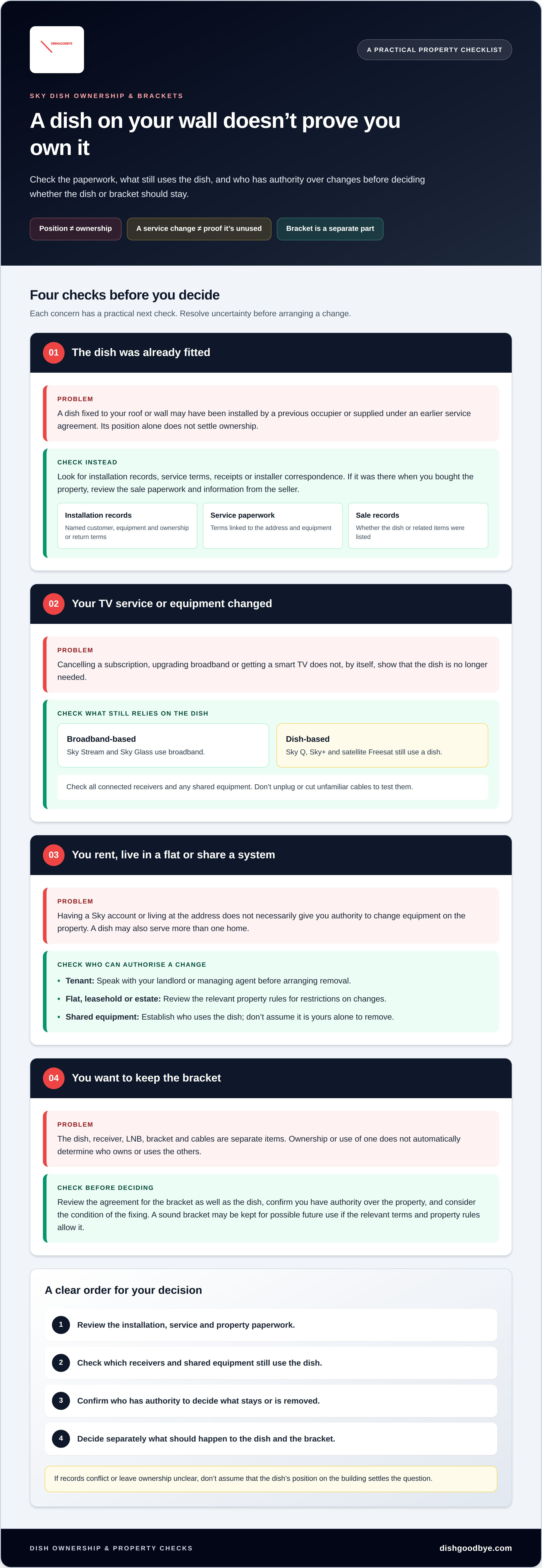
- A dish’s position on your home doesn’t establish who owns it. Review the installation agreement and property paperwork to understand what applies.
- Before arranging removal, check your service contract and make sure connected receivers or shared equipment don’t still rely on the dish.
- If you rent, live in a flat or have leasehold or estate restrictions, establish who has authority over changes to the dish and bracket.
- You may be able to keep a sound bracket for possible future use, but factor in your property restrictions and the condition of the fixing.
- After cancellation, consider whether the dish is still useful before deciding to reuse or sell it, or arrange removal with the dish, bracket and associated cable included in the quote.
Dish ownership and the distinction between installation position and ownership
A Sky dish fixed to your roof or wall doesn’t automatically belong to you. Its position shows where it was installed, not who paid for it or what the installation agreement says. If you’re asking, “Do I own the Sky dish on my house?”, start with the paperwork and circumstances surrounding its installation.
There isn’t one ownership answer for every UK home. A previous occupier may have arranged the installation, or the dish may have been supplied under an earlier service agreement. A property sale can also leave questions if the seller’s documents don’t mention the equipment. The fact that the dish is attached to the building doesn’t resolve ownership on its own.
Gather any records that could explain how the dish came to be there. Look for an installation agreement, service terms, receipt or correspondence from the installer. If the dish was already fitted when you bought the property, review the sale paperwork and information supplied by the seller. These records may show whether the equipment was purchased, supplied under an agreement or simply left in place.
- Installation records: Look for the named customer, equipment description and any terms about ownership or return.
- Property sale records: Check whether the dish or related equipment was mentioned as part of the fixtures or included items.
- Service paperwork: Review the agreement linked to the address and the equipment, rather than relying on the dish’s appearance.
- Bracket details: Treat the metal bracket as a separate part of the installation when deciding whether it can remain.
The dish, receiver, LNB, bracket and cables are separate pieces of equipment. Ownership or use of one doesn’t automatically determine who owns or uses the others. For example, you might want the dish removed but keep a sound bracket for possible future use. That depends on the relevant agreement, your authority over the property and the bracket’s condition.
The type of service can help you work out whether the dish may still be needed, but it doesn’t prove who owns it. Sky Stream and Sky Glass use broadband, while Sky Q, Sky+ and satellite Freesat services still use a dish. A smart TV or broadband upgrade alone doesn’t establish that the satellite equipment is redundant. Check which receivers and shared equipment rely on the dish before arranging removal.
If you’re a homeowner, separate the ownership question from your decision about what should stay on the building. If you rent or live in a flat with a shared system, your authority over the equipment may differ from ownership of the property. Tenants should speak with their landlord or managing agent before arranging removal. Don’t treat a dish serving multiple homes as yours alone to remove.
Make a simple record of what you find: who arranged the installation, what the paperwork says and which equipment is connected. If documents conflict or leave ownership unclear, don’t assume the mounting position settles the matter. Resolve the relevant agreement or property-authority question first, then decide whether the dish and bracket should stay together or be treated separately.
The applicable Sky installation or service terms may establish whether the equipment was purchased, supplied under an agreement or subject to return. Ownership may differ between the dish and its components, so check the terms for each item.
Checking service contracts before removal
To find out whether a Sky dish was installed under a rental, lease or service agreement, locate the paperwork linked to the property and installation. Look for terms covering equipment ownership, continued use, return or removal.
Checking the Service Agreement
A service agreement sets out the terms that apply to a service and any equipment supplied with it. Read the paperwork for the address and customer associated with the dish, rather than assuming the current occupier arranged the installation. The agreement may distinguish equipment bought outright from equipment supplied as part of a service arrangement.
Check the agreement, order confirmation and later correspondence for details such as:
- Equipment wording: Does it describe a dish, receiver, LNB, bracket or cabling?
- Ownership terms: Does it say who owns the equipment, or whether it must be returned?
- Service end terms: Does cancellation affect equipment ownership or set out what happens to supplied items?
- Removal terms: Does the agreement explain whether equipment can be altered or removed?
Read the relevant clauses together. A cancellation notice might explain when the service ends but say nothing about equipment ownership. An installation document might describe the equipment without explaining what happens after cancellation. Keep copies of useful records, including emails that identify the account holder or installation address.
Also identify which services and devices use the dish. Sky Stream and Sky Glass use broadband, while Sky Q, Sky+ and satellite Freesat services still use a dish. Switching to broadband or changing television equipment doesn’t, by itself, establish that the dish is unused. Check connected receivers and shared equipment before deciding on removal. Don’t unplug or cut unfamiliar cables to test them.
Identifying Rental or Lease Terms
Rental and lease terms set out the arrangements for occupying or using a property. They matter because having a Sky account or living at an address doesn’t necessarily mean you can decide what happens to equipment fixed to the building.
If you rent, review your tenancy agreement and any written permission for the dish installation. Check who arranged the work, who was named in any consent, and whether the landlord or managing agent set conditions. If the dish was already fitted when you moved in, distinguish that from an installation you arranged. Speak with the landlord or managing agent before arranging removal.
For a leasehold home, search the lease and related correspondence for clauses about external alterations, fixtures, satellite equipment or communal services. A flat’s dish may be part of a shared system, even if it appears to serve one home. If the management company or freeholder was involved in approving the installation, establish who has authority over the equipment before changing it.
Keep a clear record of the answer: save the relevant agreement, permission and correspondence together. For example, a tenant’s service contract may identify the account holder, while the tenancy documents explain who controls changes to the building exterior. These records answer different questions. Resolve both before deciding whether the dish, bracket or connected equipment can be removed.
Before arranging work, check that the dish and its equipment are no longer in use and are safely disconnected. DIY removal also means considering access, the condition of the fixings, the weather and nearby services. Dish Goodbye provides an upfront quote before chargeable removal work begins. Confirm the proposed work and any making good before agreeing to proceed.
For a new-build property, a homeowner may need to check lease conditions, estate rules or developer covenants before installing a dish. If you have authority to arrange removal, you can ask for the dish and LNB to be removed while leaving a sound bracket in place for possible future use. Every job is assessed and quoted individually. Take photographs for a quote only from a safe position on the ground; don’t climb a ladder or go onto the roof to take them.
Leasehold, estate and developer restrictions
Owning the dish doesn’t necessarily mean you can decide alone what happens to it. A lease, estate rule or shared-system arrangement may affect who can authorise changes to the building exterior.
Start with the property documents, not the dish’s position. For a leasehold home, look for terms about external alterations, satellite equipment, fixtures and communal services. For a new-build home, check estate rules and developer covenants. These documents may explain whether installation required permission and whether removal also needs approval.
A restriction on installation may not settle every question about later removal. For example, a developer’s rules might describe where a dish can be fitted, while a lease may cover alterations to the exterior wall. Read the relevant clauses together and note any wording about equipment already in place.
- Leasehold home: Find clauses covering exterior changes, fixtures, dishes or shared services.
- New-build property: Review estate rules and developer covenants before changing externally fitted equipment.
- Flat or communal system: Establish whether the dish serves only your home or forms part of equipment shared by residents.
- Previous installation permission: Locate any written approval and note who gave it and what conditions it covered.
Flats need particular care. A dish on a flat may connect to a communal system or serve more than one property. Don’t arrange removal without proper authority from the building owner or management company. A dish that appears to serve one living room could still be part of shared equipment, so appearance alone isn’t a reliable guide.
If permission from a landlord, management company, developer or freeholder was needed to install the dish, establish who has authority before making changes. Save relevant correspondence alongside the lease or estate documents. Written approval can clarify whether permission applied to that dish, its bracket, its location or a particular installation arrangement.
Location can matter too. UK permitted development guidance advises siting antennas to minimise their effect on a building’s external appearance where practical. In some sensitive locations, a dish on a wall, roof slope or chimney facing and visible from a road may need consent. The property’s setting and the dish’s position can therefore matter as well as ownership.
Consider a new-build house where the owner wants to remove a dish but keep its bracket. The estate covenant may cover visible exterior equipment, while the installation permission may relate to the dish as a whole. Check both before deciding what stays. Don’t assume approval for the original installation automatically covers a later change.
For a rental property, speak with the landlord or managing agent before arranging removal. For a leasehold flat, contact the building owner or management company if the dish serves a communal system or affects shared parts. For an estate property, use the relevant covenant or rule to identify the approval process. Be clear about who can authorise the work, which equipment it covers and whether the bracket may remain.
Can I sell or reuse a Sky dish after cancelling my subscription?
Cancelling a service ends the service arrangement, but doesn’t establish who owns equipment fixed to your home. Before selling or reusing a Sky dish, review the installation and service terms, then consider whether the property’s lease, estate rules or shared-system arrangements affect what you can do.
If the paperwork shows you own the dish, you can consider keeping it, selling it or arranging removal. If someone else owns it, or it serves a shared system, don’t treat cancellation as permission to take it down. A dish left by a previous occupier also needs a separate ownership check.
Reuse depends on the equipment and service you want. Cancelling a Sky subscription or switching to a broadband-based service doesn’t prove the dish is redundant. Check all connected receivers and shared equipment first. Don’t unplug or cut unknown cables to test the setup.
A dish kept for future use needs a suitable position and a clear view of the satellite. Buildings, trees, rooflines, extensions and neighbouring properties can obstruct or weaken reception. A bracket that looks sound may be worth retaining, but its condition and fixings still matter. Keeping it doesn’t guarantee that a future dish or service will work from that position.
Selling the equipment involves more than deciding that you no longer need it. Establish that you own the dish and any separate parts you plan to sell, such as the LNB or bracket. Then describe accurately what’s included and its condition. Don’t present a dish as ready to use if you can’t establish its condition or suitability for the buyer’s setup.
- For reuse: Keep the dish only if you have a likely use and the bracket is suitable to retain.
- For sale: Confirm ownership and identify exactly which components are yours to transfer.
- For removal: Check whether connected receivers, shared equipment or property restrictions affect the decision.
Consider the cables separately. Internal cabling may be left in place because removing it can disturb decoration without practical benefit. That doesn’t mean every cable is redundant or should stay; first establish what it connects to. A cable passing through a wall may also leave an entry point to address if the dish is removed.
If you decide not to sell or reuse the dish, removal can leave the exterior clearer. Dish Goodbye’s Sky Dish Removal covers the dish, its bracket, associated cable and filling the associated fixing holes. Any additional cables, holes, dishes, aerials or other devices must be mentioned in the initial enquiry and quoted separately. Ask about collection, recycling and disposal arrangements when requesting a quote.
Once ownership, use and property restrictions are clear, choose the option that fits: keep the bracket, sell equipment you own or arrange removal. Keeping the decision and relevant paperwork together can make future property maintenance clearer.
Dish Goodbye
Dish Goodbye can help once you’ve resolved ownership and property permissions, and decided removal is the right next step. Share where the dish is positioned and describe access, its condition and any extra equipment, so the work can be assessed for your property.
If you’re ready to move forward, contact Dish Goodbye to discuss removal.
Make your next move with confidence
Once you’ve decided, keep the paperwork and any written permission together. This gives you a clear record of why you’re keeping, selling or removing the equipment, and can avoid confusion if the property changes hands or someone else asks about it later.
If you’re still asking, “Do I own the Sky dish on my house?”, use the installation and property documents to guide your next step rather than relying on where the dish is fixed. You can also decide what suits your home best: leave the equipment in place, retain a bracket or clear the exterior. A considered choice now can make future property maintenance simpler.
If removal is the right choice, share the details of the equipment and access so the work can be assessed for your property. Contact Dish Goodbye to discuss your next step and move forward with a clear plan.
Frequently Asked Questions
Can I keep the bracket in case I want a dish again?
Yes, you can ask for the dish to be removed while leaving a sound bracket, provided you have authority to make that change. Consider whether the bracket is firmly attached and whether your agreement or property rules allow it to remain. Future installation may require a suitable position and a clear satellite view, so keeping the bracket doesn’t guarantee it will be useful later.
Who owns a Sky satellite dish installed at a UK property?
There isn’t one ownership rule that settles every Sky dish at a UK property. The installation agreement, service terms and property sale documents may help establish who owns the equipment. For example, records could show whether a previous occupier arranged installation or whether the dish was included among items left with the home. Its position on a wall or roof doesn’t establish ownership by itself.
Does a Sky dish belong to the homeowner, tenant, landlord or Sky?
It depends on how the dish was supplied and installed, and what the relevant agreements say. A homeowner, tenant, landlord or service provider may have different interests in the equipment and the property it’s attached to. For example, a tenant may hold the Sky account without having authority to alter the building exterior. Check the installation and occupancy documents to distinguish those responsibilities.
Who is responsible for repairing or removing a Sky dish in the UK?
Responsibility depends on the service agreement, who controls the property and whether the dish serves a shared system. A tenant should speak with the landlord or managing agent before arranging removal. For a flat or communal setup, the building owner or management company may need to authorise changes. If the dish is damaged or unwanted, identify the relevant agreement and decision-maker before arranging work.