
A dish left by a previous owner isn’t automatically yours to remove without checking first. If you’re wondering whether you can remove a dish left by a previous owner, establish who owns it and whether it serves a shared system. If you rent, get permission from your landlord or managing agent before arranging removal.
It’s understandable to want an unused dish gone and your home’s exterior looking tidy. Before arranging removal, check handover paperwork or equipment records for return requirements, and find out whether the dish is still connected to a service. If you live in a flat or a property with communal equipment, the building owner or management company may also need to approve the work.
This guide explains how to check ownership and permission, what to consider about equipment returns, and why access and safe removal matter. You’ll also learn what can be left behind, which repairs may be separate, and when professional dish removal can make the job simpler.
Key Takeaways
- Identify the dish, LNB, bracket and cables before deciding what needs to come down.
- Check property or service records for ownership and any equipment return requirements.
- Get the landlord’s or managing agent’s permission for a rented home, and proper authority for shared equipment.
- Consider the mounting position, access and possible wall or roof repairs before attempting removal yourself.
- For a Sky dish removal, Dish Goodbye can remove the dish, bracket and associated cable, with fixing-hole filling included in a standard quote.
Can an Old Sky or Satellite Dish Be Removed?
Yes, an unwanted dish can be removed, but first establish that it is no longer in use and identify every attached component. A typical satellite installation has three parts: the dish, its footplate and mounting bracket, and the cables connecting it to the home.
Dish and Mounting Bracket Removal
Removing the dish and bracket means taking down the visible reflector and its support from the wall, roof or chimney. The distinction matters because removing the full mounting assembly leaves fixing holes that need filling.
You can sometimes remove the dish while leaving its bracket in place, which may suit a household that could want satellite service again. If the bracket is fixed to a roof, removing it can disturb the surface. The fixing points and their condition affect what repairs may be needed.
LNB and Cabling Removal
The LNB is the small receiver attached to the dish arm, and the cable carries the signal towards the home. Include both in your inventory so the removal plan covers more than the dish’s reflector.
External cable may run along a wall before entering the home, while internal cable can often remain in place. Removing indoor cable may disturb the decoration without adding practical value, so distinguish the visible outdoor run from wiring inside rooms.
Identifying a Previous Owner’s Dish
A previous owner’s dish is equipment already attached when you move into a property, rather than a dish you arranged to install. In a UK home, note its position and visible parts, then compare them with handover paperwork or service records.
Look for a Sky label, an attached LNB, a cable route or a connection entering the building. These clues help describe the installation, but they don’t establish whether it is still in use or who owns it.
Before planning removal, check whether the dish serves a household television or a communal system. For example, a dish on a block of flats may feed more than one home, so its position near one flat doesn’t reveal its full purpose.
Consider the mounting surface before deciding whether to remove the bracket. A wall installation can leave fixing holes, while roof-mounted hardware may need careful repair around disturbed fixings to reduce the risk of water entering.
If the bracket is fixed to a roof, removing it may disturb the surface and leave bolt holes. Cutting the bracket above its footplate is sometimes described as an alternative, but whether that suits the job depends on the mounting’s position and condition.
After removal, the cable entry point needs a suitable seal, such as a cable gland or colour-matched mastic plug, rather than gaffer tape. Filling fixing holes and sealing the cable entry point address different openings. Neither automatically repairs existing wall damage or leaves a paint-ready finish.
Access changes the risk. A dish mounted high on a wall, roof or chimney can create a fall or property-damage hazard, so don’t climb a ladder, go onto the roof or lean out to take quote photographs.
Checking equipment ownership and return requirements
A dish left at a home is generally treated as equipment for the current occupier to decide about, but that doesn’t settle every case. It may serve a shared system, or paperwork may identify it as equipment connected with a service. Check the records before arranging removal rather than relying on the dish’s age or appearance.
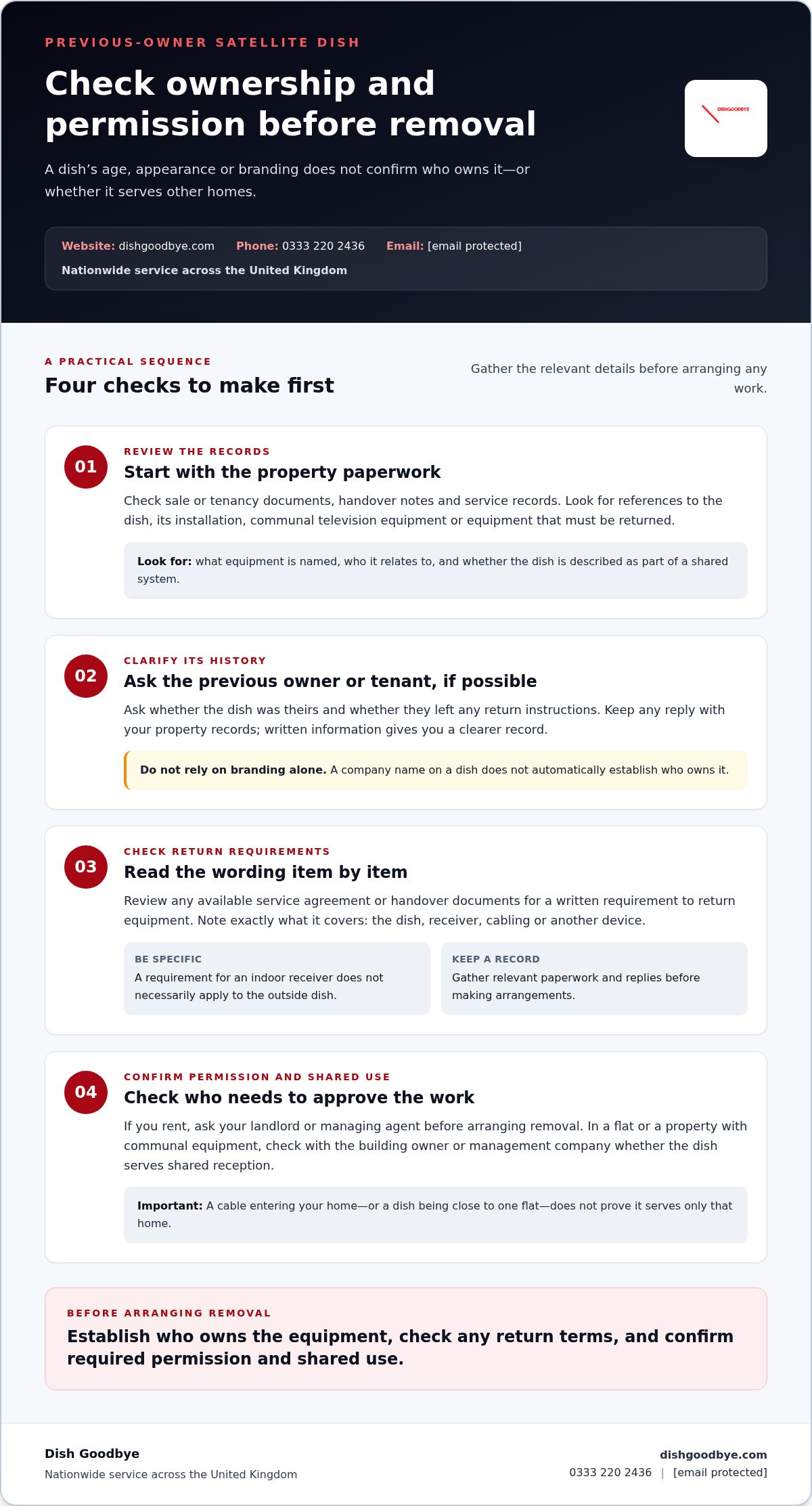
Start with the property documents you received when buying or renting the home. Look for references to a satellite dish, its installation, communal television equipment or equipment that must be returned. A handover note might say the dish serves a shared system; a service record might identify equipment associated with an account. These details help distinguish a private installation from equipment with another use or arrangement.
If you can contact the previous owner or tenant, ask whether the dish was theirs and whether they left return instructions. Keep any reply with your property records. A verbal recollection can provide useful context, but written paperwork gives you a clearer record of what was agreed. Don’t assume a branded dish automatically belongs to the company whose name appears on it.
Check for a written return requirement before treating the dish as unwanted property. Review any available service agreement or handover documents. If they say equipment must be returned, identify which item the wording covers: the dish, receiver, cabling or another device. A requirement covering an indoor box doesn’t necessarily apply to the outside dish, so read the specific wording.
Rental arrangements need particular care. If the tenancy agreement makes the tenant solely responsible for removing the dish, that agreement places removal responsibility on the tenant. If it doesn’t, responsibility falls to the property owner or property manager. The agreement should state removal responsibility in writing. A tenant should ask the landlord or managing agent before arranging work, especially if the dish was already present at move-in.
For a flat, house in multiple occupation or property with a communal system, don’t assume a dish serves only your home. The building owner or management company may need to approve removal if the equipment provides shared reception. A cable entering your flat doesn’t prove that the dish serves only your television.
Use these checks to reach a practical decision:
- Compare the dish with the sale, tenancy, and service paperwork.
- Look for a written return clause and note exactly which equipment it names.
- Ask the landlord, managing agent, or building manager about shared equipment.
- Keep relevant replies and records together before booking removal.
DIY removal safety
Assess the dish’s position before deciding whether DIY removal is sensible. A low wall fixing presents different access demands from a roof-mounted dish. Removal can cause injury or property damage, depending on the mounting position and condition. Consider the access route, fixings, weather and nearby services before starting. If you can’t access or handle the equipment safely, don’t proceed yourself.
Confirm the equipment is no longer in use and safely disconnected before touching its cables. A dish that looks old may still connect to a television or another part of the property’s setup. Identify where the external cable runs and whether it enters the building. Don’t cut or pull a cable simply because it appears redundant. If you can’t establish that it’s disconnected, stop rather than guess.
Use a simple risk check before any work:
- Access: Can you reach the dish without climbing a ladder, going onto a roof, or leaning out?
- Fixings: Are the bracket and footplate secure, corroded, or visibly damaged?
- Weather: Will conditions make access or handling difficult?
- Nearby services: Is anything close to the cable route or mounting area?
Don’t climb a ladder, go onto the roof or lean out to take photographs for a removal quote. A photo isn’t worth an unsafe reach. Describe the visible mounting position from indoors or from a safe place on the ground. If you can’t see the bracket clearly, say so rather than trying to get a closer view from a roof edge or upper-floor window.
Pay attention to what the mount is fixed to. Removing a bracket can disturb the surface, while a roof-mounted footplate may leave bolt holes or damage around its fixings. Those openings need suitable repair to reduce the risk of leaks. A cable entry point also needs a proper seal, such as a cable gland or colour-matched mastic plug, not gaffer tape.
The dish’s circuit board needs careful handling because it contains toxic elements. The removal guidance recommends taking the board out and disposing of it appropriately. Don’t break it or casually discard it with household rubbish. Keep the equipment separate while you work, and avoid handling components if reaching them means stretching, climbing or working in an unstable position.
DIY is practical only when the dish is disconnected, the fixings are accessible and the surrounding area is safe. A roof-mounted dish, uncertain cable connection, poor weather or nearby services can change that decision. Treat each as a reason to pause, not a challenge to overcome by reaching further.
Getting permission before removing a dish
Yes, leasehold or freehold arrangements can affect who controls the wall, roof or other area holding a dish. Removal can also affect a shared aerial, communal system or another person’s property, so establish who has authority before work starts.
For a leasehold home, check the lease and any building rules for requirements about external walls, roofs and alterations. The dish may be fixed to a part of the building managed by someone else, even if it serves your flat. For a freehold home, check your property documents and whether the dish is attached to or used by another property. Ownership alone doesn’t tell you whether a shared installation is involved.
If you rent, ask your landlord or managing agent before arranging removal. Send a short written request describing the dish’s location and the proposed work. For example, say whether it is fixed to the rear wall, above a window or on a roof. Ask for written permission and keep the reply with your tenancy records. This gives everyone a clear record of what was agreed.
In a block of flats, a house in multiple occupation or a building with communal reception, contact the building owner or management company. Explain which dish you mean and where its cable runs. A dish that appears to serve one flat may connect to equipment used by other residents. Don’t assume that disconnecting one visible cable affects only your television.
Permission matters for adjoining property too. A bracket may cross a boundary, sit on a shared wall or be reachable only from a neighbour’s land. Identify the property affected before planning access or removal. If a neighbour’s garden, balcony or roof is involved, agree access with them first and involve the property owner or manager where appropriate.
Make your request specific. Include:
- The dish’s position, such as a front wall or roof edge.
- Whether it has a visible cable entering the home or serving another building.
- Which parts you propose to remove, including the dish and bracket.
- How you plan to address fixing holes and the cable entry point.
- Any access that would involve shared areas or neighbouring land.
Wait for the relevant written response before arranging work. A landlord’s permission may not resolve a separate question about communal equipment; likewise, a building manager’s approval may not replace a landlord’s consent in a rented home. Keep each reply with your property documents. That paper trail helps clarify who approved removal and which parts of the installation the permission covers.
What counts as a dish left by a previous owner in the UK?
A dish left by a previous owner is equipment already attached to a property when you move in. It may include the reflector, the small LNB receiver, a mounting bracket and visible external cable. A dish can remain on a front wall, rear wall, chimney or roof after its original service has ended. Its presence alone doesn’t show whether it still works, who owns it or whether another household uses it.
Distinguish satellite dishes from television aerials when describing what you’ve found. A satellite dish typically has a shallow, round or oval reflector with an LNB on an arm. A conventional aerial has projecting elements rather than a dish-shaped reflector. The distinction matters because “remove the dish” may not describe an aerial, a separate receiver or every cable attached to the building.
Use the property handover as your starting point. For a purchase, compare the visible equipment with the sale particulars, inventory or messages from the previous owner. For a rental, check the move-in record and tenancy documents. For example, a photo showing the rear wall before you moved in can establish whether the dish was already there. These records help describe the installation, but don’t prove that it’s disconnected.
Make a simple inventory from a safe place. Note the dish’s location, visible LNB, bracket, cable route and any cable entering the home. Record whether there is an indoor receiver or a labelled connection, but don’t assume a Sky nameplate identifies the current owner. A brand may identify the equipment’s type or former service, not its present use or return arrangements.
Some installations are less straightforward than one dish serving one home. A shared system may include a dish on a block of flats and cables running to separate homes. An apparently redundant dish might also sit beside another dish or aerial, each serving a different purpose. If several cables or neighbouring properties are involved, describe what you can see rather than treating the whole setup as one unit.
Use these details to explain the equipment clearly:
- Whether it is a satellite dish or a projecting television aerial.
- Where it is mounted, such as a wall, roof, or chimney.
- Whether an LNB, bracket, and external cable are visible.
- What property records say about the equipment’s presence or use.
A clear description helps distinguish the dish from its associated hardware and indoor equipment. It also gives you a useful basis for checking whether the installation is private, shared, active or subject to written conditions. Keep photographs taken from a safe position with your handover records, and don’t climb or lean out to get a closer view.
Dish Goodbye: Sky Dish Removal
Dish Goodbye provides Sky Dish Removal when an unwanted dish is ready to come down. A standard quote covers the dish, its bracket and associated cable, plus filling the fixing holes created by their removal. Mention any additional cables, holes or devices in your initial enquiry, as they must be quoted separately.
Share the dish’s location, mounting surface and access details when requesting a free, no-obligation quote. Height and property conditions help shape the work, while existing damage, rendering and painting are outside the standard scope. This makes clear what the quoted removal covers before work begins.
For help with a leftover Sky dish, visit the Dish Goodbye service website.
Make your next move with confidence
If you’re still deciding whether you can remove a dish left by a previous owner, turn your checks into a clear plan. Keep any permissions and equipment records together, and note the dish’s position and access conditions. That gives you a practical starting point for deciding what to do next.
If removal is the right choice, avoid turning a tidy-up into a risky climb or an unexpected repair. Consider the mounting surface, cable entry and finish you want, then make sure the requested work matches those needs. A clear scope helps set expectations before the job begins.
Dish Goodbye provides satellite dish removal nationwide, covering the UK. For a Sky dish or another unwanted satellite dish, request a free quote and share details about the property and installation.
Contact Dish Goodbye about dish removal and move towards a cleaner, clearer exterior.
Dish Goodbye: 0333 220 2436 | [email protected]
Frequently Asked Questions
Can I keep the bracket in case I want a dish again?
Yes, you can leave the bracket in place if you may want to reuse the mounting point. The bracket and fixings will remain visible, and their condition may change over time. Before deciding, consider whether the bracket is secure and suits the position of a future dish. If you choose full removal later, the fixing holes will need filling too.
Do you also remove the internal Sky wiring?
Internal Sky wiring isn’t part of the standard removal scope. The standard quote covers the dish, bracket and associated cable, plus filling the fixing holes created by their removal. For example, a cable running through a living room to a television is separate from the external cable attached to the dish. Mention additional cables in your initial enquiry so they can be quoted separately.
Do you dispose of the old dish?
Please ask about collection, recycling and disposal arrangements when requesting a quote. Don’t assume that removal automatically includes taking the dish away or a particular recycling outcome. If you want the old dish collected, say so in your enquiry and describe any other equipment you want removed. This lets the arrangements be discussed alongside the removal work.
Could removing a dish cause a roof leak?
Removing a roof-mounted dish can disturb its fixings or the surrounding roof surface, creating openings that need suitable repair. Filling fixing holes addresses the mounting points, but existing roof damage may need separate attention. If the dish is fixed to roof tiles or a flat roof, describe the surface and any visible damage when requesting a quote.
Can I remove a satellite dish left by a previous owner in the UK?
Often, yes, once you’ve established that the dish doesn’t serve a shared system and you have the necessary permission. For example, a dish on a detached home may be a private installation, while one on a block of flats could serve several homes. Check the property documents and the dish’s use before arranging removal. Its presence alone doesn’t show whether it’s still connected.
Do I need planning permission to remove a satellite dish in the UK?
Whether planning permission applies can depend on the property and its restrictions, so don’t assume one answer covers every home. Removal differs from installing new equipment, but the building’s status or conditions may still matter. Check your property paperwork and establish whether specific restrictions apply before making changes to the exterior.
Do I need my landlord’s or freeholder’s permission to remove a satellite dish?
If you rent, ask your landlord or managing agent before arranging removal. In a leasehold property, review the lease and building rules, especially if the dish is attached to a shared wall or roof. For communal equipment, get the building owner or management company’s approval. Keep written permission with your records so the agreed work and equipment are clear.
How do I safely remove a satellite dish from a roof or wall?
Don’t attempt roof removal if it means climbing a ladder, walking on the roof or leaning out. First establish that the dish is disconnected, then assess access, fixings, weather and nearby services. A wall-mounted dish may still be unsafe if it’s high or unstable. For a removal quote, describe its position from a safe place rather than climbing to take photographs.