Contact: dishgoodbye.com
That rusted metal circle on your chimney is more than just an eyesore; it is technically an unauthorized development. Under the Town and Country Planning Order 2015, satellite dishes must be removed as soon as they are no longer in use. Most property owners assume leaving an old dish is harmless, but failing to meet the legal requirements for dish removal uk can lead to complications with local authorities or issues during property surveys. We understand the frustration of staring at outdated hardware that clutters your home's exterior and traps dirt against your brickwork.
It is time to say goodbye to redundant tech and stay on the right side of the law. This guide helps you navigate the maze of Permitted Development rights and the latest 2025 WEEE environmental regulations for electronic waste. You will learn exactly who is responsible for removal in a tenancy and how to avoid "Betterment" disputes with landlords. We also cover specific protections for conservation areas, where unsightly dishes have historically impacted 38% of protected zones. We'll walk you through the steps to ensure your property is clean, compliant, and completely dish-free.
Contact: dishgoodbye.com
Contact: dishgoodbye.com
Key Takeaways
- Learn why the Town and Country Planning Order 2015 classifies redundant dishes as unauthorized developments that require prompt removal.
- Understand the legal requirements for dish removal uk so you don't face unexpected fines or complications during a property sale.
- Determine whether the landlord or tenant is responsible for removal costs and how to handle fixtures in standard UK tenancy agreements.
- Avoid legal pitfalls in conservation areas and listed buildings where specific permissions are mandatory before touching external fixtures.
- Say goodbye to old tech with our professional removal process that protects your brickwork and recycles e-waste according to 2025 regulations.
Contact: dishgoodbye.com
Contact: dishgoodbye.com
Understanding UK Planning Law and Redundant Satellite Equipment
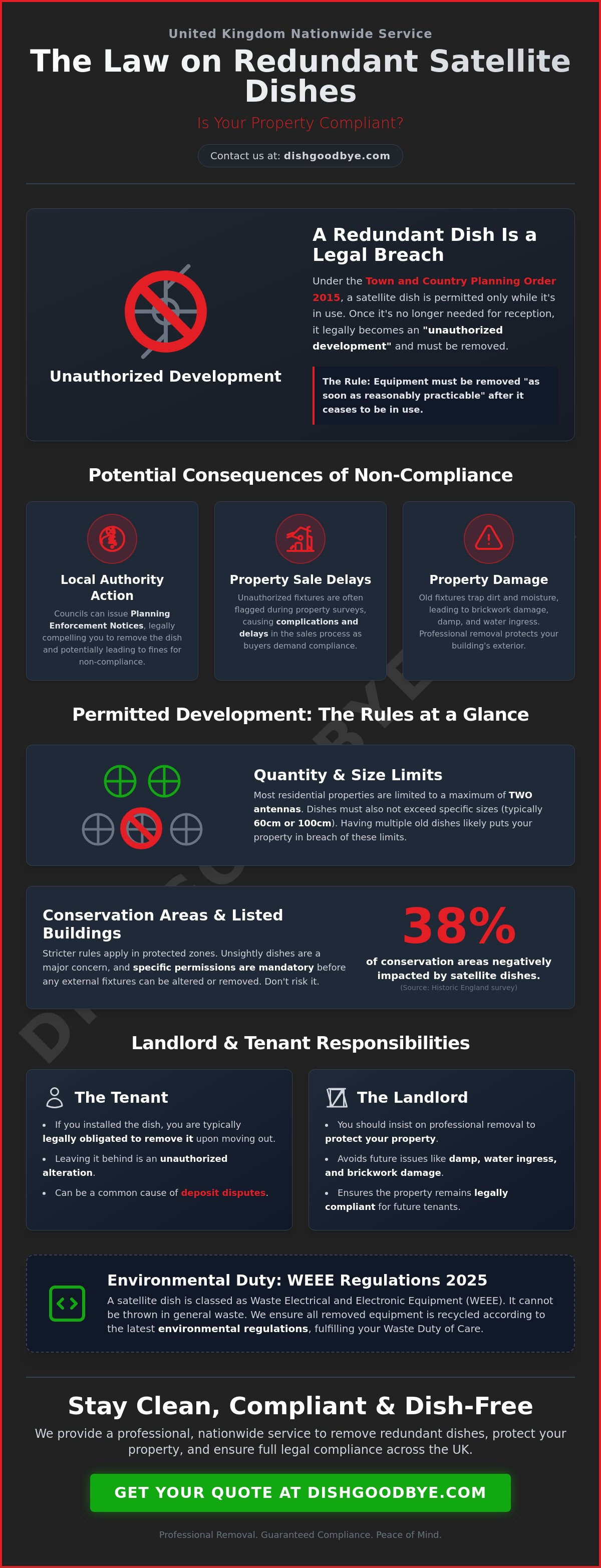
Most homeowners view an old satellite dish as a harmless relic of the past. However, the legal reality is quite different. Under the Town and Country Planning (General Permitted Development) (England) Order 2015, a satellite dish is only allowed on your property because of "Permitted Development" rights. These rights aren't permanent. They come with a strict condition: once the equipment is no longer required for reception, it must be removed as soon as reasonably practicable. We see many properties where these abandoned fixtures linger for years, but technically, they are unauthorized developments that lack valid planning status.
The foundation of UK planning law focuses on maintaining the visual integrity of our neighborhoods. When you stop using a service but leave the hardware behind, you're breaking the rules that allow the dish to be there in the first place. This isn't just a minor detail. Local authorities have the power to issue Planning Enforcement Notices to property owners who ignore these rules. These notices legally compel you to tidy up your facade. Failing to meet the legal requirements for dish removal uk can lead to fines or delays when you try to sell your home, as savvy buyers often flag unauthorized fixtures during surveys.
The "Necessary and In-Use" Rule
The law makes a clear distinction between a functional tool and abandoned clutter. A functional antenna is a modern necessity; an abandoned one is an eyesore. Planning officers expect equipment to disappear as soon as it's redundant. Facade clutter is a growing concern for local councils, especially since a 2009 survey by Historic England found that unsightly satellite dishes were a negative factor in 38% of conservation areas. If your wall is decorated with three different dishes from various past providers, you're likely in breach of the law. We help you clear that mess and restore your home's original clean lines. Removing these abandoned fixtures prevents long-term brickwork damage and ensures your property stays fully compliant.
Permitted Development vs. Full Planning Permission
Permitted Development isn't a free-for-all. For most residential homes, you are limited to two antennas. There are also strict size restrictions. Most dishes must not exceed 60cm or 100cm, depending on your specific location and building type. If your property has multiple old Sky dishes and a legacy satellite dish, you've likely exceeded these legal limits. Exceeding the size or quantity thresholds without full planning permission is a direct legal breach. We specialize in Sky dish removal and general satellite dish removal to ensure your home stays within these strict regulations. Clearing away old hardware is the fastest way to bring your property back into compliance and reclaim your home's curb appeal. Visit dishgoodbye.com to start your journey toward a cleaner, legal home exterior.
Contact: dishgoodbye.com
Contact: dishgoodbye.com
Tenancy Agreements and Landlord-Tenant Responsibilities
Tenants and landlords often clash over the metal leftovers of a television contract. Most Assured Shorthold Tenancy (AST) agreements include strict clauses regarding fixtures and alterations. If a tenant installs a dish, they're usually legally obligated to remove it when they move out. Leaving a rusted bracket behind isn't a gift to the next occupant; it's often viewed as an unauthorized alteration. We see many deposit disputes triggered by these "abandoned" fixtures. To stay compliant with the legal requirements for dish removal uk, both parties must understand where their liability starts and ends. Landlords should insist on professional extraction to protect the building's envelope from water ingress and damp.
Who Owns the Dish?
A common myth is that big providers like Sky or Virgin Media own the equipment forever. In reality, once the initial installation is complete, the hardware usually becomes the property of the person who paid for the subscription. Calling a provider to take it down is almost always a dead end. They've fulfilled their contract, and the dish is now your responsibility. This legal transfer of liability means the homeowner or tenant must manage the disposal. You can easily book a Sky dish removal to clear the way for your next tenant without the headache of chasing a provider that no longer cares about the hardware.
End of Tenancy: Avoiding Deposit Deductions
Returning a property to its original state is a core tenant duty. If you leave a dish behind, a landlord can claim the cost of removal from your deposit. This isn't "betterment," which is legally prohibited; it's a claim for the removal of an unauthorized fixture and the repair of the resulting holes. Check the official government guidance to see how these installations are viewed under planning law. It's vital to fill fixing holes properly to prevent long-term brickwork damage. We provide a clean, professional finish that ensures no trace of the old tech remains. This proactive approach keeps your deposit safe and leaves the property looking fresh and well-maintained for the next person.
Managing abandoned equipment from previous occupants is another hurdle. If you've inherited a "dish farm" on your roof, the legal requirements for dish removal uk suggest you're responsible for tidying it up to meet local planning standards. Don't let old tech clutter your life or your lease agreement. Clean walls lead to happy handovers and a stress-free moving day.
Contact: dishgoodbye.com
Contact: dishgoodbye.com
Strict Regulations for Listed Buildings and Conservation Areas
Living in a slice of history brings extra responsibility. If your home is Grade I or Grade II listed, the legal requirements for dish removal uk are significantly stricter. You aren't just dealing with general planning law; you're protecting national heritage. Unauthorised fixtures in Article 4 Direction areas carry heavy legal risks. In these zones, local councils have removed standard "Permitted Development" rights to preserve the area's character. Even removing a dish can sometimes require "Listed Building Consent" because the process might alter or damage the building's fabric. Damaging heritage masonry isn't just a repair issue. It can lead to criminal prosecution and heavy fines.
We understand the delicate balance between modern living and historic preservation. Our team specializes in sensitive extraction that respects the age and material of your property. We don't just rip hardware off the wall. We carefully remove every fixing to ensure the structural integrity of your home remains intact. This professional approach is the best way to satisfy local planning officers and protect your investment.
Conservation Area Restrictions
The "Visibility Rule" is the main priority in conservation zones. Dishes on chimneys or street-facing walls are often strictly regulated or banned entirely. Local authorities have the power to demand immediate removal if a dish spoils the historic street scene. A 2009 survey by Historic England found that unsightly satellite dishes were a negative factor in 38% of conservation areas. This statistic continues to drive local enforcement today. You can check if your property falls under these constraints by visiting your local council's planning portal. We help you clear these eyesores safely, ensuring your home contributes to the beauty of the neighborhood rather than detracting from it.
Listed Building Liability
Rusting brackets are a silent enemy for old buildings. As the metal corrodes, it expands and causes "brickwork erosion" or "spalling" in historic stone. DIY removal is a high-risk strategy in heritage settings. One wrong move can pull a chunk of centuries-old masonry away with the bolt. Professional removal requires hole-matching and specific mortar repairs to prevent water ingress. We use techniques that mirror the original materials, ensuring a seamless finish. Say goodbye to rusted metal and hello to preserved history. Visit dishgoodbye.com to book a specialist removal that protects your heritage home.
Contact: dishgoodbye.com
Contact: dishgoodbye.com
Environmental Law: WEEE Regulations and Waste Duty of Care
When you finally decide to clear that old dish, you can't just toss it in the wheelie bin. The Waste Electrical and Electronic Equipment (WEEE) Regulations 2013, recently updated by the 2025 amendments, create a strict framework for disposal. Satellite dishes, LNBs, and their associated cabling are officially classified as e-waste. This means they require specialized handling to prevent environmental damage. Following the legal requirements for dish removal uk involves more than just getting the hardware off the wall; it requires a safe journey to a licensed recycling center. We ensure every component is processed correctly, keeping your property and the planet clean.
Every householder in the UK has a legal "Duty of Care" regarding their waste. This isn't just a suggestion. It's a requirement to ensure that any waste leaving your property is handled by a licensed carrier. If you hire an unlicensed collector who fly-tips your old hardware in a country lane, you could be held legally responsible. The fines for improper disposal of telecommunications equipment are significant and entirely avoidable. We take that burden off your shoulders by providing a fully compliant extraction and disposal service across the country.
The Problem with General Waste
Councils are getting stricter about what goes into our bins. Most local authorities will flatly refuse to take satellite dishes in standard household waste collections. Older LNBs, the electronic "eye" of the dish, often contain lead and other heavy metals. If these end up in a landfill, they can leak into the soil and contaminate local water supplies. Professional recycling is the only way to ensure these materials are recovered and reused properly. Our process prevents landfill contamination and helps the UK meet its ambitious 2026 environmental targets. It's a simple way to upgrade your home's look while doing your bit for the environment.
Waste Transfer Notes and Compliance
Using a professional service provides a clear audit trail for your old equipment. While "man-with-a-van" services might seem convenient, they often lack the necessary permits to handle e-waste legally. This can lead to serious legal trouble for the homeowner if the waste isn't tracked. We provide peace of mind with a zero-landfill promise. We believe in a definitive break from old-fashioned, messy disposal methods. Say goodbye to the clutter and the compliance worries in one go. Ready for a cleaner roof and a clearer conscience? Book your satellite dish removal today and let us handle the legal heavy lifting.
Contact: dishgoodbye.com
Contact: dishgoodbye.com
Ensuring Compliance: The Professional Removal Process
Meeting the legal requirements for dish removal uk involves more than just a ladder and a spanner. It requires a commitment to the long-term health of your building. We've discussed the planning and environmental laws; now, we focus on the physical execution. Professional removal eliminates the structural risks that DIY attempts often ignore. Clean walls lead to a clear mind. We transform a messy exterior into a pristine facade with minimal effort from you. Our nationwide team handles the technical details so you can enjoy the relief of a well-maintained home.
The Duty to Maintain Property Integrity
Leaving open holes in your facade is a legal and structural liability. Rainwater finds these tiny gaps quickly. Over time, moisture seeps into the brickwork, leading to structural damp and internal mould. This damage can devalue your property and lead to expensive repair bills during a home survey. We don't just remove the hardware; we seal the scars it leaves behind. Our smoothing and filling process is a standard of care that protects your home's value. It's a simple step that prevents a mundane chore from turning into a major renovation project.
Health and Safety at Height
Safety isn't optional when working on your home's exterior. The Health and Safety at Work Act sets high standards for residential services across the UK. DIY removal from a standard ladder often breaches local safety bylaws and puts you at significant physical risk. We operate a safe, insured, and fully compliant nationwide service. We handle the heights while you stay safely on the ground. Our team uses professional-grade equipment to ensure every Sky dish removal is performed without risk to you or your property.
We take a comprehensive approach to every extraction to ensure a satisfying result. Our process includes:
- Safe removal of the satellite dish and LNB.
- Extraction of rusted brackets and stubborn fixings.
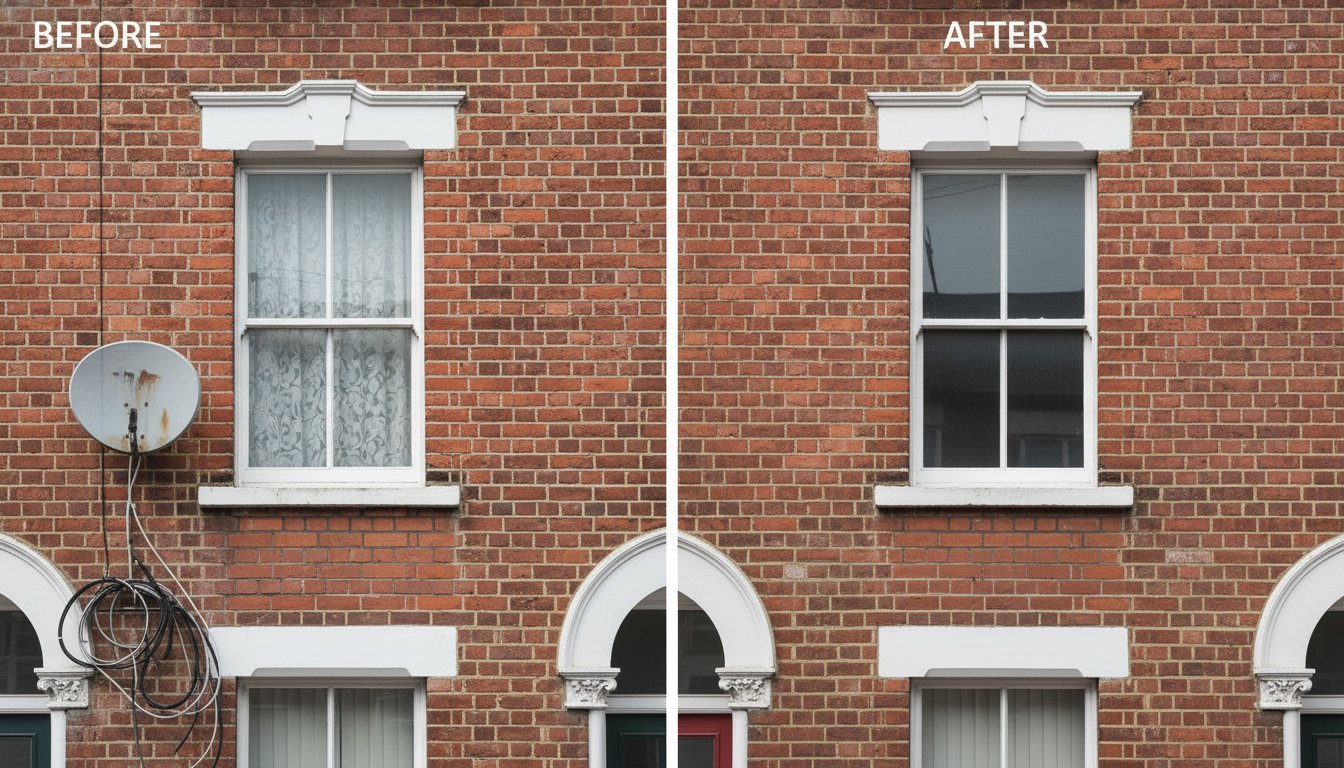
- Careful removal of trailing cables that trap dirt and debris.
- Professional filling of all mounting holes to prevent water ingress.
This thorough method ensures your home returns to its original, clean state. No more rust streaks. No more dangling wires. Just a pristine exterior that meets every legal expectation. Reclaim your home's beauty today. Our nationwide team is ready to help you say goodbye to old tech and hello to a cleaner property. Visit dishgoodbye.com to book your professional satellite dish removal and experience the satisfaction of a job done right.
Contact: dishgoodbye.com
Reclaim Your Home’s Curb Appeal Today
Contact: dishgoodbye.com
Leaving an old satellite dish on your wall is more than just a design flaw; it's a legal and structural risk. You now understand how the Town and Country Planning Order 2015 views abandoned hardware and why meeting the legal requirements for dish removal uk is essential for every property owner. Whether you are protecting a listed building or simply tidying up at the end of a tenancy, the path to a cleaner facade is clear. We take the stress out of the process with our fully insured nationwide service. We handle the heights and the heavy lifting so you don't have to.
Our team ensures a professional finish by filling fixing holes to prevent damp and providing WEEE-compliant recycling for all metal and e-waste. You get a pristine exterior without the mess or the compliance headache. It's time to upgrade your home's look and enjoy the relief of a clutter-free roof. Say goodbye to redundant tech and book your professional removal today. Your home deserves a fresh start, and we're here to make it happen. It's time to dismiss old-fashioned clutter and embrace a cleaner, more efficient home.
Contact: dishgoodbye.com
Contact: dishgoodbye.com
Frequently Asked Questions
Do I need planning permission to remove a satellite dish in the UK?
You do not need planning permission to remove a dish; in fact, the law encourages it. Under the 2015 Planning Order, you're legally expected to take down equipment as soon as it becomes redundant. Removing an old dish helps restore your home's original character and ensures you stay compliant with local standards. It's a satisfying way to tidy your facade without council paperwork.
Is it the landlord or tenant’s responsibility to remove a Sky dish?
The responsibility usually falls on the person who signed the installation agreement. If you installed a dish during your tenancy, you're typically required to remove it and repair any fixing holes before moving out. Landlords often use deposit deductions to cover the cost of clearing abandoned hardware. We help tenants avoid these disputes by providing a clean, professional extraction that leaves walls looking fresh.
Can I be fined for having an old satellite dish on my house?
You can be fined if you ignore a formal Planning Enforcement Notice from your local council. Authorities have the power to demand the removal of unauthorized or redundant fixtures that clutter the street scene. Meeting the legal requirements for dish removal uk is the best way to prevent these legal headaches. We provide a swift service that clears your liability and restores your property's curb appeal.
What are the rules for satellite dishes on listed buildings?
Removal on listed buildings often requires Listed Building Consent to protect the property's historic fabric. Standard "Permitted Development" rights are usually restricted in these cases. DIY removal is high-risk because any damage to heritage masonry can lead to criminal prosecution. We use specialist tools to ensure brackets are extracted safely without compromising the structural integrity or legal status of your historic home.
How do I legally dispose of an old satellite dish and cabling?
You must use a licensed waste carrier or take the equipment to a designated WEEE recycling center. Satellite dishes and LNBs contain metals and electronics that cannot go into your general household bin. We handle the entire disposal process for you, providing a clear audit trail for the waste. It's the simplest way to fulfill your environmental "Duty of Care" and keep the UK clean.
Does Sky remove old dishes for free?
Sky does not offer a free removal service because they don't own the dish after the initial installation. Once the hardware is on your wall, it becomes your personal property and your legal responsibility. Calling their support lines for removal usually results in a dead end. We step in to provide the professional extraction service that the big providers don't offer, clearing your roof quickly.
What is the WEEE regulation regarding satellite equipment?
WEEE regulations classify satellite hardware as electronic waste that must be recovered and recycled. These rules prevent heavy metals in LNBs from contaminating soil in landfills. Following the legal requirements for dish removal uk means ensuring your old tech is processed at a specialist facility. We follow the 2025 updated standards to ensure every component we remove is handled with total environmental compliance.
Is it illegal to leave a redundant satellite dish on a wall?
It is technically a breach of planning conditions to leave a dish on your wall once it's no longer in use. Your right to have the dish only exists while it's "necessary" for reception. Once the service ends, the dish becomes an unauthorized development. Our service clears these legal loose ends, giving you the relief of a compliant home and a much cleaner exterior.
Contact: dishgoodbye.com