That rusted satellite dish bolted to your rental property isn't just an eyesore. It's a slow-moving liability. Every Manchester landlord dealing with a redundant dish left behind by a previous tenant is sitting on a potential damp problem, a structural weak point, and a kerb appeal killer, all rolled into one piece of outdated hardware. Landlord satellite dish removal in Manchester is no longer a nice-to-have; it's a core part of protecting your investment.
You already know the frustration. Tenants move on, technology moves on, but that dish stays put, its fixings quietly corroding into your brickwork and its abandoned cables creating entry points for moisture. It's a problem that feels small until it isn't.
This guide is here to cut through the confusion. You'll learn exactly who's responsible for removal, what the real risks of leaving dishes in place are, and how a clean, professional extraction protects your walls, your rental value, and your peace of mind. From damp prevention to responsible e-waste disposal, here's everything Manchester landlords need to know about getting their properties dish-free for good.
Key Takeaways
- Redundant satellite dishes are a genuine structural risk — corroding brackets and abandoned coaxial cables can cause serious damp problems inside your property walls long before any visible damage appears.
- Landlord satellite dish removal in Manchester follows the same legal and safety standards as the rest of the UK, meaning responsibility almost always falls on the landlord once a tenancy ends.
- DIY removal carries real risks — from height safety hazards to accidental masonry damage — making professional extraction the smarter, lower-liability choice for rental properties.
- A complete professional removal goes beyond lifting the dish: brackets, fixings, and holes are fully addressed, leaving walls clean, sealed, and ready for new tenants.
- Landlords managing multiple properties across the UK can simplify the entire process through a single nationwide service provider, removing the hassle of coordinating separate contractors property by property.
The Importance of Landlord Satellite Dish Removal in Manchester and the UK
Redundant satellite equipment has quietly shifted from a minor cosmetic issue into a genuine maintenance priority. As streaming services have replaced traditional satellite subscriptions across millions of UK households, the hardware left behind has become a defining marker of how well a landlord manages their portfolio. A dish that served a purpose five years ago now serves only as evidence of neglect.
Landlords searching for landlord satellite dish removal in Manchester are often responding to the same pressures: tenant turnover, pre-let preparation, or a letting agent flagging the exterior before a photoshoot. But the underlying need isn't just local. It reflects a nationwide shift in how rental properties are expected to look and perform.
Tech clutter costs more than landlords realise. Prospective tenants browsing listings on Rightmove or Zoopla make snap judgments based on exterior photographs. A rusted dish bolted to the front elevation signals something specific: this property hasn't been properly looked after. That perception affects enquiry rates, the calibre of applicants you attract, and ultimately the rent you can command.
Why Manchester Landlords are Clearing the Skyline
The shift from satellite to streaming has been decisive. Platforms like Sky Glass and Netflix have untethered viewing from physical hardware entirely, leaving dishes obsolete almost overnight for a large portion of the rental market. Manchester's competitive rental sector means landlords can't afford to let exterior details slide. A clean, uncluttered facade communicates a well-run property before a tenant has even stepped through the door. That's the kind of first impression that fills vacancies faster.
Nationwide Standards for Satellite Dish Removal
There's a meaningful difference between taking a dish down and removing it properly. Lifting the dish off its bracket and leaving the fixings in place, or pulling cables free without sealing the entry points, creates new problems while solving the visible one. Professional dish removal means complete extraction: brackets, fixings, cables, and all. Holes are filled and smoothed. The wall is left clean, sealed, and structurally sound.
That standard doesn't change depending on postcode. Whether you're managing a terrace in Salford or a flat in Bristol, the same best-practice approach applies. Dish Goodbye operates across the whole of the UK, giving landlords with dispersed portfolios a single, consistent solution rather than a patchwork of local contractors.
Ready to clear your properties properly? Reach our nationwide team at 0333 220 2436 or drop us a line at [email protected].
The Structural Risks of Redundant Satellite Equipment
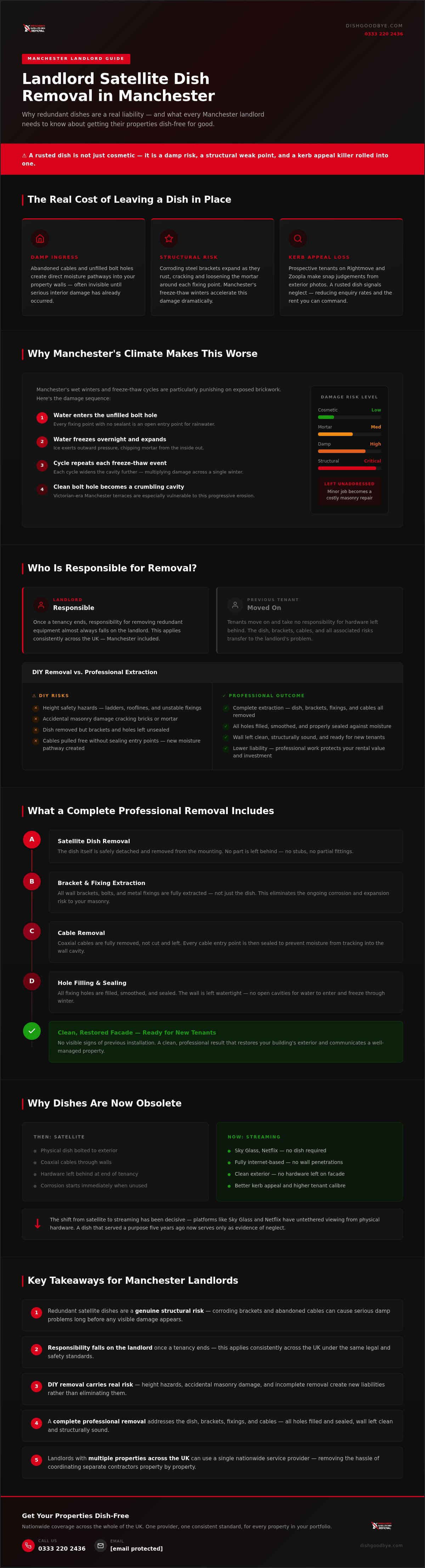
A satellite dish sitting idle on your property isn't just doing nothing. It's actively working against you. The hardware corrodes, the fixings weaken, and the cables left threading through your walls create pathways for moisture that no amount of interior redecorating will fix. For landlords managing rental stock in Manchester, understanding these risks isn't optional; it's the difference between a minor removal job and a costly repair bill.
Brickwork Erosion and Mortar Damage
Heavy steel brackets were designed to hold a dish in place through wind, rain, and temperature extremes. The problem is that the same forces acting on the dish are also acting on the fixings themselves. As steel corrodes, it expands. That expansion puts outward pressure on the surrounding masonry, gradually cracking and loosening the mortar around each fixing point.
Manchester's climate makes this worse. The city's wet winters and freeze-thaw cycles are particularly punishing on exposed brickwork. Water gets into an unfilled fixture hole, freezes overnight, expands, and chips the mortar from the inside out. Repeat that process across a single winter and what started as a clean bolt hole becomes a crumbling cavity. Unfilled holes are a direct route to damp ingress, and older Manchester terraces with their Victorian-era brickwork are especially vulnerable to this kind of progressive erosion.
The weight of the bracket assembly also matters. A standard dish mount applies sustained load stress to a relatively small section of wall. Over years, this can cause hairline fractures in the surrounding mortar that aren't visible from ground level but provide exactly the kind of entry point moisture needs.
Cable Ingress and Internal Damp Issues
Old coaxial cables present a different but equally serious problem. When a dish is abandoned, its cable often remains threaded through the wall into the property interior. Rainwater doesn't need much encouragement. It follows the path of least resistance, and a cable running through an unsealed wall cavity is a direct conduit from the outside in.
This is sometimes called "wicking": moisture travels along the cable's outer sheath and into the wall, where it saturates insulation and plasterwork long before any visible staining appears on the interior surface. By the time a tenant reports a damp patch, the damage behind the wall is already significant.
Cutting the cable flush with the wall doesn't solve this. The entry point remains open, the cable sheath is still present, and moisture still has a route in. Proper removal means extracting the cable fully and sealing the penetration point so it's watertight.
The cost comparison is stark. Proactive landlord satellite dish removal in Manchester is a straightforward, one-visit job. Repairing water-damaged plasterwork, treating mould, and addressing the underlying masonry issues it causes can run to several times that cost, with the added complication of tenant disruption and potential disputes over habitability.
Then there's the liability question. A dish that's corroded free from its bracket in high winds becomes a falling object. At height, even a lightweight dish assembly can cause serious injury or property damage. That's not a theoretical risk; it's a foreseeable one, and foreseeability matters in landlord liability cases.
If your properties still have redundant dishes attached, the smartest move is a clean, complete removal before the next tenancy begins. Find out how Dish Goodbye handles the full extraction, from brackets to sealed walls, across the whole of the UK.
Landlord Responsibility: DIY vs. Professional Removal
Ownership of a satellite dish isn't always obvious. When a tenant installs one during a tenancy, the dish itself may technically belong to them. But the bracket, the fixings drilled into your wall, and the cable threaded through your brickwork? Those become your problem the moment the tenancy ends. Most standard tenancy agreements include a clause requiring tenants to restore the property to its original condition on departure, which means removal is either their job before they leave or yours once they've gone. In practice, most landlords end up dealing with it themselves.
That's where the responsibility question gets practical. You're not just deciding who pays for removal. You're deciding how it gets done and who carries the liability if something goes wrong.
Who is Responsible for the Removal?
Tenancy agreements vary, but the general principle is consistent: alterations made to a property during a tenancy should be reversed before the keys are handed back. If a tenant installed a satellite dish without written permission, you have a strong basis for deducting removal costs from their deposit. If they had permission but left the dish behind, the same principle applies. Once the tenancy has ended and the dish remains, landlord satellite dish removal becomes the landlord's responsibility to organise. The Landlord Property Maintenance Guide covers this in broader detail, but the short version is this: waiting for a former tenant to return and sort it out is rarely a viable strategy.
Safety Standards and Height Liability
DIY removal sounds straightforward until you're standing at the top of a ladder trying to loosen a corroded bracket bolted to a chimney stack or high gable. The risks are real and specific.
- Falls from height are among the most common causes of serious DIY injury. A standard household ladder isn't designed for the kind of sustained, two-handed work that bracket removal requires.
- Insurance complications arise quickly. If a landlord injures themselves performing high-altitude maintenance work without appropriate equipment or training, standard home or landlord insurance policies may not cover the incident.
- Accidental masonry damage is a genuine risk when corroded fixings are forced rather than extracted correctly. A bracket that's been in place for years doesn't come out cleanly without the right tools.
Dish Goodbye uses specialist equipment for safe extraction at height, ensuring brackets and fixings are removed cleanly without collateral damage to your brickwork. Every job includes full hole-filling and smoothing, so the wall is left clean and sealed. No raw cavities, no half-finished edges.
There's also a financial case for going professional. Satellite dish removal carried out as part of a property maintenance programme is a legitimate, tax-deductible expense for landlords. It's routine upkeep, not a capital improvement, which means it can typically be offset against rental income. For landlords managing landlord satellite dish removal in Manchester across multiple properties, consolidating that work through a single professional provider keeps both the costs and the paperwork straightforward.
Ready to hand this one off? Call us on 0333 220 2436 or email [email protected] to arrange removal across any of your properties.
The Professional Removal and Restoration Process
Knowing a dish needs to come down is one thing. Understanding what a proper removal actually involves is another. Most landlords are surprised by how many steps sit between "dish on wall" and "wall restored." Here's exactly what a complete professional job looks like, from first fixing to final finish.
The process breaks down into five clear stages:
- Step 1: Safe dismantling of the dish, LNB, and arm. The dish itself comes down first, including the Low Noise Block converter and the mounting arm. Working at height with the right equipment means no improvised ladder balancing acts and no risk of the assembly dropping onto the property below.
- Step 2: Full extraction of brackets, bolts, and fixings. This is where most DIY jobs fall short. Corroded brackets don't pull free cleanly without the correct tools. Forcing them risks cracking the surrounding masonry. Professional extraction removes every fixing completely, leaving no buried metalwork to continue corroding inside your wall.
- Step 3: Stripping redundant cabling back to the source. Coaxial cables are traced and removed rather than simply cut flush. Every cable penetration point is cleared so there's no residual sheath left inside the wall cavity to wick moisture inward.
- Step 4: Filling, smoothing, and sealing all penetration points. Every hole gets filled and finished. No raw cavities, no half-measures.
- Step 5: Responsible recycling through approved UK centres. All removed hardware leaves the site properly. Nothing ends up in a skip or a landfill.
Wall Restoration and Hole Filling
The finish matters as much as the extraction. High-quality fillers matched to the existing mortar or render are used to bring each hole back to flush. The goal is a smooth, sealed surface that sheds rainwater cleanly rather than collecting it. When the job's done, there's no trace of the hardware that was there. Just a clean, uncluttered exterior wall, ready for photographs, viewings, and new tenants. That's the standard every landlord satellite dish removal in Manchester job should meet.
Zero-Landfill Recycling Commitment
Satellite dishes are a mix of steel, aluminium, and electronic components. Those materials need to be separated and processed correctly. Metal goes to metal recyclers; electronic components, including the LNB, are handled as e-waste through approved UK facilities. Dish Goodbye's commitment is straightforward: nothing removed from your property ends up in landfill. For more detail on how this works, the Satellite Dish Recycling Guide covers the full process.
For landlords managing multiple properties, this matters practically as well as ethically. Responsible disposal is documented, traceable, and handled entirely by the team, with no additional effort required on your part.
Ready for a clean finish across your portfolio? Book your removal with Dish Goodbye or call us on 0333 220 2436 to get started.
Partnering with Dish Goodbye for Nationwide Portfolio Care
Managing a rental portfolio across multiple locations means juggling a lot of moving parts. Maintenance contractors vary by area, quality is inconsistent, and coordinating separate tradespeople for the same job across different postcodes wastes time you don't have. That's exactly the problem Dish Goodbye solves. One point of contact. Consistent standards. Clean results wherever your properties are.
For landlords handling landlord satellite dish removal in Manchester and beyond, the ability to book multiple removals through a single provider isn't a luxury. It's a genuine operational advantage. No chasing local traders, no inconsistent finishes, no paperwork scattered across a dozen different invoices.
Improving Curb Appeal for Modern Renters
Today's renters make decisions fast. A listing photograph showing a cluttered, dish-covered facade sends a clear signal: this property hasn't been properly maintained. That perception affects how quickly your vacancy fills and the quality of applicants it attracts. A clean exterior, free of redundant hardware, communicates something different entirely. It says the landlord is on top of things. That's the kind of first impression that converts a browsing tenant into a signed lease.
Professional removal doesn't just strip hardware. It restores the wall to a clean, uncluttered finish that photographs well and presents well in person. Viewings go smoother. Enquiries come from better-qualified tenants. The property looks cared for because it is. See what a complete Dish Goodbye removal looks like and what that clean finish means for your next let.
Scalable Solutions for Property Managers
Local "man with a van" operators can handle a single removal. They can't handle a portfolio. When you're managing properties across Manchester, Leeds, Birmingham, and Bristol simultaneously, you need a provider who can coordinate removals at scale without the quality dropping off between jobs.
Dish Goodbye's nationwide coverage means multiple properties can be scheduled efficiently, with the same extraction standard applied at every site:
- Complete bracket and fixing removal at every property, no exceptions
- Holes filled, smoothed, and sealed to a consistent finish across your entire portfolio
- All hardware responsibly recycled through approved UK centres, with nothing sent to landfill
- Single point of contact for booking, scheduling, and follow-up
That consistency matters. The "clean aesthetic" that defines well-managed modern property isn't something you can achieve piecemeal. It requires the same standard applied everywhere, every time. Dish Goodbye delivers exactly that, whether you're clearing one terrace in Salford or a dozen properties spread across the UK.
Don't let redundant dishes drag down your portfolio's performance. Call us on 0333 220 2436 or email [email protected] to arrange removal across your properties and get every exterior looking exactly as it should.
Your Properties Deserve a Clean Start
Redundant satellite dishes aren't a minor cosmetic issue. They're a structural risk, a damp hazard, and a kerb appeal problem sitting on your wall right now. Landlord satellite dish removal in Manchester, and across every postcode in your portfolio, is one of the simplest ways to protect your investment and present your properties at their best.
The case is straightforward. Professional removal means complete extraction, brackets, fixings, and cables included. Holes are filled and sealed properly. All hardware is recycled responsibly through approved UK centres, with nothing sent to landfill. And with nationwide coverage, you don't need a different contractor for every property.
One call sorts the lot. Say goodbye to your old dish and request a professional removal quote today, or reach the team directly on 0333 220 2436 or at [email protected].
Clean walls, sealed brickwork, and a clutter-free exterior are closer than you think. Let's get your properties looking exactly as they should.
Frequently Asked Questions About Landlord Satellite Dish Removal
Is the landlord or tenant responsible for removing a satellite dish?
Responsibility depends on who installed the dish and what your tenancy agreement says. If a tenant installed it, they're typically required to remove it and restore the wall before leaving. In practice, most tenants don't, which means the landlord ends up organising removal once the tenancy ends. If the dish was already on the property when the tenant moved in, removal has always been the landlord's responsibility.
Where a tenant installed the dish without written permission, you generally have grounds to deduct professional removal costs from their deposit. Document the condition carefully at checkout to support any such claim.
How much does it cost to remove a satellite dish in the UK?
We don't publish fixed prices here because costs vary depending on the dish location, height, number of fixings, and how much cabling needs to be traced and removed. The best approach is to contact Dish Goodbye directly for an accurate quote specific to your property. Call 0333 220 2436 or email [email protected] to get started.
What's worth factoring in is the cost comparison. A professional removal is a straightforward, one-visit job. Leaving a dish in place and dealing with the resulting damp, masonry damage, or structural repairs later will almost always cost significantly more.
Will removing a satellite dish leave visible holes in my wall?
Not after a proper professional job. Every fixing point is filled, smoothed, and sealed as part of a complete removal. The goal is a clean, flush surface that sheds water properly and leaves no trace of the hardware that was there. That's the standard every landlord satellite dish removal in Manchester and across the UK should meet.
DIY removal often leaves raw cavities or half-finished edges because the focus is on getting the dish down rather than restoring the wall. A professional finish means your wall is ready for photographs, viewings, and new tenants without any patching up required afterwards.
Can an old satellite dish cause damp in my rental property?
Yes, and it's one of the most overlooked risks of leaving redundant equipment in place. Coaxial cables threaded through walls act as a moisture conduit, drawing rainwater inward along the cable sheath in a process sometimes called wicking. By the time a damp patch appears on an interior wall, the damage behind the plasterwork is often already significant.
Unfilled bracket holes compound the problem. Water enters, freezes in colder months, expands, and gradually breaks down the surrounding mortar from the inside. Simply cutting the cable flush with the wall doesn't close this route. Full extraction and proper sealing of every penetration point is the only reliable fix.
What happens to the old satellite dish after it's removed?
All removed hardware is taken away and processed responsibly through approved UK recycling centres. Satellite dishes are a mix of steel, aluminium, and electronic components, including the LNB, which qualifies as e-waste and requires specialist handling. None of it goes to landfill. Dish Goodbye's zero-landfill commitment means every removal is documented and traceable.
For landlords managing multiple properties, this matters practically as well as ethically. Responsible disposal is handled entirely by the team, with no additional effort or paperwork required on your part.
How long does the professional dish removal process take?
Most single-dish removals are completed in under two hours. The exact time depends on factors like access to the dish, how corroded the fixings are, and how much cabling needs to be traced and extracted. Properties with dishes mounted at significant height or with complex cable runs through multiple rooms may take a little longer.
The key point is that a complete job, dish, brackets, fixings, cables, hole-filling, and all, is done in a single visit. There's no need for follow-up appointments or separate trades to finish the wall restoration.
Do I need to be present at the property during the removal?
Not necessarily. Many landlords arrange access through a letting agent or leave a key with a neighbour. As long as safe access to the dish location is available and any relevant permissions are in place, the job can be completed without you being on site. It's worth confirming the specific access arrangements when you book.
For landlords managing properties remotely across the UK, this flexibility is particularly useful. Dish Goodbye operates nationwide, so you can coordinate removals across multiple locations without needing to travel to each property yourself.
Can you remove old TV aerials at the same time as the dish?
Yes. Dish Goodbye removes both satellite dishes and TV aerials, so if your property has redundant aerial equipment alongside a dish, both can be cleared in a single visit. Combining the work is more efficient than booking separate jobs and means the wall restoration is handled comprehensively in one go.
If you're preparing a property between tenancies and want a fully clutter-free exterior, clearing all redundant hardware at once is the cleanest solution. Contact the team on 0333 220 2436 or at [email protected] to discuss what needs to come down.