
Contact Dish Goodbye: Phone 0333 220 2436 | Email [email protected]
That rusty, redundant satellite dish on your wall isn't just an eyesore; it's a technical breach of UK planning law. You might wonder, is it illegal to leave a satellite dish once you've switched to streaming? While it's rarely a criminal offense, the Town and Country Planning Order requires dishes to be removed as soon as they're no longer in use. Most homeowners ignore these old fixtures, but leaving them to rot can lead to council enforcement or even liability if the bracket fails during a storm.
We understand the frustration of staring at outdated tech that clutters your property's exterior. You want a home that looks modern and feels safe, without worrying about landlord disputes or falling debris. This guide explains the latest 2026 planning regulations, WEEE disposal requirements, and how to protect yourself from property liability. Discover how to clear the clutter and enjoy a sleek, dish-free home with our professional removal services available across the entire UK. It's time to say goodbye to that clunky metal and enjoy a fresh, clean finish.
Contact Dish Goodbye: Phone 0333 220 2436 | Email [email protected]
Key Takeaways
- Understand why redundant tech breaches UK planning conditions and how it impacts your property's legal status.
- Get clear answers to the common question: is it illegal to leave a satellite dish on your UK property after it becomes redundant?
- Protect yourself from public liability risks by removing hazardous, rusty brackets before they cause injury or property damage.
- Clarify the legal responsibilities between landlords and tenants to avoid council enforcement or security deposit disputes.
- Learn how to comply with 2026 WEEE recycling regulations while restoring your home's clean and modern appearance.
Contact Dish Goodbye: Phone 0333 220 2436 | Email [email protected]
UK Planning Laws: Is It Illegal to Have Multiple Satellite Dishes?
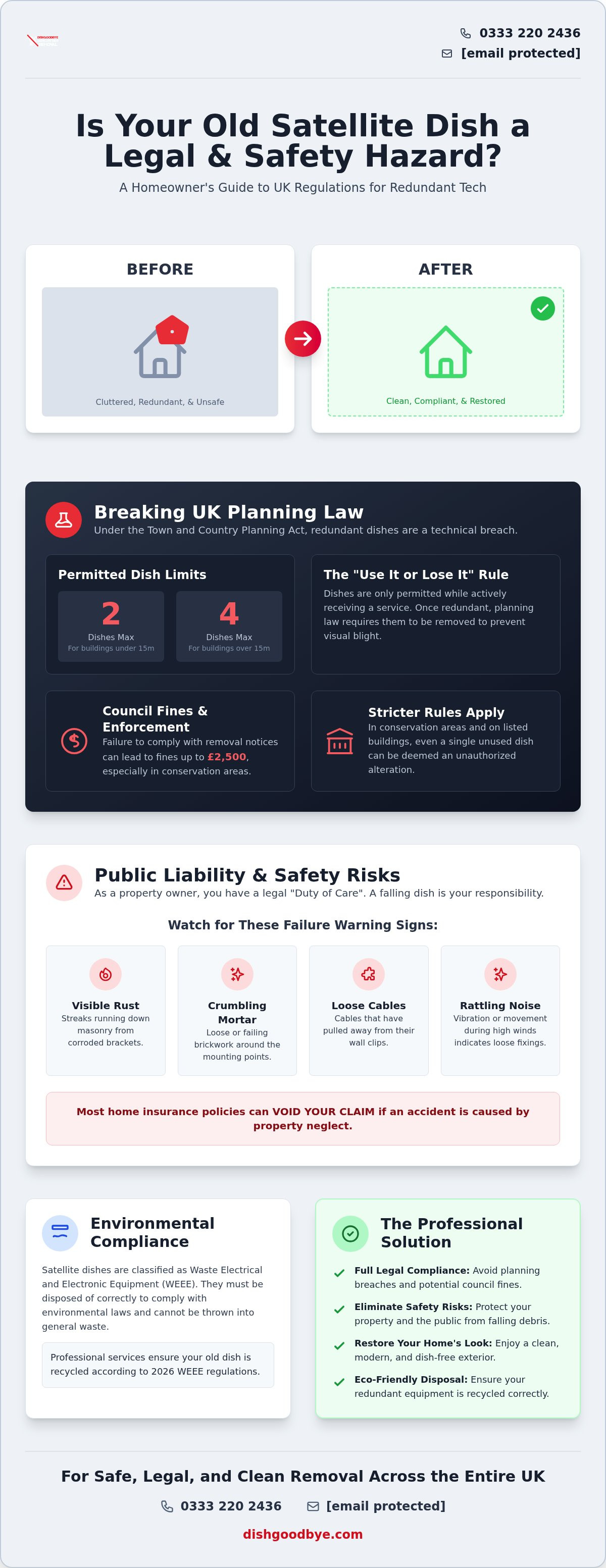
Most homeowners don't realize that their property's exterior is governed by strict aesthetic and safety standards. While you might think your old Sky dish is harmless, its legal status changes the moment you stop using it. Under the Town and Country Planning Act 1990, specific rules dictate what can and cannot be attached to your home. For residential buildings under 15 meters in height, the standard limit is two satellite dishes. If your building exceeds 15 meters, you're allowed up to four. Anything beyond this requires explicit planning permission, and having three or more on a standard semi-detached house is a clear violation.
The real issue arises when equipment becomes "redundant." In the eyes of the law, a dish is only permitted while it's actively receiving a service. Once you switch to streaming or fiber broadband, that metal plate loses its protected status. So, is it illegal to leave a satellite dish on your wall indefinitely? It's a technical breach of planning conditions. Councils view these unused items as unnecessary clutter that detracts from the local environment and curb appeal. They expect you to maintain a clean property profile, which means removing hardware that no longer serves a purpose.
Permitted Development Rights and Redundant Tech
Permitted Development (PD) rights in 2026 are defined as a national grant of planning permission that allows certain building works and changes of use to be carried out without having to make a planning application. However, these rights come with a "use it or lose it" clause. If a dish isn't needed for telecommunications, the law mandates its removal to prevent visual blight. This becomes even more critical in conservation areas or for listed buildings. In these protected zones, the threshold for what is considered "illegal" or unauthorized is much lower. Even a single unused dish can lead to a formal notice if it's deemed to spoil the character of a historic neighborhood.
Council Enforcement and Fines
If a neighbor complains or a planning officer spots excessive, rusty equipment, you may receive a formal enforcement notice. This isn't just a polite request; it's a legal order to rectify the breach within a specific timeframe. While you won't face jail time, ignoring these notices leads to significant civil penalties and costly legal battles. In conservation areas, local authorities can issue fines of up to £2,500 for failing to comply with planning rules. Don't wait for a letter to arrive. Choosing a Professional Dish Removal Service ensures your property remains fully compliant and visually appealing. We help you clear the clutter across the UK, leaving you with a smooth, clean exterior and total peace of mind. It's the simplest way to upgrade your home's look while staying on the right side of the law.
Liability and Safety: The Legal Risks of Falling Satellite Dishes
Owning a property comes with a legal "Duty of Care." This means you're responsible for the safety of everything attached to your walls. While you might wonder is it illegal to leave a satellite dish, the bigger worry is often civil liability. If a bracket fails and the dish strikes a pedestrian or a parked car, the financial consequences are your burden. In 2026, UK weather patterns have become more volatile, with high winds putting extreme stress on old, corroded fixings. Technically, while people ask is it illegal to leave a satellite dish due to planning rules, the safety risk is what keeps property owners awake at night.
Public liability claims depend on negligence. If a claimant can prove you knew a fixture was redundant and failing, you're in a difficult position. Lawyers often look for specific warning signs to build their case, including:
- Visible rust streaks running down the masonry.
- Loose or crumbling mortar around the mounting bracket.
- Cables that have pulled away from their wall clips.
- Vibration or rattling noises during high winds.
Your home insurance might not save you, either. Most policies have clauses requiring you to keep your property in a good state of repair. If an insurer determines that neglect caused the accident, they can void your claim, leaving you to pay damages out of pocket. It's a heavy price to pay for a piece of equipment you don't even use anymore.
The Danger of Corroded Brackets and Fixings
Standard Sky dish mounts aren't built to last forever. After 10 years of exposure to the British elements, the zinc coating usually fails. This leads to heavy corrosion that expands the metal, causing "spalling" in your brickwork. This is where the face of the brick pops off, weakening the anchor points. When a storm hits, these compromised fixings can't handle the vibration. The dish becomes a sail, pulling the bracket right out of the wall. It's a known risk that is entirely preventable with a quick satellite dish removal across the UK.
Property Damage and Damp Liability
The risks aren't always external. Old cabling is a common cause of "ingress" damage. Over time, the sealant around cable entry points cracks, allowing rainwater to travel down the wire and straight into your cavity wall. This often leads to internal damp and mold growth. For landlords, this is a major legal risk under the Homes (Fitness for Human Habitation) Act. You could be held liable for a tenant's health issues caused by damp from a redundant dish. Learning how unfilled holes from fixtures can cause damp is essential for any property owner. Removing the tech and sealing the holes is the only way to ensure a dry, safe home. It's a simple fix that protects your investment and your peace of mind.
Landlord vs. Tenant: Who is Legally Responsible for Removal?
When a tenancy ends, the question of is it illegal to leave a satellite dish often shifts from planning law to contract law. Most standard UK tenancy agreements include a "reinstatement" clause. This requires tenants to return the property in the exact condition they found it. If a tenant bolts a dish to the wall, they're legally responsible for taking it down and repairing the masonry. Leaving it behind isn't just a nuisance; it's a breach of contract that can lead to a deduction from the security deposit. Landlords have a right to claim the cost of professional removal to ensure their building remains in top shape for the next occupant.
While the tenant might have installed the equipment, the property owner holds the ultimate "Duty of Care" for the building's exterior. If a local council issues an enforcement notice because of a redundant dish, they'll send it to the landlord, not the former tenant. This makes proactive management essential. For property owners, following a Landlord Property Maintenance Guide helps clarify these boundaries before they become expensive legal headaches. It's always better to handle a removal during the "void" period than to wait for a planning dispute to arise.
When the Tenant Installs the Dish
If you're a landlord, don't assume the tenant will naturally take the dish with them. Modern 2026 agreements should include a specific "Sky dish removal" clause that mandates professional removal. This prevents amateur DIY jobs that leave crumbling bricks or messy, dangling cables. If you manage multiple properties across the UK, you can call 0333 220 2436 to arrange a swift, professional cleanup. We ensure the exterior looks flawless and the holes are filled, protecting your investment from damp and keeping your property's curb appeal high.
The "Abandoned Property" Legal Framework
A common myth is that the service provider owns the hardware. In reality, once a satellite dish is installed on a UK home, it belongs to the property owner. Sky or Freesat won't come back to collect old dishes because they aren't their property. You cannot legally force them to remove it. To avoid disputes, use this end-of-tenancy checklist:
- Check the check-in inventory for existing dishes or aerials.
- Inspect the bracket for new rust or loose fixings.
- Verify that all cabling is clipped securely or removed entirely.
- Ensure any holes in the brickwork are professionally filled and smoothed.
By staying organized, you transform a potential legal battle into a simple maintenance task. Clear communication and professional removal ensure your property stays compliant and ready for new tenants without any lingering tech clutter.
Environmental Law: WEEE Regulations and Disposal Compliance
Compliance doesn't end when the dish comes off the wall. Many people ask is it illegal to leave a satellite dish, but the real legal trap is how you throw it away. Satellite dishes and their Low Noise Blockers (LNBs) are strictly classified as Waste Electrical and Electronic Equipment (WEEE). This means they fall under the WEEE Regulations 2013, which require specific handling and reporting. By October 2026, the UK is implementing a mandatory DEFRA digital waste tracking system to monitor every piece of e-waste. You can't just toss these components into your black wheelie bin. Doing so is an illegal disposal method that can lead to heavy council fines and environmental damage.
You have a legal "Duty of Care" for your waste that lasts until it's properly recycled. This responsibility doesn't vanish if you hire a "man with a van" who lacks the right permits. If your old tech ends up fly-tipped in a UK alleyway, the trail of evidence often leads back to the property owner. Always verify that your contractor is a licensed waste carrier. For a deeper dive into responsible methods, read our Satellite Dish Recycling Guide. It's the best way to ensure you're contributing to the 2026 household WEEE collection target of 532,882 tonnes.
Professional Waste Transfer Notes
When we remove your equipment, we provide a formal waste transfer note. This document is your legal shield against future disputes. It proves you've handed your e-waste to a professional who follows every UK regulation. Dish Goodbye processes 100% of e-waste through approved UK recycling centres to meet the 24,387-tonne target for consumer equipment in 2026. Our "Zero Landfill" promise isn't just a slogan; it's a commitment to environmental compliance. We help you stay organized and eco-friendly across the entire country with zero stress.
The Problem with General Bin Disposal
LNBs contain heavy metals and complex circuitry that should never touch the soil. When these items sit in a landfill, they leak toxins into the environment over decades. UK councils are increasingly vigilant about spotting metal fixtures in general waste streams. If they find a dish in your household bin, you could face fixed penalty notices for improper disposal. Remember, while you might wonder is it illegal to leave a satellite dish on your wall, binning it incorrectly is a much more direct violation of environmental law. Don't delay the inevitable legal disposal requirement. Get it done right the first time.
Ready for a cleaner, greener home? Book your professional satellite dish removal today and let us handle the legal paperwork for you.
Professional Resolution: Safe, Legal, and Clean Removal
Resolving the clutter on your exterior is about more than just aesthetics. When you ask is it illegal to leave a satellite dish, you're really looking for a way to clear your property's legal and physical hurdles. Professional removal provides a definitive answer to planning breaches while protecting your home from the elements. It's the most efficient path to a clean, modern look that honors your property's structural integrity. By choosing a specialist service, you ensure that your home remains a safe, well-managed space without the lingering eyesore of redundant technology.
Why DIY Removal is a Legal and Physical Risk
Tackling a removal yourself might seem like a quick win, but it often creates more problems than it solves. The Work at Height Regulations 2005 exist for a reason; working on ladders without professional training is a significant liability. A fall can lead to life-altering injuries or expensive legal claims if you're working on a rental property. Beyond the physical danger, DIY attempts usually ignore the crucial "make good" phase. Simply yanking a bracket off the wall leaves open holes that invite moisture into your cavity walls. These gaps are a direct cause of internal damp, turning a small chore into a major repair bill. It's time to say goodbye to the hassle and the risk of amateur mistakes. Let the experts handle the height and the hardware so you can stay safe on the ground.
The Dish Goodbye Process
We've refined our removal method to be as seamless and satisfying as possible. Our team arrives across the UK to perform a complete extraction of redundant tech. We don't just take the dish; we remove the corroded brackets and every inch of trailing cable. Once the hardware is gone, we focus on restoration. We fill every fixing hole with high-quality weatherproofing material and smooth the surface to match your existing masonry. The result is a completely clear wall with a fresh, uniform finish. You won't see any trace of the old installation, just a clean exterior that boosts your home's curb appeal instantly. Our process ensures that your redundant equipment is 100% recycled, keeping you fully compliant with environmental laws. Contact Dish Goodbye for UK-wide removal today and reclaim your home's aesthetic harmony. For any questions, reach us at 0333 220 2436 or [email protected].
Contact Dish Goodbye: Phone 0333 220 2436 | Email [email protected]
Reclaim Your Home’s Curb Appeal Today
Leaving outdated tech on your walls is more than a style choice; it's a matter of legal and safety compliance. We've explored how redundant equipment breaches planning permissions and creates significant liability risks during high winds. You now know that while asking is it illegal to leave a satellite dish leads to complex planning answers, the solution is refreshingly simple. Professional removal protects your building from damp, ensures 100% e-waste recycling, and restores that sleek, modern aesthetic you deserve.
Book your professional UK-wide dish removal today. Our expert team provides complete bracket and cable extraction, professional hole-filling to prevent damp, and licensed UK e-waste recycling as standard. It's time to stop worrying about council notices or rusty fixings. Transform your home's exterior into a clean, clutter-free space that reflects your pride in ownership. We're ready to help you clear the way for a brighter, safer property profile across the entire UK.
Contact Dish Goodbye: Phone 0333 220 2436 | Email [email protected]
Contact Dish Goodbye: Phone 0333 220 2436 | Email [email protected]
Frequently Asked Questions
Is it illegal to have a satellite dish on a listed building?
Yes, it's often illegal to have any dish on a listed building without specific Listed Building Consent. These properties are protected to preserve their historical character. Installing or leaving a redundant dish without permission is a criminal offense, not just a planning breach. Always check with your local planning authority first. If you've inherited a property with old tech, professional removal is the safest way to ensure you remain compliant with heritage laws.
Can my neighbour legally complain about my old satellite dish?
Your neighbor can absolutely report an old dish to the local council if it's unsightly or appears dangerous. Councils have the power to issue enforcement notices for "visual blight" or breaches of permitted development. If the dish is redundant, the law is on their side. Addressing the issue early prevents neighborhood disputes and potential fines. A clean exterior keeps the peace and maintains the value of everyone's property in the area.
Does Sky have a legal obligation to remove my old dish?
No, Sky has no legal obligation to remove your old equipment. Once a dish is installed on your property, it becomes your personal property. The service provider is responsible for the signal, but you own the hardware. This is a common point of confusion when people ask is it illegal to leave a satellite dish behind. Since you own it, you're responsible for its safe maintenance or professional disposal when it's no longer needed.
What is the "Two Dish" planning rule in the UK?
The "Two Dish" rule is a part of UK permitted development rights for residential buildings under 15 meters. You're allowed a maximum of two satellite dishes without needing full planning permission. However, a key condition is that any dish must be removed as soon as it's no longer required for receiving services. Keeping three dishes, or even one unused dish, technically violates these national planning conditions and can trigger council enforcement.
Am I liable if my old satellite dish falls and hits someone?
Yes, you're legally liable for any injury or damage caused by a falling dish from your property. As the owner, you have a "Duty of Care" to maintain your building's exterior. If a rusty bracket fails during a storm and hits a car or a passerby, you could face a significant personal injury claim. Regular maintenance or professional removal of redundant tech is the only way to eliminate this serious financial and legal risk.
Is a satellite dish considered hazardous e-waste?
Satellite dishes and LNBs are classified as Waste Electrical and Electronic Equipment (WEEE). They contain circuitry and heavy metals that are harmful to the environment if they're sent to a landfill. It's illegal to dispose of these items in your general household waste bin. You must ensure they're processed through an approved recycling center. We handle 100% of e-waste recycling as part of our UK-wide removal service to keep you compliant.
Can I be fined for not removing a redundant TV aerial?
You can be fined if a council issues an enforcement notice for a redundant aerial and you ignore it. Like satellite dishes, unused aerials are considered unnecessary clutter under planning guidelines. In conservation areas, these fines can reach up to £2,500. While the question is it illegal to leave a satellite dish is common, the same logic applies to any redundant antenna that spoils the local environment or poses a safety hazard.