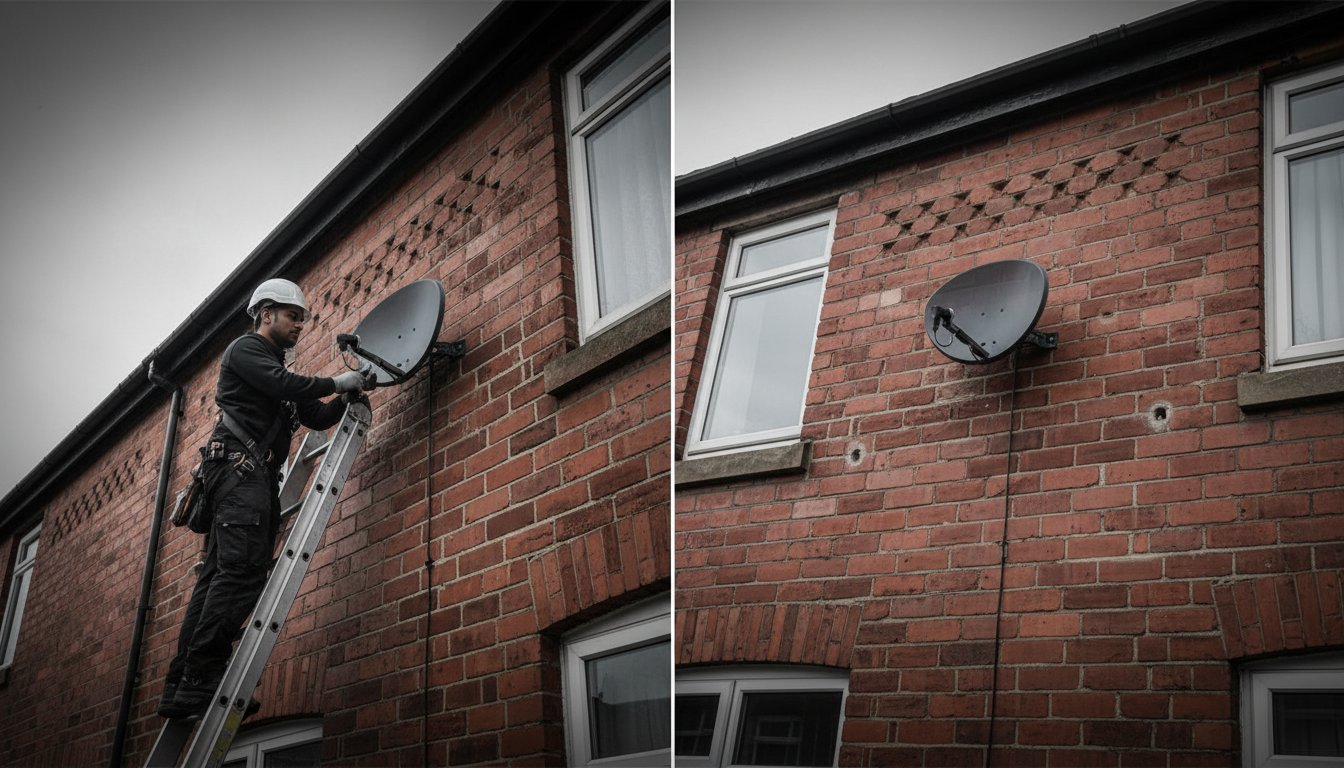
That rusted satellite dish on your gable end isn't just an eyesore; it's a structural liability waiting to happen. With over 12 million UK households now choosing streaming over satellite, these redundant "zombie dishes" are cluttering homes across the whole of the United Kingdom. If you're tired of looking at peeling metal but dread the thought of a 10-foot drop or a damp patch in your living room, you aren't alone. Learning how to remove a sky dish from a wall shouldn't feel like a high-stakes gamble with your safety or your home's integrity.
We understand that your priority is a clean, clutter-free exterior without the stress of ladder accidents or leaky drill holes. We advocate for a nationwide service standard for property care to help you reclaim your home's curb appeal with confidence. This guide delivers the ultimate 2026 safety checklist to dismantle that dish and seal your masonry like a professional. You'll discover exactly how to handle the heavy lifting, manage the cabling, and say a final goodbye to outdated tech for a sparkling, modern finish.
Key Takeaways
- Reclaim your home’s curb appeal by ditching redundant metal and preventing unsightly rust stains on your masonry.
- Prioritize your safety with our essential checklist covering tool prep, weather conditions, and proper ladder positioning.
- Get the exact technical steps on how to remove a sky dish from a wall while keeping your property’s exterior intact.
- Protect your home from moisture and insects by mastering the art of sealing old bolt holes with high-quality exterior filler.
- Say goodbye to the hassle and let us handle the height; we offer efficient, expert removal across the whole of the United Kingdom.
Why You Should Remove a Redundant Sky Dish From Your Wall
We're dedicated to helping homeowners across the whole of the United Kingdom reclaim their property's clean look. Your old satellite dish isn't a vital piece of tech anymore. It's redundant metal cluttering your exterior. These eyesores often stay bolted to chimneys and gables long after the contract ends. We see it every day. Our Nationwide service ensures these ghost fixtures don't linger. Learning how to remove a sky dish from a wall is the fastest way to improve curb appeal without spending thousands on renovations.
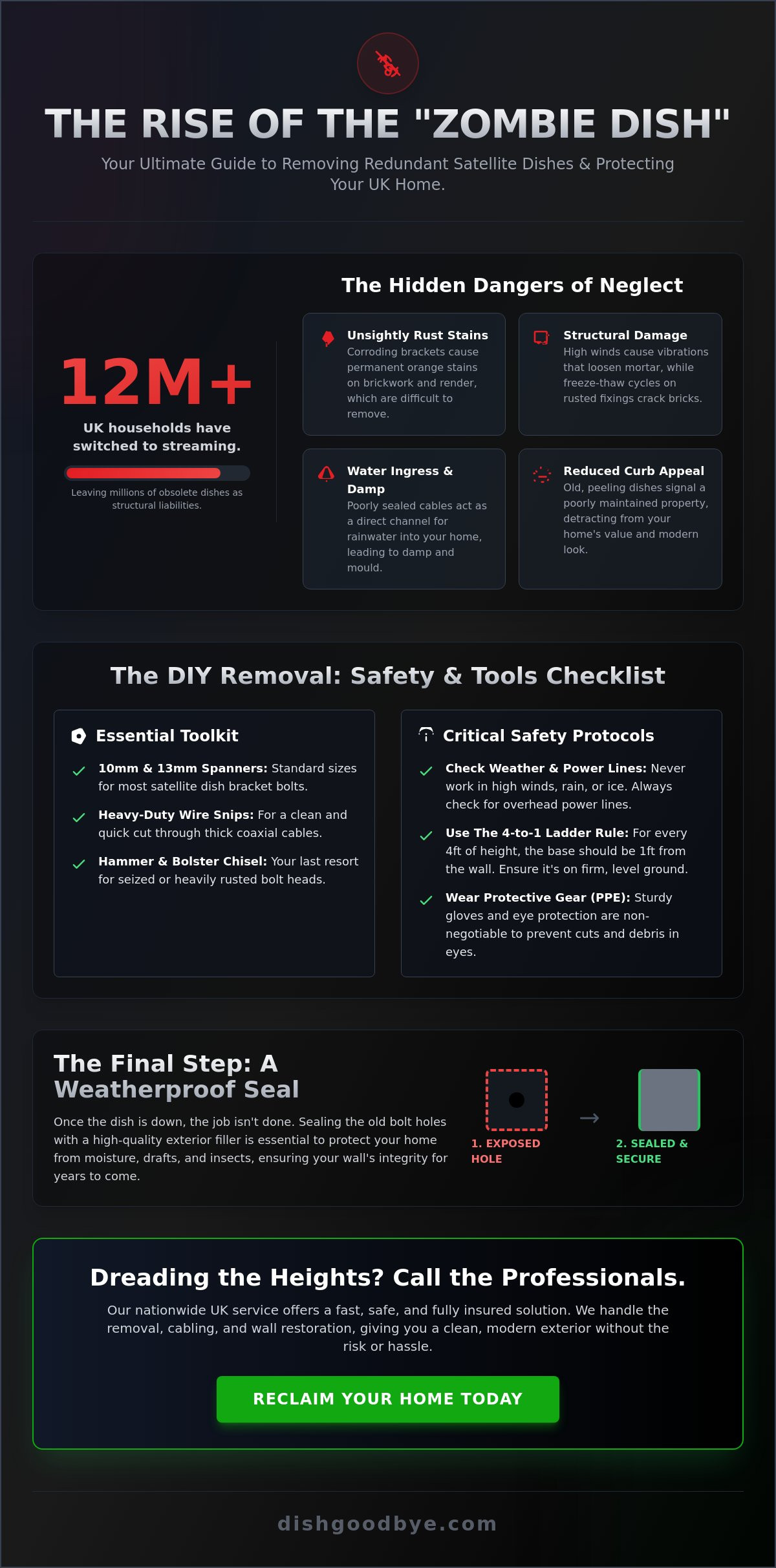
Rusting brackets are a major concern for UK properties. Damp weather causes metal to corrode quickly; this leads to permanent orange staining on light-coloured brickwork or render. These stains are incredibly tough to clean once they set into the porous surface. High winds also pose a threat. A loose dish vibrates constantly during storms. This movement puts repetitive stress on your masonry. Over several seasons, it can loosen the mortar or even crack the substrate. Removing the hardware stops this damage before it becomes a costly repair bill.
The Problem With "Ghost" Technology
Modern streaming services have changed everything. Most UK homes now rely on high-speed internet rather than orbital signals for their daily entertainment. This shift has left millions of redundant dishes across the country. On terraced or semi-detached homes, multiple dishes look chaotic and dated. They create a cluttered visual profile that detracts from the architecture. Removing old tech sends a strong signal to potential buyers. It shows a well-maintained property where the owners pay attention to the details. Say goodbye to the mess and hello to a sleek, modern exterior.
Potential Hazards of Neglected Brackets
Neglect leads to structural issues that are often hidden from view. Rusted fixings expand as they oxidize. During winter freeze-thaw cycles, this expansion can crack your bricks from the inside out. It's a slow but certain process that compromises your home's integrity. Cables are another hidden risk. If they aren't clipped properly, they act as conduits. Rainwater follows the cable straight into the entry hole in your property. This causes damp patches and mould inside your home. We recommend a professional dish removal service to handle these risks safely. Our team operates across the whole of the United Kingdom to keep your masonry secure and dry. It's a simple, effortless fix for a long-term problem.
The Pre-Removal Safety & Tools Checklist
We provide a nationwide service across the whole of the United Kingdom, so we understand the unique challenges of British homes. From coastal winds in Cornwall to the freezing temperatures of the Scottish Highlands, weather plays a massive role in your safety. Don't start this job during high winds or if there's ice on the ground. Safety is our absolute priority. Check for overhead power lines before you touch a metal ladder. It's vital to follow the Work at Height Regulations 2005 to prevent avoidable accidents. Wear sturdy work gloves to protect against sharp cable ends and eye protection to keep brick dust out of your eyes. A clean, safe workspace is the DishGoodbye way. Before learning how to remove a sky dish from a wall, you must ensure your environment is secure.
Essential Tools for the Job
- 10mm and 13mm spanners: Most Sky bracket bolts use these standard sizes; we suggest having both ready.
- Heavy-duty wire snips: These allow you to slice through the coaxial cables quickly and cleanly.
- Hammer and bolster chisel: If the bracket fixings are heavily rusted or seized, these tools help you shear off the bolt heads.
Preparation makes the task effortless. You need specific sizes to avoid stripping bolt heads and causing unnecessary frustration. Having the right kit is the first step in knowing how to remove a sky dish from a wall without damaging your masonry. Always check your tool bag before you climb to avoid unnecessary trips up and down.
Ladder Safety and Working at Heights
Your ladder is your lifeline. Set it on firm, level ground to prevent tipping or sinking. The 4-to-1 rule is your golden ratio; for every four units of height, the base should be one unit out from the wall. This creates the most stable angle for climbing. Always maintain three points of contact, such as two feet and one hand, with the ladder at all times. We require a second person to foot the base to ensure it doesn't slip outward while you work. This partner also acts as a spotter for any potential hazards. Domestic extension ladders should not be used to reach heights above 9 metres for home maintenance tasks.
If the climb feels daunting or your dish is positioned in a hard-to-reach spot, don't take unnecessary risks. You can easily say goodbye to your old dish and the stress of heights by letting our nationwide team handle the removal for you. We focus on efficiency and domestic harmony, ensuring your home looks its best without the DIY headache.
Step-by-Step: How to Safely Remove a Sky Dish
We provide a nationwide service of expert advice to help you reclaim your home's aesthetic appeal. From the tip of Cornwall to the north of Scotland, we ensure homeowners across the whole of the United Kingdom can tackle exterior maintenance with confidence. Learning how to remove a sky dish from a wall doesn't have to be a struggle; it's about following a logical sequence to ensure both your safety and the integrity of your masonry.
- Disconnect and cut: Start by snipping the coaxial cables at the dish LNB and the wall entry point using heavy-duty wire cutters.
- Lighten the load: Loosen the bolts on the dish arm first. Removing the reflector dish from the bracket reduces the weight you'll handle while standing on a ladder.
- Unscrew masonry bolts: Use a 13mm socket set or spanner to remove the four main bolts securing the bracket to the brickwork.
- The rope technique: If you're working at height or the dish is an older, heavier model, loop a nylon rope through the bracket. Have a partner on the ground take the weight as you undo the final bolt.
Managing Redundant Cables
Identifying redundant cables is simple; follow the lead from your satellite box to the exit point. In 85% of UK semi-detached homes, these cables run along the damp-proof course or window frames. To remove cable clips without chipping your bricks, use a pair of end-cutting pliers to pull the nail straight out rather than prying it. When pulling cables through the wall, check for silicone sealant first. Cut the sealant away with a utility knife to prevent internal plaster from blowing out as the cable slides through. You can find more tips on clearing household clutter at DishGoodbye.
Dismantling the Bracket and Arm
In the UK's damp climate, roughly 40% of external bolts suffer from significant oxidation. If you encounter a stubborn, rusted bolt, spray it with a penetrating oil like WD-40 and wait exactly 15 minutes before trying again. Always keep one hand firmly on the bracket while removing the final screw to prevent it from swinging and damaging your brickwork. If a bolt shears off inside the brick, don't panic. Use a metal grinder to take the head down flush with the wall. This ensures a smooth finish when you eventually fill the holes. Saying goodbye to that rusty eyesore creates an immediate sense of domestic harmony and a cleaner exterior profile for your home.
Restoring the Wall: Preventing Damp and Erosion
You've successfully taken down the hardware. Now we need to address the scars left behind. Leaving open bolt holes in your brickwork is a recipe for long-term property damage. These small gaps act as direct pipelines for moisture, driving rain, and nesting insects. We provide a nationwide service across the whole of the United Kingdom, and we've seen how a few neglected holes can lead to significant internal damp issues within just 12 months. It's time to say goodbye to those risks and ensure your home stays dry and protected.
Filling and Sealing Exterior Holes
The secret to a professional finish lies in the preparation. Don't just squirt filler over the surface. We recommend cleaning out every hole with a small brush or canned air to remove loose masonry dust. If the dust remains, the sealant won't bond properly. Use a high-quality exterior silicone sealant or a dedicated masonry filler. Choose a colour that matches your mortar or brickwork to keep the repair invisible. Properly filling and smoothing exterior holes is the only way to stop water from freezing inside the brick, which causes "spalling" or surface crumbling. This step is a vital part of learning how to remove a sky dish from a wall safely and effectively.
Responsible Recycling of E-Waste
Your old satellite dish and LNB are not general household waste. These items contain metals and electronic components that require specialist handling. In the UK, over 1.4 million tonnes of e-waste are generated annually, and we're committed to reducing that figure. You should take your old hardware to a WEEE-compliant (Waste Electrical and Electronic Equipment) recycling centre. Most local council tips have a dedicated area for "Large Appliances" or "Scrap Metal" where these items are processed correctly. We take environmental responsibility seriously. Our Dish Goodbye zero-landfill promise ensures that every piece of metal and plastic we remove is diverted from the bin and sent back into the manufacturing cycle.
We believe that finishing the job properly is just as important as the removal itself. When you follow these steps, you protect your home's structural integrity and help the environment. If you want a sparkling, hole-free wall without the hassle, we offer a convenient solution for homeowners across the country.
Ready to reclaim your home's kerb appeal? Say goodbye to that old hardware and book your professional removal today with our nationwide team.
When to Call Professionals for Nationwide Dish Removal
Learning how to remove a sky dish from a wall is a great first step toward a cleaner home, but DIY isn't the right choice for every homeowner. High walls, awkward angles, and multi-storey properties present real dangers that require more than just a basic spanner. We offer a safe, efficient, and nationwide service across the whole of the United Kingdom. Our team handles the heavy lifting, the heights, and the technical bits so you don't have to. We don't just take the dish down; we perform full cable extraction and expert wall restoration as standard. You won't have to worry about unsightly holes or dangling wires ruining your brickwork. Choosing our specialist team means you avoid the risk of falls or accidental property damage. It's the simplest way to reclaim your home's aesthetic and enjoy a clutter-free exterior.
The Risks vs. Benefits of Professional Service
It's smart to weigh the sky dish removal cost against the price of buying specialized tools or renting long ladders. DIY accidents account for thousands of hospital admissions in the UK every year. We carry full liability insurance and use professional height equipment to keep everyone safe. Whether you have one dish on a semi-detached house or dozens of dishes on a commercial block of flats, we have the expertise to clear the clutter. We've seen it all and removed it all from every corner of the country. Our service is designed to be a lifestyle upgrade that prioritizes your safety and your time. Why spend a Saturday on a ladder when we can handle it in a fraction of the time?
- Safety First: We use industrial-grade ladders and safety harnesses for all high-level work.
- Full Extraction: We remove every inch of redundant cabling, not just the dish itself.
- Wall Restoration: Our technicians use professional-grade sealant to plug holes and prevent damp.
- Total Coverage: Our technicians operate across the whole of the United Kingdom.
Saying Goodbye to Your Old Dish Today
If you've spent time researching how to remove a sky dish from a wall and decided the height is too much, we're here to help. Booking your removal is fast and easy through our nationwide platform. We've streamlined the process so you can get a quote and a date in minutes, no matter where you live in the United Kingdom. On the day of your appointment, you don't even need to wait in. We don't require internal access to your property because our work is strictly external. Our technicians arrive, remove the hardware, and tidy the masonry using weather-proof sealant. The final result is a clean, restored wall that looks as if the dish was never there. Say goodbye to that rusted metal and hello to a sparkling exterior. It's the DishGoodbye way: efficient, professional, and completely effortless. We make it easy to move on from old technology and reclaim your home's kerb appeal.
Reclaim Your Home’s Kerb Appeal Today
Leaving a rusted, redundant satellite dish on your masonry doesn't just look untidy; it risks long-term structural damage. By following our 2026 safety checklist, you've learned that moisture ingress and brick erosion are real threats to your property's integrity. You now understand the essential steps for how to remove a sky dish from a wall while keeping your safety and your home's exterior intact. Whether you're tackling the ladder work yourself or looking for a seamless transition to a cleaner facade, the goal is a sparkling, dish-free home.
We provide a professional, nationwide service across the whole of the United Kingdom to make this upgrade effortless. Our team handles every detail, from the initial climb to full property restoration and damp-proofing of the drill sites. We operate a strict zero-landfill recycling policy for 100% of the hardware we collect. Don't let an obsolete dish clutter your view or damage your brickwork any longer. It's time to choose a modern, well-managed exterior that reflects your pride in your home.
Say goodbye to your old dish with our nationwide removal service
We're ready to help you achieve that perfect, clutter-free finish today. Your home deserves to look its best, and we make the process simple and stress-free.
Frequently Asked Questions
Do I need permission to remove a Sky dish from my wall?
You don't need permission from the broadcaster to remove the dish, but your property status matters. Homeowners can act freely, while the 4.6 million private renters in the UK should obtain written consent from their landlord first. We provide a nationwide service to help you manage these property upgrades across the whole of the United Kingdom. Say goodbye to that rusty eyesore and reclaim your home's exterior today.
Can I remove a satellite dish without using a ladder?
You cannot safely remove a wall-mounted dish without a ladder or professional access equipment. Most UK dishes are installed at least 3 metres high to clear local obstructions. Attempting to reach the bracket from an upstairs window is dangerous and leads to masonry damage. Our teams operate across the whole of the United Kingdom, ensuring every dish comes down safely using industry-standard height safety gear and professional techniques.
Will removing the dish affect my TV signal if I have Sky Stream or Virgin?
Removing your old hardware won't affect your Sky Stream or Virgin Media service. These modern platforms rely on high-speed broadband or dedicated fibre optic cables rather than a satellite feed. Since 2023, the shift toward dish-free viewing has accelerated across the country. It's time to say goodbye to redundant tech. We offer a nationwide service to clear away these obsolete receivers while keeping your modern signal perfectly intact.
What tools do I need to take down a satellite dish bracket?
You'll need a 10mm or 13mm socket wrench, a heavy-duty screwdriver, and sharp wire cutters. These specific tools allow you to learn how to remove a sky dish from a wall without stripping the bolts. If the bolts are rusted, which affects 70% of outdoor brackets after five years, apply a penetrating oil first. We help homeowners across the whole of the United Kingdom achieve a professional, sparkling finish with the right equipment.
How do I fill the holes left in the brickwork after removal?
Fill the 10mm holes with a high-quality exterior masonry sealant or mortar to prevent damp. Leaving these gaps open allows water to freeze and expand, which can crack your bricks during the winter months. We recommend using a UV-resistant silicone for a quick, effortless fix. This simple step ensures your home remains weather-tight and looks great once you've said goodbye to that old, bulky bracket for good.
Where can I recycle an old satellite dish in the UK?
You can recycle your old dish at any of the 1,500 local household waste recycling centres across the country. Dishes are typically made of steel or aluminium, making them 100% recyclable. Don't put them in your domestic bin. Our nationwide service ensures that metal waste is handled responsibly, supporting a cleaner environment for the whole of the United Kingdom while you enjoy your clutter-free and modern exterior.
Does Sky take the dish back when I cancel my subscription?
Sky doesn't take the dish back because it becomes your legal property the moment it's installed. While they might request the return of a Sky Q box or hub, the dish is your responsibility to maintain or remove. Many UK residents are surprised to find they own this equipment. We're here to help you say goodbye to this unwanted hardware with our efficient removal solutions available across the whole of the United Kingdom.
Is it dangerous to cut satellite dish cables?
It's not dangerous to cut the twin coaxial cables because they carry a very low voltage, typically between 13 and 18 volts. You won't get an electrical shock, but you should still unplug your receiver from the wall socket first. Learning how to remove a sky dish from a wall involves cutting these wires cleanly at the entry point. We provide expert advice across the whole of the United Kingdom to make this task effortless and safe.