
The cost to remove an old satellite dish in the UK depends on access, the dish’s position and condition, and the work needed to leave the exterior tidy. There’s no single price that fits every property, so the quote reflects the specific job requirements.
If you are considering keeping the bracket for possible future use, make that clear before requesting a quote. This article explains what a standard quote includes, what to mention about extra cables or damage, and why safe access matters. You can then decide whether you want the dish removed alone or the bracket and associated cable removed too.
Key Takeaways
- You can keep a dish bracket in place if you may want to reuse it, but make clear which parts you want removed.
- Access, fixing condition and the work needed to leave the wall tidy all affect the removal quote.
- Tell the remover about extra cables, holes or devices, as these may need to be quoted separately.
- Get permission before arranging removal from a rented home or a building with shared equipment.
- A dish on a roof or in a difficult-to-reach position can make DIY removal risky; consider access and fixing condition before deciding how to proceed.
Removal of brackets and external cabling
Removing a dish can involve more than taking down its metal face. The scope may include the LNB, bracket, fixings and associated external cable, depending on the chosen finish.
Dish and LNB Removal
The dish is the reflector, while the LNB is the small component mounted on its arm that receives the satellite signal. Removing both clears the visible equipment and leaves the bracket and cable as separate decisions. For example, a redundant Sky dish may be removed while its wall bracket stays in place for possible future use.
The LNB connects to the coaxial cable, so removal involves separating that connection as well as taking down the dish. If the cable will remain, its exposed end can be capped and tidied rather than left loose. Decide whether the LNB should come away with the dish, because retaining one part does not automatically mean retaining the rest of the assembly.
Brackets, Fixings and Cable Removal
The bracket holds the dish against a wall, roof or chimney, and its fixings secure it to that surface. Removing the bracket means dealing with those fixings too. If you may reuse the mounting point and want the bracket left in place, say so when requesting a quote.
External cables may run from the LNB along masonry, beneath clips or through an entry point into the building. A removal enquiry should distinguish the cable associated with the dish from other cables on the property. For example, mention a separate cable serving another room, as additional cables must be quoted separately.
Before arranging removal, describe everything you want taken away. Name the dish, bracket and associated cable, and mention any extra cables, devices or holes in your initial enquiry, as these must be quoted separately. This also clarifies which fixing holes are part of the standard work.
- Specify whether the bracket should stay or be removed.
- Identify any cable that serves another room or device.
- Include the LNB and fixing holes in the requested scope.
This distinction matters if you may reuse the mounting point. Keeping a sound bracket can avoid removing it now, while a standard Dish Goodbye quote includes its removal. State your preference when requesting the quote so the agreed scope matches the result you want.
Care to avoid damage to walls and roofs
Removing a dish safely starts with understanding its mounting surface and cable route. A wall-mounted bracket, roof fixing and cable entry point each need attention. Mention visible cracked masonry, loose mortar, damaged tiles or existing water marks when describing the job. This helps distinguish removal work from pre-existing damage.
Fixings can leave holes when a bracket comes away. Filling those associated holes can leave a neater finish, but it won’t repair wider damage around the mount. For example, crumbling mortar around an old bolt may need separate masonry attention. Rendering, painting and repairs to damaged roof coverings are also different from filling fixing holes.
The cable entry point needs care too. Where a cable passes through an external wall, the opening should be sealed with a suitable cable gland or colour-matched mastic plug, rather than gaffer tape. This gives the cable entry a more appropriate finish. If the cable is removed, include the entry point in the agreed scope so it isn’t overlooked.
Before removal, note the condition of the surface around the dish. A photo taken safely from the ground can show the bracket, nearby masonry and cable route. Do not climb onto a roof or lean out of a window to take pictures. Mention visible cracks or loose materials when describing the job.
- Identify whether the dish is fixed to a wall, roof or chimney.
- Point out existing cracks, loose mortar, damaged tiles or water marks.
- Describe the cable route and its entry point.
- Separate fixing-hole filling from broader repairs or decorative work.
Roof-mounted equipment deserves particular attention because its fixing points sit among roof materials. A loose or damaged tile beside a bracket is different from a hole left by its fixing. Identify both issues separately so it is clear which work relates to removing the equipment and which concerns the roof’s existing condition.
Be precise about the finish you expect. Filling holes left by the dish’s fixings doesn’t automatically mean repainting a wall, matching its texture or restoring older damage. For example, a filled hole on painted brick may remain visible until the surrounding surface receives further decoration. Agreeing the scope beforehand helps avoid confusion about the result.
Include these details when requesting a removal quote: the mounting surface, visible condition, cable entry and any separate damage. A photo taken safely from the ground can show the relevant areas. Clear information helps define the work around the dish’s fixing points and the condition of the surrounding wall or roof.
Communal and rented property permissions
Before arranging removal, establish who controls the dish and the part of the building where it is fixed. A dish on a home you own differs from equipment attached to a rented flat or shared block. Permission may affect whether removal can proceed and who needs to approve the work.
For a rented property, ask the landlord or managing agent before arranging removal. Tenancy agreements often require landlords to approve property alterations, including satellite dish removal. Keep the approval in writing so the agreed change is clear to both tenant and property owner.
A managing agent may handle requests for a leasehold flat, while the freeholder or building owner controls external walls and shared areas. Ask which person or organisation has authority over the dish’s mounting location. Permission to alter a flat’s interior does not necessarily mean permission to remove equipment fixed to a communal wall.
Shared systems need a separate check. Do not remove a dish serving several flats, a house in multiple occupation or a communal television system without authority from the building owner or management company. First establish whether the dish serves only your property. If cables run towards several homes, pause and identify who is responsible for the system.
- Ask the landlord or managing agent for approval in a rented home.
- For a shared building, identify the owner or management company responsible for external equipment.
- Establish whether the dish serves one home or a communal system.
- Keep written permission with your removal arrangements.
Ownership can also matter when a dish was supplied under a provider arrangement. Some satellite providers require customers to return leased dishes before closing their accounts. Check your account terms and equipment status before treating the dish as unwanted. Removing leased equipment prematurely could conflict with a return requirement.
Permission should cover the specific equipment and work, not just a general request to tidy the exterior. State whether the dish, bracket and associated cable are involved, and identify the mounting location. If a building manager approves removal but asks for the bracket to remain, record that distinction before agreeing the work.
Make approval an early part of the decision, before setting a removal date or arranging access. A written response from the landlord, managing agent or building owner helps clarify responsibility. When you use a professional service like Dish Goodbye, having this clearance ensures a smooth process, giving the remover a defined scope and reducing the chance of disrupting a shared system or removing equipment that still serves another property.
DIY removal risks
A dish fixed high on a wall or roof can be difficult to control during removal. Some satellite dishes weigh more than 20kg, making the assembly awkward to handle while reaching for fixings. Height, access and the condition of the bracket all affect the task. A loose or corroded fixing can make the equipment harder to manage.
A ladder adds another challenge: one hand may need to hold the dish while the other reaches for a bolt or cable. That can leave little control over the equipment. A dish that shifts suddenly may strike the wall, roof or person handling it. Consider the access and fixing condition before deciding whether DIY removal is suitable.
Weather matters too. Wind can catch a dish as it is detached, and wet surfaces can make roof access more difficult. Nearby services also need consideration. Cables or other equipment close to the mounting point can complicate the work, especially when their purpose is unclear. Do not begin until you understand the assembly and surrounding area.
For a removal quote, take photographs from the ground. Do not climb a ladder, go onto the roof or lean out of a window to get a closer view. A ground-level image can show the dish’s position, visible cable route and access conditions without adding a risky step.
If the job involves climbing, leaning out or handling a corroded assembly, arrange a competent work-at-height assessment. It should consider access, fixing condition, weather and nearby services. For example, a dish above a conservatory may need a different access plan from one fixed to an easily reached wall.
- Check where the dish is mounted and how it can be reached safely.
- Look for visible corrosion, loose fixings or damage from ground level.
- Consider wind, wet surfaces and nearby cables or services.
- Use ground-level photographs when describing the job.
Dish Goodbye provides safe, insured removal, using proper safety equipment and techniques. This is especially relevant for roof-mounted dishes, corroded brackets or positions that require climbing. Share clear details about the location and visible condition rather than attempting a close inspection from a ladder.
DIY may appear straightforward when a dish looks small from the ground, but its weight and position change the task. If removal means reaching over an edge or handling an unstable assembly, stop and arrange a competent assessment. A careful decision beforehand helps protect the person removing the dish and the building around it.
Professional satellite dish removal costs
There’s no single reliable price for professional satellite dish removal across the UK. The quote depends on access, mounting condition, location and the work needed to make good the fixing points.
When comparing quotes, match their scope rather than looking only at the headline total. Check that each quote describes the dish, mounting position, included parts and hole filling. A quote for a wall-mounted dish is not directly comparable with one for a roof-mounted assembly that requires different access.
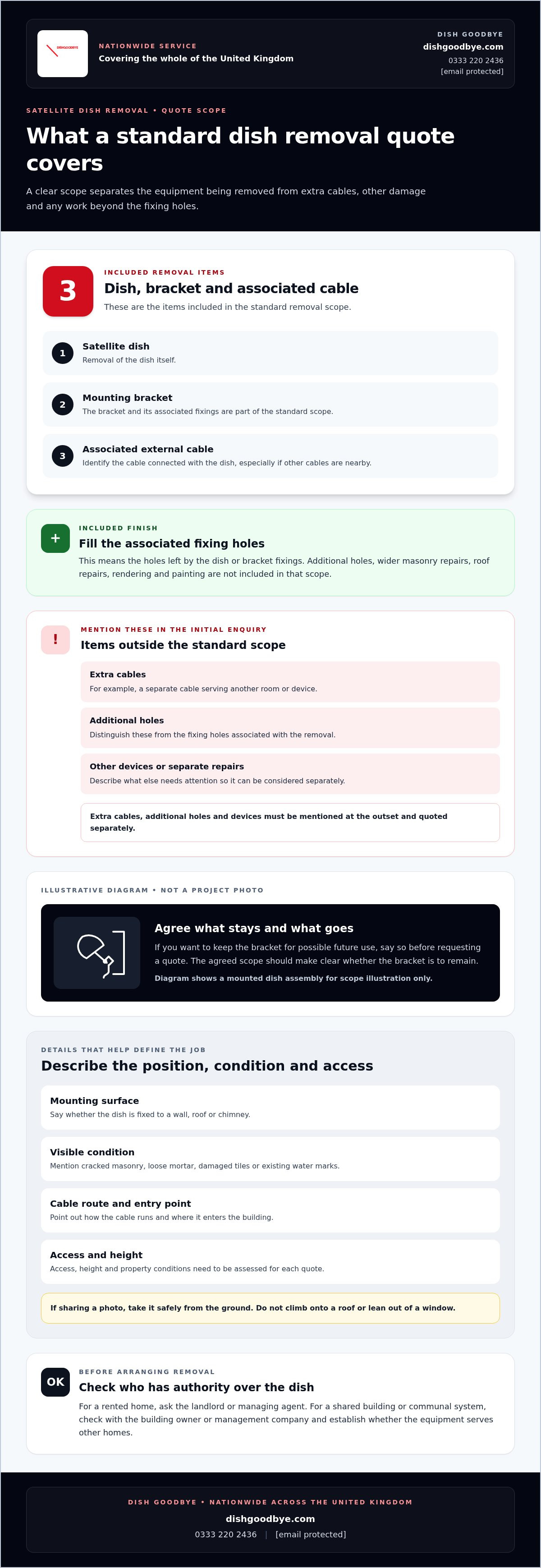
Ask for the quote to distinguish included work from additional items. Dish Goodbye’s standard quote covers the dish, its bracket and associated cable, plus filling the fixing holes created by their removal. Mention any extra cables, holes or devices in your initial enquiry, as these must be quoted separately.
Roof-mounted or hard-to-reach dishes can involve more complex access requirements than an easily reached wall-mounted dish. A roof position, corroded mount or awkward approach can affect the work needed. Share the mounting location and visible condition so the quote reflects those practical details.
A standard Dish Goodbye quote includes the dish, its bracket, associated cable and filling the fixing holes created by their removal. Additional cables, holes or devices must be mentioned in your initial enquiry and quoted separately.
The quote also reflects the property’s height, access route and the condition of the fixings. Making good matters too: filling the holes left by the associated fixings differs from repairing wider masonry damage or repainting. State what additional finish you need rather than assuming those tasks are included.
- Compare written quotes with the same removal scope.
- Check whether the dish, bracket and associated cable are included.
- Describe roof height, access and visible fixing condition.
- List extra cables, holes or devices in the initial enquiry.
- Separate fixing-hole filling from broader repairs or painting.
Before agreeing to the work, make sure the quote clearly identifies the tasks included. If you want collection, recycling or disposal arrangements, ask about them when requesting your quote. This gives you a clearer basis for understanding the scope, access and finish involved.
Dish Goodbye: Satellite Dish Removal
Dish Goodbye provides satellite dish removal and Sky dish removal nationwide, covering the UK. The service is suitable when a dish is awkward to reach or you want the dish, bracket and associated cable removed together.
A standard quote includes removal of the dish, bracket and associated cable, plus filling the fixing holes created by that removal. Mention extra cables, holes or devices in your initial enquiry, as these must be quoted separately. Access, height and property conditions shape the work. Ask about collection, recycling and disposal arrangements when requesting your quote.
For a quote tailored to your property and removal requirements, contact Dish Goodbye.
Make the next step simple
The cost to remove an old satellite dish in the UK is one part of deciding how you want your property’s exterior to look and function. First settle on the outcome you want, including whether the bracket should remain. Then provide the installation details and postcode for a free, no-obligation quote.
Dish Goodbye provides Satellite Dish Removal and Sky Dish Removal nationwide, covering the UK. Request a free, no-obligation quote by sharing your postcode, whether the dish is on a wall, roof or chimney, and what you want removed. Mention any extra cables, holes or devices in your initial enquiry, as these must be quoted separately.
Dish Goodbye: 0333 220 2436 | [email protected]
Frequently Asked Questions
Can I keep the bracket in case I want a dish again?
Yes, you can ask for the bracket to remain if you may reuse the mounting point. Make that preference clear before removal is quoted, since a standard Dish Goodbye quote includes bracket removal. For example, specify that you want the dish and LNB taken down but the bracket left attached. Check that the bracket is still suitable for your future plans rather than assuming an old fitting can be reused.
Do you dispose of the old dish?
Ask about collection, recycling and disposal arrangements when requesting your quote. This makes clear what should happen to the dish after removal, rather than assuming its collection or recycling is included. If you have a preference about what happens to the equipment, mention it with your initial enquiry. That gives the removal arrangements and the work scope a chance to be discussed together.
Do you seal the wall after removing the dish?
The standard quote includes filling the fixing holes created by removing the dish and bracket. That is different from repairing wider cracks, replacing damaged masonry or repainting the wall. For example, old staining or crumbling brick around the mounting area may need separate attention. Describe visible damage in your enquiry and distinguish it from the fixing holes left by removal.
How much does it cost to remove an old satellite dish in the UK?
The cost to remove an old satellite dish in the UK is priced according to the individual job requirements. Access, height, mounting condition and the agreed removal scope affect the quote. Share where the dish is fitted and what you want removed, including any additional cables or devices. A clear enquiry helps establish the specific work to be quoted, rather than relying on a figure that may not match your property.
What is the average UK price for satellite dish removal including labour and disposal?
There isn’t one average price that describes every removal and disposal arrangement. Each job is priced individually, with access, the dish’s position and the requested work shaping the quote. Collection, recycling and disposal arrangements should be discussed when requesting it. If you are comparing estimates, check that each describes the same removal scope and how the removed dish will be handled.
What factors affect the cost of removing a satellite dish in the UK?
The main factors are access, height, the dish’s position, the condition of its mount and the agreed scope. A roof-mounted dish with awkward access presents different requirements from one fixed within easy reach. Extra cables, holes or devices must be mentioned in the initial enquiry and quoted separately. Describe the property and equipment clearly to define the job.
Can a homeowner safely remove a satellite dish themselves, and what tools are needed?
DIY removal can be hazardous if it involves climbing, leaning out or controlling a corroded assembly. Some dishes weigh more than 20kg, so hand tools alone don’t address the challenge of access or handling. Consider the fixing condition, weather and nearby services. Don’t climb a ladder, go onto the roof or lean out to take photos for a quote. A competent work-at-height assessment is appropriate when climbing is involved.
Are there UK rules or planning permission requirements for removing a satellite dish?
For a rented property, get approval from the landlord or managing agent. In England and Wales, landlords must approve alterations, including dish removal. For a dish serving a communal system, obtain authority from the building owner or management company. The material gives no planning-permission requirements.