
What if removing the visible aerial still leaves the job unfinished? Commercial aerial removal UK should cover the full picture: redundant equipment, brackets, fixings, cabling and the holes left behind. Dish Goodbye provides commercial removals across the UK. Call 0333 220 2436 or email [email protected].
Old equipment can make a building look untidy, but coordinating access and work around occupied properties takes planning. Removing a dish or aerial without its associated fittings and cables can also leave the exterior looking only partly finished.
Use this practical checklist to define the scope before work begins, plan communication across your sites and understand what complete removal involves. You’ll also learn how fixing holes are filled and smoothed, and how removed metal and electronic waste is processed through approved recycling centres.
Whether you manage one building or properties across the UK, a clear brief helps keep the work organised and the finish neat. For commercial aerial and satellite dish removal nationwide, contact Dish Goodbye on 0333 220 2436 or at [email protected].
Key Takeaways
- Plan commercial aerial removal UK as a complete exterior-maintenance task, not just a dish or aerial take-down.
- Set out the removal scope clearly, including associated brackets, fixings and cabling.
- Compare removal approaches like for like by checking how each addresses fixings, holes, waste and property coordination.
- Use a reusable planning sequence to organise equipment inventory, access, communications and completion records across your sites.
- See how a UK-wide service can help facilities teams coordinate removal and leave building exteriors neat.
Why commercial aerial removal belongs on a UK exterior-maintenance checklist
Use an exterior-maintenance checklist to identify redundant equipment and define what needs removing. Dish Goodbye’s commercial aerial removal UK service covers redundant aerials and dishes, along with their associated brackets, fixings and cabling. Treating these items as one clear scope helps facilities teams plan consistent work across a property portfolio, rather than dealing with each visible fixture in isolation.
Unused equipment can leave elevations looking untidy, with old cables running across walls and fixing holes visible after hardware is taken down. Recording these details during a planned review helps teams specify the work needed to leave each exterior looking cleaner and more complete. It also makes it easier to compare properties and prepare a consistent removal brief.
Which redundant equipment should a commercial property review identify?
Look for satellite dishes, Sky dishes, television aerials and antennas, along with their brackets, fixings and visible cabling. Record each item by property reference, building elevation and access point. For example, note whether equipment is on the front elevation or above a particular entrance, then describe any visible cable route. This gives facilities teams a shared, practical record for coordinating work across sites.
Keep the scope focused on removing redundant equipment. A precise description makes it easier to distinguish removal from other television-system work in the property record.
Why treat the full exterior as part of the removal scope?
A dish-only description can leave important details unaddressed. The dish or aerial may come down while its bracket, fixings or associated cable remain in place. Include these elements in the scope so the intended finish is clear. After removal, fixing holes are filled and smoothed, helping the affected area look neater and addressing potential damp issues around the fixing points.
Complete removal means taking down the redundant dish or aerial, removing its brackets, fixings and cabling, and filling and smoothing the fixing holes. That definition gives property teams a straightforward way to describe the outcome they want. For background on the broader electronic-waste framework, see the Waste Electrical and Electronic Equipment (WEEE) Directive.
With the full scope recorded, facilities managers can use the same checklist to compare approaches and coordinate removal across their UK properties.
What commercial aerial removal includes, from equipment to exterior finish
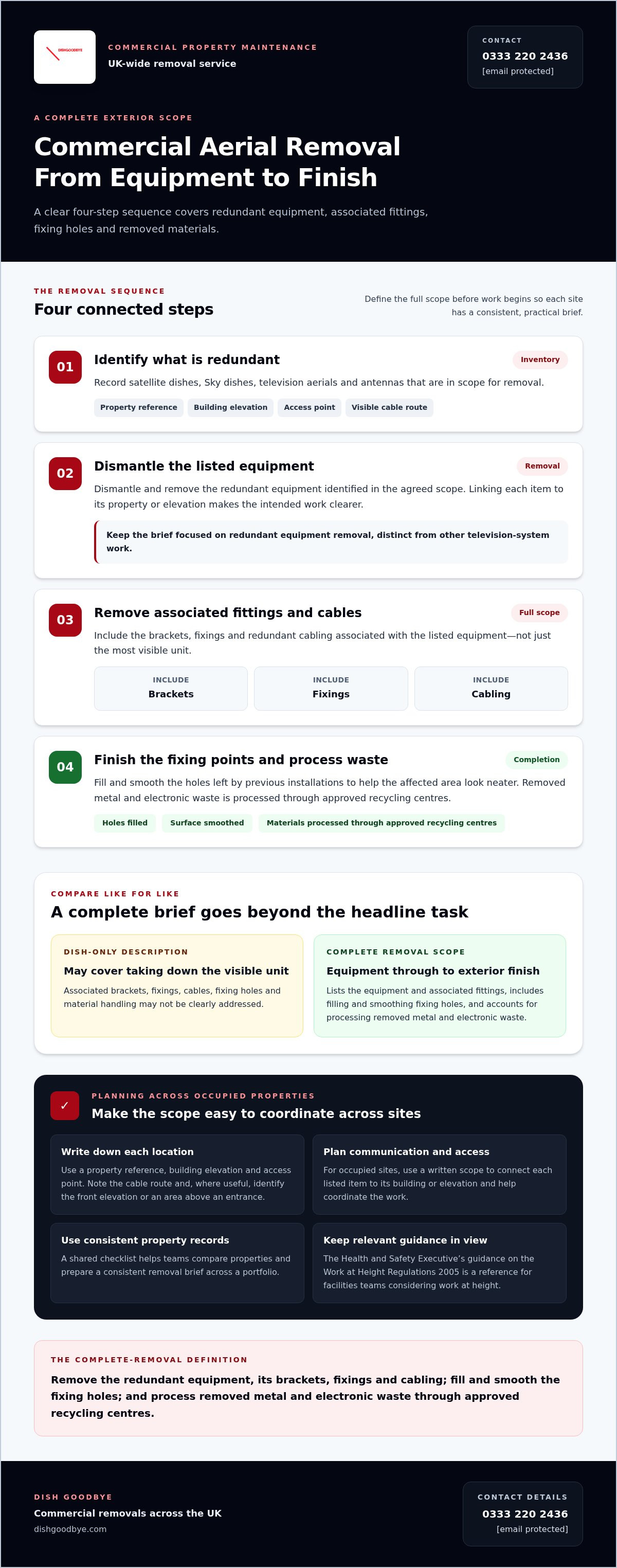
A clear removal sequence helps facilities teams understand what work is included and what the completed exterior should look like. Commercial aerial removal UK involves four connected steps: identify the redundant equipment, dismantle it, remove associated fixings and cabling, then fill and smooth the holes left behind. Together, these steps address more than the most visible item on the roof or wall.
How are dishes, aerials, brackets, and cables handled?
The work begins by identifying the redundant equipment in the agreed scope. This may include satellite dishes, Sky dishes, antennas and television aerials. The equipment is dismantled and removed along with its associated brackets, fixings and redundant cabling. Including these items helps avoid a piecemeal result, such as a dish disappearing while an unused bracket or cable remains on the elevation.
For occupied sites, a written scope can link each item to its building or elevation and make the intended outcome easier to communicate. Access planning is also important when organising the work. The Health and Safety Executive’s guidance on the Work at Height Regulations 2005 is a useful reference for facilities teams considering work at height.
Once the listed equipment and related materials have been removed, the building exterior is left without those dishes or aerials. The aim is a clearer elevation.
What happens to fixing holes and removed materials?
Taking down the hardware is only part of the finish. Holes left by previous installations are filled and smoothed, helping the affected area look neater. This gives the property manager a more complete result than removal alone, while keeping the scope specific to filling and smoothing the holes.
Removed metal and electronic waste is processed through approved recycling centres. This gives facilities teams a clear account of how those materials are handled after they leave the building.
Complete removal takes away the redundant dish or aerial, its brackets, fixings and cables, then fills and smooths the fixing holes and sends removed metal and electronic waste for processing through approved recycling centres.
For facilities teams planning work across UK properties, Dish Goodbye provides commercial removals nationwide. See the satellite dish removal service to arrange a cleaner finish without leaving associated hardware behind.
How to compare commercial aerial removal approaches without missing the details
Removal descriptions can sound similar while covering different amounts of work. For commercial aerial removal UK, compare the scope line by line, not just the headline task. A dish-only description may cover taking down the visible unit, while a complete scope also accounts for brackets, fixings, redundant cables, the holes left behind and the handling of removed materials.
Use the same criteria for each property record. Consistent descriptions make comparisons clearer across a portfolio and help facilities teams spot gaps before agreeing the work.
What should a commercial removal scope cover?
Check that the description identifies both the equipment and the finishing tasks, rather than relying on a broad phrase such as “dish removal”. Use this table as a like-for-like comparison framework:
| Criterion | What to record |
|---|---|
| Equipment and scope | Which dishes, Sky dishes, aerials or antennas are included? |
| Fixings and cabling | Are associated brackets, fixings and redundant cables included? |
| Hole treatment | Does the described finish include filling and smoothing fixing holes? |
| Waste handling | Is processing of removed metal and electronic waste through approved recycling centres included? |
| Property coordination | Are access arrangements and building-user communication needs noted? |
Hole treatment and waste handling are distinct scope elements, not details to assume from the words “equipment removed”. A complete description should make clear that exterior holes are filled and smoothed, and that This answers a common concern directly: the job can cover both the visible equipment and what it leaves behind.
How can facilities teams compare options across a property portfolio?
Keep each property record consistent. List the equipment categories, associated materials, hole treatment and waste handling in the same order for every building. Then add the relevant elevation or access point, along with access arrangements and communication needs for occupants or building users. This gives the facilities team a practical basis for coordinating work without assuming every site has identical requirements.
For related guidance on protecting the exterior during redundant equipment removal, read Professional Dish Removal Service: Protecting Your Property from Redundant Tech. A clear, shared scope helps teams compare like with like and work towards a tidy, complete result across UK properties.
The UK facilities manager’s checklist for planning aerial removal
A reusable checklist makes commercial aerial removal UK easier to coordinate across properties. Keep it focused on portfolio planning: identify what needs removing, define the expected finish, organise access and communication, then record what was completed. It’s a coordination tool, not a set of technical removal instructions.
Before work: inventory equipment and agree the scope
Create a consistent record for each property. Include its reference, the relevant building elevation, visible equipment and associated cabling. Note where the equipment is positioned, such as above an entrance or on a side elevation, so the scope is clear to everyone organising the work.
Then list the intended tasks: remove the redundant dish, aerial or antenna, its brackets and fixings, and associated cabling; fill and smooth the fixing holes. A shared checklist helps prevent one property being recorded for equipment removal only while another includes the finishing work.
- Inventory: Record the property reference, equipment and exterior location.
- Agree scope: List the hardware, fixings, cabling and hole treatment required.
- Plan access: Note relevant access arrangements and any areas that may be affected.
- Communicate: Identify building users who need clear information about the planned work and affected areas.
Keep access and communication notes practical. For an occupied building, consider which entrance, walkway or shared area could be affected, and how users should be informed. Record the arrangements for each property rather than assuming every site has the same needs.
After work: record completion and close the task
Use the original inventory to check off what was removed at each site. Record the equipment, fixings and redundant cabling addressed, along with whether the fixing holes were filled and smoothed. This creates a useful close-out record and makes it easier to track progress across a portfolio.
If you include completion photos, choose clear views of the finished exterior with no satellite dishes or aerials visible. Keep the images tied to the relevant property reference and elevation, so the record shows which area was completed without mixing it up with another site.
For wider property-maintenance planning, use consistent records to connect aerial removal with other exterior tasks across your portfolio. For commercial aerial and dish removal across the UK, arrange nationwide dish removal with Dish Goodbye.
Arrange commercial aerial removal across the UK with Dish Goodbye
Once your property records and work scope are ready, Dish Goodbye provides commercial aerial removal across the UK. The service covers redundant satellite dishes, Sky dishes, aerials, antennas and associated cabling at commercial properties. For organisations managing several sites, nationwide coverage offers a straightforward way to address the same exterior-maintenance task across their UK portfolio.
A complete brief covers the equipment itself and the items often left around it: brackets, fixings and redundant cables. Fixing holes are filled and smoothed, and That gives facilities teams a clear scope to plan around, from equipment removal through to a neater exterior finish and responsible waste processing.
What facilities teams can expect from a complete removal
Think beyond the visible dish or aerial. Include associated brackets, fixings and redundant cabling in the removal scope, then include filling and smoothing the fixing holes as part of the intended finish. For a closer look at the removal process, read Our Dish Removal Service: What to Expect.
This practical scope helps teams describe the work consistently across different properties. It also makes it easier to align removal with exterior-maintenance planning.
To plan work across your portfolio, visit Dish Goodbye’s UK-wide commercial aerial removal service. Have your property references, equipment inventory and access notes ready. These details help you set out which buildings are involved and what the desired finish includes.
How to take the next step
Contact Dish Goodbye to arrange commercial dish and aerial removal across the UK. Call 0333 220 2436 or email [email protected]. Share the properties in scope and the equipment and finishing tasks identified in your checklist, so you can move from an inventory to a clear removal plan.
Ready to tidy up redundant equipment across your sites? Call 0333 220 2436 or email [email protected] to discuss commercial removal planning with Dish Goodbye.
Make redundant equipment one less thing to manage
A clear checklist helps facilities teams coordinate removal across UK properties, compare scopes consistently and record what’s been completed. Look beyond the visible dish or aerial: include brackets, fixings and associated cabling, then account for filling and smoothing the fixing holes and processing removed metal and electronic waste through approved recycling centres.
With commercial aerial removal UK planned as a complete exterior-maintenance task, it’s easier to set a clear brief and work towards a neat finish at each property. Dish Goodbye provides commercial removal across the UK, helping facilities teams organise the work with a defined scope.
Arrange UK-wide commercial aerial removal with Dish Goodbye. Call 0333 220 2436 or email [email protected] to discuss your property checklist and plan the next step. A tidier exterior starts with a clear plan.
Frequently Asked Questions
What does commercial aerial removal include?
Commercial aerial removal covers redundant satellite dishes, Sky dishes, television aerials and antennas, plus associated brackets, fixings and cabling. Dish Goodbye also fills and smooths holes left by previous fixings, helping leave the affected exterior neater.
Can redundant satellite dishes and aerials be removed from commercial buildings?
Yes. Dish Goodbye removes redundant satellite dishes, antennas and aerials from commercial properties across the UK. The removal includes associated fixings and cabling, rather than only the visible dish or aerial. Fixing holes left by previous installations are filled and smoothed as part of the exterior finish. Facilities teams can plan the work by recording the equipment and relevant property details for each building.
Does commercial aerial removal include brackets and cables?
Yes. The removal includes associated brackets, fixings and redundant cabling alongside the equipment being dismantled. Listing these items in the task scope helps facilities teams record exactly what is to be cleared from each building. For example, a property record can identify the dish or aerial and note its associated bracket and visible cable. The scope concerns related redundant cabling.
What happens to the holes after a satellite dish is removed?
Dish Goodbye fills and smooths holes left by previous installations. This addresses the visible fixing points as part of the exterior finish, rather than leaving them as an overlooked part of the removal task. Facilities teams can include hole treatment in the agreed scope and note its completion in the property record.
How should facilities managers plan aerial removal across multiple UK properties?
Start with a property-by-property inventory of equipment, associated brackets, fixings and cabling. Add access arrangements and the finishing tasks required, including filling and smoothing fixing holes. Use the same scope and completion record across sites so work can be coordinated and recorded consistently. Dish Goodbye provides removal services across the UK, supporting facilities teams managing properties throughout the country.
How is waste from commercial aerial removal handled?
Facilities teams can record this alongside the equipment and fixings removed from each property when closing out the task.
How can I arrange commercial aerial removal with Dish Goodbye?
To arrange commercial aerial removal across the UK, call Dish Goodbye on 0333 220 2436 or email [email protected]. The service covers redundant equipment and associated fixings and cabling, followed by filling and smoothing the fixing holes. If you manage several properties, have your inventory and scope notes ready to explain which buildings and items are involved.