Visit dishgoodbye.com for professional satellite dish removal services available throughout the UK.
Falls from height remain the leading cause of workplace fatalities in the UK, turning a simple weekend chore into a serious safety risk. We understand that seeing a redundant, rusted aerial or an old Sky dish cluttering your roofline is a constant annoyance. You want it gone, but the fear of heights and the lack of specialized ladders often stand in the way. You're also likely worried about leaving gaping holes in your masonry that could lead to damp issues later.
By following our guide, you'll master the protocols for safe working at height for aerial removal. We'll show you how to navigate the 2005 Work at Height Regulations and identify the specific equipment required to protect both yourself and your home. We'll preview the hierarchy of risk control and the best methods for a clean, damage-free finish that restores your home's domestic harmony. We provide these professional removal services to homeowners across the entire United Kingdom, ensuring your property looks its best without the effort.
To book your professional removal, visit dishgoodbye.com today.
Key Takeaways
- Learn how to conduct a thorough ground-level risk assessment and equipment inspection to ensure every project starts with a solid foundation of safety.
- Master the essential UK protocols for safe working at height for aerial removal to keep yourself and your property protected from accidental falls.
- Discover the critical difference between basic household tools and the professional equipment needed to handle heavy, rusted satellite dishes safely.
- Find out how to manage unexpected risks like sudden bracket failure and heavy loads while maintaining perfect balance on a ladder.
- Explore how we provide a stress-free, expert removal service across the entire United Kingdom to help you reclaim your home's curb appeal.
What is Safe Working at Height for Aerial Removal?
In a home maintenance context, working at height means performing any task where a fall could result in injury. For most UK properties, this involves climbing ladders or accessing rooflines to reach redundant equipment. Whether it's a terrace in London or a cottage in the Highlands, the risks remain identical. We define safe working at height for aerial removal as a combination of proper planning, the right equipment, and a refusal to take unnecessary risks.
The Work at Height Regulations 2005 dictate how these tasks must be managed. These laws apply to all work where there's a risk of falling, regardless of the distance from the ground. We strictly follow the hierarchy of control established by these regulations. This means our first priority is always avoidance. If we can remove a bracket or cable from ground level using specialized tools, we will. It's the most effective way to eliminate the danger of a fall entirely.
The Legal Framework for UK Homeowners
You have a duty of care to ensure that any work carried out on your property is done safely. This applies whether you're tackling the job yourself or hiring a professional team. Understanding fall protection principles is essential for anyone stepping onto a ladder. We focus on competence, which means our technicians possess the specific skills, knowledge, and experience to handle high-reach tasks. We provide this expert service across the entire United Kingdom, giving you peace of mind that the job is handled legally and safely.
Common Hazards in Aerial and Dish Removal
Residential properties present unique challenges that differ from commercial sites. Fragile roof surfaces, such as weathered slate or old clay tiles, can crack under pressure. Unstable chimney stacks are another major concern, as they often serve as the mounting point for heavy aerials. We also keep a sharp eye out for overhead power lines. Electrical interference or accidental contact can be fatal. Finally, we never ignore the British weather. High winds can turn a wide satellite dish into a sail, while rain makes every surface a slip hazard. If the conditions aren't right, we wait. Safety is never worth a shortcut.
Contact dishgoodbye.com to arrange your safe and efficient Sky dish removal today.
Visit dishgoodbye.com for expert satellite dish removal services available throughout the UK.A Safety Checklist for Removing Redundant Equipment
Safety isn't a happy accident; it's the result of a deliberate process. Before you even touch a ladder, you need a plan. We follow a strict five-step checklist to ensure every project remains incident-free. This systematic approach is the backbone of safe working at height for aerial removal. It turns a potentially dangerous task into a routine maintenance job that protects both the technician and the property.
- Step 1: Conduct a thorough ground-level risk assessment to spot potential obstacles.
- Step 2: Inspect all equipment, including ladders and harnesses, for any signs of wear or defects.
- Step 3: Secure the work area with cones or tape to protect passers-by, pets, and children.
- Step 4: Ensure a buddy system is in place. Never attempt to work at height alone.
- Step 5: Plan for the weight of the hardware. A large satellite dish can be heavy and awkward once unscrewed.
Risk Assessment: The First Line of Defence
Start by identifying an exclusion zone. This is the area directly below the work site where debris might fall if a bolt snaps. Keep family members well away from this perimeter. We always check the structural integrity of the mounting brackets before applying any force. By adhering to HSE guidance on working at height, we ensure that every removal meets national safety standards. Evaluating the safest access point is vital, as the most obvious spot isn't always the most stable.
Equipment Inspection Protocols
Ladders are the most common tool for residential removals, but they're also dangerous if misused. Always follow the 1-in-4 rule: for every four meters of height, the base should be one meter out from the wall. Different UK wall types require different considerations. Smooth render is far more prone to ladder slip than standard brick. We use specialized stand-offs to keep the ladder away from the wall. This prevents us from crushing your plastic gutters and provides a more stable working platform. Our nationwide teams are trained to handle these variables on every property type found across the United Kingdom. If you're unsure about the stability of your own equipment, it's often safer to book a professional removal instead of risking a fall.
Visit dishgoodbye.com for reliable removal services available across the entire UK.
Visit dishgoodbye.com for professional satellite dish removal services available throughout the UK.
Professional Equipment vs. DIY Tools
Tackling a high-reach task requires more than just a standard garden ladder. Most domestic ladders lack the stability and height needed for safe working at height for aerial removal, especially when dealing with steep roof pitches or chimney mounts. We use industrial-grade equipment that exceeds basic safety standards. This ensures every removal is a satisfying, low-effort experience for you. Professional-grade gear allows us to reach redundant tech without straining or wobbling, which is a common frustration for DIYers. We invest in the latest access technology to ensure our nationwide teams can handle any property type across the United Kingdom.
Our approach involves more than just climbing. We use professional-grade fall arrest systems for complex chimney work. These systems provide a secure anchor point that a simple rope cannot match. We also utilize specialized tools for cutting redundant cabling. These aren't your standard pliers; they are designed to snip through thick, weathered coaxial cables cleanly. This prevents unnecessary tugging on your brickwork and ensures a tidy result. By choosing professional methods, you avoid the physical exertion and risk associated with outdated DIY tactics.
Essential PPE for Aerial Removal
Personal Protective Equipment (PPE) is your last line of defense. We don't just wear hard hats; we prioritize high-grip footwear designed specifically for navigating the slick tiled or slate roofs common in the UK. This provides a tactile sense of security on every surface. Protective gloves are vital for handling rusted brackets and sharp metal edges without injury. We also insist on eye protection to prevent grit or metal shards from entering the eyes during the dismantling process. These small details transform a hazardous chore into a controlled, professional operation.
The Role of Specialized Access Equipment
Sometimes a ladder simply isn't the right tool for the job. For very high or awkward removals, we may utilize scaffolding towers or cherry pickers. According to the Access Industry Forum, selecting the correct access equipment is the most effective way to prevent falls. We distinguish between roof ladders, which hook over the ridge, and extension ladders to ensure the right tool matches your roof's pitch. Learn more about how a Professional Dish Removal Service protects your property from the risks of redundant tech.
Visit dishgoodbye.com for professional satellite dish removal services available throughout the UK.
Visit dishgoodbye.com for expert satellite dish removal services available throughout the UK.Managing Hidden Hazards During Dismantling
Removing old tech isn't just about the climb. It's about what happens when you reach the top. Rusted bolts are a major invisible threat. Over years of relentless British rain, metal fixings degrade and can snap without warning. This leads to sudden bracket failure, which is a leading cause of accidents during safe working at height for aerial removal. We always test the tension of a bracket before fully committing our weight or attempting to unscrew it. This careful approach prevents the hardware from falling unexpectedly.
Managing the physical weight of a Sky dish while balanced on a ladder is a skill in itself. These items are awkward. They shift your center of gravity. We also look out for the cable trip hazard. Loose wires can easily wrap around your boots during a descent. We secure all redundant cabling before we start the downward climb. We also ensure the ground stays clean. Metal shards from drilling or rusted flakes can harm pets and children. We leave your site spotless. Our nationwide teams across the United Kingdom prioritize this level of detail on every job.
Protecting Property Integrity
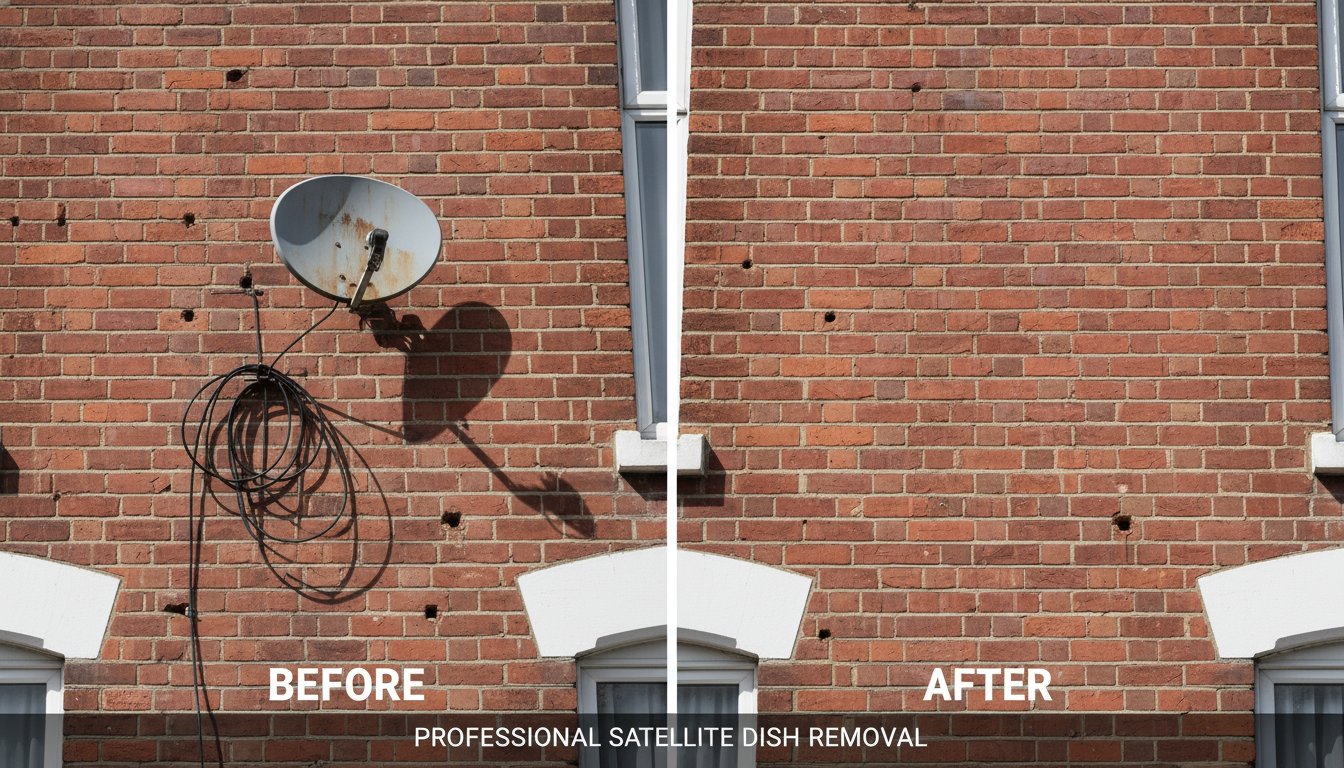
Most guides forget what happens after the dish is gone. Leaving holes in your brickwork is a recipe for disaster. These gaps allow water to seep into your walls, causing damp and erosion over time. We don't just pull the hardware and leave. We fill and smooth every hole left by old mounting brackets. This restores your home's visual appeal and structural health. It's a small step that makes a huge difference in domestic harmony. For a deeper look at the process, check out our TV Aerial Removal Guide.
Weather and Environmental Factors
British weather changes fast. A satellite dish acts exactly like a sail in a gust of wind. This wind loading can pull a technician off a ladder in seconds. We also manage thermal risks. Roof surfaces get incredibly hot in summer and dangerously icy in winter. Proper cable management is the final step. We ensure any remaining entry points are sealed against water ingress. This keeps your interior dry and your home efficient. If you want to skip the risk and the physical exertion, book your professional satellite dish removal with our expert team today.
Visit dishgoodbye.com for expert satellite dish removal services available throughout the UK.
Visit dishgoodbye.com for professional satellite dish removal services available throughout the UK.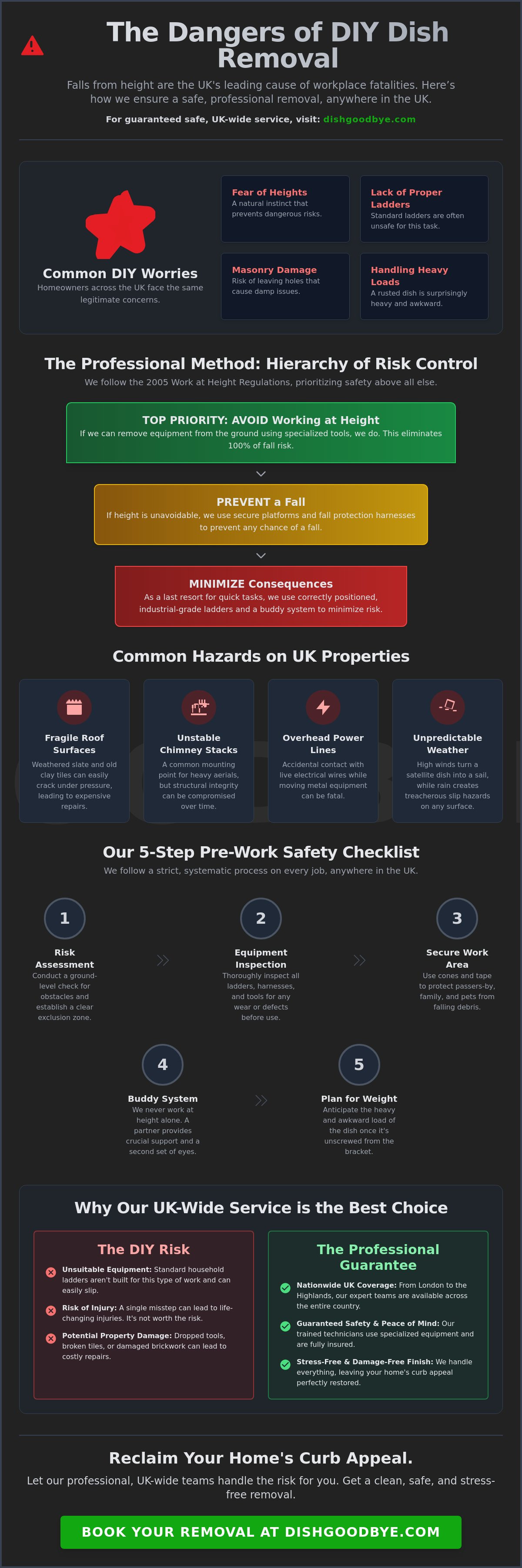
Why Professional UK-Wide Removal is the Best Choice
Choosing a professional service transforms a risky weekend project into a seamless home upgrade. We provide a comprehensive nationwide service across the UK, reaching every corner from the coast of Cornwall to the heights of Caithness. Our teams bring the expertise needed to handle safe working at height for aerial removal without putting you or your property at risk. We understand the daily frustrations of looking at rusted, redundant tech. Our goal is to provide a sense of relief by handling the entire process from start to finish. You won't need to worry about specialized ladders or the physical exertion of hauling heavy metal down from your roofline.
Our technicians are fully trained in the latest safety-at-height protocols. This expertise allows us to navigate complex roof structures that would be dangerous for a DIYer. We offer complete peace of mind. We handle the removal, the essential hole-filling, and the final disposal. We also address a major gap that most generic safety guides ignore: recycling. We operate with a strict zero-landfill promise. Every dish and aerial we collect is processed at approved centers. This ensures that your old equipment is recycled responsibly rather than cluttering up the environment. It's a modern, clean solution for a modern home.
The Dish Goodbye Guarantee
We provide fully insured removals that protect both your property and your wallet. Our professional team works with a brisk, energetic rhythm, usually finishing the entire task in under an hour. This efficiency means your domestic harmony is restored quickly and without unnecessary fluff. We treat your home with the care it deserves, ensuring a visual result that looks as if the dish was never there. For more information on how we handle old hardware, see our Satellite Dish Recycling Guide.
Get a Nationwide Quote Today
Reclaiming your home's curb appeal is simple. We offer transparent pricing for any residential property in the United Kingdom. Our booking process is designed to be as low-effort as the removal itself. Visit our website to schedule your appointment and say goodbye to old-fashioned, inefficient methods of property maintenance. We are ready to help you achieve a better, cleaner result for your home today. Experience the satisfaction of a well-managed household with our expert help.
To book your professional removal, visit dishgoodbye.com today.
Take the Risk Out of Your Roofline Today
Restoring your property's domestic harmony shouldn't involve a trip to the hospital. We've explored the critical protocols for safe working at height for aerial removal, from conducting ground-level risk assessments to using industrial-grade fall arrest systems. You now know that professional removal is about more than just a ladder. It's about protecting your brickwork and ensuring that old hardware is recycled responsibly through our 100% recycling guarantee.
Don't let rusted brackets and heavy satellite dishes remain a source of daily frustration. Our fully insured technicians provide a nationwide service across the UK. This ensures that every home from the South Coast to the Scottish Highlands can benefit from a clean, efficient removal. We handle the heavy lifting and the meticulous hole-filling so you don't have to. It's time to dismiss old-fashioned, risky DIY methods. Enjoy a clutter-free home today.
Book your safe, professional dish removal today with Dish Goodbye and reclaim your time. We make the transition from a cluttered roofline to a spotless home swift and seamless.
Visit dishgoodbye.com for expert satellite dish removal services available throughout the UK.
Visit dishgoodbye.com for professional satellite dish removal services available throughout the UK.
Frequently Asked Questions
Can I legally remove a satellite dish myself in the UK?
Yes, you can legally remove a dish yourself, but you must comply with the Work at Height Regulations 2005. These regulations apply to any task where a fall could cause injury. While no law stops a homeowner from climbing a ladder, you're responsible for your own safety and the safety of passers-by. We recommend professional help to ensure safe working at height for aerial removal without the risk of legal or physical complications.
What is the safest type of ladder for removing a TV aerial?
An industrial-grade extension ladder with a wide, stabilized base and a stand-off attachment is the safest choice for this task. Standard domestic ladders often lack the load-bearing capacity and stability required for high-reach removals. A stand-off is crucial because it keeps the ladder away from the wall. This prevents damage to your plastic gutters and provides a more secure working angle. We use these specialized tools on every job across the United Kingdom.
Do I need a harness to remove a dish from a bungalow?
A harness is required if there is any risk of falling from an unprotected edge or onto a dangerous surface. While bungalows are lower than houses, a fall from just two meters can still cause serious injury. The hierarchy of risk control suggests avoiding height or using collective protection first. If you're working near a roof edge or on a steep pitch, professional fall arrest equipment is the only way to guarantee your safety.
What happens if a redundant bracket is rusted into the brickwork?
Rusted brackets often require specialized penetrating oils or a controlled cut to remove them without cracking the masonry. Forcing a rusted bolt can cause the brick to shatter, leaving a massive hole in your wall. We use high-torque, precision tools to gently extract these fixings. If a bolt snaps, we grind it down and seal the area to maintain your home's hygiene and structural integrity. This prevents long-term damage to your property.
How do I prevent damp after an aerial has been removed?
You must seal every mounting hole with a high-quality masonry filler or silicone sealant to prevent water ingress. Leaving these holes open allows rain to penetrate the brickwork, which leads to internal damp and frost damage. We include hole-filling as a standard part of our removal service across the UK. This simple step ensures your home remains dry and comfortable once the old technology is gone. It's a vital part of maintaining a well-managed home.
Is it safe to leave old coaxial cables hanging from my roof?
No, hanging cables are a significant trip hazard and can act as a conduit for water to enter your property. Wind can also whip loose cables against your walls, damaging the render or brickwork over time. We always remove the cabling along with the dish or aerial. We clip any remaining wires securely or remove them entirely to restore a clean, organized look to your home's exterior. This eliminates the frustration of messy, dangling wires.
What should I do if my aerial is near power lines?
Stop immediately and contact a professional if an aerial is within two meters of overhead power lines. Electricity can jump across small gaps, especially in damp conditions. Attempting a DIY removal near live wires is life-threatening. We conduct a visual survey on every UK property to identify these hazards before starting work. Safety near electricity is non-negotiable for our nationwide teams. Don't take chances with your life for the sake of a redundant aerial.
Why is it dangerous to remove a satellite dish in windy weather?
A satellite dish acts like a sail, and even a moderate gust can generate enough force to pull you off a ladder. This is known as wind loading. It makes safe working at height for aerial removal nearly impossible during stormy conditions. We monitor local UK weather forecasts closely and will reschedule a removal if wind speeds exceed safe limits. It's a small delay that ensures a much safer and more satisfying result for everyone involved.
To book your professional removal, visit dishgoodbye.com today.