
dishgoodbye.com | 0333 220 2436 | [email protected]
Who needs to agree before a satellite dish comes off a shared wall or roof? Removing a dish from a shared property may seem like a simple tidy-up, but unclear responsibility and access arrangements can lead to neighbour disputes or delays.
A clear plan makes the work easier to coordinate. First identify who owns or manages the shared exterior, get the necessary agreement in writing, and arrange access with the people affected. That way, residents know what is happening and what to expect from the finished exterior.
This guide explains who to involve, how to plan access, and what happens during removal. Dish Goodbye’s UK-wide satellite dish removal service takes care of the dish, brackets, fixings and redundant cabling, then fills and smooths the holes left behind. Removed metal and electronic waste is processed through approved recycling centres, helping leave the exterior neater and the job properly finished.
Key Takeaways
- Before removing a dish from a shared property, identify who owns or manages the exterior and get the relevant agreement in writing.
- Check your tenancy or lease documents to understand what they say about changes to shared walls, roofs or other communal areas.
- Agree the removal plan and access arrangements in advance, and let affected residents know what to expect.
- Clarify how the exterior will be left, including what will happen to brackets, fixings, cabling and holes.
- Once arrangements are agreed, Dish Goodbye can remove redundant satellite equipment across the UK and leave the fixing holes filled and smoothed.
Removing a Dish from a Shared Property: Why Agreement Comes First
A satellite dish can look like a simple piece of equipment to take down. But if it is fixed to a wall, roof or other area used or managed by several people, the decision may involve more than the person who wants it removed. Before arranging the work, identify who has authority over that part of the building and agree how access will be handled.
There is no single permission rule for every shared building. Ownership, tenancy or lease terms, and the property’s management arrangements can all affect who needs to be involved. Start by identifying the relevant decision-maker, agreeing the removal plan and arranging access before booking the work.
What counts as a shared area in a property?
A private space is generally for the use of one household, while a shared area serves or is managed for multiple occupants. Examples can include a communal façade, roof, shared entrance or access route, and other common building spaces. A dish may be beside one resident’s flat, but its location alone does not establish who is responsible for the surface it is attached to.
Check the property documents and management arrangements to understand how the exterior is treated. In a block of flats, for example, an outside wall or roof may be managed as part of the wider building, even if the dish serves just one home. Arrangements can differ from one property to another.
Why should agreement come before dish removal?
Agreeing first helps prevent avoidable friction. Residents can find out when access is needed, the person managing the building can clarify the scope, and the work can be planned without last-minute uncertainty. Put the agreed details in writing, including which equipment is to be removed, who has approved the work, how access will be arranged and when it is expected to take place.
For leasehold properties, review the lease and any relevant property documents. These may include covenants in English law, which are agreements that can set conditions affecting a property. Do not assume that a resident’s request or the dish’s position settles the question of approval. If responsibilities are unclear, ask the landlord, freeholder, managing agent or relevant residents’ body to identify the correct process.
This is practical guidance, not a universal legal determination. The documents and management arrangements for your building matter. Once the decision-maker and access plan are agreed, removing a dish from a shared property can proceed with clearer expectations and less disruption for everyone involved.
Who Should Approve Satellite Dish Removal in a Shared Building?
Start by separating two questions: who arranged or uses the dish, and who controls the wall, roof or other area it is attached to? They may not be the same person. A tenant might use the dish, for example, while the landlord or building owner manages the exterior.
The right person to approach depends on the property’s ownership and management arrangements. A tenant may need to speak with their landlord; a leaseholder may need to follow the lease and contact the freeholder or managing agent. In a building with a residents’ body, it may also have a role in communicating or coordinating decisions. An owner-occupier should still check who manages the shared parts of the building. No single stakeholder automatically has final authority in every situation.
How do ownership and occupancy affect the approval conversation?
Check the documents that apply to your situation. A tenancy agreement, lease, title documents or building-management guidance may explain who looks after the exterior and what process to follow before arranging work. Responsibility for a dish does not automatically mean control over the surface it is fixed to.
Keep written replies, approval conditions and agreed arrangements with your property records. They provide a clear reference if questions come up later.
What should a request to the property manager include?
Make the request specific and easy to assess. Include:
- Location: where the dish is fitted, such as a shared wall or roof, and whether brackets or cables cross common areas.
- Proposed work: what equipment is to be removed and what will happen to the fixings, cabling and holes left behind.
- Access needs: which shared routes or areas may be needed and whether residents could be affected.
- Timing: your preferred work arrangements, so the manager can explain any building-specific coordination requirements.
Ask who should approve the request and whether there are building procedures to follow. If the planned work may affect a party wall or structure, consult GOV.UK guidance on the Party Wall etc. Act 1996. Do not assume that every satellite dish removal falls under the Act; the relevant details depend on the work and property.
Once the appropriate parties have agreed the scope and access, you can plan the removal with fewer unanswered questions. Learn about satellite dish removal and how the dish, associated brackets, fixings and redundant cabling can be cleared from the exterior.
Shared Property Dish Removal: Compare Common Situations Before Acting
An unused dish is not automatically free for anyone to remove. It may be fixed to a shared wall or roof, or its cabling may run through communal space. Use the comparison below to identify a sensible starting point, then check the arrangements that apply to your building.
| Situation | Who may need to be involved | What to check | Access planning |
|---|---|---|---|
| Tenant | Landlord or named property contact | Tenancy agreement and any building guidance | Agree access to the dish and any shared routes or areas |
| Leaseholder | Freeholder, managing agent or residents’ body, as relevant | Lease terms and building-management arrangements | Coordinate access to communal parts with the relevant contact |
| Landlord | Building owner, freeholder or managing agent, depending on the arrangement | Ownership records and any management procedures | Plan access with the resident and anyone responsible for shared areas |
| Managing agent | Freeholder, landlord or residents’ body, according to its role | Management instructions and the building’s approval process | Communicate arrangements to affected residents and coordinate entry |
If you are a tenant or leaseholder
Start with your tenancy or lease documents, then raise the request with the landlord or property contact they identify. Describe where the dish is, its visible condition, and whether brackets or cables cross shared areas. Include the access needed for the work, and keep the response and any conditions with your property records. For leasehold guidance, The Leasehold Advisory Service offers information about leasehold matters.
If you manage or own a shared building
First establish who can approve work affecting the communal wall, roof or access route. Your role may involve coordinating the request rather than deciding it alone, so check the building’s ownership and management arrangements. Once the process is clear, tell residents what access is needed and when, and flag any expected temporary disruption.
Record the agreed scope, access arrangements and expectations for the exterior after removal. Clear notes help residents, property contacts and the people carrying out the work share the same understanding.
The correct next step depends on the property’s arrangements. Confirm those before booking removal, then plan the work around the agreed access. Explore satellite dish removal for a practical way to clear redundant equipment once the arrangements are in place.
How to Plan Dish Removal and Access in a Shared Property
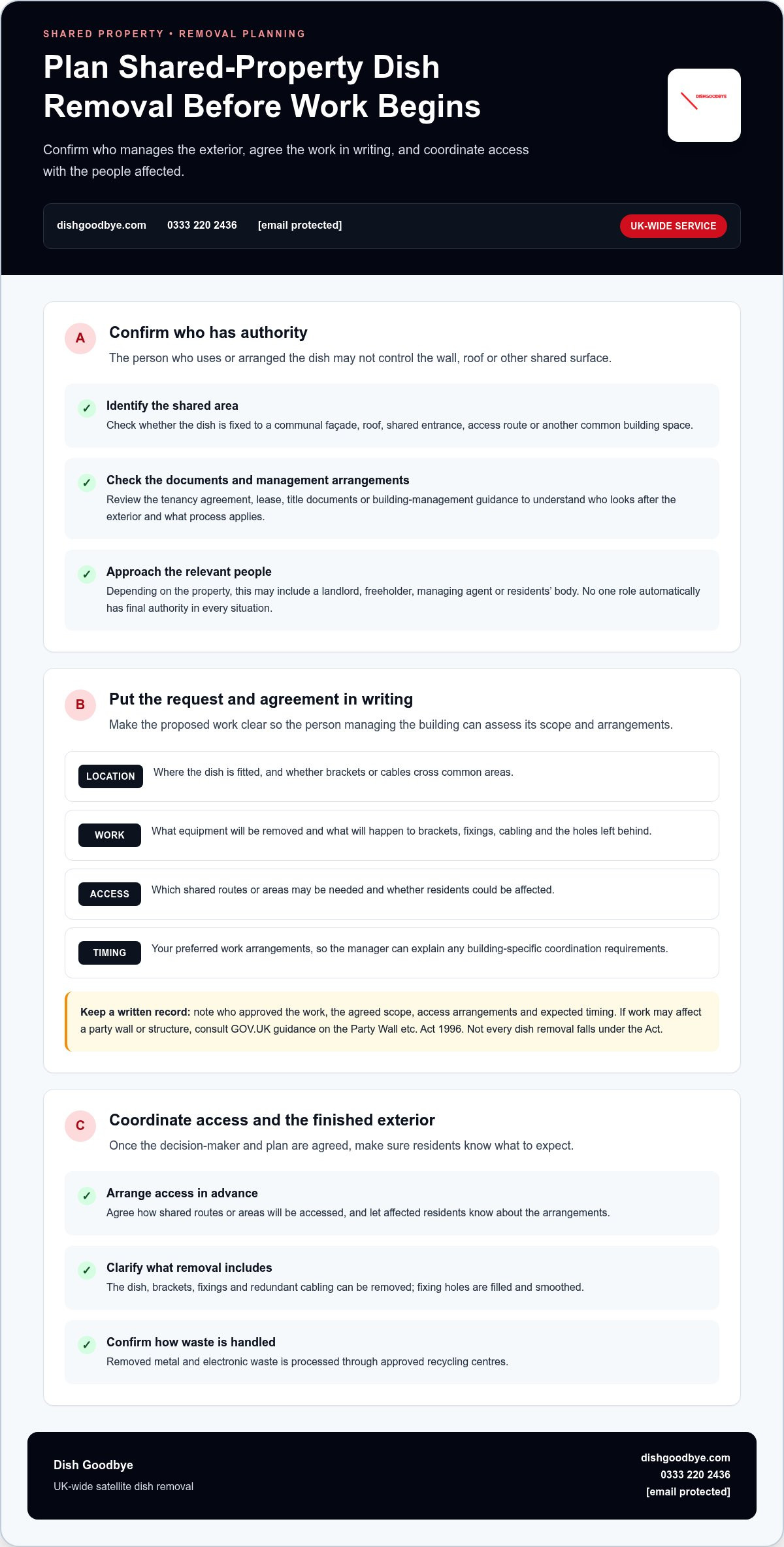
Once the relevant people have agreed to the work, turn that agreement into a clear plan. A little coordination helps residents know what to expect and ensures the removal covers the equipment and fixing points, not just the dish itself.
- Identify the stakeholders. Confirm who manages the wall, roof or communal route involved, and who needs to approve access or the work.
- Agree the scope. Record which dish is being removed and whether its brackets, fixings and redundant cabling are included. Note where the cables run, especially if they pass through a shared area.
- Arrange access. Agree how the relevant communal areas will be reached with the people responsible for them. Tell affected residents about the planned work and any temporary disruption before the visit.
- Complete the removal. The agreed work can then go ahead with a shared understanding of what is being taken down and which areas are involved.
- Review the exterior. Check that the equipment and redundant cabling have been cleared and that the fixing holes have been filled and smoothed as agreed.
How can residents coordinate access with minimal disruption?
Keep access arrangements simple and specific. Confirm which entrance, pathway or communal area needs to remain accessible, and share the plan with residents whose homes are near the work area. If access through a resident’s space is needed, arrange it with them in advance rather than leaving it until the day.
Make sure the person coordinating the building and the people carrying out the removal have the same access information. Clear communication helps avoid confusion without promising a particular work duration.
What should happen to the wall and removed equipment?
Removing only the dish can leave its supporting brackets, fixings and redundant cables behind. Include these in the agreed scope so the exterior can be left neater. Dish Goodbye’s satellite dish removal service removes the associated equipment and fills and smooths the holes left by previous fixings.
Removed metal and electronic waste is processed through approved recycling centres. After the work, review the relevant wall or roof area against the agreed finish. That final check helps confirm the removal is complete and the shared exterior looks tidier.
Ready to arrange satellite dish removal after access and approval are agreed? Dish Goodbye provides removal across the UK for shared and residential properties.
Arrange Shared Property Dish Removal with Dish Goodbye
Once the relevant property stakeholders have agreed the work and access, you can move from planning to removal. Dish Goodbye provides satellite dish removal across the United Kingdom for residential and commercial properties, clearing redundant equipment from shared exteriors in line with the agreed arrangements.
What does professional shared-property dish removal cover?
Dish Goodbye removes the satellite dish along with its associated brackets, fixings and redundant cabling. The fixing points are dealt with too: after removal, the holes left by the previous installation are filled and smoothed to leave the exterior neater.
Removed metal and electronic waste is processed through approved recycling centres. The service covers the job from taking down the equipment to addressing the fixing points and responsibly processing the removed materials.
What details help get the removal arranged?
Have a few practical details ready so the property and access arrangements are clear:
- Property type: for example, a flat, shared building or commercial property.
- Dish location: describe where it is fitted, such as on a wall or roof, and note any visible brackets or cabling.
- Access information: explain which communal areas or routes are involved and any arrangements agreed with the relevant property contact.
- Approval: confirm that the appropriate stakeholders have agreed the work and access plan.
These details connect the agreed plan with the removal itself. If you are removing a dish from a shared property, having the approval and access information to hand helps keep the process clear for residents and those coordinating the building.
With the arrangements agreed, take the next step and arrange satellite dish removal with Dish Goodbye. The UK-wide service includes removing the dish, brackets, fixings and redundant cabling, filling and smoothing fixing holes, and processing removed metal and electronic waste through approved recycling centres.
dishgoodbye.com
0333 220 2436
[email protected]
Get the Shared Exterior Ready for a Fresh Start
Removing a dish from a shared property is easier to coordinate when you identify who needs to agree, check the relevant property documents and arrange access with the people responsible for communal areas. A clear written plan helps residents understand the work and what will happen to the exterior afterwards.
Once approval and access are in place, Dish Goodbye’s UK-wide satellite dish removal service covers the dish, brackets, fixings and redundant cabling. Fixing holes are filled and smoothed, and It is a practical way to clear redundant equipment and leave the outside neater.
Ready to take the next step? Arrange satellite dish removal with Dish Goodbye and move ahead with a clear plan and a tidier shared exterior.
dishgoodbye.com
0333 220 2436
[email protected]
Frequently Asked Questions
Who is responsible for removing a satellite dish from a shared property?
Responsibility depends on who owns or manages the area where the dish is attached, as well as the property agreements. The resident using the dish, landlord, freeholder or managing agent may need to be involved, but no one role is automatically responsible in every building. Check the relevant lease, tenancy agreement or management guidance, then agree who will arrange the work and access before booking removal.
Can I remove a satellite dish from a communal wall without permission?
Do not assume you can remove it just because it is unused or close to your home. A communal wall may be managed separately from your private space, and your lease, tenancy agreement or building arrangements may set out an approval process. Contact the landlord, freeholder or managing agent identified in your documents. Get the agreed scope and access arrangements in writing before work begins.
Does a landlord have to remove a tenant’s old satellite dish?
There is no single answer that applies to every tenancy. The tenancy agreement, who arranged or owns the dish, and control of the exterior may all affect who should organise removal. A tenant should raise the request with their landlord or named property contact and describe where the dish is, its condition and any access needed. Agree who will arrange the work and what happens to the fixings afterwards.
How do I get permission to remove a dish from a shared building?
Start by checking your lease, tenancy agreement or building-management guidance to find the relevant property contact. Send a written request identifying the dish’s location, any visible brackets or cables, the proposed removal and the access required. Ask which approval route applies and whether residents need advance notice. Keep the written response and any conditions with your property records before arranging the work.
Can a satellite dish be removed without damaging the wall?
Careful removal can help avoid unnecessary damage, but the result depends on the existing fixings and the wall’s condition. Dish Goodbye removes the dish and associated equipment, then fills and smooths the fixing holes left by previous installations. This leaves a neater finish, though it should not be taken as a promise that every surface will look exactly as it did before the dish was fitted.
What happens to the brackets and cables when a shared-property dish is removed?
Brackets, fixings and redundant cabling are included in the removal, rather than left attached to the building. Dish Goodbye’s service covers the dish and associated parts, and the fixing holes are filled and smoothed afterwards. Agree the work scope with the relevant property contact so it is clear what will be taken away.