

dishgoodbye.com | 0333 220 2436 | [email protected]
Could an old dish on your wall leave a way for pests to get in? If you’re searching for “remove old satellite dish pest prevention”, focus on the whole installation, not just the dish. Unused brackets, fixings and cable holes can leave gaps or sheltered spots around your home. That doesn’t prove pests are present, but it gives you a practical place to start.
From ground level, look for loose cables, visible holes and damage around the installation. Don’t climb to inspect equipment mounted out of reach or try to dismantle it. A possible access point is a reason to check the exterior, not evidence of pest activity indoors.
This article explains how redundant satellite equipment can leave potential entry points, what you can assess safely and why removal should include filling and smoothing fixing holes. Dish Goodbye removes satellite dishes across the UK, including associated brackets, fixings and redundant cabling, then fills and smooths holes left by previous installations.
Key Takeaways
- Redundant dishes, brackets and cables may leave sheltered spots or possible entry gaps, but they are not proof of pest activity.
- Removing an old satellite dish as part of pest prevention means addressing fixing holes as well as clearing away unused hardware.
- A ground-level visual check can help you spot visible gaps or damage. Don’t climb or dismantle equipment to inspect it.
- Removal and filling fixing holes can address hardware-related risks, but cannot prevent every pest problem.
- A complete removal covers redundant brackets and cabling, as well as filling and smoothing holes left behind.
Can an old satellite dish create pest-entry risks?
An old satellite dish can leave potential pest-entry risks if its fixings or cable route have created gaps. Brackets can also leave sheltered spaces against an exterior wall. But equipment alone doesn’t prove pests are present, and a dish isn’t automatically an attractant. Check for visible openings and damage rather than assuming there’s an infestation.
Where might pests find shelter or access?
Inspect the whole installation, not just the dish. Brackets sit close to the wall, and fixings can leave small holes if they loosen or are removed. A cable route may also pass through an opening in the exterior. These are worth noting because a gap or sheltered space may provide access or cover.
A possible opening doesn’t necessarily lead into the home. A visible hole may stop at the outer surface, and a cable entry may already be sealed. From the ground, look for gaps around cables and fixings, loose hardware, or visible damage to the surrounding wall. Don’t reach up or pull at equipment to test an opening.
Closing potential access points is one part of prevention. This aligns with Integrated Pest Management (IPM) principles, which consider prevention alongside other ways of managing pest risks. Removing redundant hardware and filling its fixing holes can address gaps associated with the installation, but it won’t deal with every possible route into a building.
Does an old dish mean you have a pest problem?
No. A dish, bracket or cable is evidence of old equipment, not pest activity. A possible opening is a reason to look more closely from a safe position, not confirmation that anything has entered the property.
Keep the signs distinct: equipment on the wall is one observation, visible damage to exterior materials is another, and indoor activity is separate again. If you notice damage or activity, record what you can see and where. Don’t assume the dish caused it.
For remove old satellite dish pest prevention, treat removal as one practical part of exterior upkeep. Complete removal clears redundant brackets, fixings and cabling, while filling and smoothing the resulting holes addresses gaps associated with the installation. It can reduce specific risks, but can’t guarantee pest prevention throughout the property.
Keep your first check simple: observe from the ground, note visible gaps or damage, and leave roof-mounted equipment alone. You don’t need to climb a ladder or dismantle anything to assess what you can safely see.
How brackets, cables and fixing holes affect exterior pest prevention
A redundant dish installation can leave several details to consider during exterior upkeep. Brackets are attached with fixings, and cables may pass through an opening in the wall. Fittings can loosen over time, or the surrounding material can become damaged. These are useful inspection prompts, but they don’t establish that pests have entered the property.
A possible access point is a gap to inspect, not proof that pests have entered.
Why old fixings deserve a closer look
From an accessible position on the ground, look for visible gaps around fixing points, loose-looking fittings, or cracks and damage in the surrounding masonry. These observations can help identify where the exterior may need attention. Don’t pull at a bracket or climb to inspect a fixing that’s out of reach.
After redundant equipment is removed, filling and smoothing can tidy the surface and close holes left by the installation. The repair should suit the location and condition of the wall. Filling a visible hole can reduce one potential opening, but it doesn’t prove that every route into the property is sealed or resolve separate damp or pest concerns.
What to check around redundant cables
Follow any visible cable route with your eyes from ground level. Note sections that hang loose, look damaged, or appear to enter the wall through an opening. A cable’s presence alone doesn’t mean it attracts pests. The useful question is whether the cable entry or nearby surface appears damaged or unsealed. Don’t tug on cables or dismantle roof-mounted equipment during an inspection.
Removing redundant cabling leaves fewer obstructions around the wall and can make routine exterior checks simpler. Dish Goodbye’s removal service covers associated brackets, fixings and redundant cabling. Technicians fill and smooth holes left by previous installations, and removed metal and electronic waste is processed through approved recycling centres. See the satellite dish removal service for details.
That’s the practical focus of remove old satellite dish pest prevention: address possible gaps and sheltered spots connected to unused hardware without treating them as evidence of pest activity or a complete solution to every risk.
Does removing the satellite dish prevent pests better than leaving it in place?
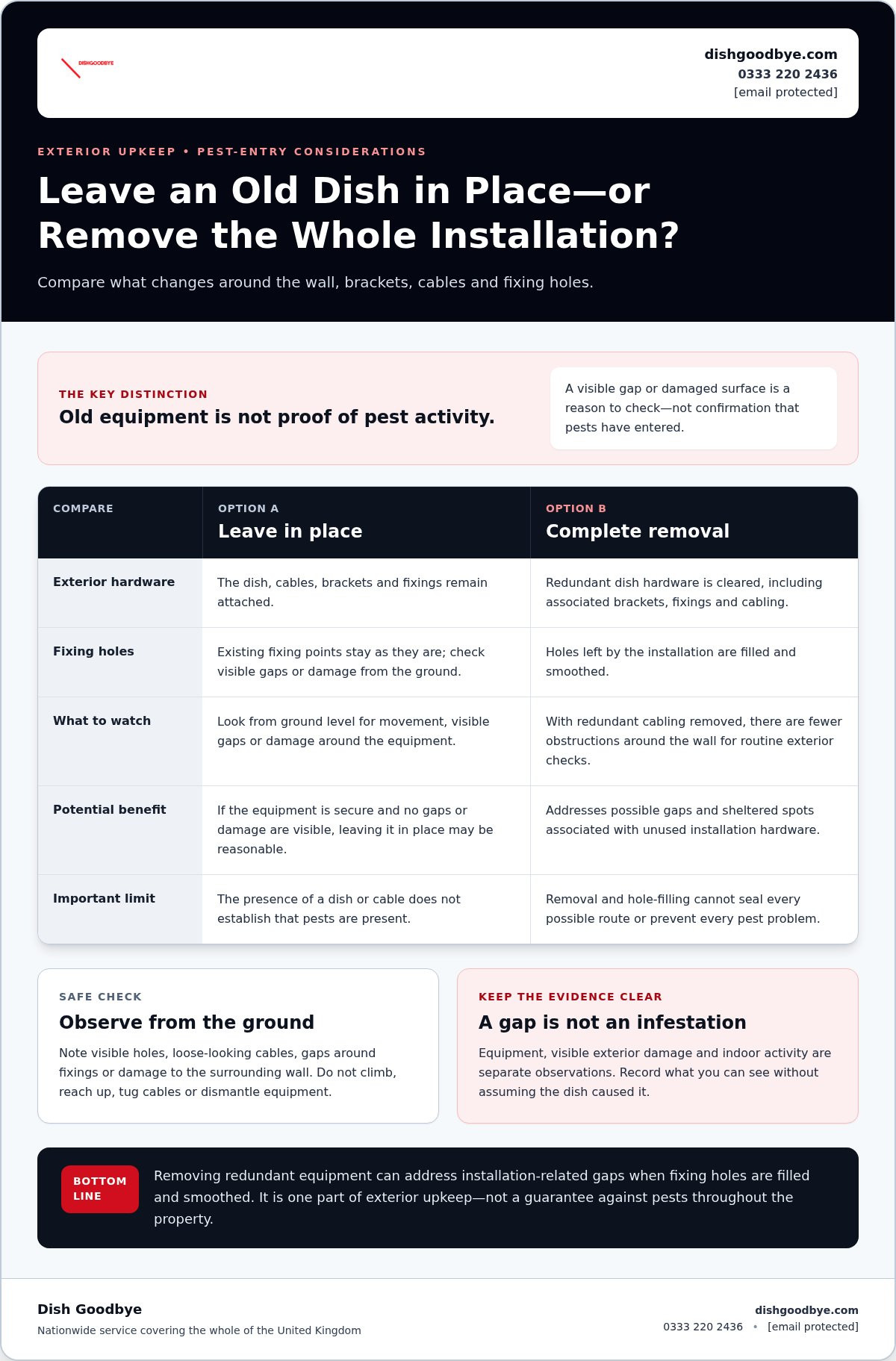
Removing an unused dish can help address potential hiding places and openings linked to its brackets, fixings and cables. The benefit depends on the wall’s condition and what happens to the fixing holes afterwards. Removal isn’t a complete pest-proofing solution. If the equipment is secure and you can’t see gaps or damage, leaving it in place may be reasonable.
Use this comparison to weigh up the options:
| Option | Exterior condition | Remaining fixings | Follow-up inspection |
|---|---|---|---|
| Leave it in place | Dish and cables remain; check visible condition from the ground. | Brackets and fixings stay attached. | Look out for movement, damage or visible gaps. |
| Remove equipment | Dish and redundant cabling are cleared away. | Fixing points may need suitable filling and smoothing. | Check the repaired area from ground level. |
| Repair fixing holes | Addresses visible openings left by the installation. | Doesn’t remove brackets or cables that remain. | Check that the surface looks intact; this isn’t certification that the property is pest-proof. |
What removal can improve, and what it cannot guarantee
Removing redundant hardware can leave the exterior simpler and easier to maintain. A complete removal includes associated brackets, fixings and cabling, followed by filling and smoothing holes left by the installation. This addresses the installation as a whole, rather than leaving fittings or visible gaps behind.
Closing possible entry points is one preventive measure among several. The EPA’s IPM Principles describe a broader approach to pest management. Removal is a targeted improvement, not a promise that pests can’t enter elsewhere. Filling a fixing hole also doesn’t certify the whole exterior as pest-proof or resolve unrelated building issues.
When leaving the dish in place may still need attention
Look for observable changes: a bracket that appears loose, equipment that moves, damaged material around a fixing, or a visible opening where a cable enters the wall. These conditions call for attention to the exterior, whether or not you decide to remove the dish. Don’t climb to inspect roof-mounted equipment; keep checks at ground level.
If removal is the right next step, Dish Goodbye’s satellite dish removal service covers redundant equipment and associated fittings, with holes filled and smoothed. This can address remove old satellite dish pest prevention concerns linked to the installation while keeping expectations realistic.
A safe checklist for checking an old dish and possible pest entry points
Keep the inspection simple and safe. Observe from accessible ground without climbing or touching the equipment. Don’t use a ladder or dismantle a roof-mounted dish, bracket or cable. You’re noting visible conditions, not diagnosing a pest problem.
- Start with a ground-level view of the dish. Look for visible movement, tilted brackets or hanging parts. Don’t push, pull or test them. Note anything that looks loose or damaged.
- Scan the fixing points and nearby wall. From a safe position, look for visible gaps around fixings, cracks, missing material or damage to the exterior surface. A gap is a potential opening to assess, not proof of entry.
- Follow any visible cable route. Check for loose sections and look where cables appear to enter the wall. Don’t tug on them or reach up to inspect a high entry point. Record only what you can see.
- Check accessible indoor areas. Without moving hazardous equipment or disturbing the wall, look for signs that concern you, such as visible damage or indications of activity. A redundant dish outdoors on its own doesn’t confirm an indoor pest issue.
- Finish with another ground-level exterior check. Step back and note the location of any visible opening or damage, such as “cable entry above the side window”. Keep your description factual and don’t make assumptions about what caused it.
An old fixing mark or a cable that appears redundant may simply be an exterior maintenance matter. Recurring indoor signs of activity or damage that appears to be getting worse should be considered separately from the dish. A possible opening is a reason to inspect; indoor signs need their own assessment.
If you’re considering removal, make sure the work covers the dish as well as its brackets, fixings and redundant cables. Filling and smoothing the holes left behind helps complete the exterior maintenance, although it can’t certify the whole property as pest-proof. Dish Goodbye removes redundant equipment and fills and smooths holes left by previous installations.
To address remove old satellite dish pest prevention concerns linked to redundant hardware, explore satellite dish removal and hole filling.
Remove the old dish and close off the job properly
Removing a redundant dish is most useful as a complete exterior maintenance job, rather than taking down the dish and leaving the rest behind. Brackets, fixings and cabling can remain attached, and old fixing points may leave holes that need attention. A thorough removal covers these parts together, leaving the wall clearer and the work area neatly finished.
What complete satellite dish removal addresses
The service includes dismantling and removing the dish, its associated brackets and fixings, and redundant cabling. This clears the hardware connected to the old installation in one task. It also means you don’t have to climb up to handle roof-mounted equipment yourself.
After removal, technicians fill and smooth holes left by previous installations. This helps restore the exterior surface and can reduce openings related to the dish’s fixings. The aim is a tidier wall with the hardware and installation holes addressed, rather than a dish-free wall with loose fittings or visible gaps left behind.
Removed metal and electronic waste is processed through approved recycling centres. The job clears redundant equipment, addresses fixing holes and directs materials for recycling.
Make exterior maintenance simpler with Dish Goodbye
Removing old equipment can address potential access points or sheltered areas linked to the installation, but it can’t guarantee that pests won’t enter elsewhere. Treat it as one useful step in looking after your home’s exterior. If you’re considering how to remove old satellite dish pest prevention risks associated with old hardware, complete removal and hole filling can help address that particular maintenance task.
Dish Goodbye provides satellite dish removal across the UK, including associated brackets, fixings and redundant cabling, followed by filling and smoothing holes left by previous installations. You don’t need to take on work at height yourself. Read the professional satellite dish removal service guide.
After removal, check the repaired area from ground level and note any other visible exterior issues separately. A finished repair supports good maintenance, but it isn’t a guarantee against future pest activity.
Make your exterior maintenance simpler
An old satellite dish doesn’t prove pests are present, but its brackets, cables and fixing holes can leave exterior gaps or sheltered spots worth checking. Keep inspections to a safe view from ground level, and treat visible openings as possible access points, not confirmation of pest activity.
A complete remove old satellite dish pest prevention approach considers the whole installation. Dish Goodbye removes redundant dishes, brackets, fixings and cabling, then fills and smooths holes left by previous installations. Removed metal and electronic waste is processed through approved recycling centres. These steps can address hardware-related openings, but they can’t guarantee protection from every pest risk.
Dish Goodbye provides satellite dish removal across the United Kingdom. If redundant equipment is ready to go, arrange professional satellite dish removal and make this part of exterior upkeep easier. A clearer wall and properly finished fixing points are practical steps towards a well-maintained home.
dishgoodbye.com | 0333 220 2436 | [email protected]
Frequently Asked Questions
Can an old satellite dish attract pests?
An old dish doesn’t automatically attract pests or mean they’re present. Brackets and cable routes may create sheltered spots, while gaps around fixings are worth checking as possible access points. Look for visible damage or openings from ground level, but don’t assume the dish is the cause of indoor activity. It’s a reason to inspect the exterior, not proof of an infestation.
Can pests get into a house through satellite dish holes?
An opening around a fixing or cable route could be a possible way into a building, but a visible hole doesn’t confirm that anything has entered. The gap may not lead indoors, or it may already be sealed. Observe the area from the ground and note any visible opening or damaged material. Filling holes after removal can address gaps associated with the installation.
Does removing a satellite dish stop mice or insects getting in?
Removing a dish can reduce risks associated with its brackets, fixings and redundant cabling, especially when holes left by the installation are filled and smoothed. It can’t prevent every possible route into a property or guarantee that pests won’t enter. Think of removal as one practical part of exterior maintenance. Check other visible gaps separately, and keep inspections to places you can access safely.
What should I check around an old satellite dish for pests?
From ground level, look for visible gaps around fixings, openings where cables enter the wall, damaged exterior material and loose or hanging components. Don’t touch or test the equipment. You can also check accessible indoor areas for visible damage or activity without moving hazardous equipment. A gap is a potential access point, not proof of entry. Note what you see and where it is.
Should I remove an old satellite dish before sealing the holes?
If the dish is redundant, removing it first makes it possible to deal with the fixings and cable penetrations left by the installation. Sealing around equipment that remains in place may leave some fixing points inaccessible. A complete removal can include the dish, brackets, fixings and redundant cabling, followed by filling and smoothing the holes. Don’t climb up or dismantle roof-mounted equipment yourself to prepare for the work.
Can I remove an old satellite dish myself to prevent pests?
Only inspect from a safe position on the ground. Don’t climb a ladder or dismantle roof-mounted equipment, as working at height can be hazardous. A professional removal service can take down the dish and associated brackets, fixings and redundant cabling, then fill and smooth the holes left by the installation. This can address hardware-related openings without requiring you to reach or work on the equipment.
dishgoodbye.com | 0333 220 2436 | [email protected]