
What’s the point of taking down an old TV aerial if rusty brackets, loose cables and empty fixing holes are left behind? Complete redundant TV aerial removal clears the whole installation and helps leave your home’s exterior looking neat. Dish Goodbye serves customers across the United Kingdom. Visit dishgoodbye.com, call 0333 220 2436 or email [email protected].
An unused aerial can make a roofline look cluttered, but removing it yourself may involve working at height. And the job isn’t complete if brackets, cables or exposed fixing holes are left behind.
This guide explains how to tell whether an aerial is redundant, what complete removal involves and how the exterior can be left tidier. It also covers what happens to the removed metal and electronic waste. Dish Goodbye dismantles the aerial, brackets and fixings, clears redundant cabling, then fills and smooths the fixing holes. Removed metal and electronic waste is sent to approved recycling centres.
Key Takeaways
- Dish Goodbye provides service across the United Kingdom. Visit dishgoodbye.com, call 0333 220 2436 or email [email protected].
- An aerial is redundant when nobody in the household relies on it for their television setup. Check how each TV is used before arranging removal.
- Complete redundant tv aerial removal clears more than the aerial itself. It includes associated brackets, fixings and redundant cabling.
- Roof-level access and attached fixings can make removal difficult to manage safely. Unfilled holes can also affect the finished look of the exterior.
- Removal includes filling and smoothing fixing holes, with removed metal and electronic waste sent to approved recycling centres. Find out more at dishgoodbye.com, call 0333 220 2436 or email [email protected].
When Is a TV Aerial Redundant, and What Does Removal Actually Include?
A TV aerial is redundant when the property no longer needs it for its television setup. That depends on how people in the household watch TV, not simply on the age or appearance of the equipment. Someone may still rely on an aerial for their usual viewing, so check how the televisions are connected before deciding to remove it.
A television antenna, also known as an aerial, receives broadcast signals. The Television antenna overview explains its general purpose. For a removal decision, the practical question is whether the aerial still plays a part in your home’s setup.
How can you tell whether an old TV aerial is still in use?
Consider how each television is connected and what household members use to watch programmes. An aerial may still serve a TV or receiver, even if it looks dated or hasn’t been noticed for a long time. Age, weathering and apparent disuse are reasons to investigate, not proof that an aerial is redundant. First establish its purpose, then plan removal if nobody relies on it.
Which parts of a redundant aerial installation need clearing?
The visible aerial is only one part of the installation. Supporting brackets, wall or roof fixings and redundant cabling may also remain attached to the property. Removing only the aerial can leave this hardware behind, so a complete exterior clear-out deals with the whole setup. Read the TV aerial removal guide for more on clearing redundant equipment.
Complete redundant tv aerial removal means addressing the aerial and its associated components, rather than stopping once the most noticeable item is gone. Brackets and fixings can leave the exterior looking unfinished, while unused cables may continue to trail across a wall or roofline.
Dish Goodbye’s removal service includes dismantling the aerial, brackets and fixings, and clearing redundant cabling. The fixing holes are filled and smoothed to help leave the surface tidier. Removed metal and electronic waste is sent to approved recycling centres.
That full-service approach matters when you want the outside of your home properly cleared. For nationwide aerial removal across the United Kingdom, the whole installation can be dealt with in one job, from the aerial to the leftover fixings and cable.
Why TV Aerial Removal Needs Care Around Roofs, Fixings, and Brickwork
TV aerials are often fixed above ground level on a roof, chimney or exterior wall. Even a modest-looking installation can be awkward to reach, and removing it involves more than taking away the visible aerial. Brackets, fixings and cables may be attached across different parts of the property, so the full installation needs careful handling.
What can make removing an aerial from height difficult?
Access can be restricted by the aerial’s position, the roof shape or nearby features. Working near a roof edge while handling equipment and fixings can make a household task difficult and risky. Brackets and cables add more items to manage, especially if they extend across the exterior. Avoid taking unnecessary personal risks to clear unused equipment. Professional redundant tv aerial removal takes care of the height-related work as part of clearing the installation.
The Work at Height Regulations 2005 are available on Legislation.gov.uk for readers who want to consult the official text. The practical point is simple: roof-level work deserves proper care, not a rushed attempt to remove an eyesore.
Why should aerial fixing holes be filled?
Removing brackets can leave holes in brickwork or other exterior surfaces. If holes are left open, water may get in and contribute to damp or deterioration around the fixing point. The surface can vary from one property to another, so treat the finishing work as part of the clear-out rather than an afterthought.
Filling and smoothing fixing holes helps leave the exterior neater and can help prevent potential damp issues.
A complete removal also considers what happens to the parts taken down. Dish Goodbye sends removed metal and electronic waste to approved recycling centres. For more detail on responsible disposal, see the satellite dish recycling guide.
A tidy result comes from dealing with the whole job: the aerial, brackets, fixings, cables and marks left behind. If you’re ready to clear equipment that’s no longer needed, explore nationwide aerial removal from Dish Goodbye.
What Happens During Complete Redundant TV Aerial Removal?
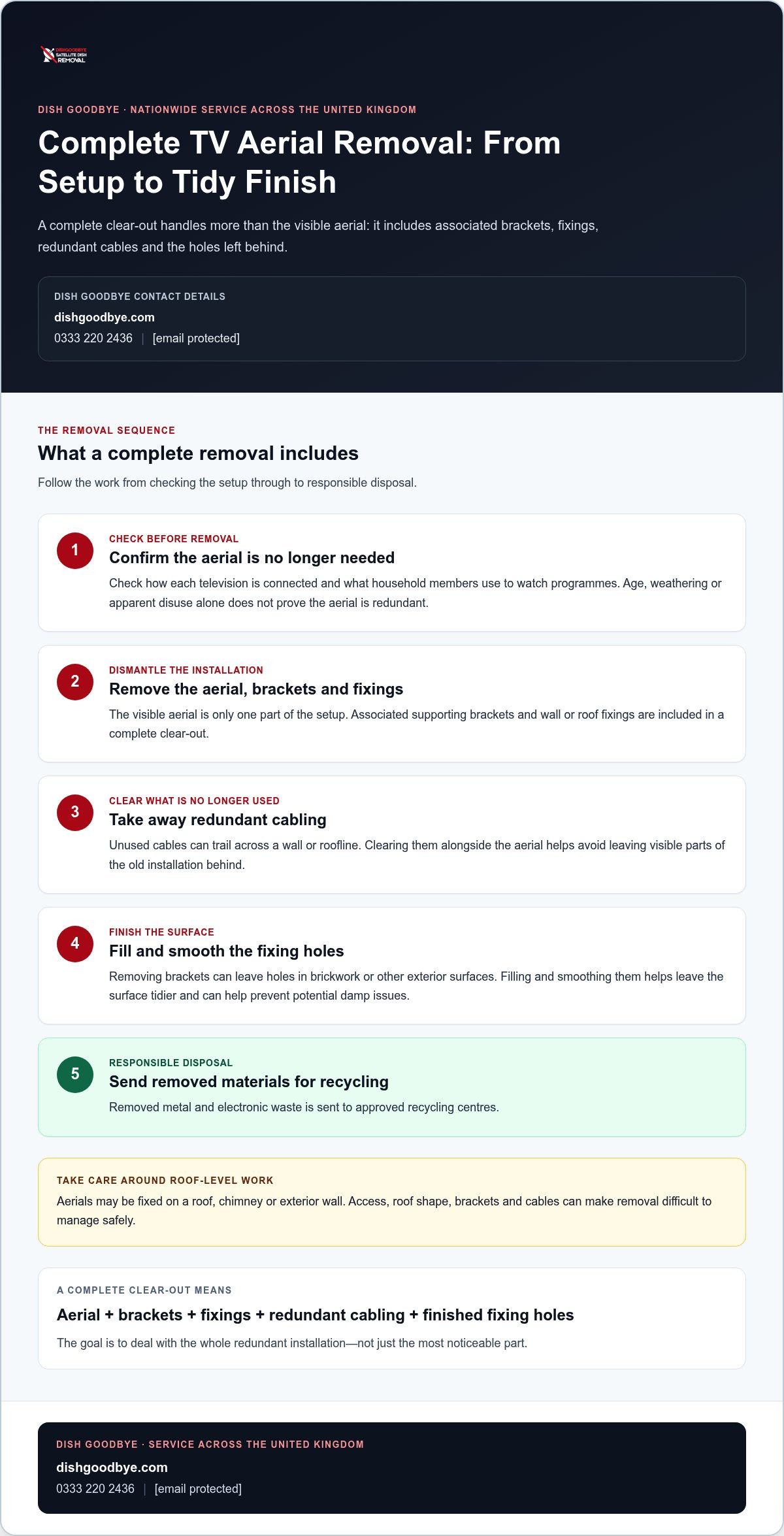
Complete removal deals with the installation as a whole, not just the aerial visible on the roof. The equipment and attachments are dismantled, including associated fixings and redundant cables. The fixing holes are then filled and smoothed, and
How are the aerial, brackets, fixings, and cables cleared?
The work starts by identifying the aerial and its attachments. This includes supporting brackets, wall or roof fixings and cables that are no longer needed. The aerial and associated hardware are dismantled, then the redundant cabling is cleared as part of the same job.
Focusing on the full installation avoids leaving visible brackets or cables behind after the aerial is gone. Complete redundant tv aerial removal addresses those associated parts too, without leaving the homeowner to manage equipment at height.
How is the exterior left tidier after removal?
Once the fixings are removed, the holes left by the previous brackets are filled and smoothed. This helps create a neater exterior, but it isn’t a promise that the old fixing points will become invisible. The final appearance can depend on the surface around them.
Responsible handling is part of the removal process, so the equipment is not simply left behind for the homeowner to dispose of.
In short, complete removal dismantles the aerial and its associated brackets, fixings and cables, fills and smooths the fixing holes, and sends removed metal and electronic waste to approved recycling centres.
If you’re documenting the finished work, after photographs should show the cleared exterior with no satellite dish or aerial remaining. To arrange removal across the United Kingdom, visit nationwide aerial removal.
DIY or Professional TV Aerial Removal: Which Approach Makes Sense?
The right approach depends on more than whether the aerial looks easy to reach. Consider its position, available access and the full scope of the installation. Taking down only the visible aerial doesn’t finish the job if brackets, fixings and redundant cables remain, or if the fixing holes need attention.
What should you consider before attempting removal yourself?
First consider whether the aerial is on an exterior wall or higher up on a roof, and whether it can be reached safely. The job becomes more involved when you account for supporting brackets, fixings and cables running across the property. If access feels awkward or you’re unsure how to manage the full installation, don’t take unnecessary risks to clear equipment you no longer use.
DIY may seem like a quick way to remove an eyesore, but the result can be incomplete if only the aerial comes down. Leftover hardware and cable can still clutter the exterior, and fixing holes may remain unfinished. For broader context on what removal can involve, read the professional dish removal service guide.
What does a professional removal service take care of?
A complete service considers the entire installation. Dish Goodbye dismantles the aerial and clears its associated brackets, fixings and redundant cabling. This covers the supporting parts as well as the most visible equipment, without leaving the homeowner to manage work at height.
After the fixings are removed, the holes left behind are filled and smoothed to help leave the exterior tidier. This is finishing work, not a promise that previous fixing points will be invisible.
The practical difference is clear: DIY means assessing access and handling every part of the job, while professional redundant tv aerial removal covers dismantling, clearing, finishing and responsible processing in one service. It’s a straightforward option if you’d rather avoid working at height and want more than the aerial itself taken away.
Ready to clear an unused installation? Arrange nationwide TV aerial removal with Dish Goodbye, serving customers across the United Kingdom.
Arrange Nationwide Redundant TV Aerial Removal and Clear the Exterior
Once you’ve established that nobody at home relies on the aerial, arrange removal of the complete installation. Dish Goodbye serves customers across the United Kingdom, clearing the aerial and associated parts that can otherwise leave an exterior looking cluttered.
What information helps explain the aerial removal job?
Start with a simple description of the equipment and where it’s fitted, such as on an exterior wall or roof. If you can see brackets, fixings or cabling from a safe position, mention those too. This gives a useful overview without requiring you to inspect technical details, climb up or assess roof access yourself.
You don’t need to work out exactly how the equipment is attached. Share what you can comfortably observe from the ground. If you’re unsure whether a visible cable or fitting belongs to the aerial, say so rather than investigating it at height.
How can you take the next step?
Complete redundant tv aerial removal is about more than taking down the aerial. Dish Goodbye dismantles the aerial and clears associated brackets, fixings and redundant cabling. The fixing holes left behind are filled and smoothed to help leave the exterior tidier, while
This gives you one straightforward way to clear the equipment, remove leftover hardware and finish the fixing points, without taking on roof-level work yourself. For broader context on removing old equipment, see the professional dish removal service guide.
Ready to clear an unused aerial installation? Arrange nationwide aerial removal with Dish Goodbye.
Website: dishgoodbye.com
Telephone: 0333 220 2436
Email: [email protected]
Clear the Roofline and Enjoy a Tidier Exterior
Before arranging removal, make sure nobody in your household still relies on the aerial. If it’s no longer needed, redundant tv aerial removal can clear more than the equipment you see from the ground.
A complete job includes the aerial, its brackets, fixings and redundant cabling. Filling and smoothing holes left by previous fixings helps leave the exterior neater, while You don’t need to take on awkward work at height yourself.
Dish Goodbye serves customers across the United Kingdom. Take the next step and arrange nationwide aerial removal for a cleaner, more finished look outside your home.
Clearing old equipment can be a straightforward way to refresh your property’s exterior. Get in touch to arrange removal.
dishgoodbye.com
0333 220 2436
[email protected]
Frequently Asked Questions
Is it worth removing a redundant TV aerial?
It can be worthwhile if the aerial is no longer needed, as removal clears unused equipment from your home’s exterior. First establish whether anyone still relies on it for their television setup. A complete removal can also clear associated brackets and redundant cabling, rather than leaving those parts behind. Fixing holes left by the installation can be filled and smoothed to help the area look tidier. Removal is not necessary for every property.
Can I remove a TV aerial myself?
Whether DIY is suitable depends on the aerial’s position, access and the work involved. An aerial fitted high on a roof can be difficult to reach and handle, and the task may extend to brackets, fixings and cables. The fixing holes may also need attention afterwards. Prioritise your personal safety, and consider a professional service if access is awkward or you want the complete installation cleared without taking on work at height.
What happens to the holes after a TV aerial is removed?
Removing aerial brackets and fixings can leave holes in a wall or another exterior surface. Dish Goodbye fills and smooths holes left by previous installations as part of its removal service. This helps leave the area tidier and can help prevent potential damp issues associated with exposed holes. The finish is not a promise that every repair will be invisible or match the surrounding surface exactly.
How is a redundant TV aerial removed?
Complete removal covers the aerial and its associated installation, rather than just the visible equipment. The work includes dismantling supporting brackets, clearing fixings and removing redundant cabling. Once those parts are gone, holes left by previous fixings are filled and smoothed to help tidy the exterior. You don’t need to handle roof-level work yourself.
What happens to an old TV aerial after removal?
Responsible handling takes account of the removed metal and electronic waste instead of treating every component as general rubbish. Dish Goodbye sends removed metal and electronic waste to approved recycling centres. This does not mean every component is necessarily recycled. For broader information about responsible disposal, read the satellite dish recycling guide.
Does TV aerial removal include brackets and cables?
Yes. Dish Goodbye’s aerial removal includes dismantling associated brackets and fixings, as well as clearing redundant cabling. That’s more complete than taking down the aerial alone, which could leave hardware or loose cable on the exterior. The service also includes filling and smoothing holes left by previous fixings to help leave the area tidier. It clears the redundant installation rather than providing repair or new installation work.
How can I arrange redundant TV aerial removal in the UK?
Dish Goodbye provides redundant TV aerial removal across the United Kingdom. Get in touch and describe where the aerial is fitted, along with any brackets, fixings or visible cabling you can see safely. The service includes clearing those parts, filling and smoothing fixing holes, and sending removed metal and electronic waste to approved recycling centres. Visit dishgoodbye.com, call 0333 220 2436 or email [email protected].