
dishgoodbye.com | 0333 220 2436 | [email protected]. An old aerial swaying in high winds can be unsettling, especially if you’re worried about the roof, wall or anything below it. Movement may point to loose or ageing brackets, fixings or a mast, but you can’t diagnose the cause from the ground.
Take noticeable movement seriously, but don’t climb up, touch the aerial or try to secure it yourself. From a safe spot, look for visible changes such as a leaning mast, separated parts or fresh marks around the wall or roof. If anything appears unstable, keep clear of the area below and arrange appropriate help.
This guide explains why aerials move in gusty weather, which visible signs deserve attention and what you can safely check from the ground. You’ll also learn when removing an aerial that’s no longer needed can clear redundant equipment and address the fixing holes. Dish Goodbye provides aerial and satellite dish removal nationwide across the United Kingdom. Visit dishgoodbye.com, call 0333 220 2436 or email [email protected].
Key Takeaways
- Dish Goodbye provides aerial and dish removal nationwide across the UK. Visit dishgoodbye.com, call 0333 220 2436 or email [email protected].
- An old aerial swaying in high winds may be moving at its mast, brackets or fixings, but movement alone doesn’t identify a fault.
- Observe from a safe position and note visible changes, such as a new angle or separated components. Don’t climb up to test or tighten the setup.
- If the aerial is no longer needed, professional removal can clear the aerial, brackets, fixings and redundant cabling. Fixing holes are filled and smoothed.
- Removed metal and electronic waste is processed through approved recycling centres.
Why Does an Old Aerial Sway in High Winds?
Seeing an aerial shift in a gust can look alarming, particularly when it’s fixed above a roof or high on a wall. But visible movement doesn’t reveal what’s happening at the fixings or prove that a specific part has failed. An old aerial swaying in high winds is a reason to pay attention, not a diagnosis.
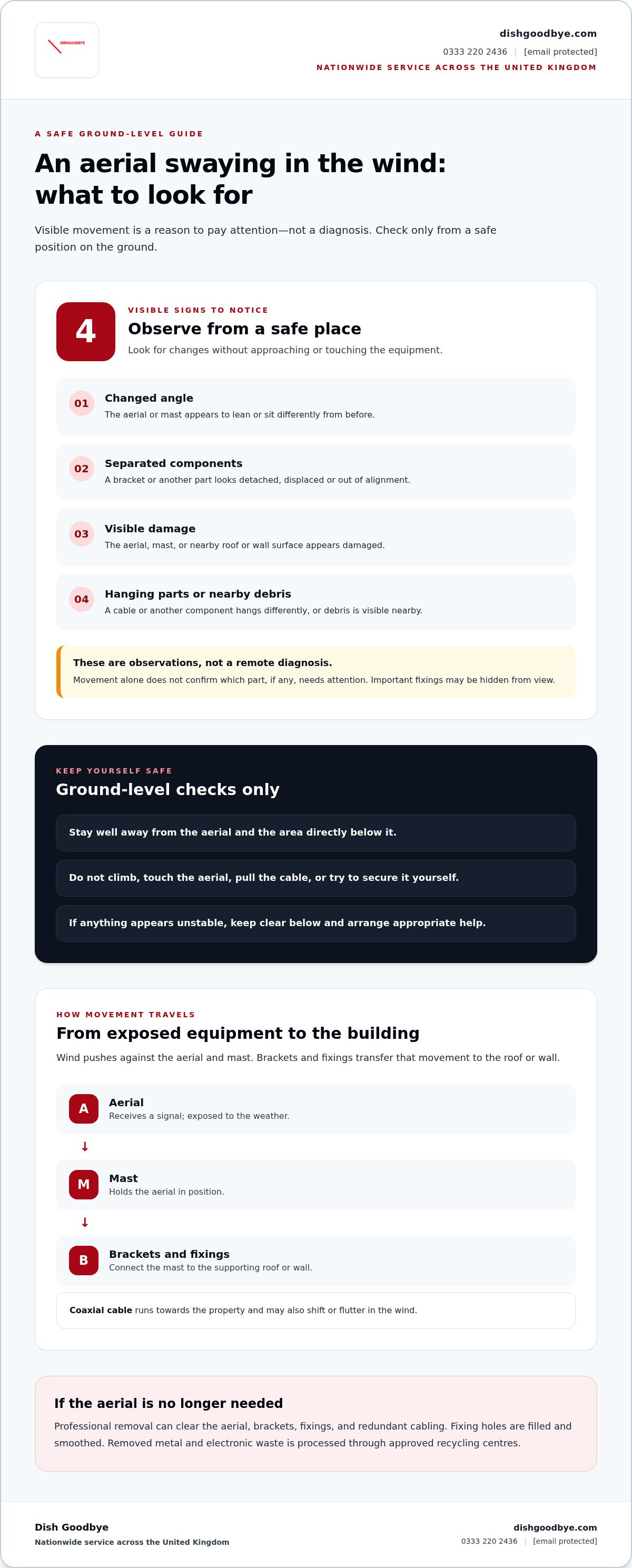
A typical setup includes the aerial, a supporting mast, brackets and fixings that attach the mast to the building, and coaxial cable running towards the property. Each part has a different role. The aerial receives a signal, the mast holds it in position, and the brackets and fixings transfer forces from the assembly to the roof or wall.
Which parts of an old aerial move in the wind?
The aerial and mast are exposed to the weather, so gusts push against them. Depending on the installation and conditions, you may see either part move. Wind can also make an attached coaxial cable shift or flutter. These visible movements don’t tell you which component, if any, needs attention.
Brackets and fixings connect the mast to the supporting surface. They’re harder to assess from the ground, even when movement is visible higher up. The engineering topic of wind-induced oscillations helps explain how wind can make masts move, but a general reference can’t establish the condition of an individual household aerial.
Does visible movement always mean the aerial is unsafe?
No single conclusion follows from movement alone. A gust may make exposed equipment shift, but that doesn’t confirm a loose bracket, damaged fixing or other defect. You also can’t judge from a distance whether the amount of movement is safe. That depends on the particular setup.
Keep the next step simple: observe from a safe position on the ground. Note what appears to move and whether the aerial seems to have changed angle, but don’t climb a ladder, pull the cable or test the mast. If the movement worries you, leave the equipment alone and arrange appropriate help. A safe view from the ground is useful; attempting a closer inspection at height isn’t.
How Wind Acts on Aerial Masts, Brackets, and Fixings
An aerial and its mast are exposed to the weather, so gusts push against them. Wind strength and direction can change from moment to moment. The assembly may appear to sway, pause, then move again with another gust.
Wind pushes against the aerial and mast, while brackets and fixings transfer that movement to the roof or wall. This explains why movement is visible, but it doesn’t reveal the condition of the whole installation. What you can see from the ground may not show how the brackets attach or what is happening at the fixings.
Why gusts can make an aerial appear to oscillate
Think of a flexible pole moving when a breeze pushes it. It may rock as the push changes, then shift back when the gust eases. An aerial mast can show a similar back-and-forth motion. The comparison describes what movement can look like, but can’t confirm whether a particular installation is secure or damaged.
Gusts can also come from changing directions, so the aerial may seem to move intermittently rather than continuously. How often it moves, or how dramatic it looks, isn’t a reliable test of its condition. Keep your observations to what you can see safely from the ground.
How brackets and the supporting surface affect movement
Brackets hold the mast against a roof or wall, and fixings secure the brackets to the building. When wind pushes the aerial and mast, movement passes through those connections to the supporting surface. The condition of the fixings and the material around them both matter, but installation age alone can’t establish whether either is sound.
From a safe position, you might notice a bracket that appears separated from a wall, shifting parts or damaged material around an attachment point. These are observations, not a remote diagnosis. Some fixings may be hidden from view, so a ground-level look can’t establish their condition. Don’t approach, pull at the equipment or climb up to investigate.
If an aerial is no longer needed, professional removal can clear it along with its associated brackets, fixings and redundant cabling. Dish Goodbye provides removal nationwide across the United Kingdom. Find out more about redundant aerial removal.
Which Signs Around a Swaying Aerial Deserve Attention?
Movement is a reason to pay attention, not proof that a particular part has failed. A ground-level check can help you spot visible changes and decide whether to keep people away or arrange help. It can’t confirm whether the aerial is securely fixed, because important parts may be hidden from view.
What can you check safely from the ground?
Choose a safe place with a clear view, well away from the aerial and anything directly below it. Look for changes you can see without climbing, approaching or touching the equipment. If you have an earlier view of the installation, compare it with what you see now.
From that safe position, look out for:
- A changed angle: the aerial or mast appears to lean or sit differently from before.
- Separated components: a bracket or other part looks detached, displaced or out of alignment.
- Visible damage: the mast, aerial or surrounding roof or wall surface appears damaged.
- Hanging or loose-looking parts: a cable or another component hangs differently, or debris is visible nearby.
These are observations, not a diagnosis. A cable that looks loose, a changed position or debris nearby doesn’t reveal exactly what has happened. Note what you can see without trying to get a closer look.
When should you keep people clear of the area?
If anything appears detached, loose or at risk of falling, keep away from the space below and make sure other people do too. Don’t stand beneath the aerial to watch it, retrieve debris or inspect the mounting surface. If a cable or component is hanging down, leave it untouched and arrange appropriate help.
Visible warning signs tell you what to report, not whether the aerial is secure. Even a careful look from the ground can’t establish the condition of hidden fixings or determine how stable the whole setup is. Avoid ladders, roof access and any attempt to pull, shake or test parts yourself.
If you notice no obvious damage, that still isn’t proof that everything is sound. Stay grounded, keep your distance if you’re concerned and arrange an appropriate assessment rather than trying to settle the question by getting closer. A clear description of what changed, such as a new lean or a separated-looking bracket, helps explain your concern.
What to Do When an Old Aerial Sways in Strong Wind
If you notice an old aerial swaying in high winds, keep your response simple and safe. You don’t need to get closer to work out what’s happening. A ground-level observation can help you describe what you’ve seen, but it can’t confirm whether the aerial or its fixings are secure.
What should you do during or just after strong winds?
Follow these steps:
- Stay on the ground. Don’t climb a ladder, access the roof or reach towards the aerial.
- Observe from a safe position. Note visible changes, such as a new angle, separated parts or a hanging cable.
- Keep clear of apparent hazards. If anything looks loose or detached, keep yourself and others away from the area below. Don’t touch the equipment or retrieve anything that has fallen.
- Arrange appropriate help. Share what you observed so the situation can be assessed without attempting a closer inspection yourself.
Don’t try to tighten brackets, dismantle the aerial or test whether it moves by pulling on it. A ladder puts you close to equipment that may be unstable, and handling it could make the situation worse. Leave work at height and assessment of the fixings to someone equipped to carry it out safely.
Should you secure the aerial or remove it?
The right next step depends partly on whether the aerial is still needed and on the condition of the setup. If it’s still in use, don’t attempt a DIY repair or adjustment. Arrange an appropriate assessment. If it’s redundant, removal can clear the equipment rather than leave it on the roof or wall.
Movement alone doesn’t prove failure. Keep clear of anything that appears unstable and explain what you noticed. If removal is the goal, read this TV aerial removal guide for more on clearing unused equipment. Professional aerial removal can include the associated brackets, fixings and cabling, with fixing holes filled and smoothed.
Dish Goodbye provides removal nationwide across the United Kingdom. If your aerial is no longer needed, explore redundant aerial removal.
How Professional Removal Can Clear a Redundant Aerial
If an aerial is no longer needed, removing it can clear redundant equipment from the outside of your home. That can be a practical option if an old aerial swaying in high winds is causing concern, but removal isn’t a fix for every wind-related issue. It won’t address unrelated damage to a roof, wall or other part of the property.
What happens during redundant aerial removal?
Dish Goodbye removes the unused aerial, its brackets and fixings, along with associated redundant cabling. The fixing holes are filled and smoothed to help protect the exterior, rather than leaving the mounting points open and unfinished.
There’s no need to climb up, loosen components or dismantle the setup yourself. Leave the work at height to the removal service. If you’re concerned about visible damage beyond the aerial’s fixings, note what you can see from a safe position and arrange appropriate attention for that issue too.
How removal helps leave the exterior tidier
Once redundant equipment is gone, the roofline or wall can look simpler and less cluttered. Brackets, fixings and unused cabling are included in the removal, so the result isn’t just an aerial taken down with leftover hardware still attached. Filling and smoothing the fixing holes also helps leave the exterior neater.
Removed metal and electronic waste is sent to approved recycling centres for processing. This clears old equipment without leaving you to manage the dismantling and disposal yourself.
Professional removal won’t diagnose or repair every possible problem with a building. But if the aerial is redundant, clearing it removes the equipment and addresses the holes left by its fixings. Dish Goodbye provides removal nationwide across the United Kingdom. Explore nationwide aerial removal to clear an unused installation.
For more information, visit dishgoodbye.com, call 0333 220 2436 or email [email protected].
Choose a Safe, Clear Next Step
An old aerial swaying in high winds can look worrying, but movement alone doesn’t confirm a fault. Stay on the ground, observe from a safe distance and note any visible changes. If the aerial is no longer needed, professional removal can clear the redundant equipment without DIY work at height.
Dish Goodbye provides aerial and satellite dish removal nationwide across the United Kingdom. The service includes associated brackets, fixings and redundant cabling. Fixing holes are filled and smoothed, and removed metal and electronic waste is processed through approved recycling centres. Removal can leave your exterior clearer, though it won’t resolve every separate issue affecting a roof or wall.
Ready to clear an unused aerial? Arrange professional removal of a redundant aerial and take a simple step towards a tidier exterior.
Visit dishgoodbye.com, call 0333 220 2436 or email [email protected]. Keep safe and leave work at height to the professionals.
Frequently Asked Questions
Is it normal for a TV aerial to move in strong wind?
Aerials and masts are exposed to gusts, so some movement may be visible, but you can’t tell from movement alone whether a particular installation is secure. There’s no universal amount of movement that can be declared safe based only on a view from the ground. Watch for changes such as a new angle or separated-looking parts, and arrange an appropriate assessment if you’re concerned.
Can a swaying aerial damage a roof or wall?
Movement or loose-looking attachments may be associated with damage around the mounting points, but visible swaying doesn’t prove that damage has occurred. From a safe position, look for obvious changes to the roof or wall surface, such as damaged material near the brackets. Don’t approach or touch the fixings. A ground-level view can’t establish the condition of hidden attachments or diagnose the cause.
What should I do if my aerial looks loose after a storm?
Stay on the ground and observe it from a safe distance. If parts appear detached, hanging or likely to fall, keep clear of the area below and keep others away too. Don’t touch the aerial or cable, climb a ladder or retrieve anything that has fallen. Note what looks different, such as a changed angle, then arrange appropriate help to assess the situation.
Can I tighten or remove a swaying aerial myself?
Don’t try to tighten, dismantle or test a swaying aerial from a ladder or roof. Working close to equipment that may be unstable can put you at risk, and pulling on it could make the situation worse. Keep your checks to safe observation from the ground. If the aerial is still needed, arrange an appropriate assessment; if it’s redundant, professional removal is a safer way to clear it.
Should I remove an old aerial that is no longer used?
If an aerial is redundant, professional removal can clear it and its associated exterior equipment. It’s a practical option, but it doesn’t diagnose or resolve every separate wind-related issue affecting a roof or wall. If you can’t tell whether the aerial is still needed, establish that first. Don’t climb up to check or attempt removal yourself. Dish Goodbye provides aerial and satellite dish removal nationwide across the UK.
What happens to the brackets and holes when an aerial is removed?
Dish Goodbye’s removal includes the aerial, associated brackets and fixings, and redundant cabling. Fixing holes are filled and smoothed to help protect the exterior and leave a neater finish. Removed metal and electronic waste is processed through approved recycling centres. The service covers the United Kingdom. Visit dishgoodbye.com, call 0333 220 2436 or email [email protected] for information about redundant equipment removal.