
dishgoodbye.com | 0333 220 2436 | [email protected]
Could a dish that’s wobbling become dangerous when the next storm hits? Strong winds can put pressure on a loose satellite dish, its brackets and the fixings holding it to your home. The loose satellite dish storm damage risk isn’t just about losing your TV signal. Equipment that shifts further could strain its fixings, damage brickwork or roof materials, let water in around fixing holes, or fall.
You don’t need to climb a ladder or touch anything to assess the situation. This guide explains what you can look for safely from the ground, what to do if a dish appears unstable, and when to keep clear and arrange professional help. You’ll also learn how professional removal deals with redundant or storm-loosened equipment, including its brackets, fixings and cabling, and leaves fixing holes filled and smoothed.
dishgoodbye.com | 0333 220 2436 | [email protected]
Key Takeaways
- A poor TV signal doesn’t prove the dish has shifted. Treat visible movement in the dish, bracket or fixings as a separate warning sign.
- Repeated movement can put strain on the bracket, fixings and mounting surface. Don’t dismiss equipment that looks insecure.
- After a storm, stay at ground level and look for a tilted dish, shifted bracket or hanging cable. Don’t climb up to inspect it.
- The loose satellite dish storm damage risk calls for a calm, safe response: keep clear, prevent access beneath unstable equipment and arrange professional help.
- If a dish is loose, damaged or no longer needed, professional removal can take away the dish, brackets, fixings and associated cabling.
Loose satellite dish storm damage risk: what can happen?
A satellite dish may be loose if the dish, its bracket or the fixings appear to move or sit insecurely. You might notice a tilt, a gap between the bracket and wall, or parts that seem out of position. A change in reception can be frustrating, but it doesn’t tell you whether the equipment is physically secure.
The dish, bracket, fixings, cable and the wall or roof they’re attached to form a connected assembly. If one part shifts, it may put strain on another. Depending on how the equipment was installed and what you can see, possible concerns include continued movement, shifting cables, worsening fixings, damage to the mounting surface or equipment falling. These are risks to take seriously, not predictions that a dish will fail.
A satellite dish includes parts such as a parabolic antenna and a feedhorn. This overview of satellite dish components helps show why visible movement in one area is worth noticing, even if the picture still appears normal. Keep your assessment to what you can safely observe from the ground.
Why storms can draw attention to a loose dish
Wind and rain may prompt you to look more closely at exterior equipment, especially if you notice a new angle, movement or a cable hanging differently after bad weather. But weather can also affect reception without shifting the dish. Signal loss during or after a storm, on its own, isn’t evidence that the bracket or fixings have moved. Look for visible changes rather than trying to diagnose the equipment from the TV picture.
Signal trouble or a physical safety concern?
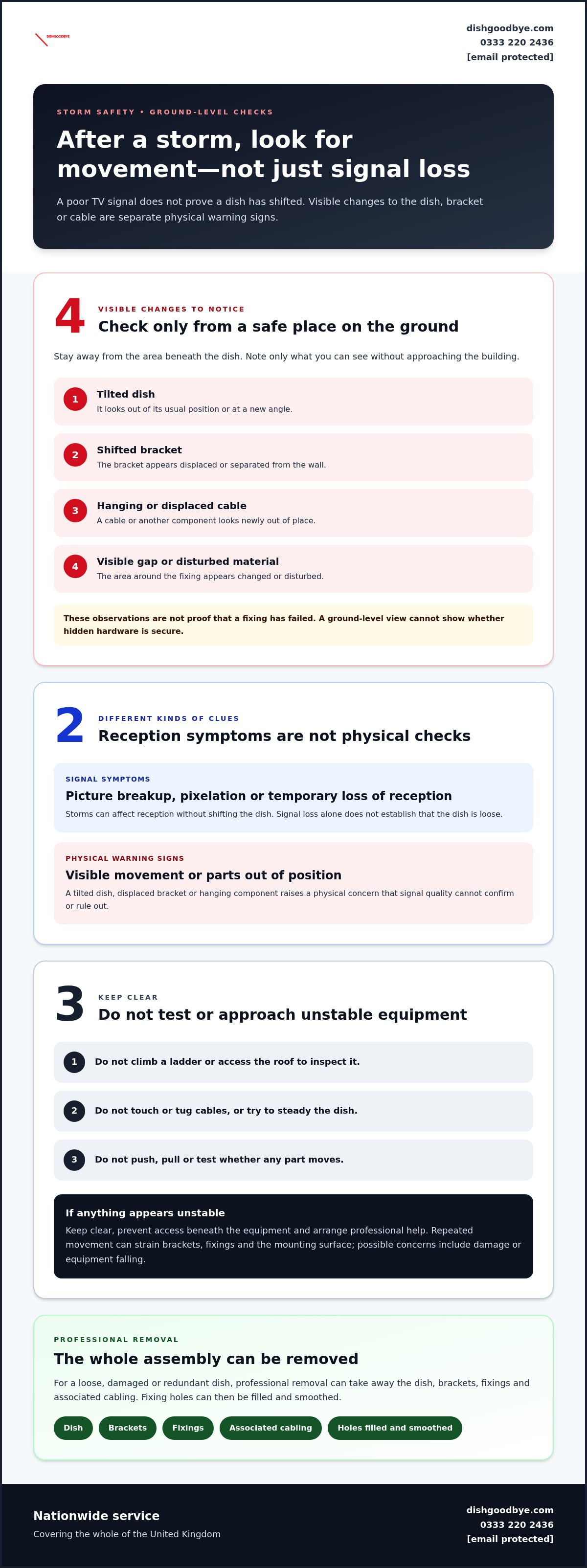
Picture breakup, pixelation or a temporary loss of reception are signal symptoms. A visibly tilted dish, displaced bracket or hanging component is a physical warning sign. Signal quality can’t confirm whether fixings are secure, and poor reception alone doesn’t establish that the dish is loose. In short: reception symptoms affect the picture; visible movement raises a physical concern.
If you spot a physical change, don’t climb up or try to steady the equipment. Keep clear if anything appears unstable. The next step is to focus on safety and arrange professional help, rather than relying on signal checks to judge the fixings.
How a loose satellite dish can affect brackets, walls, and cables
A dish doesn’t sit on the wall by itself. Its bracket holds it in position, fixings secure the bracket to the mounting surface, and a cable runs from the dish towards the property. If one part appears to have shifted, the rest of the assembly may also be under strain. Repeated movement is a reason to take the situation seriously, but it doesn’t prove that damage has occurred.
The loose satellite dish storm damage risk depends on the equipment’s installation and what you can actually observe. A view from the ground may show movement, but it can’t reveal the condition of fixings hidden behind a bracket or beneath roof materials. Signal strength can’t provide that information either.
What the mounting bracket and fixings do
The bracket supports the dish and holds it against a wall or other mounting surface. Fixings connect the bracket to that surface and help keep the equipment in place. If you can see a gap, a displaced bracket or a fixing that appears separated, treat it as an observation that warrants attention, not a diagnosis of what has failed. Don’t pull, push or try to tighten any part yourself.
Possible signs of strain on walls or roof surfaces
From the ground, look for visible changes such as a gap around the bracket, disturbed material nearby, or components that no longer appear aligned. These signs can prompt concern, but they don’t confirm hidden structural damage. Don’t approach the equipment for a closer look, especially if it’s high up or seems unstable.
A cable that’s newly hanging or appears to move with the dish is another reason to keep clear and arrange professional help. Don’t tug it or try to secure it. If equipment is difficult to access, the HSE’s guidance on the Work at Height Regulations explains the risks and precautions associated with work at height.
When professional removal can help
If a dish is unwanted, visibly loose or unsafe to reach, removal can address the whole assembly rather than leaving brackets, fixings or associated cabling behind. Dish Goodbye removes these items and fills and smooths the fixing holes. Learn more about professional satellite dish removal.
How to recognise a loose satellite dish safely after a storm
Keep the check simple and stay on the ground. Choose a safe spot with a clear view, away from the area beneath the dish. Compare its position with how it usually looks, but only if you can do so without approaching the building or standing under the equipment.
From that distance, note any obvious changes:
- The dish looks tilted or out of its usual position.
- The bracket appears shifted or separated from the wall.
- A cable or another part is hanging or looks displaced.
- Nearby material appears disturbed or there’s a visible gap around the fixing area.
These are observations, not proof that a fixing has failed. A ground-level view can’t show whether hidden hardware is secure. Don’t climb a ladder, access the roof, touch cables or test whether the dish moves. Even a small movement test could bring you too close to equipment that may be unstable.
What you can check from the ground
If you can see the dish from a safe place, note what looks different and when you first noticed it. You can also note whether it’s still needed for reception or appears redundant. Don’t delay taking precautions to gather details, and don’t approach for a close-up photograph. The official UK government guide provides information about dish siting and notes the context for equipment that’s no longer needed.
When to stop observing and keep clear
If parts are hanging, the dish looks as though it could fall, or you’re unsure whether the area is safe, move away. Keep other people clear of the space below it while arranging professional help. Don’t stand underneath to watch for further movement.
A clear view from the ground can help you describe what you’ve noticed, but it can’t certify that the installation is safe. The loose satellite dish storm damage risk should be assessed based on the equipment’s condition, not guessed from a distance. If the dish is redundant or unsafe to access, professional satellite dish removal can address the dish, brackets, fixings and associated cabling.
What to do if a satellite dish is loose or storm-damaged
If a dish looks unstable after a storm, put safety first. Move away from the equipment and keep people clear of the area directly beneath it. Don’t approach to inspect it closely, even if you want to see how badly it has shifted. If there appears to be an immediate danger to people or property, contact the appropriate emergency assistance.
Once you’re at a safe distance, arrange professional help. Describe what you can see, such as a tilted dish, a displaced-looking bracket, a hanging cable or material that appears disturbed around the mounting point. Mention whether the dish is still needed or is redundant. These observations help explain the situation without requiring you to touch the equipment.
What to do while waiting for help
Keep the space below visibly unstable equipment clear. Don’t touch the dish, bracket, fixings or associated cabling, and don’t ask someone else to climb up and check it. If you can’t prevent people from passing close to the area, keep yourself at a safe distance and explain the hazard clearly.
For redundant equipment, removal also provides a responsible way to deal with the dish and its associated parts. Dish Goodbye removes dishes, brackets, fixings and cabling, fills and smooths the fixing holes, and sends removed metal and electronic waste to approved recycling centres. Explore satellite dish removal and recycling.
Why DIY storm repairs can add risk
A ladder or roof can introduce another hazard, especially when you’re reaching towards equipment that may already be loose. Tightening a fixing or pulling a bracket doesn’t show whether hidden fixings or the mounting surface are sound. It can also bring you close to hanging parts or cables. Don’t climb, dismantle the dish or try to secure it yourself.
The loose satellite dish storm damage risk can’t be judged by appearance alone, and a quick DIY adjustment isn’t a reliable safety check. Leave the equipment untouched and arrange professional removal if it’s loose, damaged or no longer wanted. The dish and connected parts can then be dealt with together, without putting you on the roof or beneath unstable equipment.
Professional removal for a loose or redundant satellite dish
Professional removal is a sensible next step if a dish looks loose or damaged, or if it’s no longer needed and is positioned somewhere unsafe to access. You don’t have to climb up to check the fixings or attempt to take it down. Leave the equipment untouched while arranging removal, so you stay away from work at height and avoid disturbing parts that may already be insecure.
Removing the complete assembly addresses more than the dish itself. Brackets, fixings and associated cabling can remain attached to the property if only the dish is taken down. Full removal deals with these connected parts and the fixing holes left behind.
What professional dish removal addresses
Dish Goodbye removes the satellite dish, its brackets and fixings, along with associated cabling. Technicians fill and smooth the holes left by the installation, helping leave the exterior neater once the equipment is gone. Removed metal and electronic waste is sent to approved recycling centres.
This is a practical resolution for unwanted equipment and equipment that isn’t safe to access yourself. Don’t try to judge the loose satellite dish storm damage risk by tightening or dismantling the hardware. Professional removal can take care of the assembly as a whole, rather than leaving behind the fittings and cables connected to it.
A simple next step for UK property owners
If your dish is redundant, visibly damaged or too high to reach safely, arrange professional removal instead of tackling it yourself. Dish Goodbye covers the whole of the United Kingdom, so property owners across the UK can use the service. Find out more about professional satellite dish removal to clear unwanted equipment from your home.
Keep clear of any unstable dish while you arrange the next step. There’s no need to handle the equipment or climb to inspect it.
Choose a safe next step for your dish
A poor signal doesn’t prove that a dish is loose, but visible movement, a shifted bracket or hanging cable deserves caution. Check only from a safe place on the ground. If the equipment looks unstable, keep clear and don’t climb up, touch it or try to tighten the fixings.
The loose satellite dish storm damage risk depends on the equipment’s condition and how it’s mounted, so avoid guessing or testing it yourself. If the dish is redundant or unsafe to access, professional removal can take care of the dish, brackets, fixings and cabling. Fixing holes are filled and smoothed, and removed metal and electronic waste is processed through approved recycling centres.
Dish Goodbye provides satellite dish removal across the United Kingdom. Arrange professional satellite dish removal and take a safer, simpler step towards clearing unwanted equipment from your property.
dishgoodbye.com | 0333 220 2436 | [email protected]
Frequently Asked Questions
Can a loose satellite dish fall off during a storm?
Insecure equipment can shift further or fall, but a storm doesn’t mean a dish will definitely come down. The loose satellite dish storm damage risk depends on its installation and visible condition. If the dish or bracket looks displaced, or parts are hanging, stay clear and keep others away from the area below it. Don’t approach to test its stability; arrange professional help.
How can I tell if my satellite dish is loose?
From a safe place at ground level, look for a dish that appears tilted or out of position, a visibly shifted bracket, a gap around the mounting point, or a hanging cable. Compare its appearance with what you remember, if you can do so without going closer. These signs call for caution, but don’t prove what has failed. Don’t climb up, touch the equipment or test whether it moves.
Should I remove a satellite dish myself after storm damage?
No. Don’t climb a ladder or roof, loosen fixings or dismantle a dish that may be unstable. Reaching equipment at height adds risk, and pulling or tightening parts won’t tell you whether hidden fixings are secure. Keep clear and arrange professional removal if the dish is damaged, loose or redundant. If it appears to pose an immediate danger, move away and contact appropriate emergency assistance.
Can bad weather affect satellite signal without loosening the dish?
Yes. Heavy rain, snow or thick cloud can disrupt satellite reception, causing picture breakup or loss of signal without proving that the dish has moved. Strong wind may also affect alignment, but reception symptoms alone can’t confirm whether the bracket and fixings are secure. Treat a poor picture as a signal issue, and assess physical safety only by observing the dish from a safe distance without touching it.
What should I do if my satellite dish is hanging by its cable?
Move away and keep other people clear of the area below it. Don’t touch the cable or dish, try to support the equipment, or approach for a closer look. A cable shouldn’t be treated as a safe support. Arrange professional help and describe what you can see from a safe position. If the situation appears to create an immediate danger, contact appropriate emergency assistance.
Can a loose satellite dish damage a wall or roof?
It can put strain on the bracket, fixings and the surface supporting them, but the outcome depends on the installation and the equipment’s condition. From the ground, you may notice a visible gap, shifted parts or disturbed material. These observations don’t confirm hidden damage. Keep clear if the dish looks unstable, and don’t climb up to inspect the wall or roof more closely.
dishgoodbye.com | 0333 220 2436 | [email protected]