
Could removing one redundant dish create a bigger problem if permissions, safe access and waste records are overlooked? The commercial satellite dish removal regulations to consider depend on the building and its location. Dish Goodbye provides commercial removal nationwide across the UK. Contact: 0333 220 2436 or [email protected].
Getting equipment off a roof is only part of the job. Before work begins, establish who can authorise it, plan safe access and let people using the building know what to expect. These steps help facilities teams coordinate removal with day-to-day operations and other work on site.
This guide explains which property permissions to review, including considerations for listed buildings and conservation areas. It also covers work-at-height planning, asbestos checks where building materials could be disturbed, and waste records to consider when equipment is removed.
Dish Goodbye removes dishes, brackets, fixings and redundant cabling, then fills and smooths the fixing holes. Removed metal and electronic waste is processed through approved recycling centres. For commercial satellite dish removal across the UK, contact Dish Goodbye on 0333 220 2436 or [email protected].
Key Takeaways
- Before scheduling removal, establish who can authorise the work and define whether the scope includes dishes, brackets, fixings, cables and associated aerials.
- Commercial satellite dish removal regulations can vary with the UK nation and property. Check the building’s specific planning and conservation constraints before work begins.
- Plan safe access separately from planning permission, and coordinate the schedule with occupants, tenants, contractors and other rooftop work.
- Keep a clear record of waste streams, collection dates, destinations and any supporting evidence available for the handover.
- Dish Goodbye provides nationwide commercial removal, including associated brackets, fixings and redundant cabling, with fixing holes filled and smoothed.
Commercial satellite dish removal regulations: what to check before work starts
Before booking removal, establish who can authorise it, what constraints apply to the property and exactly what the work will cover. Checking these points in order helps prevent delays and gives the property team time to coordinate access around building users.
Define the scope in practical terms: list each dish or aerial, its brackets and fixings, and the redundant cabling to be removed. Confirm whether the work includes filling and smoothing fixing holes. A written scope helps everyone understand what is included and what should be left in place.
Permissions depend on the property, its location and the work proposed. Don’t assume every removal needs planning permission, or that one rule applies across the UK. Separate the organisation’s authority to commission work from any planning or heritage consent that may be relevant. For background on the wider electronic-waste framework, see the Waste Electrical and Electronic Equipment (WEEE) Directive.
Who can authorise removal from a commercial property?
Depending on the building’s ownership and management arrangements, the decision-maker may be the freeholder, landlord, managing agent or an authorised facilities representative. Review lease terms, management agreements and site procedures before arranging access. These documents may explain who can approve exterior work, access shared areas or coordinate with other contractors.
Keep authorisation separate from planning and heritage checks. Approval from the person or organisation responsible for the property does not, by itself, establish whether additional consent is needed. Record who authorised the scope, then assess any property-specific requirements separately.
Which property details can change the checks?
Look beyond the dish itself. Listed status, conservation controls, shared ownership and a complex rooftop can all affect the checks and access arrangements. For example, a dish on a shared roof may require coordination or approval beyond what is needed for equipment attached to a privately controlled part of a building.
Planning and heritage requirements vary by property and location. Check current official guidance for the relevant UK nation and site before deciding whether consent is needed. The UK’s nations have different planning systems, so avoid applying one nation’s guidance universally. Once authority, constraints and scope are clear, plan safe access and coordinate the removal.
UK rules for commercial dish removal: safety, planning and conservation
Keep safety planning separate from planning and heritage checks. A roof-access plan addresses how people will reach and work around the equipment. Planning checks address whether the building’s location or status affects the proposed work. Completing one check does not replace the other.
A pre-work check is a sensible planning step, not proof that every dish removal needs planning permission. Requirements can differ across England, Scotland, Wales and Northern Ireland, and depend on the property and proposed work. Check current official guidance for the relevant nation and site before drawing a legal conclusion.
How should a commercial site plan safe rooftop access?
Start with the actual site. Identify the intended access route, areas that need to remain clear and how the work could affect occupants or other contractors. Agree arrangements with site management, then tell relevant occupants what to expect, including any access changes or temporary restrictions.
Work at height needs appropriate planning and competent people. The Health and Safety Executive (HSE) publishes guidance for Great Britain; in Northern Ireland, consult the Health and Safety Executive for Northern Ireland (HSENI). Use relevant current guidance to inform the site-specific assessment. A general checklist cannot determine whether a particular roof-access plan is safe.
When can building-conservation checks matter?
A dish attached to a listed building or a building in a conservation-sensitive location may raise questions about effects on its character or historic fabric. Removal is not automatically exempt from consent, but consent is not always required. The answer depends on the designation, the work and the applicable rules.
For an English property, Historic England provides advice on the historic environment. Elsewhere, seek guidance from the appropriate heritage body for that nation, such as Historic Environment Scotland, Cadw in Wales or the relevant heritage service in Northern Ireland. The local planning authority can also advise on property-specific planning controls. Confirm the position before scheduling work, particularly where removing fixings or cables could affect the building fabric.
Make the checks practical: document access arrangements, identify who is coordinating the site and record any planning or heritage advice relevant to the proposed scope. This gives facilities teams a clear basis for communicating with occupants and scheduling the work. For coordinated commercial satellite dish removal, Dish Goodbye serves commercial properties nationwide across the UK.
Commercial dish removal records: demonstrate responsible waste handling
A clear removal record tells the property team what was taken away, when the work happened and how the waste was handed over. It can support maintenance records, contractor coordination and later questions about the job. Keep the record factual: it helps document the work but does not automatically prove that every legal requirement has been met.
Responsible handling means recording what was removed and keeping relevant evidence of where it went. The applicable waste rules and paperwork depend on how items are classified and the circumstances of the transfer. Check current official guidance before describing a document as legally required or treating every dish, cable or fitting as the same waste type.
What information can a property manager organise?
Keep a simple record with the building’s maintenance and contractor documentation. Useful fields may include:
- Work scope: the equipment and associated parts included in the removal.
- Site contact: the person who coordinated the work.
- Collection date: when the items left the property.
- Item or waste stream and destination: describe the material as accurately as the available information allows, and record the stated destination.
- Supporting evidence: note any handover information or other records supplied for the work.
These are practical record-keeping suggestions, not a claim that every field is legally mandatory. Check the current requirements for each waste stream before deciding what evidence to retain.
How should removed dishes and cables be handled?
Removed equipment can contain different materials, including metal components and electronic parts. Don’t assume they all fall into one category. Check current official waste guidance to establish how each item should be classified and whether the Waste Electrical and Electronic Equipment (WEEE) rules apply. Requirements may depend on the item and the circumstances, so don’t assume a particular certificate or document applies to every removal.
Dish Goodbye processes removed metal and electronic waste through approved recycling centres. Property managers can record the stated destination and retain any available supporting evidence with the job file. For more detail on responsible disposal, read the UK satellite dish recycling guide.
These records form a useful part of a commercial satellite dish removal regulations review. Keep them with the work scope and site documentation, and record only what the available evidence supports.
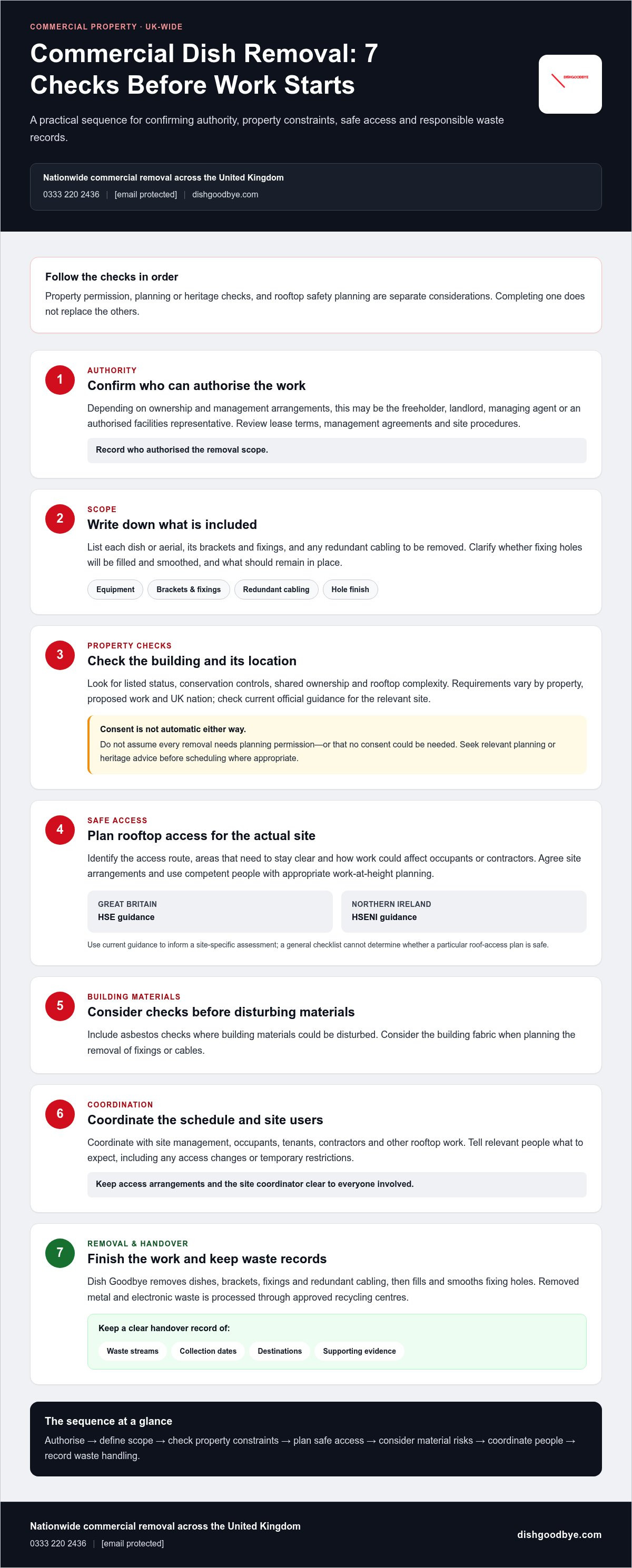
A commercial satellite dish removal compliance checklist for facilities teams
A clear sequence helps facilities teams move from approval to close-out without missing practical details. Use this checklist to organise the work, then apply the site-specific safety and legal checks relevant to the building. It is a planning aid, not a substitute for a risk assessment or legal advice.
- Confirm authority. Identify who can approve the removal and arrange access under the site’s management procedures.
- Inspect property constraints. Review ownership arrangements, listed status, conservation controls and other relevant restrictions. Resolve applicable permission or consent questions before setting the work date.
- Plan safe access. Coordinate rooftop access with site management and consider occupants, tenants, contractors and other work taking place on the roof. Use relevant current guidance to inform site-specific safety arrangements.
- Define the scope. Record which dishes, brackets, fixings and redundant cabling are included, along with access arrangements and the site contact.
- Organise records. Decide where to keep the work brief, completion notes and any available waste-handover evidence with the property’s maintenance records.
Consider the schedule alongside shared access, maintenance, deliveries and other rooftop activity. Tell relevant occupants and contractors what to expect, agree access arrangements with site management, and plan the work to minimise avoidable disruption. Use the commercial satellite dish removal regulations review to guide the plan, not as a universal statement of legal duties.
What should the pre-work brief cover?
Keep the brief specific and easy to follow. List the equipment and fixings to be removed, describe the cable scope, name the site contact and set out agreed access arrangements. Record relevant property permissions or heritage checks and any restrictions before confirming the work date. Include instructions for protecting the exterior and leaving the work area tidy.
What should the close-out review confirm?
Compare the completed work with the agreed scope. Check that the specified dish, brackets, fixings and redundant cabling have been addressed. Review the exterior finish, note any follow-up maintenance needs, and file completion notes and available waste-handover evidence with the site records. Record only evidence that was actually provided.
For a practical overview of the process, see how professional dish removal works. To arrange nationwide commercial dish removal, contact Dish Goodbye about your removal.
Choose a compliant commercial removal plan and clear the property
A well-organised close-out starts before removal day. Confirm who has authorised the work, check requirements for the specific building and location, plan safe access, and decide how relevant completion and waste records will be kept. This gives facilities teams a clear route from approval to a documented handover.
Use the commercial satellite dish removal regulations review to guide decisions, not as a substitute for checking current requirements that apply to the site. Once the scope and arrangements are clear, account for more than the visible dish. Brackets, fixings and redundant cabling can also be part of a complete removal.
What does a complete commercial removal involve?
Dish Goodbye removes redundant dishes and associated brackets, fixings and cabling from commercial properties nationwide across the UK. Fixing holes are filled and smoothed to help protect the building exterior. Removed metal and electronic waste is processed through approved recycling centres.
For a closer look at the practical steps, read the professional dish removal service guide. It can help property teams understand how equipment removal, exterior finishing and waste handling fit together.
After the work, compare the completed removal with the agreed scope. Note whether the specified equipment and associated parts have been addressed, review the exterior finish, and file available waste-handover evidence with the site’s maintenance records. If the review identifies follow-up property maintenance, record it separately so it doesn’t get lost in the removal paperwork.
Streamlining your commercial removal process
When arranging removal, outline the site, the equipment involved and any access arrangements or scheduling considerations. Clear information helps keep planning focused, including coordination with occupants, tenants, site management and other contractors. Dish Goodbye provides commercial satellite dish removal across the whole of the UK.
Ready to clear redundant equipment from your commercial property? Arrange professional satellite dish removal.
Contact Dish Goodbye: 0333 220 2436 or [email protected].
Make your commercial removal plan clear from the start
A smooth decommissioning starts with clear authorisation, checks for property-specific planning or heritage considerations, and a safe-access plan suited to the site. Keep a record of the agreed scope and relevant waste-handover information, giving the property team a useful trail for its maintenance records.
The right commercial satellite dish removal regulations checks depend on the building, its location and the proposed work. Once those details are understood, arrange removal of the dish, brackets, fixings and redundant cabling. Dish Goodbye serves commercial properties nationwide across the UK, fills and smooths fixing holes, and sends removed metal and electronic waste to approved recycling centres.
Arrange professional satellite dish removal and make the next step simpler. Contact Dish Goodbye on 0333 220 2436 or at [email protected]. With a clear plan and coordinated removal, you can leave the property tidier and move forward with confidence.
Frequently Asked Questions
Do I need planning permission to remove a satellite dish from a commercial building?
Not every dish removal requires planning permission, but the answer depends on the property, location and proposed work. Check whether the building has planning or conservation controls and consult current guidance from the relevant local planning authority before arranging work. Planning permission is separate from the building owner’s or manager’s authority to instruct the job. Don’t assume rules for installations automatically determine what applies to removal.
Does a listed commercial building need consent before a satellite dish is removed?
It may need consent, so check before arranging work. The answer depends on the building’s designation and whether the proposed removal could affect its character or historic fabric. Don’t assume consent is always required, or that removal is automatically exempt. Ask the relevant local planning authority or heritage body for property-specific guidance, and keep any advice or decision with the site’s project records.
Who is responsible for arranging commercial satellite dish removal?
The property owner or freeholder will often have authority, but a landlord, managing agent or facilities representative may arrange the work if their role or agreement allows it. Check the lease, management agreement and site procedures to identify the authorised decision-maker. The person who instructs removal should also coordinate access and the agreed scope. This authority is separate from any planning or heritage consent that may apply.
What safety checks are needed before removing a commercial rooftop dish?
Plan the work around the actual site and the risk of falls or items affecting people below. Consider rooftop access routes, the work area, exclusion arrangements, occupants and coordination with site management or other contractors. Use current guidance from the Health and Safety Executive, or the relevant authority in Northern Ireland, to inform a suitable site-specific assessment. Check building information for asbestos before work that could disturb the building fabric.
Do old commercial satellite dishes count as WEEE?
Satellite dish equipment may fall within the Waste Electrical and Electronic Equipment (WEEE) framework, but the dish, electronic parts, metal brackets and cables may need to be considered separately. Don’t assume every component has the same waste classification. Check current official waste guidance for the items being removed and the circumstances of the handover. Record the destination and retain any supporting waste information provided for the property file.
What records should a business keep after satellite dish removal?
Keep a practical record of the agreed work scope, site contact, removal date, items taken away and stated waste destination. File any handover evidence or completion notes provided with the building’s maintenance and contractor records. These details help the property team understand what was completed and follow up on any exterior maintenance. They are useful record-keeping suggestions, not a claim that every field is legally required.
Can a commercial property manager remove a dish without the building owner's permission?
Only if the manager has authority to approve that work under the property’s management arrangements. A job title alone may not establish permission to alter or access the building exterior. Check the lease, management agreement and site procedures, and get the appropriate authorisation before scheduling removal. Even with the owner’s approval, check separately whether the property’s location, designation or proposed work raises planning or heritage considerations.
Contact Dish Goodbye: 0333 220 2436 or [email protected].